Belarusian potash: Why the Kremlin is interested in Lukashenka’s deal with the Trump administration
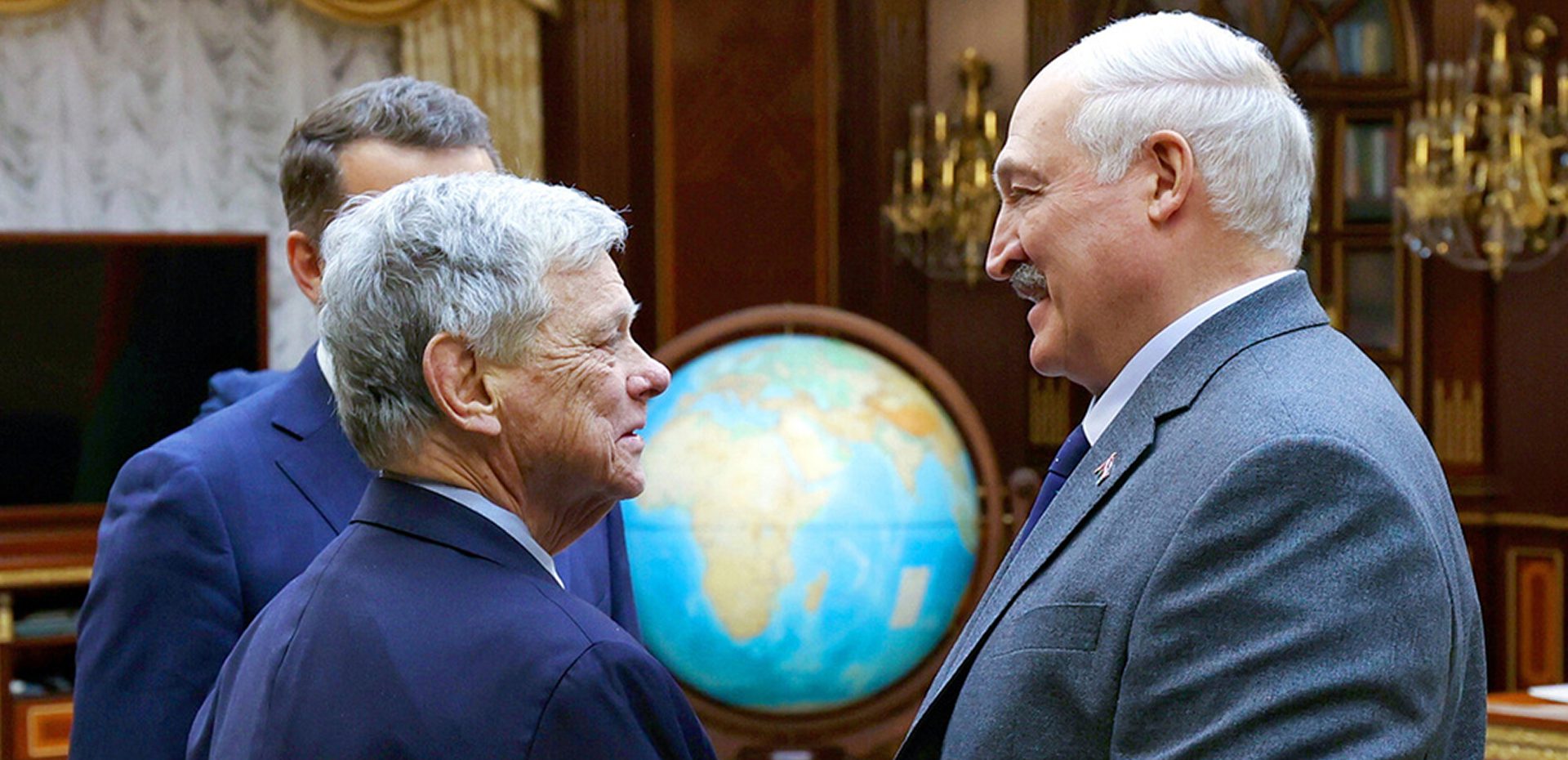
The recent deal on the release of political prisoners struck by Alyaksandr Lukashenka and the Trump administration, which led to the partial easing of potash sanctions against Belarus, took place with Moscow’s tacit approval. The deal does not undermine Russia’s economic, military, or political control over Belarus, yet it gives the Kremlin an opportunity to observe the mechanics of US sanctions relief; assess the limits of Washington’s flexibility; and identify potential points of leverage vis-à-vis the European Union. Potential US efforts to involve European allies in the debate over the West’s relationship with Belarus risk eroding the Western consensus on sanctions against Belarus, which would serve Moscow’s interests.
Prisoners released but no let up in repression in Belarus
On 13 December 2025, Alyaksandr Lukashenka released 123 political prisoners, including leaders of the 2020 protests. In response, the United States partially lifted the sanctions imposed in 2021 on three companies producing and distributing Belarusian potash. The US sanctions relief, however, has not altered the underlying logic of Lukashenka’s repression. According to the Viasna Human Rights Centre, more than one thousand political prisoners remain in Belarusian jails.
The economic impact of sanctions relief
Potash fertilisers are a key pillar of Belarus’s exports and the backbone of Minsk’s foreign currency revenues. Prior to the introduction of sanctions in 2021, Belarus accounted for around 20 per cent of global potash production, and the state-owned company Belaruskali ranked among the world’s four largest producers, alongside Russia’s Uralkali, Canada’s Nutrien, and the US company Mosaic.
In response to the rigging of the 2020 election results and the violent suppression of mass protests that followed, the European Union and the United Kingdom introduced successive rounds of sanctions on Belarus. These measures were significantly expanded in 2021, following the forced landing of a Ryanair flight in Minsk, to include trade restrictions on Belarusian potash fertilisers. The United States, in turn, imposed blocking sanctions on key companies in the sector, including Belaruskali, prohibiting business transactions with them within its jurisdiction. In 2022, Lithuania halted the transit of Belarusian fertilisers across its territory and their transhipment through the port of Klaipeda, which since 2009 had effectively served as the sole export route for these supplies.
As a result, Belarus lost access to its key export channel and to part of its traditional sales markets.1 Potash exports were redirected through Russian infrastructure, but this shift was accompanied by a temporary decline in volumes and export revenues, as well as by a deepening dependence of the Belarusian economy on Russia.2
The US interest in Belarusian potash might be attributed to several factors. Firstly, it might be linked to Washington’s trade negotiations with Canada, which accounts for a significant share of potash exports to the United States. Amid trade tensions between the two countries, the availability of alternative suppliers gives the US room for manoeuvre. Secondly, this interest is widely seen as having a PR dimension for President Trump: it would allow him to cultivate the image of himself as the liberator of Belarusian political prisoners without revising the overall sanctions architecture since the main trade sanctions on Belarusian goods were imposed by the European Union and the United Kingdom and remain in force. Finally, Trump or his close circle might have private commercial interests in the Belarusian potash sector.
The global potash market reacted calmly to the easing of sanctions against Belaruskali, as the scope for any further increase in Belarusian potash exports remains limited. Before the introduction of sanctions, Belarus’s potash exports were estimated at around 10–12 million tonnes per year. Currently Belarus exports over 8–9 million tonnes, largely to China.3 As a result, Belarus is already close to the upper limit of its available export capacity, which constrains the additional impact of sanctions relief.
In any case, the US sanctions relief on Belarusian companies has not removed the key structural constraints. Belarus’s exports continue to be limited by logistics: the Lithuanian port of Klaipeda remains closed to the transit of potash as a result of EU and Lithuanian sanctions. The expanding restrictions on Belarusian banks complicate payments under export contracts and limit the financing of shipments.
The Trump administration could apply political pressure on Europe to encourage the easing of sanctions – a scenario on which Lukashenka appears to be counting. At the same time, neither the European Union nor the United Kingdom currently show any readiness to revise their sanctions regimes; at best, the issue could arise only in the context of broader consultations with the United States, for example as part of discussions on regional security.
Why the Kremlin does not oppose the deal
Despite the fact that direct engagement with the United States could potentially reduce Belarus’s isolation, Moscow did not publicly obstruct the negotiations between Minsk and Washington. Belarus’s economic, military, and political dependence on Russia since 2020 – and particularly after the full-scale invasion of Ukraine – has become systemic, which makes any foreign policy manoeuvres by Minsk – including dialogue with the United States – inherently limited and aligned with the Kremlin’s interests.
Belarus imports almost all of its oil and gas from Russia at preferential prices. Around two-thirds of the country’s trade goes to Russia. Alternative export and import routes rely on Russian infrastructure, giving Moscow significant leverage over the regulation of trade flows.
Belarus’s military dependence on Russia is institutionalised through bilateral agreements on military cooperation within the framework of the Union State of Belarus and Russia, in particular those adopted after 2020. These agreements allow Moscow to deploy troops and military equipment on Belarusian territory and to rapidly scale up its presence in crisis situations.
It is telling that less than a week after concluding the agreement with the United States, Lukashenka announced the deployment on Belarusian territory of Russia’s Oreshnik medium-range ballistic missile, whose destructive power Vladimir Putin has publicly compared to the effects of nuclear weapons.
Beyond the state’s structural dependence on Moscow, Lukashenka’s personal political fate is also closely tied to Russia. After the 2020 crisis, Putin’s support became the key factor enabling Lukashenka to remain in power, significantly narrowing his room for independent decision-making.
At the same time, the deal with the United States can be interpreted as Lukashenka cautiously attempting to identify additional external pillars of support. This step does not signal a revision of the alliance with Russia, but it does indicate that there are limits to the Kremlin’s ability to keep even its closest partners on a tight leash.
From the Kremlin’s perspective, this dynamic does not entail significant risks, and it also opens up additional opportunities. The deal between Minsk and Washington allows Moscow to observe how US sanctions relief functions in practice – from decision-making structures and interagency coordination to legal mechanisms and political compromises.
In addition, any attempts by Washington to garner support from European countries, for example on the issue of restoring transit through Klaipeda, would place further tension on transatlantic ties and deepen dissension on Russia policy within the European Union. For the Kremlin, such an outcome would be an ideal result.