Cracks in the Kremlin walls: Threats to the stability of the Putin regime
This publication was funded in 2025 by the Russia Strategic Initiative, U.S. European Command. The views expressed in this publication do not necessarily represent the views of the Department of War or the United States Government.
Summary
- The Putin regime remains resilient to potential shocks. Only Putin’s death or serious illness would lead to its collapse. A threat to the regime may emerge if economic problems, elite fragmentation, political change, and the social consequences of the war combine to reinforce one another.
- The Russian economy, while not efficient, remains highly resilient. Global commodity markets are not a potential destabilising factor for the regime.
- Russian elites, including the security services, remain fragmented and dependent on Putin’s arbitration. Under normal conditions, this strengthens the Kremlin’s control, but it could lead to multiple intra-elite conflicts if and when the centre weakens.
- Disagreement between the siloviki (security officials) and the pragmatists over the general direction of domestic policy, including economic policy, remains a structural vulnerability of the regime.
- The military has grounds for discontent, but there is no informal leader capable of articulating it. In the absence of such a figure, and since the armed forces are not a political actor in their own right, military involvement in politics remains unlikely.
- The ongoing renewal of the elite reduces the long-term risk of the governing apparatus ceasing to function, but in the short term, it increases the regime’s vulnerability due to bureaucratic conflicts, growing repression, and the likelihood of administrative failures.
- Russian society is more passive than inclined towards protest. Mass military demobilisation and the radicalisation of the militarist community could become destabilising factors, particularly if they coincide with intra-elite conflict or a governance crisis.
- The most likely scenario is still the regime’s natural death together with Putin’s death; the next most likely is an elite split, should Putin weaken significantly and lose the ability to perform the role of supreme arbiter; the least likely is a popular uprising, which, if it emerges, would most likely come not from the liberal anti-war protest movement, but from the radicalised pro-war community.
Introduction
After the initial failure of Russia’s invasion of Ukraine in March 2022 and the introduction of Western sanctions, many predicted a deep crisis for the Putin regime and even its possible collapse. Four years later, it appears relatively resilient.
However, the apparent strength of the Putinist system does not mean it is invulnerable. To a large extent, the regime is sustained through the constant exercise of state power, the growing role of the repressive apparatus, and the lack of alternatives available to the elites. As external pressure increases, the system is becoming ever more centralised and inert. As a result, it risks losing the flexibility needed to address internal problems.
This study examines the main vulnerabilities that could significantly affect the resilience of the Putin regime. External factors, such as a lost war, a foreign occupation, and similar developments, are deliberately excluded from the analysis.
Economic and infrastructure risks
The modern Russian economy differs fundamentally from the Soviet economy: the existence of both market prices and a floating rouble exchange rate allows it to absorb external and internal shocks through price adjustments. It is mistaken to imagine that economic and social problems alone can destroy the Putin regime.
Commodity markets no longer represent a direct threat to regime survival. The federal budget is less dependent on hydrocarbon revenues than in previous decades, while rouble devaluation partially offsets losses from falling export income. Sanctions and inflation generate pressure, but do not create the conditions for immediate political destabilisation.
Technological degradation and infrastructure constraints are also not drivers of political destabilisation in the short term. Technological backwardness affects the economy in the long run, gradually reducing the potential for economic growth, but it does not create the sort of acute situations that could bring the population into the streets or split the elite. Infrastructure vulnerabilities are cumulative: the probability of a major accident at any given moment is low, but increases as infrastructure deteriorates; the political consequences would most likely remain localised.
The main internal threat to economic stability is the degradation of economic institutions resulting from the confrontation between the siloviki and the pragmatists. A significant strengthening of the silovikis’ position within Putin’s inner circle could, in a short period, push the economy out of equilibrium and trigger a permanent crisis. At present, however, the probability of this is assessed as low.
Elite and security risks
Russian elites remain consolidated around Putin largely because the war and the ensuing confrontation with the West leave them with few viable alternatives. At the same time, repression, mutual distrust, and bureaucratic competition deepen fragmentation within the elite and reduce its capacity for collective action independent of the Kremlin.
The central weakness of the Putin system is the absence of an institutionalised mechanism for political succession. The regime was built around a single leader and depends heavily on Putin’s role as supreme arbiter between competing factions in the political system, the bureaucracy, and the security services.
The ageing of key figures and reliance on a narrow circle of loyal administrators make the system sensitive to sudden personnel changes. Since 2024, the regime has entered a phase of controlled elite renewal. The Kremlin is gradually replacing ageing members of the ruling class with younger technocrats, loyal administrators, and politically reliable figures with personal ties to Putin.
However, this does not imply that new centres of power are emerging – the system’s dependence on Putin remains intact. As a result, the renewal of the elite reduces long-term risks but, in the short term, increases the likelihood of destabilisation due to bureaucratic conflicts and governance failures.
The security apparatus remains the main pillar of regime stability, but it is fragmented by design. The Kremlin deliberately encourages competition among the military, the FSB, Rosgvardiya, the Ministry of Internal Affairs, and other security services to prevent any of them from becoming too powerful.
Under normal conditions, this fragmentation strengthens presidential control. During a political crisis, however, it could produce paralysis, institutional rivalry, and infighting.
Social risks
Russian society remains predominantly passive and adaptive rather than politically mobilised. Most citizens concentrate on managing their declining living standards and avoid direct involvement in politics.
At the same time, the war is accelerating militarisation, ideological radicalisation, and the normalisation of violence within Russian society. These trends are gradually eroding both social norms and state institutions.
One of the most serious long-term risks concerns the mass return of veterans from the war in Ukraine. Many former servicemen may face difficulties in reintegrating into civilian life due to economic stagnation and the weakness of the institutions which are supposed to provide support and guidance. The recruitment of veterans may promote a culture of violence within law enforcement agencies and the security services.
Future radicalisation is more likely to emerge from nationalist and pro-war constituencies than from the liberal anti-war opposition. In a period of political instability, the former could become a source of pressure on the regime.
Nevertheless, a popular uprising remains unlikely under current conditions. Public dissatisfaction alone is not sufficient to threaten regime stability unless combined with elite fragmentation and a broader crisis of governance.
Conclusions
The Putinist system still retains substantial resilience and the capacity to adapt to severe shocks. Many of the challenges that appeared to be potential triggers of a severe crisis in 2022–2023 have been neutralised by the authorities or have lost their relevance.
Putin’s illness, death, or incapacitation would constitute the gravest test for the regime, which, in the authors’ view, would be unable to survive. Other destabilisation scenarios are likely to materialise only through the convergence of several negative factors that the system would struggle to manage because of accumulated internal tensions.
Risks matrix
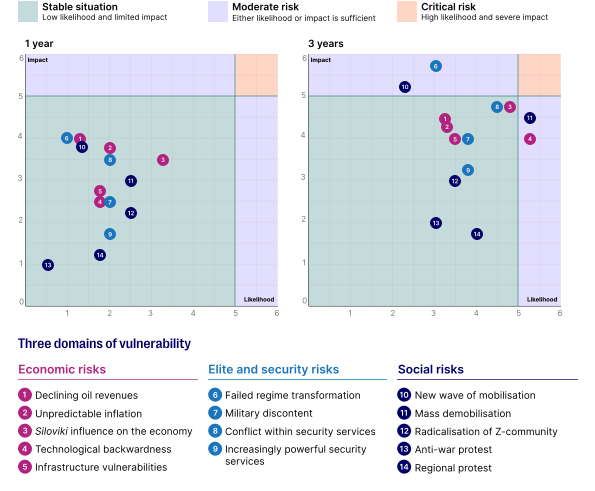
The Putinist system has learned to cope with individual crises, but the war continually generates new sources of tension. As long as the conflict in Ukraine continues, these problems can be partly suppressed, postponed, or explained away as the result of extraordinary circumstances.
The end of the war may prove no less difficult a test: the system will simultaneously have to address the challenges of demobilisation, post-war reductions in military spending, veterans’ expectations, and the search for a new model of legitimacy. The post-war transition will become a stress test for the regime and may expose contradictions which either did not matter under wartime conditions or which the Kremlin had previously managed to contain.