From ‘circus’ to ‘Fourth Reich’: How Russia interprets Munich 2026
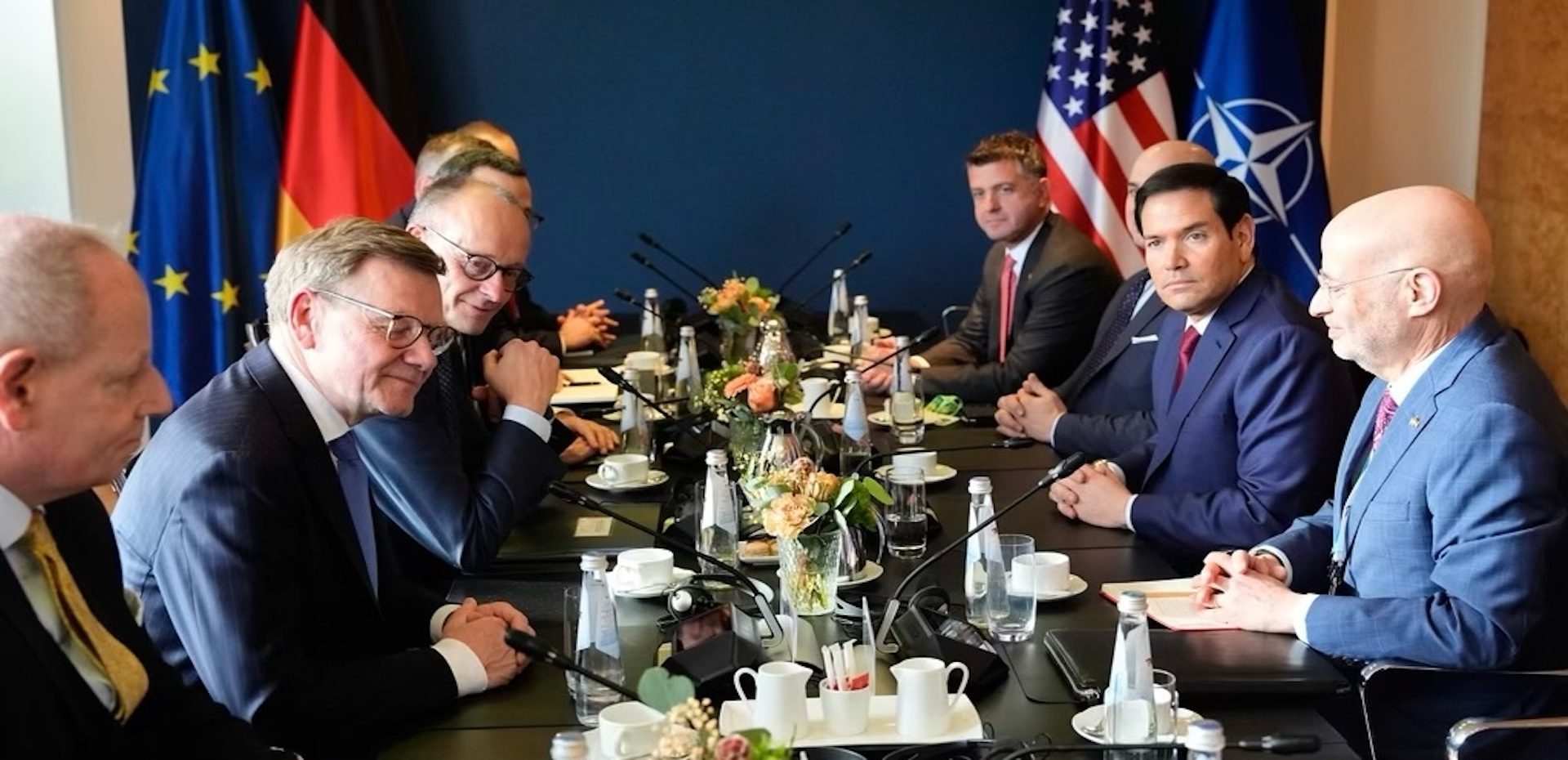
In Russian official and pro-government discourse, the Munich Security Conference is presented as evidence of a weak and divided Europe that depends on the United States and is incapable of an independent strategic role. Against this background, criticism of Germany and the United Kingdom has intensified, while rhetoric towards the United States has become more restrained in the context of negotiations on Ukraine.
‘Munich circus’
The annual Munich Security Conference took place on 13–15 February. A Russian delegation did not participate: following the full-scale invasion of Ukraine, the organisers have not sent invitations to representatives of the Russian authorities.
Until 2022, Moscow regarded the conference as an important international platform for direct dialogue with Western politicians and for the public articulation of its position. In 2007, Vladimir Putin used the conference to denounce the US-led ‘unipolar’ world in an angry speech. Foreign Minister Sergei Lavrov and other officials also spoke in Munich on other occasions. After participation ceased, the rhetoric of the Russian authorities changed. In official comments, the forum is now described as politicised and as having no influence on Russia’s foreign policy course.
In state and Kremlin-aligned media, this year’s Munich conference was referred to as a ‘circus’, an ‘anti-Russian sabbath’, and a venue for adopting Russophobic but, in general, weak decisions.
This position rests on a stable perception of Europe in Moscow: without US support and NATO infrastructure, European states are not regarded as independent actors in international relations. From Moscow’s perspective, Europeans’ unwillingness to invest systematically in defence, their lack of readiness to wage modern warfare with the mass use of drones, and their continuing dependence on Washington confirm their strategic vulnerability.
At the same time, Chancellor Friedrich Merz’s statement of his intention to make the Bundeswehr the strongest army in Europe is interpreted by Russian officials as a ‘revival of Nazism’. Merz himself is described as a ‘demon’, while European Commission President Ursula von der Leyen’s call to change the approach to Europe’s defence capability is presented as a step towards a ‘Fourth Reich’.
The harsh rhetoric towards Germany contrasts with the coverage of other European leaders. Emmanuel Macron, despite attempts at mediation and calls for dialogue with Moscow after 2022, is more often mentioned in Russian media in an ironic tone. Keir Starmer is also not perceived as a significant centre of power – his domestic political position is assessed as unstable. Despite sharp criticism, Merz’s figure in Russian discourse is simultaneously perceived as potentially significant for a future dialogue on the possible restoration of ties with Europe.
London instead of Washington
In the context of the Munich conference, another shift in Russian discourse has become visible. Whereas previously the United States was described as the main opponent as the leader of the ‘collective West’, this role is now increasingly attributed to the United Kingdom. In this vein, the pro-government political analyst Oleg Yanovsky argues that London ‘claims the role of central coordinator’, forming a coalition of countries oriented towards deepening Europe’s military mobilisation. This shift fits into a broader concept of anti-British confrontation that Moscow has pursued in recent years.
Of course, the United Kingdom had been regarded by Moscow as a hostile state before this. However, over recent months, it has acquired the status of principal opponent against the backdrop of a softening of rhetoric towards the United States after the start of Donald Trump’s second term. After his meeting with Vladimir Putin in Anchorage, public assessments of Washington became noticeably more cautious.
Changes have also appeared in public opinion. In 2022, 75 per cent of Russians held negative views of the United States. After the Anchorage summit in August 2025, the share of positive assessments exceeded negative ones for the first time: more than 40 per cent expressed a favourable attitude towards Americans. By the beginning of 2026, the indicators had stabilised. In January, 45 per cent of respondents viewed the United States negatively, 33 per cent positively, and 22 per cent found it difficult to answer.
Against this background, Russian state media’s coverage of the United States’ role at the Munich conference was restrained. Attention focused on Washington’s distancing from Europe – in particular, on the cancellation of a meeting between Secretary of State Marco Rubio and European leaders to discuss the Ukrainian issue, which was interpreted as a ‘humiliation of the Europeans’. Russian media actively quoted a Politico source as saying that the United States ‘does not need weak allies’.
In summary, Russian discourse around the Munich conference reflects a redistribution of symbolic roles within the construction of the ‘collective West’. At the same time, despite its demonstrative downgrade in official commentary, the conference itself continues to be regarded in Moscow as an indicator of the mood and coordination of Western elites. In this sense, ‘Munich’ remains for the Russian leadership less a platform for dialogue than a marker of the degree of European consolidation and transatlantic ties – and, consequently, a factor influencing the Kremlin’s long-term calculations.