Rosstat leaks: How the war against Ukraine has affected Russia’s demography
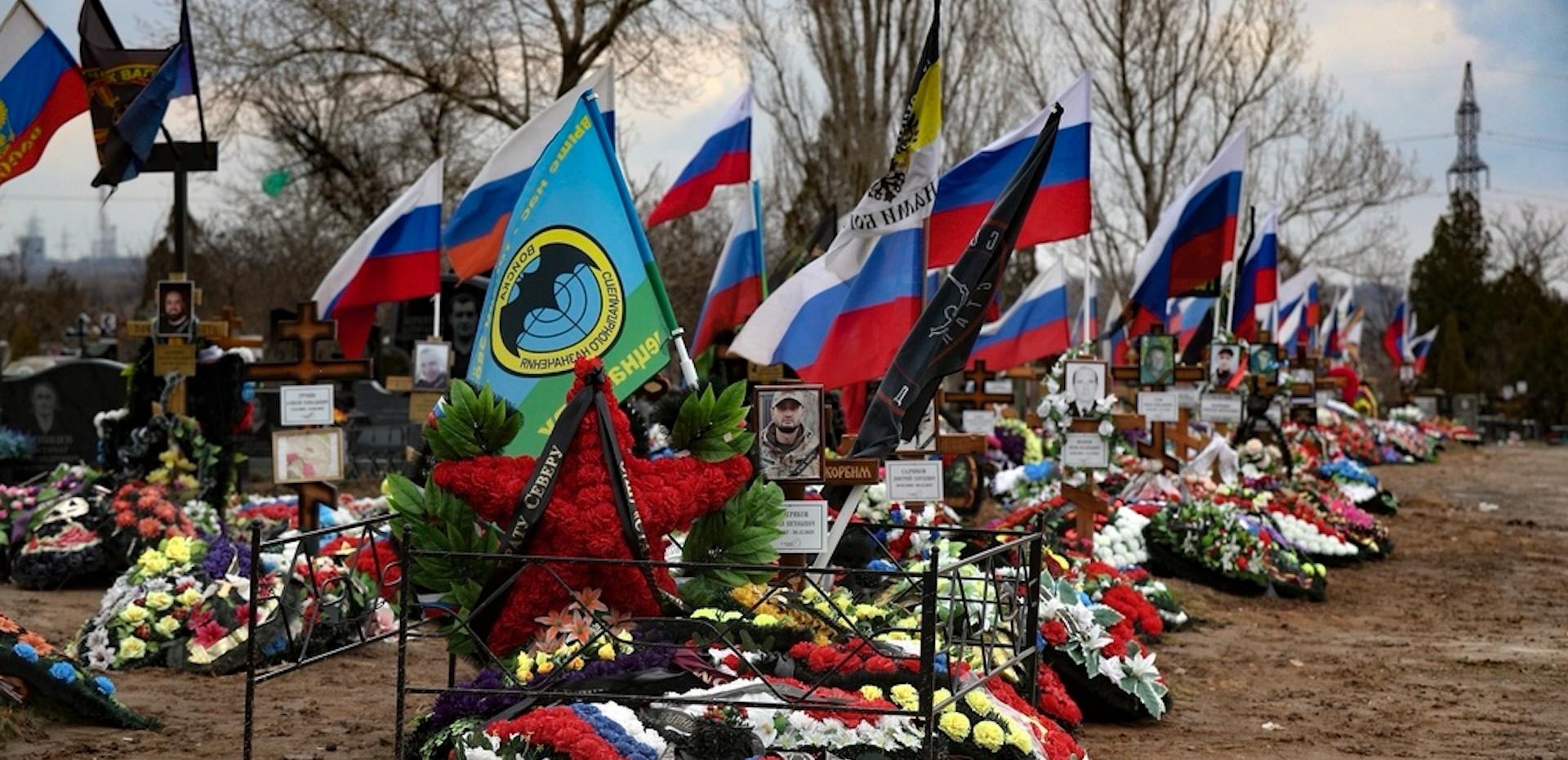
The leak of a Rosstat database, which became public on 1 November, has given researchers access to one of the most valuable sets of Russian demographic statistics. The data makes it possible not only to establish more precisely the scale of human losses, but also to trace the broader demographic consequences of the invasion of Ukraine, information that the Russian authorities have systematically concealed. NEST Centre has obtained access to the Rosstat database and is launching a series of articles examining the actual demographic situation in Russia. The first article is based on a section of the leaked database containing records of 11.6 million registered deaths between 2021 and 2026.
SUMMARY
- More than 490,000 Russians have been killed in the war in Ukraine. This estimate is based on death records from the leaked Rosstat database registered between 24 February 2022 and 29 September 2026.
- In 2025, male life expectancy in Russia fell to 65.3 years – 14.1 years lower than female life expectancy. This is the largest gap on record. Life expectancy for both sexes stood at 72.3 years in 2025 – 5.7 years below the 78-year target the Russian government aims to achieve by 2030.
- A total of 6,947 foreign nationals fighting on the side of the Russian army have been killed in Ukraine. Central Asian countries are the main source of foreign recruits for the Russian army. Citizens of Kazakhstan, Uzbekistan, Tajikistan, Kyrgyzstan, and Turkmenistan account for 58.9 per cent of the recorded deaths.
- Spring 2025 was the deadliest period of the war, marked by the Russian Armed Forces’ offensive towards Pokrovsk and fighting in the Kursk and Belgorod regions. More than 19,000 deaths were recorded in May – the highest monthly figure in the data available to date.
- Russian official statistics increasingly classify homicides and suicides under a different category – ‘deaths of undetermined intent’. Since 2022, the rate of increase in the share of deaths which fall into this category has doubled, accompanied by a proportional decline in the shares recorded as homicides and suicides. This trend is most pronounced in the Moscow region and St Petersburg.
Russia’s losses in the war against Ukraine have already exceeded its combined losses in the war in Afghanistan and both Chechen wars. The authorities made concerted efforts to conceal the demographic reality of the war, but achieved the opposite: today, we can discuss it on the basis of evidence that, at best, we had hoped to see only decades later.

Aby Shukiurov
Associate Fellow, NEST Centre
What is known about the Rosstat data leak and why the database is reliable
In recent years, Russia has systematically concealed demographic statistics. Since February 2023, the law has allowed the government to ‘temporarily suspend’ access to any official data. NEST Centre’s sources are convinced that Deputy Prime Minister Tatyana Golikova, who oversees the national project ‘Demography’, was the main driving force behind the restrictions on access to data within the government. One of the aims of these restrictions was to prevent researchers and journalists from indirectly estimating Russia’s losses in the war against Ukraine.
Since 2024, it has become impossible to calculate mortality rates using publicly available demographic data. Detailed information on causes of death has disappeared from official statistics, while Rosstat has begun responding to requests for certain sensitive data by citing a ‘temporary suspension of access’, which has been repeatedly extended.
On 1 November, it became known that the hacker groups Cyber Partisans and Silent Crow had breached Rosstat’s digital systems. They managed to gain access to a detailed dataset, including mortality records.
NEST Centre has obtained the leaked database, which contains approximately 11.6 million unique records covering the period from 2021 to September 2026. Its structure corresponds to the official death registration form. The database’s limited coverage is explained by the way the data was extracted: the database was created in mid-2023, with records from several previous years added retrospectively.
We verified the authenticity of the database using three criteria:
- First, we compared the number of deaths calculated from the leaked database with the figures that Rosstat itself had made publicly available – the final estimate for 2023 and the preliminary estimate for 2024. To arrive at a figure comparable to Rosstat’s total number of deaths, we excluded stillbirths, the occupied territories, and versions of death certificates that had not yet been processed. The comparison shows only minimal differences:
| Year | Rosstat figures | Our data after applying filters to ensure comparability |
| 2023 (final annual figures) | 1 764 618 | 1 764 583 |
| 2024 (preliminary annual figures) | 1 818 635 | 1 818 551 |
- Second, the reliability of the data was confirmed when we examined causes of death. For example, we found that the number of homicides matched the official figures for 2021–2023:
| Year | Rosstat figures1 | Leaked database |
| 2021 | 5839 | 5781 |
| 2022 | 5414 | 5332 |
| 2023 | 4724 | 4723 |
- Third, although the database does not contain individuals’ names, it is possible to identify them if their exact dates of birth and death are known (allowing up to 99 per cent of individuals to be identified), as well as, in cases of ambiguity, the civil registry office where the death was registered.2 Using a simple query, we were able to find death records for approximately 4,000 political and public figures. The records may contain information about their places of residence, places of death, and circumstances of death.
For example, Alexei Navalny’s record states that his death was registered by the Salekhard civil registry office of the Civil Registry Service of the Yamalo-Nenets Autonomous Okrug, and that he died on 16 February 2024 in the town of Labytnangi. His death record lists ‘acute heart failure’ as the underlying cause of death, but codes it as hypertensive heart disease – a chronic condition. The immediate cause, ‘pulmonary oedema’, is coded as ischaemic cardiomyopathy. The descriptions and codes contradict each other, and the record itself was edited almost a year after his death.
In addition to verifying information about the deaths of well-known individuals, we successfully conducted several checks against records of deaths that had not been publicly reported (relatives and acquaintances). This further confirms the reliability of the database.
The authenticity of the data has also been indirectly confirmed by NEST Centre sources who previously worked directly with Rosstat’s database. Bloomberg journalists and other reputable sources have reported finding no evidence of falsification.
None of the above rules out certain problems with the data, particularly for the period before July 2023. The metadata suggests that death certificates issued before that date were probably uploaded to the database in a single batch. This also makes it impossible to establish precisely when individual records from before July 2023 were entered into the database. This explains certain features of death records from that period. For example:
- The database contains thousands of death certificates for war-related deaths that were registered retrospectively: the registration date in the metadata precedes the actual date of death for 6,955 people in 2022 and 6,422 in the first half of 2023.
- The database contains 807 difficult-to-detect duplicate death records with the code Y36 (operations of war). These records have different IDs, so they could initially be assumed to refer to different individuals. However, comparing the civil registry office code, exact date of birth, exact date of death, sex, and causes of death shows that they refer to the same individuals. This may be because the death certificates were entered into the database again when continuous data collection began, even though they had already been uploaded before 1 June 2023.
- The place of death is almost never recorded before July 2023 (only 3.29 per cent of death records from 2022 specify the region of death, compared with 98.08 per cent in 2025). This makes it impossible to calculate life expectancy by region for the period before July 2023.
These features can be explained by the fact that, from July 2023, Rosstat began receiving information on deceased individuals from the Federal Tax Service (FTS) population register through the so-called System of Interdepartmental Electronic Interaction (SMEV). When we compare Rosstat’s monthly death registration data with SMEV messages linked to the FTS, we find that the figures from the two sources are almost identical from July 2023 onwards, whereas for the earlier period, most registered deaths appear only in Rosstat’s data.
Estimate of irrecoverable military losses
Our estimate of the number of military personnel killed in the war against Ukraine is based on death records from the database registered between 24 February 2022 and 29 September 2026.
We can identify some war-related deaths with a high degree of accuracy: the record contains the code ‘operations of war’, lists the manner of death as ‘during military operations’, or explicitly mentions a military operation. However, the Y36 code (‘Operations of war’) includes not only combatants but also civilians killed as a result of the war. Distinguishing between the two can be difficult, if not impossible, in some cases.3
In addition, we cross-referenced all deaths without a military code against Mediazona’s list of named fatalities, using date of birth, date of death, region, and sex. This identified approximately 25,000 additional deaths. As a result, the main list of military fatalities, excluding duplicates, comprised approximately 464,000 individuals: each death is confirmed either by a military code or by name.
However, many death certificates of military personnel contain no reference to the war. We searched for such records among men aged 16–70 who died after 24 February 2022, applying two criteria: (1) the death was registered outside the civil registry offices of the Donetsk and Luhansk People’s Republics and the Zaporizhzhia and Kherson regions; and (2) the record could not be matched against Mediazona’s list. This identified approximately 60,000 deaths.
Court rulings declaring missing persons dead – approximately 41,000. Courts also declare missing persons dead in peacetime, so we counted only the number of such rulings exceeding the pre-war level in 2021, rather than all such rulings. We consider almost all of this excess to be war-related.
Scoring system and machine learning model. We identified approximately 19,000 deaths using a hybrid method. We assessed each record against six rules: points were added for characteristics typical of deaths on the battlefield and deducted for characteristics associated with deaths under normal circumstances.
Scoring MethoD
| Characteristic | Points | How it is determined |
| Military service | +11 | Employment status is recorded as ‘in military service’ |
| Death in a combat zone | +7 | The place of death is Ukraine, including the occupied territories, or the place-of-death field mentions the ‘special military operation zone’, a military unit, or settlements along the front line |
| Death certificate issued more than 90 days later | +7 | The medical death certificate was issued more than 90 days after the date of death – this can occur when the body cannot be recovered or identified for an extended period |
| Death outside the region of residence | +4 | The region of death differs from the region of residence or the region where the death was registered |
| Death certificate issued within two days | −2 | The certificate was issued on the day of death or within the following two days – typical of deaths under normal circumstances |
| Death at home | −3 | Home is recorded as the place of death |
The points are added together, and the records are divided into two groups based on their total score:
- Group A – 12 points or more: The strongest indicators of a war-related death. At least 95 per cent of these records genuinely relate to military personnel.
- Group B – 10 points or more: A broader group with a slightly lower degree of confidence. At least 90 per cent relate to military personnel.
For example, military service combined with death outside the region of residence gives 15 points – placing the record in Group A. Death in a combat zone combined with a delayed death certificate gives 14 points – also Group A. However, military service combined with a certificate issued within two days gives only 9 points, so the record is excluded from the estimate.
The same records are independently assessed by a machine learning model – the Explainable Boosting Machine. This is a ‘transparent’ model that makes it possible to see how much each characteristic contributes to the decision. Both models were calibrated against Mediazona’s list of named fatalities: their ability to identify individuals confirmed to have been killed in the war was used to assess their accuracy.
Finally, we added approximately 6,000 deaths registered by civil registry offices in the Donetsk and Luhansk People’s Republics and the Zaporizhzhia and Kherson regions. Around 4,000 of these were deaths caused by gunshot wounds and explosive injuries, including during shelling. A further 2,000 represent the excess number of court rulings declaring missing persons dead compared with the pre-war level.
| Indicator | Deaths, thousands |
| Main list: military code or match with the list of named fatalities | ≈464 |
| Court rulings declaring missing persons dead above the 2021 level | ≈41 |
| Identified using the scoring system and machine learning model | ≈19 |
| Civil registry offices in the annexed regions: gunshot wounds and explosive injuries, court rulings | ≈6 |
| Total registered military deaths | ≈530 (521–537) |
We estimate the total number of registered military deaths at approximately 530,000 – between 521,000 and 537,000, depending on the methodology used. This figure includes around 8,000 citizens of other countries and Ukraine. It is a lower bound: the estimate excludes war-related deaths among women and people outside the specified age range whose records do not mention the war, as well as those killed whose deaths have not yet been registered.
It is worth noting that the registration of deaths under the Y36 code (‘Operations of war’) is subject to substantial delays and is spread over time. Although most registrations, particularly in 2026, still occur in the month of death or the following month, a large number of deaths are registered two or three months later or more.
Life expectancy: A record decline among working-age men and a gap of more than 14 years compared with women
Rosstat stopped publishing life expectancy data for 2024 because this indicator serves as an indirect measure of the impact of the war. Using the Rosstat database, we were able to estimate life expectancy in Russia for 2024 and 2025.4
In 2025, male life expectancy fell to 65.3 years – 3.1 years lower than in 2019 and almost at the level recorded in 2021, the worst year of the pandemic. This decline was driven by men aged 15–54: increased mortality in this age group reduced life expectancy by 3.9 years.5 In other age groups, mortality was, by contrast, lower than before the war.
Female life expectancy continued to rise during the war, reaching a record high of 79.3 years in 2025. As a result, the gap between men and women reached 14.1 years. This is the largest gap since records began in 1959: even during the crisis years of the 1990s, the difference in life expectancy between men and women did not exceed 13.7 years.
Life expectancy for both sexes stood at 72.3 years in 2025 – 5.7 years below the 78-year target the Russian government aims to achieve by 2030. This is the third time the Kremlin has set this target: in 2018, it planned to achieve it by 2024, before postponing the deadline by six years. Today, Russia is no closer to achieving this target than it was when it was first introduced.
Trends in wartime fatalities
The Rosstat database makes it possible to assess monthly trends in fatalities among Russian military personnel. More than 435,000 deaths in the database have the Y36 code, meaning they are directly linked to military operations. Approximately 4,000 more are identified by name as prisoners recruited while the Wagner Group was active. Although their death records do not contain a military code, the circumstances clearly indicate that they were killed on the battlefield.
The total monthly figures, covering approximately 440,000 fatalities, represent the lowest and most conservative estimate. We used this data to construct a chart of deaths by month. The chart is more useful for assessing the dynamics of military operations than the absolute number of deaths, which could be considerably higher depending on the methodology used. For example, the widely reported ‘meat assaults’ in Bakhmut in late 2022 accounted for only one-sixth of the daily losses recorded in spring 2025. According to our calculations, 6 May 2025 was the deadliest day of the war, with 808 people killed.
The deadliest incidents of the war
Destruction of a military convoy near Rylsk
- Number killed: 187.
- Date: 8 August 2024.
- What happened: A convoy of lorries was hit by missiles 30 kilometres from the Ukrainian border, a few minutes before midnight on 9 August 2024. Pro-war Z-bloggers expressed outrage at the time, arguing that moving troops in convoys in the third year of the war, after numerous attacks, warranted execution. The Ministry of Defence did not comment on the incident. Fourteen lorries were destroyed by fire. Of the 187 people killed, 127 have been identified by name. Approximately half were volunteers who had signed contracts after the war began.
Destruction of a building in Makiivka on New Year's Eve
- Number killed: 152.
- Date: 1 January 2023.
- What happened: Missiles struck a vocational school building in Makiivka, near Donetsk, where mobilised troops from Russia's Samara region were stationed. Ministry of Defence officials stated at the time that the widespread use of mobile phones by the troops had enabled the Ukrainian Armed Forces to detect their signals and determine their location. Critics, however, stressed that housing more than a hundred troops in a single building within HIMARS range was unacceptable. Of the 152 people killed, 139 were mobilised troops.
Destruction of a convoy in the Kherson region
- Number killed: 88.
- Date: 10 November 2023.
- What happened: The Telegram channel 'VChK-OGPU' was among the first to report the incident. It also claimed that the convoy had been used as a diversion. The Ministry of Defence did not comment on the incident. Of the 88 people killed, 76 have been identified by name. Around half were volunteers who had signed contracts after the war began.
Strike on Zhytlivka near Kreminna in the Luhansk region – possibly during a military parade
- Number killed: 87.
- Date: 13 June 2023.
- What happened: Pro-war bloggers reported that soldiers had been assembled in formation to await the arrival of a general. They allegedly stood there for around two hours before being hit by a missile strike. The Ministry of Defence did not comment on the incident. Of the 87 people killed, 66 have been identified by name. Forty-three of them were prisoners who had signed contracts with the Ministry of Defence.
Strike on a training ground near Trudovske in the Donetsk region
- Number killed: 65.
- Date: 20 February 2024.
- What happened: According to media reports, military personnel had again been assembled in formation to await the arrival of a general. The Ministry of Defence did not comment on the incident. Of the 65 people killed, 58 have been identified by name, including 20 volunteers and 16 mobilised troops.
'Meat assaults' near Bakhmut
In mid-May 2023, Yevgeny Prigozhin gave an interview to blogger Konstantin Dolgov. He stated that he had recruited approximately 50,000 prisoners, 20 per cent of whom had been killed near Bakhmut. It appears that 'Putin's chef' was not lying: according to the Rosstat database, by 20 May, when the capture of Bakhmut was announced, around 10,600 prisoners had been killed, the vast majority during the eight months of assaults. This represents approximately half of all prisoners killed during the years of the war.
It was during the fighting for Bakhmut that the term 'meat assaults' came into common use. In December 2022, Ukraine estimated Russian fatalities near the city at 50–100 per day. This corresponds to the actual figures: according to Rosstat, around 60 prisoners alone were being killed each day at that time.
However, it is important to understand that Bakhmut and its 'meat assaults' cannot be compared with subsequent events in the war, such as the offensive in the Pokrovsk direction in spring 2025. By then, an average of 600 people were being killed each day. According to current estimates, the deadliest day was 6 May, with 808 fatalities. This was not the result of a single incident: losses that day were spread across the entire front.
However, if Rosstat’s data are to be believed, losses began to decline in summer 2025. Experts attribute this to a change in tactics: Russia moved away from mass assaults towards small assault groups and stopped using heavy equipment. Rosstat's figures show a continuous decline, but more time is needed to confirm or refute this trend. For example, deaths over the past six months have not yet been registered in the database. In reality, by autumn 2026, losses may have returned to their previous high level or exceeded it. British officials report 54,000 casualties in October, while the UK's Ministry of Defence previously cited 2,090 killed and wounded per day as a record since the start of the war. Earlier estimates by British intelligence proved accurate: they were very close to the Rosstat figures that are now available.
Losses on Russian territory
Around 17,500 Russian military personnel have been killed in fighting on Russian territory – approximately 16,000 over ten months in Kursk region and around 1,500 over three months in Belgorod region.
Russia's Ministry of Defence once provided a fairly honest casualty figure. This happened on 25 March 2022, when the ministry reported 1,351 fatalities, broadly corresponding to the 1,326 deaths officially registered at that point. By September of the same year, however, Defence Minister Sergei Shoigu was clearly lying when he reported 5,937 fatalities: by that point, 8,234 deaths had already been registered.
Foreign nationals fighting for Russia
Rosstat's data contain a substantial proportion of foreign nationals who died at the front and had links to military service. We examined data on deceased foreign nationals, the causes of their deaths, and the locations where they died most frequently. This is not a complete list of all foreign nationals killed, nor is it a final casualty figure: some cases do not appear in the database. We identified 6,947 records of foreign nationals killed in fighting in Ukraine.
Central Asian countries are the main source of foreign recruits for the Russian army. Citizens of Kazakhstan, Uzbekistan, Tajikistan, Kyrgyzstan, and Turkmenistan account for 4,091 records – 58.9 per cent of the working sample. The largest numbers of fatalities were among citizens of Kazakhstan (1,375) and Uzbekistan (1,301). They were followed by Tajikistan (831), Belarus (719), Kyrgyzstan (415), Azerbaijan (408), and Turkmenistan (169).
FOreign nationals killed in the war in ukraine
The high proportion of people from Central Asia among those killed may be linked to the recruitment of migrant workers through deception and coercion. ЛPeople were offered civilian jobs in Russia, promised assistance in obtaining documents or release from prison, but ultimately found themselves in military units. There is documented evidence that migrants were forced to sign military contracts under threats and physical pressure and were then sent to the front line.
Rosstat's data include people from Colombia, Cuba, Nepal, Sri Lanka, Nigeria, Cameroon, Kenya, Yemen, Egypt, and many other countries. Those killed include nationals from Latin America, Africa, South Asia, and East Asia.
The geographical distribution of deaths among foreign nationals fighting for Russia corresponds almost entirely to the areas of active fighting. More than 63 per cent of all records relate to Donetsk region – 4,375 people. A further 774 people were killed in Luhansk region, 558 in Zaporizhzhia region, and 67 in Kherson region.
In total, 5,780 deaths – 83.2 per cent of the working sample – occurred in Russian-occupied parts of Ukraine, including Crimea and Sevastopol. A further 901 people were killed in Kharkiv, Sumy, and Dnipropetrovsk regions.
Russia's border regions – Kursk and Belgorod – account for 224 records. In 42 cases, the place of death could not be established, although the documents explicitly state that the deceased had served in the military or in an equivalent capacity.
North Korean military personnel represent a separate case. Unlike recruited military personnel from other countries, North Korean army losses are not included in Rosstat's data. According to South Korean intelligence estimates, between 16,000 and 20,000 North Korean soldiers took part in fighting in Kursk region. On 26 April 2026, a memorial complex was opened in Pyongyang, listing by name around 2,300 North Korean soldiers killed in the war. South Korean media reported that relatives of the dead soldiers received death certificates and were required to sign non-disclosure agreements.
Military fatalities outside Ukraine
Rosstat's data make it possible to track deaths among Russian military personnel and mercenaries not only in Ukraine, but also in other countries where Russia is involved in armed conflicts. Between September 2023 and September 2026, the database recorded 355 deaths of Russian nationals in Mali, of which 645 showed indications of a connection to military operations. The two largest spikes in fatalities coincided with major attacks on Russian contingents: on 27 July 2024, when Wagner fighters were killed near Tinzaouaten (69 records), and on 25 April 2026, when armed groups attacked military facilities in several areas of Mali (45 records). Cross-referencing the records with open sources made it possible to confirm the deaths of several Russian nationals who had previously been identified or considered missing. An analysis of the biographies of those killed also points to a change in the composition of the Russian contingent: among those deployed to Mali after 2023 are people without significant combat experience, unlike Wagner veterans who had taken part in earlier operations.
In Syria, the database contains 878 records of deaths of Russian nationals between January 2022 and March 2026, of which 26 show indications of a connection to military operations. The highest number of deaths in a single day – ten – occurred on 29 January 2024 and was presumably linked to a military helicopter crash. Of the six people identified among the dead, most were regular military personnel with combat experience.
In the Central African Republic, only 32 records of deaths of Russian nationals were identified for 2022–2026, most of them without an established cause of death. Unlike Mali, the data for the Central African Republic show no major single-day spikes in fatalities, which may reflect a decline in the intensity of Russian mercenaries' direct involvement in combat. However, the absence of a recorded connection between a death and military operations does not mean that no such connection exists. Classification in the database is incomplete, so these figures cannot be considered a comprehensive estimate of Russian military fatalities in these countries.
Undetermined causes of death, domestic violence, and the distortion of statistics
One might have expected the return of hundreds of thousands of people with combat experience from the front to affect the number of violent deaths within Russia. However, official statistics show the opposite: between 2021 and 2025, the numbers of suicides and homicides fell to record lows, while the number of deaths of undetermined intent remained almost unchanged.
The reason is that some homicides and suicides were probably classified as ‘deaths of undetermined intent’, a category of causes of death that demographers refer to as ‘garbage codes’. In practice, ‘undetermined intent’ reveals little about the circumstances of death. This classification is used when an expert cannot or does not wish to establish whether a death resulted from an accident, suicide, or homicide.
Such cases occur everywhere, but in countries with reliable statistics they are extremely rare, accounting for less than 1 per cent of all deaths. In Russia, they outnumber homicides and suicides combined and account for around 2 per cent of all deaths. It is therefore unsurprising that leading Russian and Western demographers have long regarded this category as one in which concealed violent deaths, primarily homicides, are recorded. In 2021, there were two deaths classified as being of ‘undetermined intent’ for every registered homicide or suicide. By 2025, this ratio had risen to three and a half.
Since the start of the war, this trend has become particularly pronounced in the Moscow region. Between 2021 and 2025, the number of suicides fell fourfold, while homicides fell fivefold. However, the total number of deaths from injuries, poisonings, and other external causes remained almost unchanged, at around 7,000 per year, excluding war-related deaths. Suicides, homicides, poisonings, falls, and drownings together declined by 3,400 deaths, while the number of deaths classified as ‘undetermined intent’ increased by exactly the same amount.
A similar pattern can be observed in St Petersburg. The city previously recorded around 400 suicides annually, but only 44 in 2025. In 2021, 835 people died from accidental poisoning by alcohol, drugs, and other substances, compared with just 16 in 2025. Only three deaths by drowning were registered in the whole of 2025, while the number of deaths classified as being of ‘undetermined intent’ increased almost two and a half times, from 849 to 2,200. We also observe a sharp increase in such deaths in the Vladimir region, Tuva, the Kemerovo region, and Yakutia.
The largest share of deaths classified as being of ‘undetermined intent’ involves injuries caused by blunt or sharp objects – typical consequences of fights and beatings. During the war, the number of such deaths increased, while the number of homicides involving knives, blunt objects, or bare hands almost halved. In 2021, there were seven deaths from blunt-force injuries classified as being of ‘undetermined intent’ for every homicide involving a blunt object. By 2025, this ratio had risen to more than fifteen.
Deaths classified as being of ‘undetermined intent’ may conceal domestic violence against women. Over the past decade, the number of registered homicides of women has fallen almost fourfold. However, the number of deaths among working-age women caused by blows from objects and classified as being of ‘undetermined intent’ has not declined. In 2015, there was less than one such death of ‘undetermined intent’ for every homicide of a working-age woman. By 2025, there were more than two.
The characteristics of these deaths are more similar to those of homicides than accidents: the proportion of women among the victims is the same as among homicide victims and twice as high as among those killed by accidental blows. A significant share of these deaths result from beatings, including domestic violence, but are not classified as homicides.
Deaths classified as being of ‘undetermined intent’ are increasing most rapidly among older people. Among women over 60, their number has doubled over the past decade. This may reflect both uninvestigated violence and a failure to examine the circumstances of deaths among older people, for example, in cases involving falls.
In cases of fatal injuries, the external cause of death is determined by a forensic medical expert, taking into account the examination findings and the circumstances of the incident as described in the law enforcement authorities’ order commissioning the examination. This procedure is set out in the Russian Ministry of Health’s guidance No. 13-2/I/2-22576 of 12 November 2024.
Following the start of the full-scale war, these problems may have worsened due to the additional workload associated with military losses, investigations into the circumstances of deaths among those involved in the war, and the return of large numbers of people with combat experience. Against a background of existing staff shortages and limited resources, this may have made the work of both investigative units and forensic medical institutions more difficult.
Under heavy workloads, experts may be more likely to classify borderline cases as deaths of undetermined intent when the available evidence is insufficient to establish the circumstances of death. At the same time, staff shortages in law enforcement agencies may limit the thoroughness of investigations and the collection of information needed for forensic assessment. Administrative pressure from regional authorities seeking favourable homicide and suicide mortality figures may have been another contributing factor.
The figures for deaths of ‘undetermined intent’ may conceal domestic violence, alcohol-related fights and beatings, alcohol and drug poisonings, as well as violence committed by those returning from the front, which is regularly reported in the media. A separate issue is suicide among those involved in the war and their families: if such deaths are recorded as being of ‘undetermined intent’, it is impossible to estimate their scale using the data available to us.
Conclusion
The first stage of our analysis of the Rosstat database has made it possible to reconstruct the picture of mortality in Russia during the years of the full-scale war. It has allowed us to estimate military losses, identify anomalies in Russian cause-of-death statistics, and produce initial estimates of the decline in life expectancy among Russian men and the number of foreign nationals killed in the war.
The database examined so far represents only a small part of the material that remains to be analysed. According to Silent Crow, the hackers managed to obtain approximately 23 TB of data (Cyber Partisans put the figure at more than 10 TB).
It can be assumed that the unexplored data contain not only demographic information on births, migration, the age structure of the population, and demographic projections, but also important information about Russia’s economic situation. Judging by the first public reports and statements, the hackers have access to at least some data on industry and the population of the occupied territories of Ukraine, disability, oil production, and exports and imports of certain goods.6
Rosstat’s extensive documentation may be of particular value. According to the hackers, the leaked data include internal documents and official correspondence, probably including communications between Rosstat, its regional offices, and other government bodies, as well as materials revealing the internal workings of Russia’s main statistical agency and its regional divisions. These materials are important for both journalists and researchers: they offer a better understanding of how the bureaucracy operates and how ‘knowledge about the population’ is produced.
The remaining datasets have yet to be analysed, and the findings may substantially expand the picture presented here. This is only the beginning.