Ideology instead of economics: How the war has changed the SPIEF
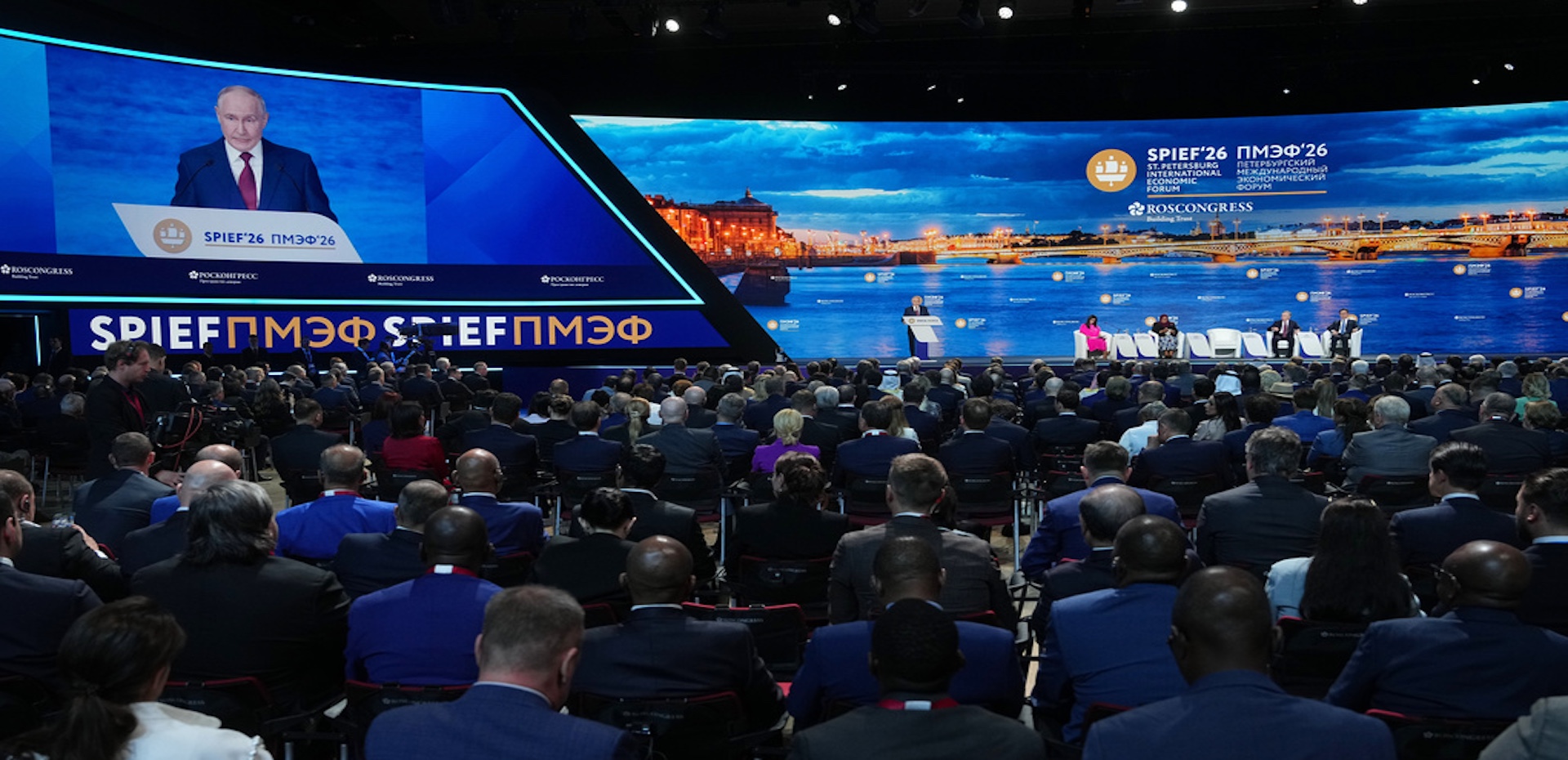
The St Petersburg International Economic Forum (SPIEF) is one of the most important events of the year in Russia. It is often referred to as the ‘Russian Davos’, where Vladimir Putin delivers key statements on economic policy. Over the last few years, the SPIEF has undergone a fundamental transformation. Whereas in the past it was primarily an economic event where political questions were of secondary importance, economic issues are now increasingly overshadowed by discussions about Russia’s strategic direction.
The beginning of this year saw a serious deterioration in Russia’s economic situation: a recession, declining budget revenues, a growing deficit, and minimal investment activity. However, the sharp rise in oil prices triggered by the closure of the Strait of Hormuz, combined with the lifting of US secondary sanctions, reduced the pressure on the Russian government’s budget and allowed Putin to avoid addressing uncomfortable economic issues in his SPIEF speech. The temporary improvement in economic conditions, together with moderately optimistic statements from government ministers, shifted observers’ attention away from the economy and towards geopolitical and ideological agenda-setting.
Among the most memorable and widely debated contributions were those of two controversial conservative ideologues, the philosopher Alexander Dugin and the businessman Konstantin Malofeev. Whereas their role in the SPIEF had previously been largely peripheral, in 2026 they emerged as key speakers on a panel discussing potential scenarios for Russia's future development. On the opening day of the forum, which coincided with the largest Ukrainian drone attack on St Petersburg since the war began, Dugin and Malofeev presented their vision of the world order and of the future of Russia and Ukraine. In particular, they described the use of nuclear weapons as a ‘good scenario’. This message was directed simultaneously at a domestic audience, as a call to accept radical escalation, and at a foreign audience, as an attempt to intimidate and to project an image of Russia as a state prepared to consider a nuclear strike as a possible course of action.
Dugin has a reputation as someone who, even if he does not directly influence Kremlin policy, is adept at sensing the mood of Russia’s political leadership. He spoke about the need for ‘de-Westernisation’, the revision of the Russian Constitution, the rejection of neoliberalism, and a greater role for central economic planning. In this context, the remarks of Igor Shuvalov, chairman of the state development corporation VEB.RF, were particularly notable. He publicly criticised the rise of anti-capitalist sentiment and called for resistance against those in the president’s circle urging him to return to Soviet-style governance.
This reflects the existence of two competing approaches within the governing elite: a technocratic one, aimed at preserving market mechanisms, and a militarist–ideological one, which views the economy solely as an instrument for achieving political objectives.
The transformation of the SPIEF reflects broader changes in the relationship between the state and business, in the form of the dominance of politics over economics and the large-scale undermining of property rights. Since 2022, the nationalisation of assets has become widespread in Russia. Various legal mechanisms have been used to justify it, ranging from challenges to the legality of privatisations carried out in the 1990s and accusations that owners support Ukraine, to fully justified prosecutions of officials on corruption charges.
Among the most significant recent precedents was the seizure of the personal assets, valued at approximately 8 billion roubles, of Alexander Galitsky, founder of the venture capital fund Almaz Capital Partners and one of the pioneers of Russia’s IT industry. In addition, in 2025, Dmitry Kamenshchik, owner of Domodedovo Airport, Denis Shtengelov, owner of KDV Group, and Konstantin Strukov, the controlling shareholder of Yuzhuralzoloto Group, all lost control of their businesses.
Against this backdrop, the ideological turn of the SPIEF appears entirely consistent. It has ceased to function as a tool for attracting investment capital to Russia and instead serves to consolidate a new ideological framework for the country, adapted to a protracted military conflict and long-term confrontation with the West.