Loyalty, not money: Why Putin seeks ‘voluntary contributions’ from big business for the war against Ukraine
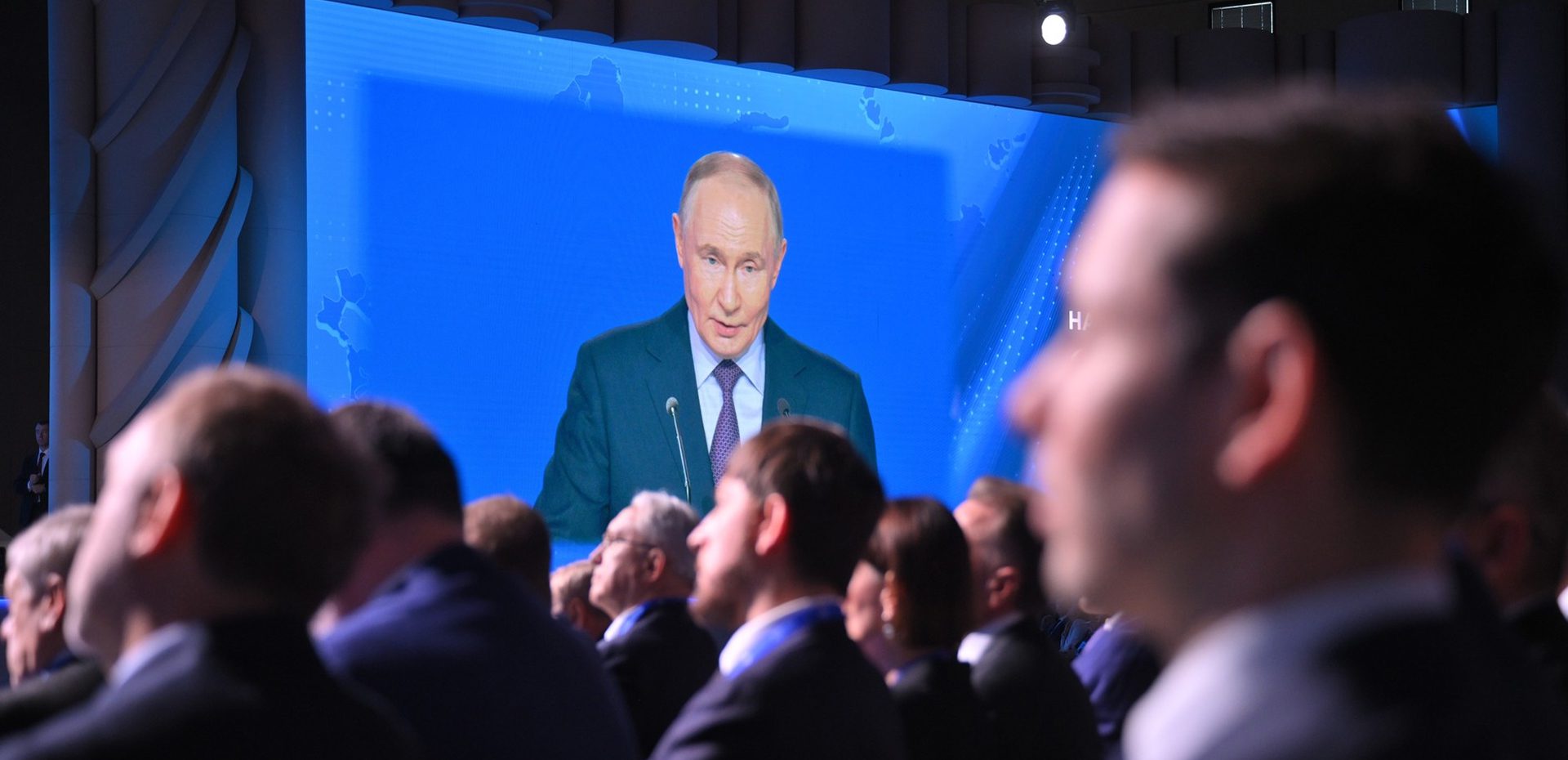
On 26 March, Vladimir Putin held a closed meeting with representatives of Russia’s largest businesses. According to his press secretary, Dmitry Peskov, the president supported the idea, put forward by entrepreneurs, of making ‘voluntary’ contributions to the budget to finance the war in Ukraine. Many observers interpreted this as a sign of serious economic difficulties. NEST Centre experts believe that it has little direct economic rationale. In essence, it is a demand that the elites confirm their loyalty. The willingness of businesspeople to finance wartime costs is becoming a key factor in maintaining their position within the hierarchy. The meeting was intended to demonstrate Putin’s readiness to wage a prolonged war and, at the same time, his continued control over the elites.
Cash keepers
The basic arrangement between the Putin regime and big business first took shape in the early 2000s. It implied that the oligarchs recognised their status as holders of assets and beneficiaries, rather than being full owners. Property rights could be revised in cases of insufficient loyalty. In return, a pledge of allegiance and the absence of political ambitions ensured relatively predictable conditions for doing business.
A key episode in establishing these new rules was the Yukos oil company case. As an example to others, the company was driven into bankruptcy, its core assets came under state control, and its head, Mikhail Khodorkovsky, was imprisoned, along with several colleagues.
Criminal cases against Vladimir Gusinsky and Boris Berezovsky are also indicative. Both possessed significant media resources and used them with a degree of independence from the authorities. Both businessmen were forced to leave Russia, and a substantial share of their assets came under the control of the state and Kremlin-affiliated structures. Loyalty to the regime quickly turned from an advantage into a condition for survival.
This system of informal arrangements became entrenched following Putin’s return to the presidency in 2012. Businesses that had aligned themselves with President Medvedev were dismantled. For example, the brothers Ziyavudin and Magomed Magomedov, co-owners of the Summa Group and close to Medvedev, received nearly 20-year sentences in high-security penal colonies and lost most of their assets. Oligarchs who did not want to share the Magomedovs’ fate, such as Alisher Usmanov, shifted their political alignment.
After the start of the full-scale war in 2022, the system of conditional property rights tied to political loyalty evolved into a more rigid system of control, dividing actors into ‘insiders’ and ‘outsiders’. Regulatory changes were introduced that simplified the seizure of assets from companies with foreign participation, often at undervalued prices and without full compensation. In parallel, quasi-legal mechanisms began to be used – including the revision of privatisation deals from the 1990s or the designation of enterprises as ‘strategic’ – creating formal grounds for expropriation.
The nationalisation of business has become a systemic practice: more than 150 companies have been affected since 2022. Prosecutors often demand the return of assets privatised 25–30 years ago, citing procedural violations by regional authorities. One recent example is the transfer of 100 per cent of the shares of the Dalpolimetall mining and metallurgical complex to state ownership, as well as the nationalisation of Domodedovo Airport.
Updating loyalty
Putin’s 26th March meeting with big business was primarily symbolic. From a financial perspective, ‘voluntary contributions’ are unlikely to affect the actual situation at the front. The state has more extensive and manageable mechanisms for replenishing the budget.
For example, in January, VAT was increased by 2 percentage points to 22 per cent, which, according to Ministry of Finance estimates, should generate an additional 5.3 trillion roubles over three years. Earlier, the budget received around 320 billion roubles from a one-off windfall tax on large companies. From 2025, the corporate profit tax was increased by 5 percentage points. The Minister of Economic Development, Maksim Reshetnikov, did not rule out the introduction of a new windfall tax if the rouble weakens.
In this context, individual voluntary contributions from businesses are of limited significance. The proposal attributed to oligarch Suleiman Kerimov to donate 100 billion roubles is not comparable to current war expenditures, which amount to around 259.4 billion roubles per week.
The involvement of large businesses in financing the war began as early as 2022. In addition to fulfilling defence orders, some companies have been involved in recruiting contract soldiers and providing additional payments. Structures linked to Oleg Deripaska (Rusal), Leonid Mikhelson (Novatek), Sergey Gordeev (PIK), Mikhail Gutseriev (Mospromstroy), and others were supposedly involved in these practices. According to journalistic investigations, informal channels were also used to finance the war, including contributions to state-affiliated funds and entities.
Against this background, Putin’s public request to business leaders is politically rather than economically significant: elites confirm their readiness not only to be subservient, but also to finance the war and share responsibility for it. Such meetings allow the participants to swear a new oath of allegiance and to renew their right to use resources. This is particularly relevant against the backdrop of the growing role of the security services in redistributing assets.
Putin has staged such rituals before. One example is the Security Council meeting on 21 February 2022, at which participants hesitantly demonstrated support for the start of the war. Another is the meeting with business leaders on 24 February 2022 – the day the war began. Later, Western countries imposed sanctions on all 37 participants who attended that meeting.
Over the years of war, Russia’s most important businesspeople have adapted to the new reality and accepted a subordinate role. They will not enter into open conflict with the authorities, especially given the effect of sanctions, which have left them, along with Putin, effectively isolated. The war in the Middle East and the physical risks of remaining in the United Arab Emirates have called into question one of the few remaining options for diversifying risks and ‘stepping aside’ gradually. This has further reinforced businesspeople’s understanding of the lack of viable alternatives.