Neither friend nor foe: How perceptions of Russia are changing in Iran
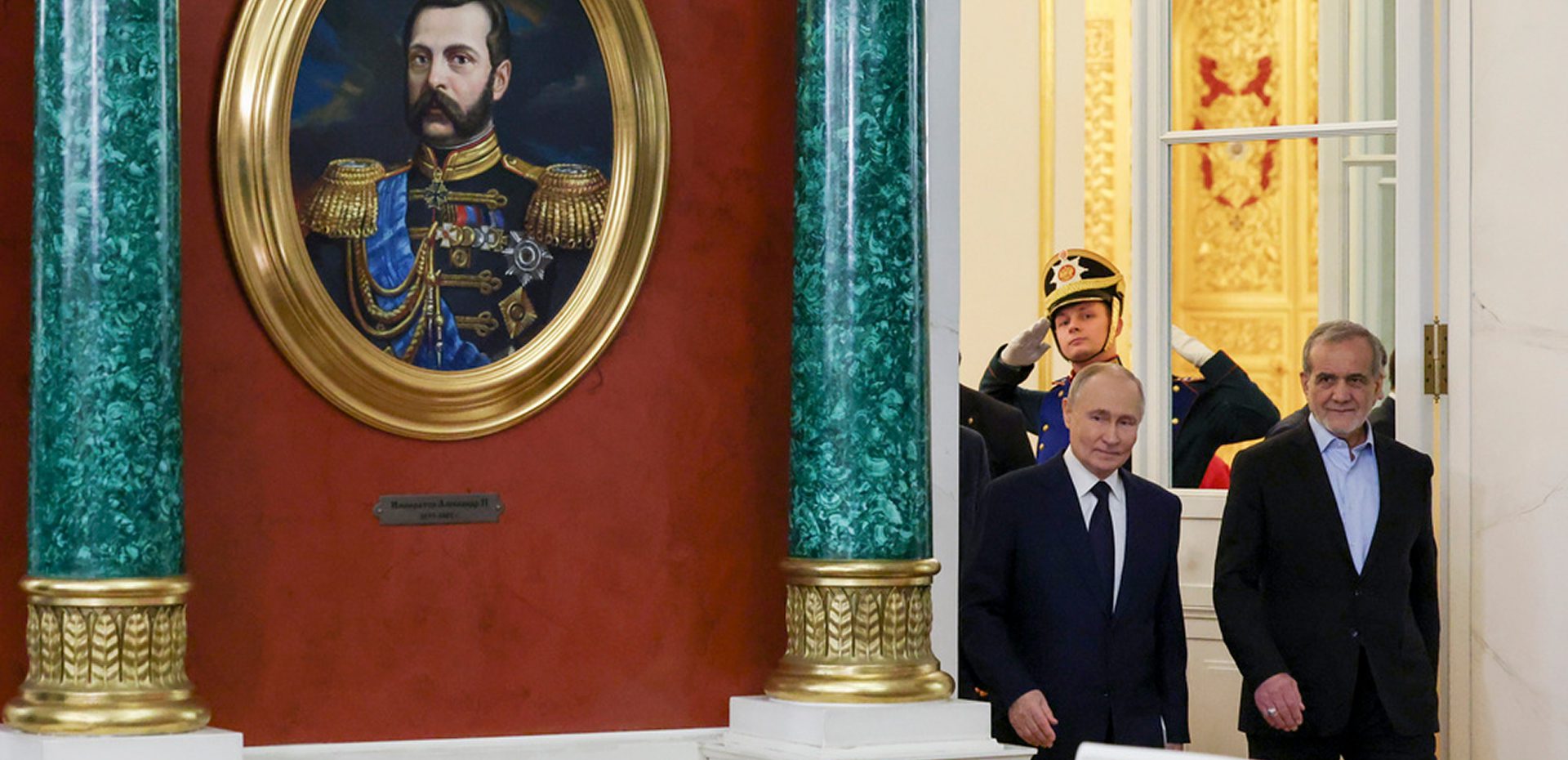
Despite official rhetoric hailing Russia as a strategic ally, mistrust runs deep in Iran. Historical trauma, the war in Ukraine, regional crises and Moscow’s perceived unreliability have fuelled elite criticism and public disillusionment, leaving Tehran’s backing limited and devoid of firm commitments.
At the official level, the Iranian authorities emphasise the friendly nature of relations with Russia. In practice, however, these relations remain limited and marked by mistrust. Historical trauma, the war against Ukraine, regional crises, and the absence of support at critical moments have undermined Tehran’s trust in Moscow. This is reflected both in criticism from political elites and the media, and in a worsening of public perceptions of Russia. As a result, Iran’s support for Russia is largely rhetorical and is not underpinned by concrete commitments.
‘Beware of the Russians!’
The official Iranian narrative today seeks to portray Russia as a benevolent ally and a reliable partner capable of shielding an isolated country from the economic pressure of US sanctions. In an article published immediately after his election victory in July 2024, the incumbent president, Masoud Pezeshkian, stressed that ‘Russia is a valued strategic ally and neighbour to Iran’.
Beyond official statements, however, attitudes towards Moscow are noticeably more ambivalent. Discontent within the Iranian establishment on the most sensitive Russia-related issues generally comes not directly from senior decision-makers, but from second-tier officials or through pro-government media outlets.
Thus, the conservative newspaper Jomhouri Eslami called for a ‘substantial revision of political relations with Russia and for compelling Russian statesmen to repent for their betrayal of the Iranian people’.
Similar negative reactions towards Moscow followed the escalation of the conflict in the Gaza Strip in October 2023, when the Kremlin was criticised for a position that, according to Jomhouri Eslami, ‘is no different from that of the US, the UK, China, and the Zionists’.
The outlet warned Iranian officials against excessive dependence on Russia, whose stance on Gaza was said to demonstrate that ‘Iran should not rely on Moscow’, since ‘Russians are known worldwide for their dishonesty, baseness, and for prioritising their own interests over those of others’.
The debate that unfolded in the Iranian press in spring 2025, over whether Russia is capable of acting as a genuine mediator between Tehran and Western countries in negotiations about Iran’s nuclear programme, was also indicative of Iranian attitudes.
While pro-government media expressed cautious optimism, reformist newspapers categorically opposed Moscow’s involvement. Ham-Mihan published an article titled ‘Beware of the Russians!’, which argued that Russia, in order to protect its interests on the global stage, ‘seeks a middle path on Iran’s nuclear programme that will not allow the crisis to be fully resolved and will not break the vicious circle of crises’.
Critical assessments were also voiced by former senior diplomats. In October 2025, Iran’s former foreign minister Mohammad Javad Zarif publicly accused the Kremlin of sabotaging nuclear negotiations in previous years.
Taken together, these debates reflect a broader trend of deteriorating attitudes within Iranian society towards Russia over the past four years. According to GAMAAN, in September 2021, six per cent of Iranians viewed Russia very positively, while 47.4 per cent viewed it very negatively. By November 2025, the share of extremely positive assessments had fallen to 5.1 per cent, while extremely negative views had risen to 53.2 per cent.
Among the key factors shaping this trend are the war against Ukraine and disappointment with Moscow’s actions in regional crises, including the so-called 12-day war between Iran and Israel.
Even at the official level, Tehran’s support for Moscow remains limited and largely rhetorical. Iran does not recognise the occupation of Ukrainian territories and is not prepared to provide Russia with full-scale military assistance. This restraint is explained both by doubts about the Kremlin’s willingness to come to Iran’s aid in the event of a direct conflict, and by a reluctance to sever relations with the West altogether.
Mistrust between the two sides is further reinforced by Moscow’s behaviour during crises that directly affect Iran’s domestic politics. Russia’s prolonged silence in response to the bloodiest protests in Iran in the past 47 years was perceived in Tehran as a sign of the Kremlin’s uncertainty about the stability of the Iranian regime. This further strengthened the perception of Russia as a partner whose support is shaped by circumstances rather than by stable alliance commitments.
Historical trauma
Diplomatic crises between Moscow and Tehran are often driven by historical trauma – and by the Kremlin’s attempts to balance its relations with Iran and with the Arab states.
Perceptions of Russia have always been ambivalent within Iran. On the one hand, Iranians treat Russian culture with considerable reverence. All major Russian writers, from classical authors to contemporary figures, are translated into Persian.
On the other hand, attitudes towards the shared past remain complex, particularly regarding the outcome of the Russo-Persian wars of the early 19th century, which resulted in the annexation of part of Persia (as Iran was then known) by Russia. An additional source of tension is the Soviet occupation of northern Iran during the Second World War.
Events of the distant past, especially those associated with historical trauma, continue to resonate within Iranian society. In August 2021, Russia’s ambassador in Tehran was summoned to the Iranian foreign ministry over a photograph of him with his British counterpart, in which they were seated on the historic staircase of the Russian embassy, where the Tehran Conference of 1943 took place. The composition of the photograph reminded many Iranians of an image of Stalin, Roosevelt, and Churchill, and it was perceived as an insult, including by Mohammad Javad Zarif, then the foreign minister.
Geographical names also remain a sensitive issue. For Tehran, the use of the term ‘Persian Gulf’, which is also the norm in the West, is a matter of principle. In February 2021, the Iranian authorities sent a note of protest to the Russian foreign ministry after one of its publications referred to the gulf as the Arabian Gulf.
At times, public discontent emerges despite Tehran’s official line. Thus, in August 2018, following the signing of the agreement on the legal status of the Caspian Sea, Iranian nationalists claimed that the authorities, acting in Russia’s interests, had agreed to reduce Iran’s share of the Caspian basin from 20 to 13 per cent.
Attitudes towards the war against Ukraine
Russia’s full-scale military invasion of Ukraine in February 2022 was greeted positively by Iran’s leadership. The supreme leader of the Islamic Republic, Ayatollah Ali Khamenei, stated that Kyiv ‘became a victim of a crisis created by the United States’ and stressed that ‘NATO would have launched a war against Russia if it had not started the military operation in Ukraine’.
Among Iranian intellectuals and the intelligentsia, however, Russia’s aggression against Ukraine is perceived as a colonial war and a continuation of Moscow’s historically expansionist policy. Iranian youth, representatives of Generation Z, express particularly strong solidarity with Ukrainians on social media.
After the start of the full-scale war in Ukraine, Russia’s popularity as a partner in foreign policy declined sharply in the eyes of Iranians, from 25 per cent in 2021 to 13 per cent in March 2022. In August 2022, only three in ten Iranians agreed that Russia was conducting a military operation in Ukraine in self-defence. The majority of respondents believed that Moscow was violating the principle of territorial integrity, linking this assessment to Iran’s own security concerns.
Formally, Tehran continues to support Ukraine’s sovereignty and does not recognise the occupation of Ukrainian territory, including Crimea. When necessary, senior Iranian officials reiterate this position.
In July 2023, the then Iranian foreign minister, Hossein Amir-Abdollahian, reaffirmed Iran’s commitment to the principle of the territorial integrity of states, including Ukraine, as a core requirement of international law. He was responding to a joint statement of the Russia-GCC (Gulf Cooperation Council) Strategic Dialogue, which addressed the issue of three islands in the Strait of Hormuz which are disputed between Iran and the UAE.
At the same time, a group of former Iranian ambassadors and retired diplomats published an open letter condemning the Kremlin’s policy. ‘Russia <…> has used Iran’s territorial integrity as a bargaining chip to achieve its regional goals and interests, which constitutes <…> clear disregard for Iran’s national interests on the international stage’, the letter stated.
The Syrian factor
Throughout the many years of the military campaign in Syria, the leadership of the Islamic Republic suspected Moscow of close cooperation with Israel against Iran.
After the missile strike on Iran’s consulate in Damascus on 1 April 2024, Jomhouri Eslami asked: ‘Why [does] Russia, which controls the Syrian airspace, not prevent air strikes on Iranian targets in Syria?’ Furthermore: ‘Have Iranian officials ever asked themselves why such attacks never take place against Russian forces in Syria and why Russia's advanced air defence does not prevent Israel's crimes against Iran?’
Russia’s delayed response, as well as China’s, to Israel’s attack on Iranian territory in October 2024 was also sharply criticised on Iranian social media and in the press. The reformist outlet Ham-Mihan lamented that ‘neither Beijing nor Moscow condemned Israel’s actions’, comparing this approach to the position of some European countries that have strained relations with Iran.
The fall of the Assad regime in December 2024 prompted a restrained reaction from senior Iranian leaders. At the same time, second-tier officials and military figures were openly critical of Moscow. A senior general, Behrouz Esbati, stated that Russia had misled Iran by claiming that its aircraft were bombing Syrian rebels.
The 12-day war
A serious test for the entire power structure of the Islamic Republic was the 12-day war with Israel in June 2025. None of Iran’s foreign partners, including Russia, provided military support to Tehran, prompting it to reassess its relations with them.
The highly effective strikes by Israel, which led to the destruction of the entire Iranian military leadership, strengthened the public outrage in Iran over delays in arms deliveries from Russia. In addition, the value of the Treaty on Comprehensive Strategic Partnership between Russia and Iran, signed in January 2025, was called into question, as it contains no mutual military obligations.
‘Russia has transferred the S-400 missile defence system to Turkey and Saudi Arabia, but does not supply it to Iran because it could be used against Israel’, argued Ali Motahari, the former deputy speaker of the Iranian parliament.
Moreover, Mohammad Sadr, a member of the Expediency Discernment Council, claimed that ‘Russia provided Israel with information about the location of air defence systems in Iran’.Heshmatollah Falahatpisheh, the former head of Iran’s parliamentary committee on national security and foreign policy, stated with indignation that ‘the Iranian people have already paid more than they should have for the war in Ukraine’.