On the eve of Geneva: Can negotiations move beyond deadlock?
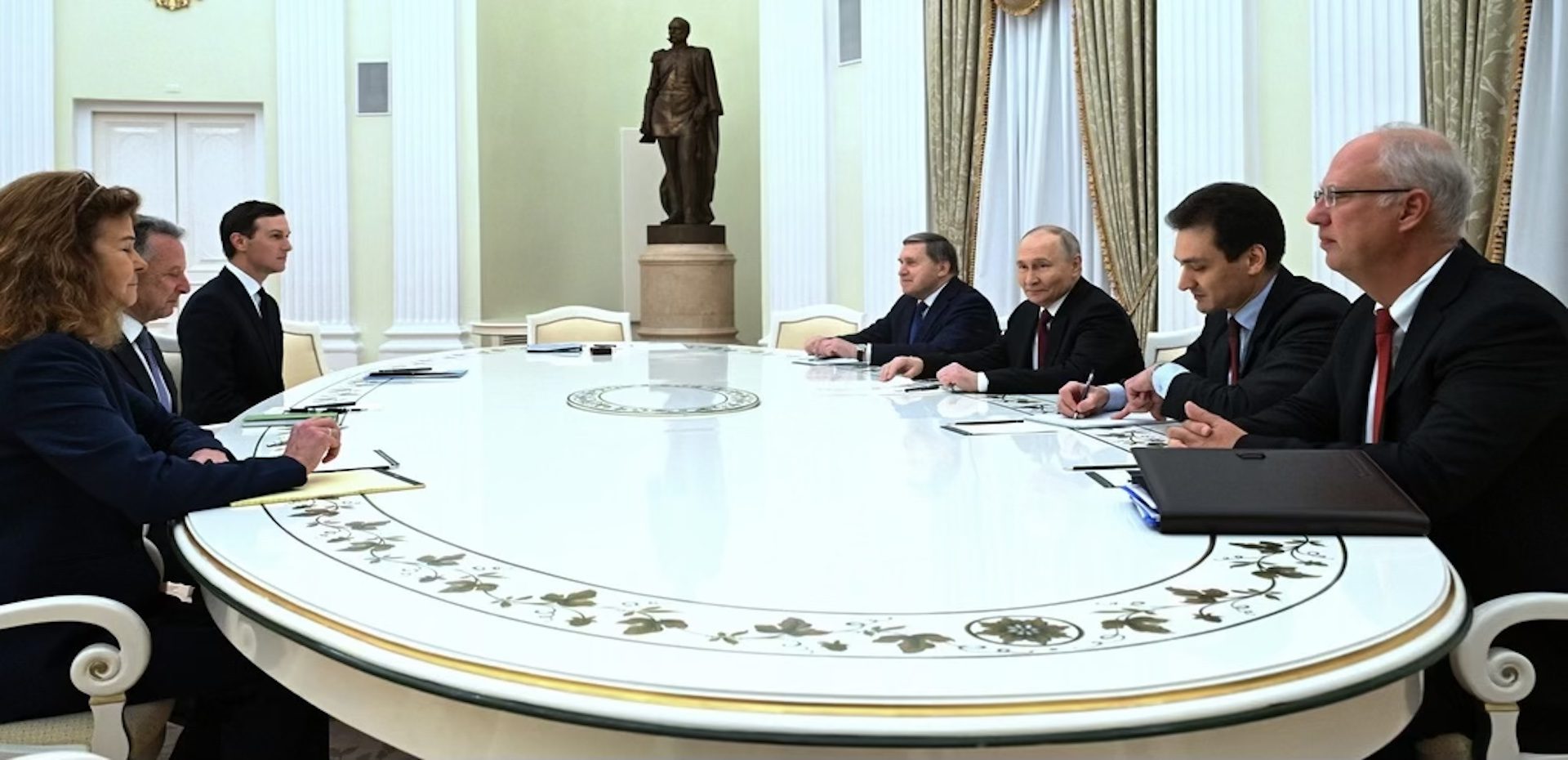
As it approaches the next round of negotiations in Geneva, Moscow has not revised its position. Russia continues strikes against Ukrainian infrastructure, calculating that this will undermine society’s resilience to further resistance. At the same time, it does not view its own technological vulnerabilities as a factor capable of significantly altering its strategy. In these conditions, the negotiation process is likely to remain in a state of stagnation until the balance of forces on the battlefield changes or new external circumstances emerge that could adjust the parties’ calculations.
What peace rests on
A further round of negotiations between Russia and Ukraine, mediated by the United States, is scheduled for 17–18 February in Geneva. The previous two rounds took place in Abu Dhabi and were described by the parties as ‘constructive’. At the end of January, they agreed on a temporary suspension of strikes on energy infrastructure, and after the most recent meeting the first prisoner exchange in five months took place. However, the parties have not moved closer to a comprehensive ceasefire agreement.
Two key issues remain unresolved – territory and the parameters of a post-war settlement in Ukraine, including security guarantees.
Moscow insists that peace is possible only on the basis of agreements allegedly reached by Vladimir Putin and Donald Trump at the Anchorage summit: recognition of Russia’s control over the entirety of Donbas, including around 20 per cent of territories it has not captured, and the freezing of the frontline in other directions. Kyiv categorically refuses to discuss such a scenario.
Disagreements also concern the parameters of Ukraine’s post-war political order. Russian officials again state the need to hold ‘democratic elections’ and to form a ‘viable government’ in Kyiv before signing a peace treaty. Western media reported that Volodymyr Zelenskyy was allegedly prepared to hold a referendum and national elections in May 2026, but the Office of the President of Ukraine denied these reports.
Moscow also opposes the deployment of foreign military contingents in Ukraine as a post-war security guarantee. According to Volodymyr Zelenskyy, this is because Vladimir Putin ‘wants to retain the ability to return’.
Pressure on the negotiations
The parties’ negotiating positions are directly influenced by the current dynamics of the conflict. Moscow demonstrates the capacity to inflict long-term damage and to increase the costs of resistance. At the same time, episodes involving restrictions on access to satellite communications point to vulnerabilities on the Russian side, although in its perception they are not critical.
The disconnection of Starlink terminals, illegally used by Russian forces to adjust artillery fire and coordinate assault operations, revealed the dependence of Russian units on foreign satellite services. Pro-war social media reported disruptions and ‘chaos’ in communications systems, and in some cases assault operations were suspended. Against this backdrop, reports indicated advances by the Armed Forces of Ukraine in the Zaporizhzhia direction, near Huliaipole, where Ukrainian forces managed to penetrate Russian defensive lines. The restriction of access to satellite communications may have affected the tactical situation on this section of the frontline.
At the same time, Russia is intensifying strikes on Ukraine’s energy infrastructure aimed at the country’s systemic weakening. The centralised heating model makes large cities vulnerable to the destruction of key nodes, the restoration of which requires significant resources and time. As a result, strikes on infrastructure increase the economic and social cost of continuing the war for Kyiv and its Western partners.
Awaiting a turning point
The prospects for negotiations are largely determined by the structure of external pressure and the internal calculations of the parties. The key question is whether the participants have the resources and incentives to alter the current configuration of the conflict.
The ability of the United States to influence the situation remains limited. Donald Trump is unlikely to change the dynamics significantly: the instruments available to the US president to compel peace are limited. Pressure on Kyiv is theoretically possible through reducing or slowing military support, but such a step entails reputational costs within the United States and in relations with allies.
The potential for direct pressure on Moscow is also limited. The sanctions regime has approached the limits of expansion, and at this stage no additional instruments are apparent that could alter the Kremlin’s position in the short term. The only external factor capable of influencing Moscow’s calculations remains China, on which Russia’s dependence is increasing. In this context, contacts between Washington and Beijing cause concern in Moscow.
For Putin, the current configuration is relatively comfortable. The economy has adapted to a war footing, the defence industry is functioning, and the frontline does not show strategic failures. The costs – financial and demographic – are significant, but they are distributed over time and so far do not create critical pressure on the system.
The displacement of Moscow to the periphery of global political processes is becoming an increasingly noticeable factor for the Kremlin. Events in Venezuela, Iran, Syria, and Armenia have demonstrated the limits of Russian resources amid their concentration on the war in Ukraine. In a number of cases, Moscow proved unable to respond promptly or to maintain its previous level of involvement.
An additional source of tension is the transformation of relations with China. The formula previously described as an equal partnership is gradually shifting towards asymmetry and growing Russian dependence on Beijing.
In such conditions, the Kremlin could theoretically consolidate what has been achieved and end the war. However, any concessions would be perceived as weakness, both domestically and externally. For this reason, the conflict can end for Moscow only on its own terms. If such terms are not achieved, the war will have to continue.
In that case, the bet is not on Kyiv’s capitulation, but on systemic attrition: strikes on energy and logistics, and increased expenditure on defence and reconstruction. The cost of continuing the war for Kyiv and its Western partners will rise until Moscow secures settlement terms it considers acceptable, or until it faces costs exceeding its current capacity to sustain the conflict.