Protests in Iran: Another setback for the Kremlin?
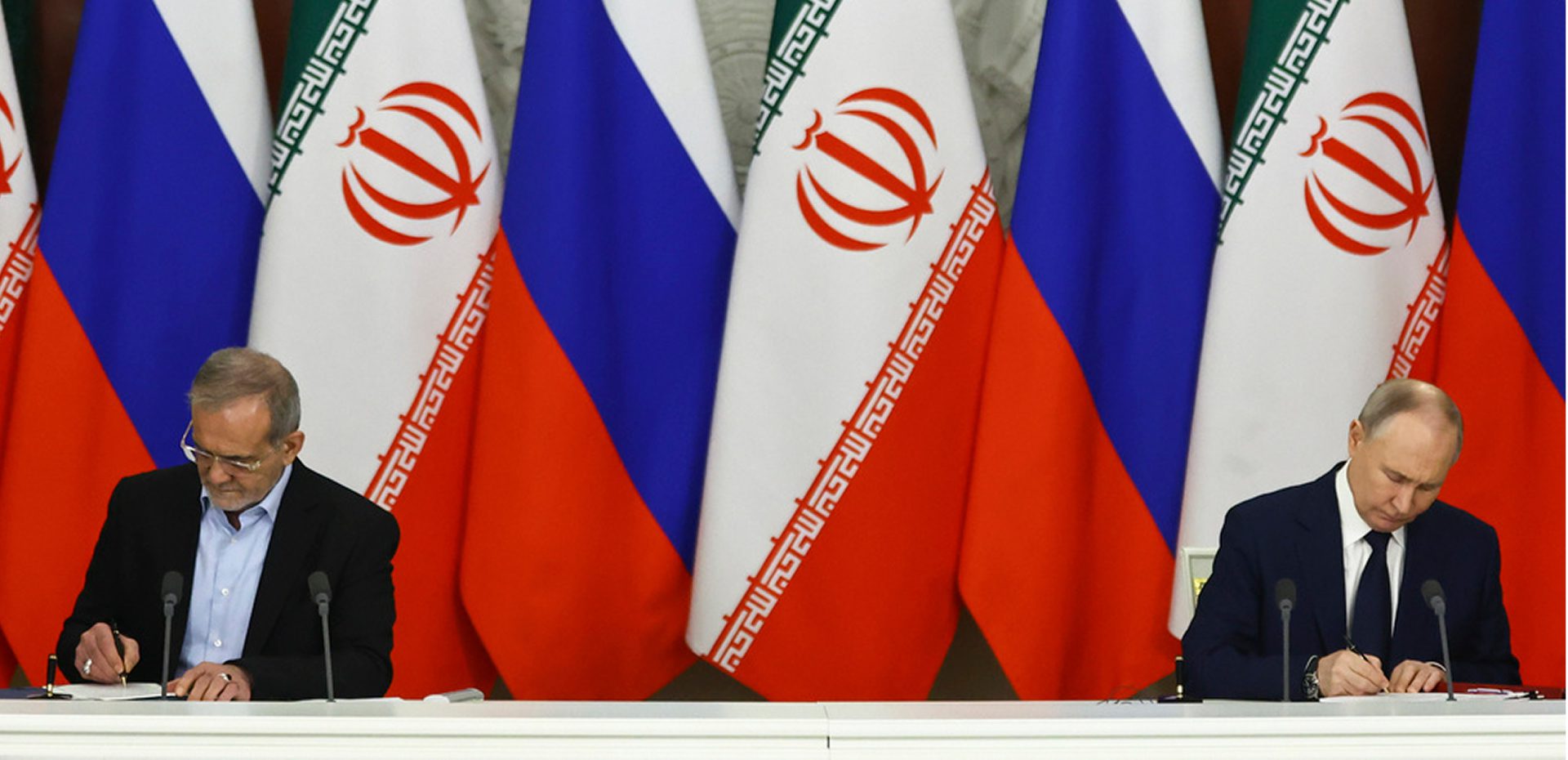
The largest protests Iran has seen in recent years represent more of an irritant for Moscow than a direct threat. The Kremlin is betting on the survival of the Iranian regime and is prepared to offer diplomatic support, but it lacks both the resources and the willingness to intervene directly. The fall of the regime would be a political blow for Moscow, further weakening its position in the Middle East, but it would not significantly affect Russia’s ability to continue its war against Ukraine.
Betting on regime resilience
The Iranian protests that began in late 2025 represent the most serious challenge the regime has faced in recent years. Triggered by a sharp rise in inflation and the massive depreciation of the national currency, the unrest initially centred on economic grievances. However, these demands quickly gave way to calls for regime change, including calls for the restoration of the monarchy.
The authorities responded both by cutting internet access and with violent repression. Available estimates suggest that at least 2,500 people have been killed, although the true death toll remains unknown due to severe communication restrictions.
The Russian government has publicly expressed support for the Iranian authorities, portraying the unrest as the result of external interference. Officials and state media describe the protests as a ‘colour revolution’, in effect blaming the United States and Israel. This rhetoric not only signals solidarity with Tehran, but also reproduces a familiar Kremlin narrative, in which mass protests in authoritarian regimes are framed as the product of foreign provocation rather than internal processes.
The greatest risk for Russia would be regime change in Tehran, which the Kremlin currently sees as unlikely. Iran has experienced mass protests before, including incidents that resulted in hundreds of deaths. In the absence of either an organised domestic opposition or foreign intervention, the Iranian authorities have always managed to retain control. The Kremlin appears to be counting on the same happening again.
The emergence of a secular government in Iran, particularly with direct US involvement, would be highly undesirable for Moscow since it would mean the loss of another partner in the Middle East and the further erosion of Russia’s regional standing.
At present, however, this outcome does not appear inevitable. There are indications that Iran and Israel have used Russia as a channel to convey mutual signals that neither intends to strike first.
Even if a US or Israeli intervention were to occur, it would most likely be limited to targeted strikes. As the 12-day war in June 2025 demonstrated, such actions are insufficient on their own to bring about regime change in Iran. Donald Trump has shown a preference for surgical military operations and is unlikely to agree to a full-scale campaign against the Islamic Republic.
Ruslan Suleymanov
Associate Fellow, NEST Centre
The strategic partnership agreement signed between Russia and Iran in January 2025 does not oblige either side to enter a conflict on behalf of the other. In any case, the Iranian authorities do not appear to need external support for now.
However, in the event of serious instability, some sort of response could still be expected from Moscow. In the wake of the successful US operation to seize Venezuelan president Nicolás Maduro in early January, a failure by Russia to intervene on Iran’s behalf could deal a further blow to the Kremlin’s reputation. The potential humiliation if both countries were to slip out of Russia’s sphere of influence is acknowledged within the Russian political elite.
At the same time, the Kremlin’s practical options are limited. Russia’s military resources are concentrated in Ukraine, while its desire to avoid provoking the Trump administration has led it to respond with silence to threats of military force against its partners.
An alliance that never was
After 2022, relations between Russia and Iran developed rapidly, but they never evolved into a full-fledged alliance. Yet if Iran ceased to be a partner for Russia, the military and economic costs for Moscow would be tangible, albeit limited in their effect.
At the beginning of the full-scale war against Ukraine, Russia viewed Iran as a supplier of specific types of military equipment, including combat drones, missiles, and ammunition. According to one estimate, since late 2021 Iran has supplied Russia with ballistic and air-defence missiles worth $2.7 billion. In addition, in 2023 the two sides signed an agreement covering the delivery of Iranian Shahed-136 drones and the transfer of production technology, estimated by Western sources to be worth around $1.75 billion. Iranian Revolutionary Guard Corps advisers were reportedly deployed to Crimea and other occupied territories to assist with the training of drone operators.
There have also been reports that Iran has provided Russia with several Mohajer-6 drones, designed for reconnaissance and strike missions, including the delivery of precision-guided munitions, as well as Fateh-360 and Fateh-110/Zolfaghar ballistic missiles with ranges of several hundred kilometres. However, their combat use in Ukraine has not been confirmed.
Over time, military cooperation has become more advantageous for Russia than for Iran. The transfer of drone production technology enabled Russia to begin manufacturing its own low-cost, long-range strike drone, known as the Geran-2, at a facility in the Alabuga special economic zone in the Republic of Tatarstan. By mid-2025, Russia was producing thousands of Geran-2 drones per month, nine times more than initially planned, using domestically sourced components. As a result, Russia’s dependence on Iranian drone supplies and related components has declined significantly.
In exchange for missiles and drones, Moscow promised to supply Iran with Su-35 fighter jets and S-400 air defence systems. These deliveries either did not take place or remained small-scale since there has been no public confirmation that they occurred. This has caused disappointment in Tehran because the gains from cooperation with Russia were expected to be significantly higher.
In the early phase of the full-scale war in Ukraine, Iran served not only as a source of weapons for Russia, but also as a model of how to adapt to sanctions. Moscow borrowed and applied Iranian methods of circumventing export controls, including multi-layered supply chains routed through third countries, shell companies, the re-export of dual-use components, barter arrangements, and settlements conducted outside the dollar-based financial system. Alternative logistics routes also played an important role, above all those running via the Caspian Sea.
Economic cooperation, however, has remained limited. By the end of 2024, trade turnover between Russia and Iran stood at approximately $4.8 billion, only slightly above its 2021 level. By comparison, Russia’s trade turnover with Turkey reached $52.6 billion in 2024.
A broad Russian economic or technological presence in Iran never emerged. Russian businesses are only weakly integrated into Iran’s financial and digital infrastructure. As a result, the current turbulence in Iran – including disruption to internet access and banking transactions – has not had any noticeable impact on Russian interests or assets.
Prolonged instability, however, could slow the implementation of larger projects, including those involving Russia. These include the development of the International North–South Transport Corridor, the construction of nuclear power plants, and the development of gas fields.
The loss of Iran would deal Russia a primarily political rather than economic setback, eroding its standing in the Middle East, while leaving its capacity to sustain the war against Ukraine largely unchanged.