Russia, war, and oil
Summary
- Four years into the war, sanctions have not affected Russian oil production. Output in 2025 was only 2.5 per cent below 2021 levels, largely in line with OPEC+ quotas.
- Russia continues to export roughly three-quarters of its oil production. Sanctions have reshaped logistics, counterparties, and price discounts, but have not substantially reduced export volumes.
- Global price declines and rouble appreciation primarily drive lower export and fiscal oil revenues. Between May and December 2025, oil-related budget revenues were 35 per cent lower year-over-year, broadly in line with a 32 per cent decline in the rouble price of exported oil.
Introduction
Russia’s war against Ukraine is now almost four years old. During this period, the US, the EU, and their partners have imposed extensive restrictions on Russian oil and petroleum products: import bans, a price cap, shipping and insurance measures, and, most recently, the addition of major firms to the US Treasury Department’s list of ‘Specially Designated Nationals’. The debate over the effectiveness of the sanctions remains heated because many analyses focus on short-term snapshots rather than considering their impact over a multi-year time frame.
Four years is enough time to take a broader view, rather than merely surveying recent developments. Therefore, we will try to answer three simple questions:
- Is oil production in Russia rising or falling?
- Are Russian companies' export revenues from the sale of oil and petroleum products rising or falling?
- Why is fiscal revenue from oil and petroleum products falling?
Production
- Oil production in Russia in 2025 fell by 8.8 per cent compared to its peak level in 2019.
- Sanctions affect where, how, and at what price Russia sells, but not how much Russia sells.
In the last pre-war year of 2021, oil production in Russia (including gas condensate) amounted to 525 million tonnes (10.54 million barrels per day). In 2025, this figure was 512 million tonnes (10.28 mbd). In other words, in four years, oil production in Russia fell by 2.5 per cent. It would seem that this answers the question about the impact of sanctions. If sanctions limited the sale and, accordingly, the production of oil, we would expect persistent failure to meet production quotas, abrupt declines in production at around the time when logistical, insurance, or payment-related problems originated, an increasing number of shut-in wells, or clear evidence from regional economic statistics.
At the end of 2016, Russia and nine other oil-producing countries joined the twelve OPEC countries to form the OPEC+ coalition, which makes coordinated decisions on changes in oil production by member countries. In total, the 22 OPEC+ member countries account for more than 40 per cent of global oil production, and since spring 2020, the coalition's policy of limiting oil production has been an important factor in stabilising global oil prices.1
Russia's oil production quota in December 2021 was 11 mbd, and in January 2022, it fell to 10.5 mbd. Subsequently, it was reduced five more times, reaching a low of 8.98 mbd from May 2024 to March 2025. From April to December 2025, Russia's quota slowly increased and currently stands at 9.57 mbd; oil production (excluding condensate) last year was 9.13–9.14 mbd.2
If we overlay the volume of Russian quotas within OPEC+ and the volume of oil production in Russia (excluding gas condensate) on a single graph, we can see that these two indicators have changed synchronously. Throughout 2022–2023, oil production in Russia slightly exceeded the established quotas,3 and in 2024, it corresponded to them with minimal deviations. The close relationship between quotas and output suggests that most of the observed decline is consistent with OPEC+ policy rather than a sanctions-driven production collapse. This does not rule out the possibility that sanctions have had an effect on production costs or on the feasibility of increasing production beyond quota levels. The data set out in the graph does not show significant changes in production volumes after the introduction of the latest sanctions.
However, given the significant decline in the price of Russian exported oil reported by the Ministry of Economic Development in December and January, the conclusion that sanctions do not affect production volumes is no longer as clear-cut following the introduction of the latest US sanctions (against Rosneft and Lukoil).
Exports
- Russia exports about three-quarters of its oil production (including exports of petroleum products).
- Sanctions did not materially reduce Russian production/export volumes; their main effect was to increase transaction costs and discounts, i.e. the price disparity between Russian and non-Russian oil, and to reshape logistics and counterparties.
- The introduction of Western sanctions had no impact on Russian export volumes, with the exception of the cessation of oil supplies via pipelines to Poland and Germany.
Russia does not have strategic oil reserves and does not possess significant oil storage facilities; in 2011–2025, slightly less than half of the oil produced (47-48 per cent) was exported, with the remainder sent for processing. Of the petroleum products obtained after refining, slightly more than half (52 per cent in 2011–2021) was exported. Overall, including petroleum products, Russia exported slightly less than three-quarters of its oil production. The sanctions imposed by the Western coalition after the Russian army's invasion of Ukraine had no significant impact on these proportions.
Data on exports of oil and petroleum products from Russia shows that their decline during the war does not exceed the effect of the reduction in oil production under OPEC+ rules, and comparison of this data with the dates of the adoption of sanctions decisions does not indicate that these decisions had a visible impact on export volumes.4
Thus, the available data does not provide evidence that Western sanctions have had an impact on Russian oil production or on oil export volumes from Russia, which is not surprising. Given that global oil production is 103-104 mbd, more than half of the oil produced is consumed within the countries which produce it. The international oil trade amounts to 49-50 mbd, and given Russia’s prominence in seaborne and pipeline markets, replacing 6.5–7 mbd quickly would likely require higher prices or sustained spare capacity elsewhere.5
The stability of oil production and refining volumes plays a much greater role in the Russian economy than financial indicators, as it affects the performance of related sectors of the economy and levels of employment. At the same time, financial indicators related to the oil industry have a significant impact on macroeconomic indicators: the balance of payments, fiscal revenue, the rouble exchange rate and, consequently, inflation depend on them. One of the main goals of imposing oil-related sanctions was to reduce the export volumes, export revenues, and fiscal revenues. However, as the analysis shows, the West has not been able to achieve significant success in this area.6
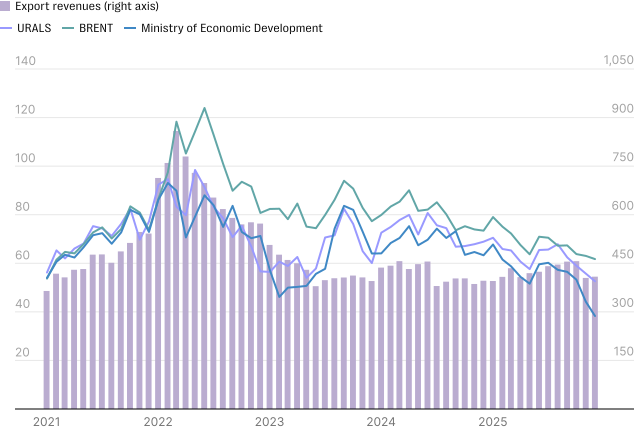
Export revenue is simply volume multiplied by price, but the latter is rarely taken into account when publishing rapid assessments on the decline in Russia's revenues from exports of oil and oil products. Meanwhile, global oil prices, which skyrocketed to $122.7/bbl in June 20227, have since begun a steady decline, falling to $62.5/bbl in December 2025. It is clear that even without the impact of Western sanctions, including the price cap, the decline in global oil prices would have led to a decrease in revenue from Russian oil exports. If we remove the price change factor, for example, by comparing April–June 2021 with June–August 2025, when the average price of Urals oil was at the same level ($69/barrel), we can see that the average daily revenue from Russian oil and oil product exports remained the same (around $430 million).
Russia’s oil and petroleum product export revenues (USD million per day, monthly) and oil prices (USD per barrel, monthly average)
Russian oil revenues and the budget
- The Russian budget's dependence on oil has decreased sharply over the past 10 years: the share of revenues derived from hydrocarbon production and exports fell from 50 per cent in the mid-2010s to 22 per cent in 2025.
- Discounts on the price of Russian oil due to sanctions are highly volatile and sometimes may have the opposite of the anticipated effect on revenue dynamics in the short term, increasing the selling price of Russian oil.
- Tax receipts fell mostly because of prices and the foreign exchange rate, amplified by Russia’s tax-price formula.
- In 2025-2026, Russia raised its main tax rates (VAT, profit tax and personal income tax), which will compensate for a significant portion of the decline in oil revenues.
In addition to oil and petroleum products being Russia's largest export item, accounting for about 40 per cent of total exports, taxation of the oil industry generates a significant portion of fiscal revenue. Although the share of fiscal revenue which comes from the oil industry has halved compared to the first half of the 2010s, it exceeded 25 per cent in 2025.8
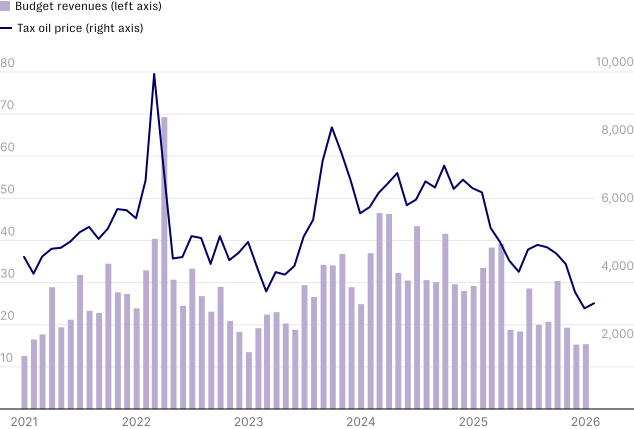
Tax rates on oil production and exports in Russia are determined based on the price of exported oil, which is calculated by the Ministry of Economic Development using a special algorithm. The ministry does not use actual data from payment documents, but rather information published by specialised agencies. In addition, oil companies pay taxes in Russian roubles using the Bank of Russia's exchange rate. Thus, Russian fiscal revenue depends on the rouble price of Russian export oil.
In November 2024, the US dollar exchange rate was almost 108 roubles. By mid-April 2025, the dollar had fallen below 83 roubles, and since then it has been in the range of 77 to 83 roubles, showing a tendency to fall further. The strengthening of the rouble, exacerbated by the decline in world oil prices, led to a fall in fiscal revenue, which in May–December 2025 was 35 per cent lower than in the same period in 2024. Given that the average rouble price of Russian export oil fell by 32 per cent during this period, it is hard to attribute the decline in Russian fiscal oil revenues to the effect of sanctions.
Of course, sanctions have had and continue to have a significant impact on the price of Russian export oil, creating a discount on the price of Brent oil, which has fluctuated widely since the war began. At the same time, analysis shows that the discount reached its maximum value during the period of greatest uncertainty regarding the functioning of European sanctions: between December 2022, when the price cap and ban on Russian oil imports to Europe came into effect, and March 2023, when Russian companies managed to rebuild alternative logistics and payment mechanisms. By the summer of 2024, the sanctions had become normalised, leading to a drop in the discount to around 10 per cent, where it remained until November 2025, when US sanctions against Rosneft and Lukoil were announced.
In November-December 2025, the discount began to grow rapidly, exceeding 15 per cent, but the effect of this, and for how long it will remain noticeable, will be seen in the statistics for 2026.
However, regardless of the reason for the decline in oil revenues, this is a major problem for the Russian authorities. The strengthening of the rouble in the first quarter of 2025 led to a decline in oil revenues over the following three quarters by 0.6 per cent of GDP. The budget lost another 0.6 per cent of GDP due to an overestimated forecast of the export price of oil.
Tax price of oil (RUB per barrel) and oil budget revenues (RUB billion per day), 2021–2025, monthly
When planning the budget for 2026, the Kremlin had three options:
- Maintain a high budget deficit, financed by borrowing on the domestic market. The negative effect of such a policy is well understood: rising interest rates, reduced lending to the real economy, and increased stagnation.
- Weaken the rouble, which can be achieved by liberalising capital outflows and/or by ending the Bank of Russia’s ‘mirror’ operations on the domestic currency market.9 The side effect would be accelerated inflation and the inevitable tightening of the Bank of Russia’s monetary policy.
- Raise taxes, which would curb consumer spending and have a deflationary effect.
Putin consistently supports the position of his economic advisors, who demand that the macroeconomic situation be kept under strict control. He has therefore chosen the third option: an increase in the VAT rate from 20 per cent to 22 per cent starting 1 January 2026 and the introduction of VAT for small businesses, which should increase fiscal revenue by 0.8 per cent of GDP.