Welcome to work, not to stay: Russia’s new migration model
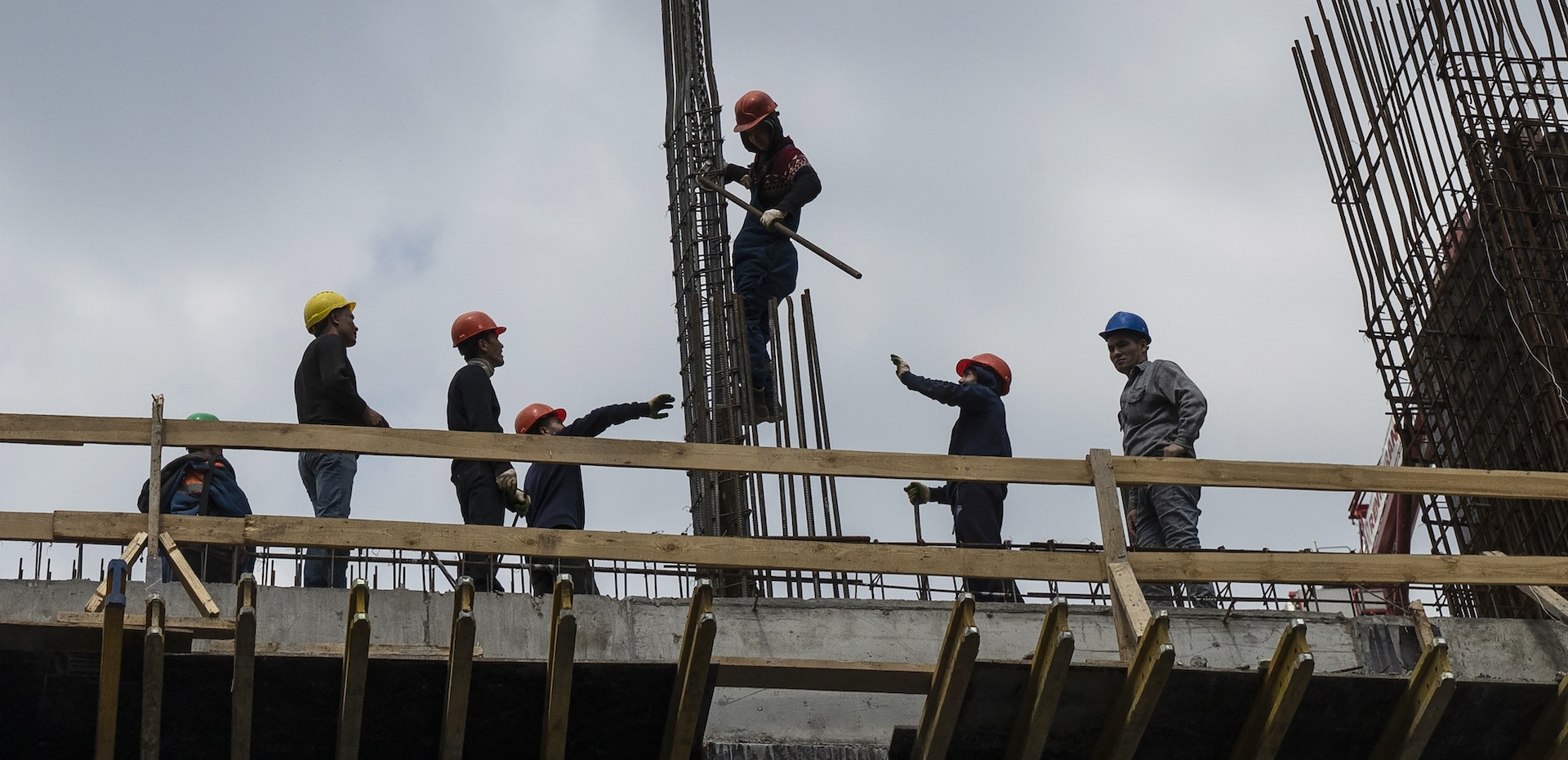
Demand for labour in Russia continues to grow as the population declines. For now, the authorities are closing the gap through higher wages, the recruitment of workers from increasingly distant countries, and rising costs for businesses. But sooner or later, this will no longer be enough – Russia will need not only more workers, but more people, even if the Kremlin does not want migrants to become Russian citizens.
The conflict within the regime
By mid-2024, the Russian authorities were at odds with each other over migration. On the one hand, after the terrorist attack at Crocus City Hall on 22 March 2024, which killed 149 people, the security services demanded a tighter migration policy. On the other hand, the Russian economy had almost exhausted its available labour resources: by 2025, the unemployment rate had fallen to an unprecedented 2.2 per cent. As early as April 2024, Deputy Prime Minister Tatyana Golikova estimated that the economy would require an additional 2.4 million workers by 2030. It is becoming increasingly difficult to reduce migration while at the same time ensuring that the economy has a sufficient supply of labour.
The authorities were unable to agree on a unified response to the labour shortage. Alexander Bastrykin, head of the Investigative Committee, proposed determining the minimum number of foreign workers required and developing a roadmap for replacing them with Russian citizens. The government’s socioeconomic policymakers took a different approach, based on the fact that there were already almost no available workers left in the country. To find them, in 2025 the Ministry of Labour and Social Protection launched the ‘Kadry’ (‘Workforce’) project, aimed at ‘inactive’ citizens who are not formally considered unemployed but who are not working either. Officials believed that the project would help to meet the economy’s growing demand for workers. Finally, Maxim Oreshkin, deputy head of the Presidential Administration, proposed reducing the need for additional labour through higher wages and productivity: in his words, there would no longer be ‘cheap labour’ in the Russian economy.
The Kremlin faced three requirements that were difficult to reconcile: reducing migration-related security risks, ensuring that the economy did not run short of workers, and at the same time trying to preserve an economic model based on cheap migrant labour. In the end, after the Crocus City Hall attack, the advocates of tighter control over migration began to prevail. In December 2024, Putin proposed creating a ‘powerful unit’ for migration policy within or attached to the Interior Ministry, to which representatives of economic agencies would be assigned. The president explicitly spoke of the need to combine the economic and law-enforcement dimensions of migration policy.
On 2 April 2025, the Interior Ministry’s Main Directorate for Migration Affairs was abolished. It was replaced by the Service for Citizenship and Registration of Foreign Nationals, headed by Andrei Kikot, who came from the Prosecutor General’s Office and at the same time became First Deputy Interior Minister.
This was not simply a victory for the security services. The state chose a way to reconcile incompatible demands: the economy would continue to make use of migrant labour, but the Interior Ministry would determine the conditions under which migrants could enter the country and work.
Expectations and reality
The security services’ arguments cannot simply be dismissed as a response to an invented threat. Irregular migration exists, a large black market in registration documents for foreign nationals has emerged, and the risks of terrorism cannot be denied. However, the statistics do not support the view that foreign nationals have a higher overall level of criminality. According to calculations by the Far Eastern Federal University based on Interior Ministry data, in 2019–2023 there were on average around 1,050 crimes per 100,000 foreign nationals, compared with 1,314 per 100,000 members of Russia’s permanent population. However, this comparison is not entirely accurate, due to the lack of precise data on the average annual number of foreign nationals present in the country.
Interior Ministry officials say that there are many unregistered migrants in the country, which would make the recorded crime rate among migrants even lower. Moreover, migrants are predominantly working-age men, a group which among Russian citizens has a higher crime rate than the general population. At the same time, more than a quarter of crimes committed by foreign nationals involved violations of migration law, including the use of forged documents and illegal border crossings.
The statistics do not support the claim that migrants have a higher overall propensity for crime. However, they do point to two narrower problems: the rapid growth of crime among foreign nationals with irregular status, and an increase in the number of terrorism-related offences. These risks are directly addressed by screening foreign nationals before entry, including through the use of biometric data, digital profiles, and a unified registration system. These measures allow the state to establish migrants’ identities, know where they are, and determine whether they still have the right to remain in the country. The problem arises at the next stage, when the need to monitor the legality of a migrant’s stay is taken to imply a need to control the working life of a migrant who is legally present.
The most radical solution, and the one the security services would very much like to implement, is simply to reduce migration. But this runs up against economic constraints. At the end of 2025, 2.25 million foreign nationals held valid work patents, while around another 200,000 were working in Russia with work permits. This does not include citizens of Eurasian Economic Union countries, who require neither patents nor work permits.
The issue is not limited to migrants who are already working. In the coming years, the Russian labour market will also have to replace a very large number of its own workers. According to the Labour Ministry’s forecast, around 12 million people will be needed by 2032: more than 11.5 million to replace those leaving the labour market – primarily because older generations are retiring – and approximately another 500,000 for newly created jobs.
Bastrykin’s proposal to replace migrants with Russian workers therefore appears logical only until the question arises of where these Russian workers would come from. This is particularly clear in the construction sector: in 2025, around 6.8 million people were employed in the industry, including an estimated 800,000 foreign workers. In the coming years, the sector will need several hundred thousand more workers. A large-scale move away from migrant labour would mean one of two things: either abandoning some projects or accepting higher labour costs.
The cost of restrictions
The limits of tougher enforcement were clearly demonstrated by the Vologda region. In February 2025, Governor Georgy Filimonov banned foreign nationals working under patents from employment in construction. But major projects linked to the steel and mining company Severstal had to be exempted from the ban almost immediately. The company was building a complex in Cherepovets worth 116 billion roubles and planned to employ foreign workers. The regional authorities, who had previously argued that workers could be found within the region and in neighbouring areas, backed down.
St Petersburg demonstrated another cost of such restrictions. After foreign nationals working under patents were barred from courier jobs, the volume of deliveries did not fall: employers had to find other workers. From July 2025, courier wages rose by 20–25 per cent, while industry representatives estimated that delivery costs had at least doubled.
This is where the limits of the most radical security-driven approach become apparent. It is possible to remove a migrant from a job by administrative means. But the job itself does not disappear. As a result, the state has arrived at a different solution: not to abandon large-scale labour migration, but to change its form.
From 2027, the Interior Ministry plans to launch a pilot scheme for the organised recruitment of foreign workers. Unlike the current patent system, under which a citizen of Uzbekistan or Tajikistan can independently look for and change employers while their patent remains valid, the new mechanism envisages a pre-defined link between the worker and the employer. Both the employer and the foreign worker will be entered into state registers, while the worker’s legal status will depend much more heavily on compliance with the terms of a specific contract. Andrei Kikot, head of the new migration service, summed up the rationale well: control over the entry, exit, and stay of foreign nationals is one of the most important issues in ensuring the country’s security.
Organised recruitment has become a compromise between the demands of the security services and the needs of the economy. Businesses retain access to the foreign labour they need. The state gains significantly greater control over who enters the country, where they work, and when they must leave. The costs of this compromise fall mainly on migrants themselves: they lose some of the freedom provided by the patent system.
Unwanted citizens
The new restrictions raise a key question: to what extent are they actually related to the threats used to justify the reform? Biometrics help to establish a person’s identity. A register makes it possible to identify someone who has lost the right to remain in the country. Pre-entry screening can prevent a foreign national who poses a threat from entering. But the rise in crime among irregular migrants does not in itself explain why a legally employed worker should not be allowed to change employers.
Moreover, as early as 2023, Bastrykin himself identified irregular status, undeclared employment, low wages, and the inability of migrants to defend their rights in dealings with employers as factors contributing to migrant crime. The new system addresses the first of these problems, but risks aggravating the last by making a migrant’s ability to remain legally in Russia even more dependent on a specific employer. Measures needed to control the legality of a migrant’s stay thus affect the working life of a legally employed worker.
This is why organised recruitment resembles the kafala system, the arrangement that developed in the Gulf states under which a foreign national’s right to live and work historically depended on an employer-sponsor. More important than the institutional similarity, however, is the difference between the contexts in which Russia and the Gulf states adopted this approach. The Gulf monarchies imported labour without wishing to turn temporary workers into permanent residents. Russia is moving towards a similar model despite many years of natural population decline.
Moreover, the Russian state’s approach has changed markedly in recent years. Migration was previously viewed, among other things, as a demographic resource, while the adaptation and integration of newcomers were seen as the state’s responsibilities. The new system is now built around a different view of foreign workers: they arrive to meet a specific economic need, work for the required period, and then leave. In October 2025, Kikot explicitly identified organised recruitment ‘based on the principle of the mandatory return of foreign nationals to their countries of residence’, and minimising the presence in Russia of migrants’ non-working family members, as mechanisms of the new policy.
As a result, the state is simultaneously restricting the use of migrant labour in certain sectors and expanding the organised recruitment of workers from other countries. It is attempting to reject not migration itself, but migrants as potential new residents of the country, while retaining them as a source of temporary labour.
Although the economy still determines how many workers Russia needs, the security apparatus now has substantially greater influence over the conditions under which foreign nationals may enter Russia, work, and remain in the country. Reflecting this approach, on 4 August 2026 Vladimir Putin signed a law that more than doubled the number of administrative offences punishable by the expulsion of foreign nationals, from 22 to 45. The law’s main innovation was to prevent courts from replacing expulsion with an ordinary fine on humanitarian grounds such as marriage, having children who are Russian citizens, or long-term residence in the country. If a migrant commits an offence included in the new list, expulsion becomes mandatory.
The state has achieved what it wanted: it has created a controlled channel for bringing in workers without bringing in new permanent residents. But Russia’s population is shrinking faster than demand for labour is growing. For now, the gap is being closed through higher wages, the organised recruitment of workers from increasingly distant countries, and rising costs for businesses. Sooner or later, this will no longer be enough – Russia will need migrants, including those who have just been denied the right to become residents, to address not only its labour shortage but its demographic decline.