Slow decline: Russia’s economy is worsening, but neither collapse nor recovery is likely
Can the current economic situation in Russia be described as a crisis? If by ‘crisis’ one means a turning point when old patterns no longer hold true and new ones have not yet emerged, then the answer is no. The Russian economy continues to decline under the influence of well-established factors: military spending, high interest rates, and sanctions. To some extent, the situation can be compared to a parachute jump. A parachutist falls under the force of gravity, but air currents push him from side to side. For the parachutist, the crisis comes at the end of the descent, when he makes contact with the ground. The landing may pass without difficulty. However, events may also unfold differently. In June, the Russian economy continued its ‘parachute jump’, while the winds continued to buffet it.
Summary
- The Bank of Russia's decision to slow the pace of key interest rate cuts triggered a sell-off in the government bond market and forced the Ministry of Finance to suspend borrowing. The Bank of Russia explicitly identifies this year's and next year's fiscal policy as the main source of inflationary risks and is not confident that there will be further reductions in the key interest rate.
- In June, the federal budget showed restraint in spending and even recorded a small surplus. We forecast that, by the end of the year, revenues may reach the level set out in the budget law. However, there is still no clarity on the extent to which expenditure and the budget deficit will be increased.
- In May, the decline in industrial production intensified. The main reason was the wave of Ukrainian strikes on Russian oil refineries, which reduced oil refining output by 15 per cent and triggered a crisis in the petrol market.
- For the second consecutive year, Russia has recorded a decline in air passenger traffic. The main constraint is the inability of Russian airlines to offset the natural shrinkage of the aircraft fleet through deliveries of new aircraft. Purchasing Airbus and Boeing aircraft is impossible because of sanctions, while Russia has so far been unable to begin serial production of domestically manufactured aircraft.
The Bank of Russia in a cloud of uncertainty
On 19 June, the Bank of Russia decided to cut the key interest rate by 25 basis points to 14.25 per cent, surprising analysts who had expected a 50-basis-point reduction. At the press conference following the meeting, the Governor of the Bank of Russia, Elvira Nabiullina, identified uncertainty over fiscal policy as the main reason why the Bank had decided on a more cautious approach.
This point was developed further in the Bank’s summary of its policy discussion:
‘The pro-inflationary risk stemming from fiscal policy has effectively materialised, but uncertainty remains regarding the scale of the fiscal impulse… Maintaining a non-zero primary structural deficit until 2029 implies a larger fiscal impulse in 2026–2028 than previously assumed. This increases pro-inflationary risks and may raise the estimated neutral rate of interest.’
The Bank of Russia refrained from signalling the future path of the key interest rate, stating that ‘neither further cuts in the key interest rate nor the size of any cut at a particular meeting are predetermined. We may need to pause in order to assess all incoming information and the effects of our previous decisions.’
Source: The Bank of Russia
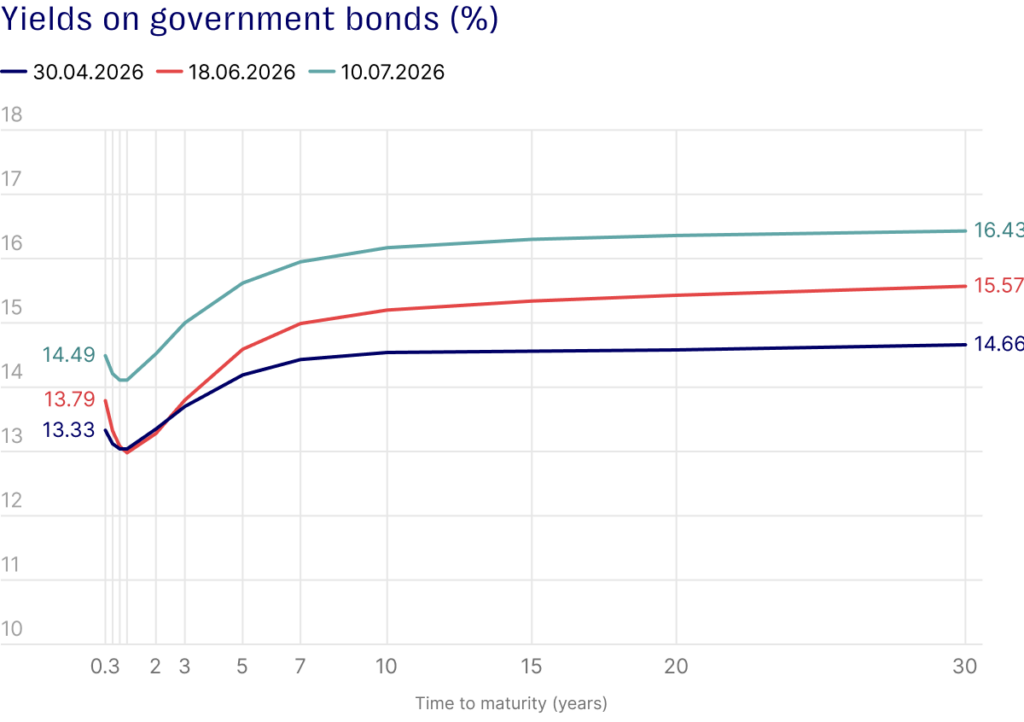
The decision triggered a sharp sell-off in the government bond market. The main Russian stock market index, the MOEX, fell by 3.5 per cent on the day the decision was made, and continued to decline gradually over the following two weeks. The resulting market volatility forced the Ministry of Finance to cancel the placement of federal loan bonds (OFZs) scheduled for 24 June. A week later, on 1 July, demand at the OFZ auction amounted to only one quarter of the volume offered by the Ministry of Finance, while the actual volume placed was just 10 per cent of the planned issuance. The Ministry of Finance subsequently cancelled the OFZ placement scheduled for 8 July.
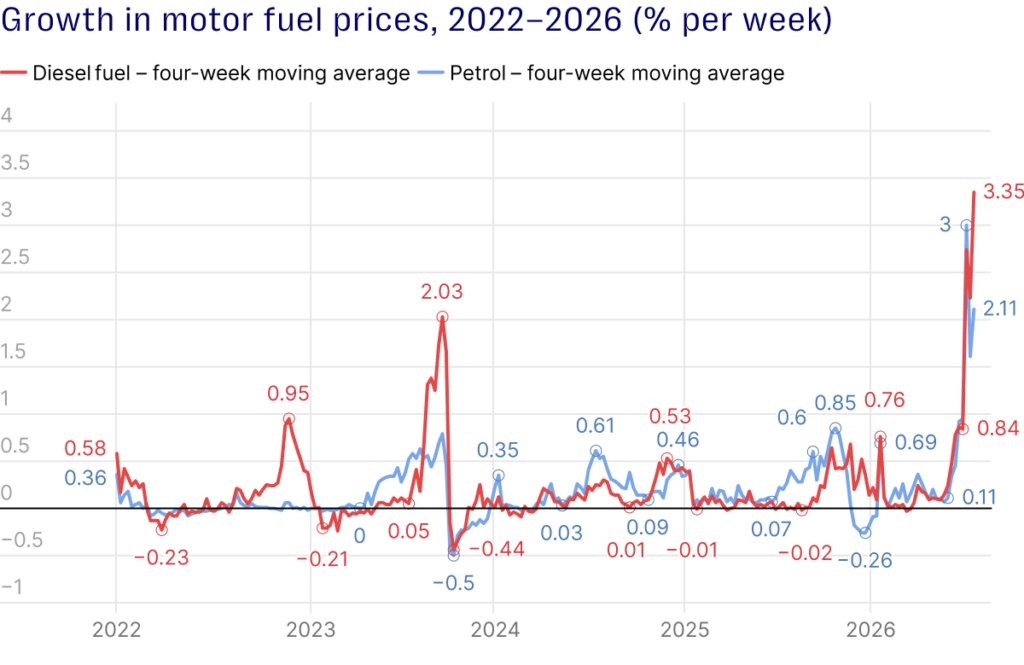
In June, a series of successful Ukrainian strikes on Russian oil refineries led to a petrol crisis (discussed in more detail below), resulting in a sharp increase in fuel prices. Over the course of the month, petrol prices rose by 6.9 per cent, while diesel prices increased by 7.5 per cent, together contributing 0.33 percentage points to monthly inflation. Overall inflation reached 0.87 per cent in June – the highest figure for that month since 2012. Given that there are very few grounds to expect the petrol crisis to ease or disappear, it can be stated with confidence that, at its meeting on 24 July, the Board of Directors of the Bank of Russia will find it difficult to justify even a minimal cut in the key interest rate.
The Budget: Temporary improvement and uncertain prospects
A potentially strong argument in favour of further monetary easing is the (possibly temporary) normalisation of the federal budget. In June, budget revenues exceeded expenditure, reducing the cumulative deficit since the beginning of the year from RUB 6 trillion to 5.7 trillion.
In June, the federal government's oil and gas revenues remained broadly in line with their May level (RUB 683 billion versus RUB 679 billion, or US$8.8 billion1), although the rouble-denominated tax price of oil was 9 per cent lower than in May.2 This apparent paradox has a straightforward explanation: the decline in mineral extraction tax (MET) revenues, which are linked to the oil price, was offset by a reduction in the reverse excise payment that the budget provides to oil refineries and which depends on the volume of petroleum product exports. Export volumes, in turn, declined following numerous successful Ukrainian strikes.
The calculated price of Russian export oil for June was around one quarter lower than in May – US$65.32 compared with US$85.62. However, in July, oil companies are due to pay the quarterly additional income tax (AIT), which is expected to generate RUB 350–400 billion in budget revenues. Overall, we expect the federal government's oil and gas revenues to reach RUB 1.05–1.1 trillion (around US$13 billion) in July.
Over the first six months of the year, oil and gas revenues totalled RUB 3.66 trillion. Including the expected July receipts, this figure will rise to around RUB 4.7 trillion, or just under 53 per cent of the annual budget target of RUB 8.9 trillion. Given that the period of high oil prices is now over and only one quarterly AIT payment remains (in October), we estimate that the shortfall in oil and gas revenues by the end of the year will amount to around RUB 1 trillion.
At the same time, during the second quarter the federal budget began to fully reflect the impact of the tax rate increases introduced at the beginning of the year, most notably in value added tax (VAT) receipts. In addition to the increase in the standard VAT rate from 20 per cent to 22 per cent, higher VAT revenues were driven by the expansion of the tax base and the uncovering of a large-scale tax evasion scheme.
There are grounds to believe that non-oil and gas revenues collected by the federal government will exceed the level set out in the budget law by around RUB 1 trillion, bringing total annual budget revenues broadly into line with the planned figure. At the same time, there is still no clarity regarding the level of federal budget expenditure this year, or, consequently, regarding the size of the planned budget deficit. The government has made no public comment on the situation. This, once again, is likely to make it more difficult for the Bank of Russia to justify a decision to cut the key interest rate at its meeting on 24 July.
We do not expect the first indications of amendments to this year’s budget to emerge before the end of August, when the government begins discussions on the parameters of next year's budget. Given that, by the middle of the year, the budget deficit exceeded the level set out in the budget law by around RUB 2 trillion, total expenditure for the year is likely to be increased by RUB 3–3.5 trillion. This increase will most likely be financed entirely through a larger budget deficit, which would bring the deficit to around 3 per cent of GDP.
Industry offers little cause for optimism
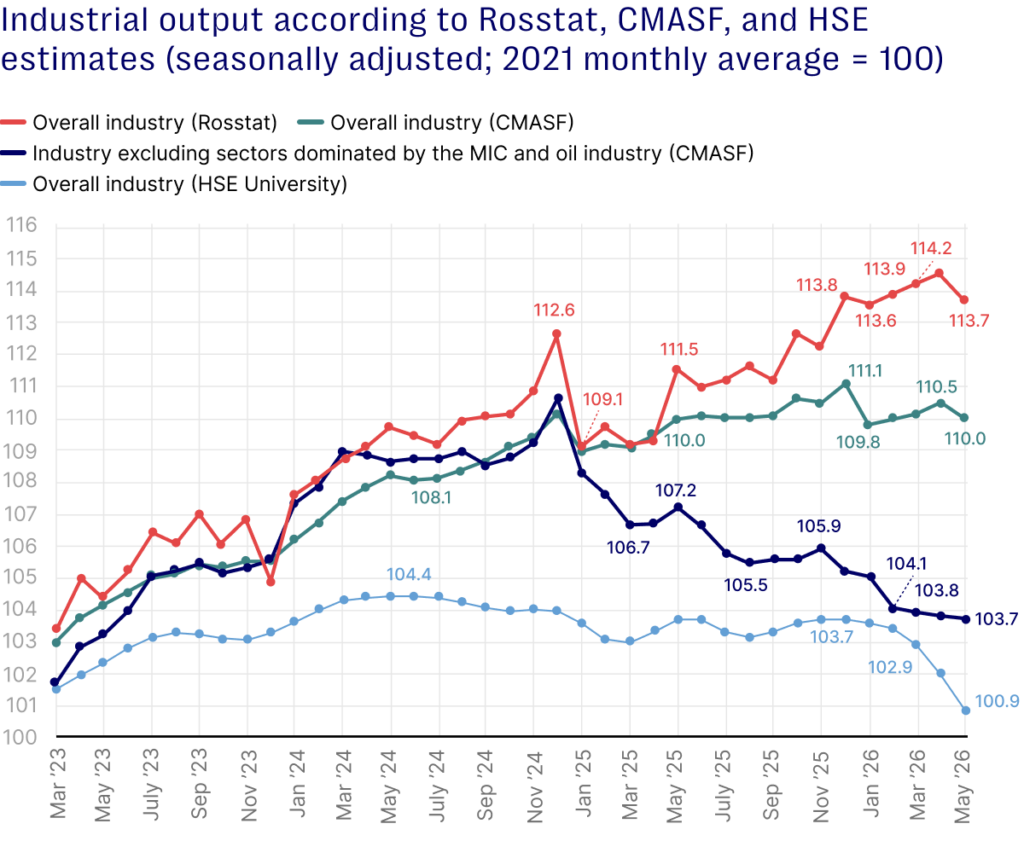
Rosstat's industrial production data for May once again received mixed assessments from analysts. Rosstat's official estimate put industrial output in May 2026 at 99.3 per cent of its level in May 2025. Analysts at the Centre for Macroeconomic Analysis and Short-Term Forecasting (CMASF) noted that the reported figure was affected by there having been one more working day than in the same month last year. After adjusting for this calendar effect, they estimated that Russian industrial output in May 2026 stood at 98.1 per cent of its level a year earlier.
Source: CMASF
Analysts at the HSE Development Centre, who traditionally produce estimates for civilian industry, estimate that the level of output in May this year was 96.8 per cent of the level in May 2025.
In addition to oil refining, which recorded a sharp decline in May, departures from recent trends can also be seen in the automotive industry, which is continuing its short-term rebound, and in the ferrous metallurgy sector, which is closely linked to vehicle manufacturing.
The debate over economic ‘overcooling’ continues
The continued, albeit gradual, decline in industrial output has triggered a new round of debate within the government's economic team over the risk of the economy overcooling (i.e. of a shortage of demand relative to productive capacity). However, despite warnings from the industrial and banking lobbies, which have been calling for faster cuts in the key interest rate, Elvira Nabiullina maintains that no such risk exists. The Bank of Russia's main argument – that economic overcooling should be reflected in rising unemployment, which has not been observed in Russia – does not appear convincing.
First, a recession does not mean that all sectors of the economy are contracting. Sectors that recorded a decline in the first quarter account for 44 per cent of total employment, while Russia's manufacturing industry (excluding defence enterprises) employs less than 10 per cent of the workforce.
Second, there is often an informal social contract between workers and the management of industrial enterprises, under which employees move to part-time work or take unpaid leave during periods of falling output. Employees have an incentive to accept such arrangements in order to preserve their social status: being unemployed is widely regarded as socially undesirable, and only 20 per cent of those whom Rosstat classifies as unemployed are registered with the employment service. Employers, in turn, ensure that they can quickly bring workers back if market conditions improve.
Since the Bank of Russia began its monetary tightening cycle in mid-2024, the number of employees working part-time has increased by around 200,000. Over the same period, the number of employees taking unpaid leave has risen by around 500,000. Together, these two groups amount to more than 40 per cent of the 1.6–1.7 million unemployed people recorded by Rosstat, a figure that has remained broadly stable.
The petrol crisis intensifies
Since the spring of 2026, Ukrainian drone and missile strikes on Russian oil refineries have intensified, and have begun to target crude oil distillation units. Damage to these units brings refining to a halt, and repairs have become much more time-consuming, especially since much of the equipment was imported from Europe and the United States. The output of Russian oil refineries fell by 11 per cent in April and by 15 per cent in May compared with the corresponding months of the previous year.
As a result, domestic consumption began to exceed production even after the government imposed a ban on petrol exports, and petrol inventories started to decline gradually, falling to 1.7 million tonnes by mid-June. Although the government uses indirect measures to limit increases in motor fuel prices, which have broadly risen in line with consumer price inflation since 2019, price rises accelerated sharply in June. Over the month as a whole, petrol prices increased by 6.9 per cent. This indicates that supply was falling behind demand. Many small petrol station chains began to close because they were unable to purchase petrol from the major oil companies, which themselves were struggling to maintain supplies to their own retail networks. Queues at petrol stations, with waiting times ranging from 30 minutes to two hours, became a common occurrence across many regions.
Source: Rosstat
In June, Ukrainian drones and missiles struck three major oil refineries in Moscow, Yaroslavl, and Omsk, which together process around 15 per cent of Russia's crude oil. According to expert estimates, oil refining volumes had fallen by around one quarter by mid-June, compared with June of the previous year. Rosstat's official data are expected to be released in the second half of July.
The hard landing of Russia's aviation hopes
In 2025, passenger traffic on Russian airlines declined by 2.5 per cent compared with 2024, the first such decrease since 2022. From January to May this year, Russian airlines carried 2.2 per cent fewer passengers than in the same period a year earlier. At the same time, the passenger load factor remained close to 90 per cent, while passenger turnover exceeded the previous year's level, reaching 106.57 billion passenger-kilometres. In other words, people did not fly less frequently and, on average, travelled longer distances. Analysts are unanimous in identifying the shortage of aircraft available to Russian airlines as the main reason for the decline in passenger traffic.
There have been almost no deliveries of new aircraft since 2022, meaning that Russia's commercial airliner fleet will continue to shrink this year and next year. The government maintains that the shortage of aircraft will be resolved through domestic production, relying on the serial manufacturing of the short-haul SJ-100 (‘Superjet’), the medium-haul MC-21, and the Il-114-300 regional turboprop.
These assurances were reiterated at a meeting on the development of the aviation industry chaired by Vladimir Putin on 24 June. Under the current aircraft industry development programme, serial production of all three aircraft types is scheduled to begin this year. By 2030, the programme envisages the production of 142 SJ-100 aircraft, 270 MC-21s, and 51 Il-114-300s. During the meeting, however, Putin acknowledged that the start of serial production would be delayed and that the programme, in its current form, would not be fulfilled.
Russian airlines' greatest hopes are undoubtedly pinned on the MC-21, which is intended to replace aircraft from the Airbus A320 and Boeing 737 families. However, this is the aircraft that has encountered the most serious difficulties, calling into question the success of the project as a whole.
The MC-21 originated in the early 2000s. In 2003, the project won a competition organised by the Russian Aviation and Space Agency (Rosaviakosmos). Under the original plans, detailed design work was to be completed in 2004–2005, with construction of the first prototype scheduled for 2005–2006. The aircraft was expected to make its maiden flight in 2006, with serial production due to begin in 2009. However, it soon became clear that no suitable engines were manufactured in Russia. This was followed by the global financial crisis of 2008, after which the United Aircraft Corporation (UAC) concentrated its efforts on the short-haul Superjet programme.
In early 2014, construction of the first MC-21-300 prototype began at the Irkutsk Aviation Plant. Two and a half years later, the new aircraft was officially unveiled, and a year after that, at the end of May 2017, the MC-21-300 completed its maiden flight. As there was still no suitable Russian aircraft engine, it was decided to equip the aircraft with PW1400G engines manufactured by the US company Pratt & Whitney. The aircraft was designed to carry up to 211 passengers over a range of up to 6,500 km. This exceeded the range of the baseline Airbus A320 and was comparable to the most advanced Boeing 737 models available at the time. Certification was expected to be completed by 2019, allowing serial production to begin.
This target was not met, and in 2020 the COVID-19 pandemic slowed down production and regulatory reviews, but by the end of 2021 all certification procedures had been completed, and the MC-21 received approval to enter service. Following Russia's full-scale invasion of Ukraine, however, the United Aircraft Corporation (UAC) was placed under sanctions. Pratt & Whitney withdrew from the project, leaving the aircraft without its planned engines. Other Western companies which had supplied components for the programme also ended their cooperation with UAC.
The sanctions regime halted deliveries of Airbus and Boeing aircraft, as well as spare parts for them, making the MC-21 project even more important. It was widely understood that it was only a matter of time before Russia's commercial aircraft fleet began to shrink.
Cooperation with China in aircraft manufacturing also failed to develop. A promising joint wide-body aircraft project foundered on China's unwillingness to manufacture aircraft in Russia for use by Chinese airlines. UAC, for its part, recognised that even if the aircraft were developed and manufactured in Russia, it would be impossible to sell it to third-country customers.
The collapse of the project also meant that UAC lost access to Chinese-made components, leaving the MC-21 programme completely reliant on import substitution. This required Russia to begin domestic production of composite materials and of more than 80 components and assemblies.
Three years later, at the end of May 2025, the first MC-21 with no imported components completed its maiden test flight. The aircraft then entered the certification programme, which requires a total of 220–230 certification flights. In early May 2026, Sergei Chemezov, the head of the state corporation Rostec, which owns UAC, announced that around one third of the certification flights had been completed. He also stated: ‘We will complete the entire certification programme in the first quarter of next year and begin serial production during the course of that year.’
However, import substitution came at a cost. The aircraft became almost six tonnes heavier, reducing its range by more than 40 per cent to around 3,800 km. This effectively turned the MC-21 from a medium-haul aircraft into a short-haul one comparable to the Superjet, which has a range of 3,500 km.
Import substitution has not only worsened the aircraft’s performance, but also made it more expensive. Under the original plan, the MC-21 had a list price of US$85 million, around 15–20 per cent lower than that of the Airbus A320 and Boeing 737. In early 2026, however, it emerged that the production cost of the MC-21 would be RUB 9 billion (around US$117 million) per aircraft, with manufacturers seeing no prospect of lower costs before 2030.
At the same time, Aeroflot, which has agreed to purchase 108 MC-21 aircraft by 2030, will pay RUB 3.6 billion for each aircraft. The difference between the sale price and the production cost will be covered by the federal government. The total cost of this subsidy is expected to amount to around US$7.5 billion. In addition, the government will have to guarantee UAC's profitability and cover the cost of interest payments on bank loans. The government's revised programme for the development of the aircraft industry envisages the production of 264 MC-21 aircraft, although the target date has now been postponed to 2035.