Shell game: The illusion of Russian import substitution
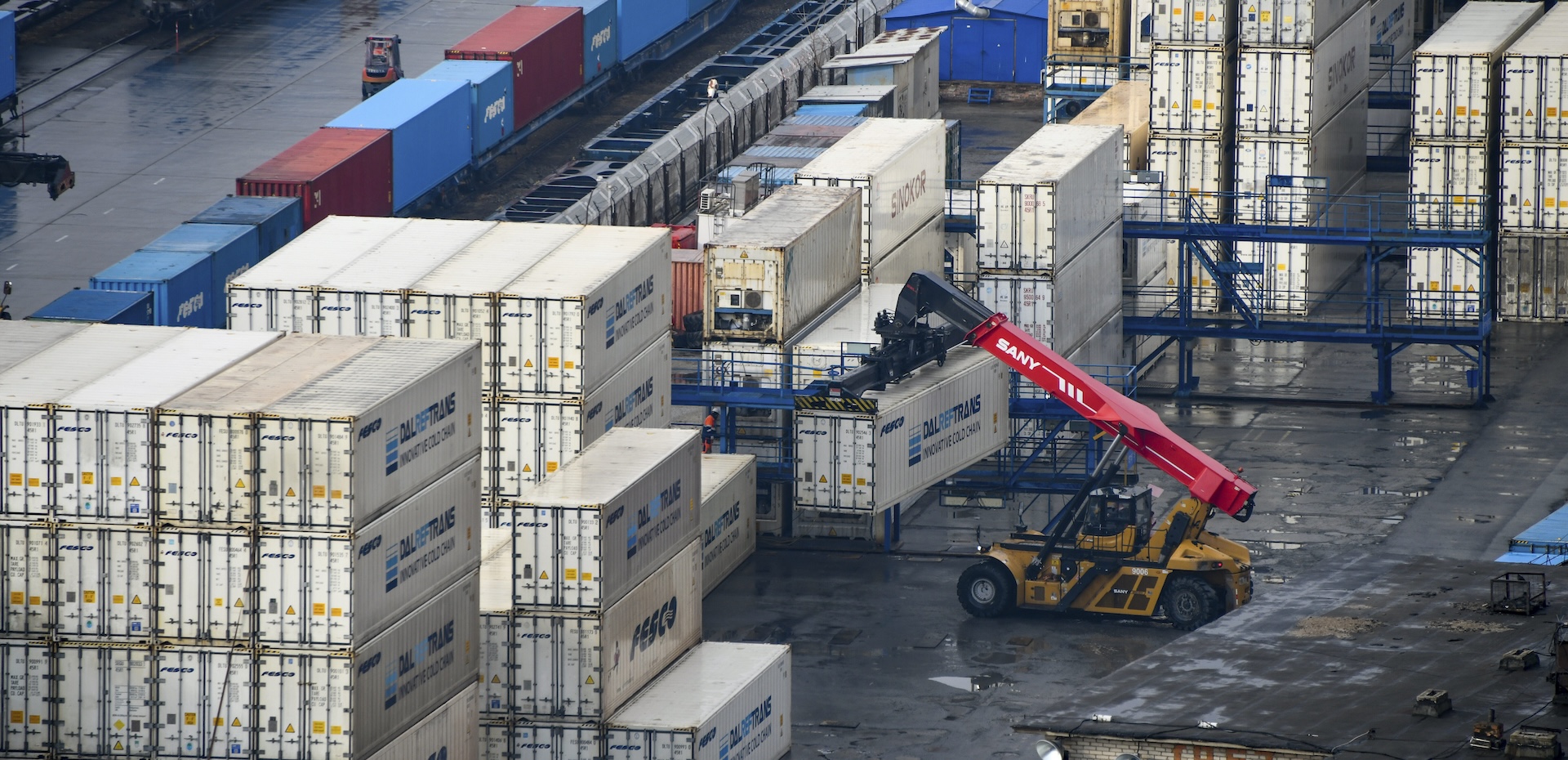
After the full-scale invasion of Ukraine and the introduction of Western sanctions, Russian businesses were able to replace many of their former suppliers, restructure logistics, and adapt to the new restrictions. This allowed the country to maintain its supply of imported goods. However, the Russian economy has not been able to significantly reduce its dependence on imports. Russia has learned to circumvent restrictions, but not to overcome its technological lag.
Parallel imports
In March 2022, a month after the start of the invasion of Ukraine, Russian Prime Minister Mikhail Mishustin signed a government decree which removed liability for importing foreign goods without the consent of the intellectual property rights holder. This decision introduced a mechanism known in Russia as parallel importation.1 ‘Amid external restrictions, this decision will help to ensure that goods in demand remain available on the domestic market and will make it possible to stabilise their prices,’ the Prime Minister explained.
Three weeks later, the Ministry of Industry and Trade approved a specific list of the brands and product categories of which parallel imports were allowed. It included consumer electronics, clothing, cars, spare parts, industrial equipment, computer equipment, and other goods without which Russian companies could not continue operating. This was a direct acknowledgement that many sectors of the economy and individual companies depend on imports.
At the time, from the perspective of the Russian authorities, allowing parallel importation appeared entirely rational. It was a way to keep the economy afloat after the mass departure of foreign companies from the Russian market. Parallel imports quickly became a significant part of Russia’s foreign trade. In 2022–2023, goods worth approximately $70 billion were imported into Russia under this scheme. In 2024, the average monthly volume was around $3 billion. Overall, in 2022–2024, parallel imports accounted for around 13 per cent of goods supplied to Russia.
Russian businesses built new logistics chains, in which a foreign manufacturer sells goods to an intermediary – a company registered in a friendly or neutral jurisdiction and formally unconnected to the Russian importer. The goods then pass through several countries, are repackaged, and sometimes have their export codes changed. Complex equipment is sometimes purchased in parts, imported through different countries under different codes, and reassembled in Russia. These arrangements rapidly developed from an emergency measure into a stable supply system. The Russian economy learned to obtain a significant share of the foreign goods it needs through unofficial channels.
At the same time, the Kremlin began to discuss the need for almost total import substitution: parallel imports provided time to develop domestic production, after which Russian-made products were expected to enter the market and the need for alternative sources of supply would disappear. Experts understood that alternatives for many product categories – such as modern processors and memory chips, automotive electronics, and specialised machine tools – could not emerge within a reasonable timeframe, due to the need for enormous investment, accumulated scientific and engineering capacity, and specialists capable of developing adequate equipment, technologies, and production facilities.
None of this was available to the Kremlin either in spring 2022 or in May 2026, when the government reduced the list of goods permitted for parallel importation for the ninth time.2 This time, computers and storage devices from more than twenty foreign brands, including Acer, Asus, Cisco, HP, IBM, Intel, Kingston, Samsung, and Toshiba, were removed from the list. But this does not mean that Russia has succeeded in developing and producing modern high-tech goods.
A question of packaging
On the one hand, the volume of parallel imports is declining. After exceeding $3 billion a month in 2022–2024, parallel imports worth $23.1 billion, or less than $2 billion a month, were imported into Russia in 2025. In the first half of 2026, this figure fell to $1.7 billion a month. Industry Minister Anton Alikhanov explained this as follows: ‘We are starting to produce many products in this country, and we are no longer interested in having this kind of uncompetitive parallel import mechanism.’ He added that there were no plans to abolish the scheme entirely for now, as the Ministry was ‘still interested’ in some items.
Overall import statistics do not confirm that the curtailment of parallel imports reflects a comparable reduction in dependence on foreign goods. According to the Federal Customs Service, imports of goods in 2025 amounted to $279 billion – 1.8 per cent below the level recorded in 2023–2024 ($285 billion and $283 billion, respectively). Parallel imports, by contrast, fell by one-third. This disparity reveals how Russia actually adapted: it did not begin producing domestic alternatives to imported goods, but changed its suppliers.
Before the war, in 2021, Europe and Asia accounted for broadly similar shares of Russia’s imports – around 46 per cent each. By 2023, Europe’s share had fallen to 27.5 per cent, while Asia’s had risen to 65.8 per cent. In 2025, this ratio remained virtually unchanged, at 25.9 per cent and 66.6 per cent, respectively. Thus, by 2023, Western suppliers had already been largely replaced by Asian suppliers, primarily Chinese ones.3 This rapid reorientation of trade became the main mechanism through which the economy adapted to the boycott of Russia by Western companies.
How, then, can Minister Alikhanov say that Russia has begun producing servers, computers, and data storage systems which qualify for inclusion in the register of domestic electronic products, and for preferential treatment in public procurement?
The point is that inclusion in this register does not require key components to be of Russian origin. For example, a server using an Intel or AMD processor can be recognised as Russian on the basis of installed software, the design of its casing, or the fact that its assembly or other technologically simple operations were carried out in Russia. All this allows a bureaucrat reporting to Putin to describe a server with a foreign processor, memory, and storage devices as a domestic product.4 Russia’s technological dependence does not disappear. It merely shifts into the final product, where it is no longer visible in the statistics.
Ultimately, the statistically significant decline in parallel imports says nothing about the success of import substitution. Restrictions on the use of the officially permitted parallel importation channel do not eliminate demand for foreign goods. They merely make the adaptation process more difficult and expensive.
The history of parallel imports illustrates a broader problem with Russian industrial policy. The government attempts to achieve economic results through administrative decisions. If a Russian product cannot compete successfully, imports are restricted. If equipment cannot be produced domestically, the assembly of foreign components is counted as domestic production. If overall imports do not decline, replacing a Western supplier with a Chinese one is counted as import substitution.