Trump in the Russian mirror: A year of shifting narratives
From early euphoria to open scepticism, Russian media coverage of Donald Trump oscillated throughout his second term. This analysis shows how Kremlin-aligned outlets used Trump’s words and actions to advance strategic narratives about Ukraine, Europe, and a changing global order – revealing more about Moscow than about Trump himself.
Introduction
When Donald Trump took the oath of office on 20 January 2025, Russian state media could barely contain its optimism. Putin congratulated the new president within hours, declaring Russia ‘open to dialogue’ on Ukraine. Within days, Trump announced he would call Putin directly – something his predecessor had refused to do for years.
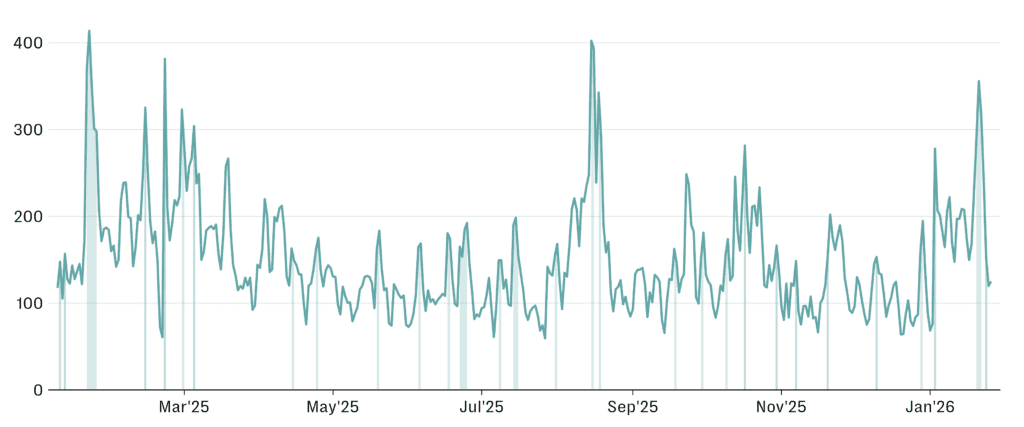
Twelve months later, that early euphoria has given way to something more complex. This analysis examines how Russian-language media – monitored systematically by the NEST Centre throughout 2025 and early 2026 – portrayed Donald Trump during the first year of his second term. As Figure 1 shows, media attention to Trump spiked repeatedly throughout the year, with 30 distinct episodes of elevated coverage. The tone of that coverage oscillated between adulation and contempt, tracking closely with whether Trump’s actions served Moscow’s interests on any given day. This pattern reveals less about Trump himself than about how the Kremlin calibrates its messaging to shape Russian and international audiences’ understanding of American power.
For Western policymakers, understanding this messaging is essential. Russian media does not simply report events – it frames them to advance strategic narratives about European weakness, Ukrainian illegitimacy, and the inevitability of a new world order in which Russia and America divide spheres of influence while Europe watches from the sidelines.
Trump’s Media Presence Index (MPI) in Russian-language media, January 2025 to January 2026
The honeymoon: Signals and symbolism
Trump’s inauguration generated the most intense Russian media coverage of the year. His 78 executive orders reversing Biden-era policies, his suspension of foreign aid, and his announcement that Zelensky was ‘ready for a deal’ were portrayed as a vindication of everything Moscow had argued for years.
But even in these early days, Russian commentators noted the gap between Trump’s rhetoric and reality. His campaign promise to end the war in ‘24 hours’ quietly became envoy Keith Kellogg’s 100-day deadline. Russian media observed this backtracking with pointed sarcasm – ‘how wonderfully 24 hours turned into 100 days’ – while maintaining a generally supportive tone.
The first Putin-Trump phone call in mid-February marked a genuine milestone. Russian markets gained half a trillion rubles on the news. Coverage celebrated the marginalisation of both Ukraine and Europe in what was portrayed as a return to great power politics. When Trump said he saw ‘no problem’ in negotiating with Russia without Zelensky present, Russian media framed this as appropriate recognition that Ukraine’s fate would be decided over its head.
Humiliation: Zelensky in the Oval Office
The late February confrontation between Trump and Zelensky in the Oval Office became the most gleefully covered episode of the year. Deputy Security Council Chairman Dmitry Medvedev set the tone, calling Zelensky a ‘cocaine clown’ who ‘got a slap from his masters’.
Russian media saturated audiences with images of Trump berating Zelensky on camera, the Ukrainian ambassador’s shocked expression, and Zelensky’s early departure without signing the planned minerals deal. When Finnish President Alexander Stubb observed that Putin had won ‘without even being present’, Russian outlets amplified this as Western acknowledgement of the obvious.
The coverage served a dual purpose: domestically, it validated the narrative that Ukraine’s Western backing was always conditional and transactional; internationally, it signalled to European audiences that American support could evaporate at any moment.
The dance: Phone calls and validation
Through spring and early summer 2025, a pattern emerged. Regular Putin-Trump phone calls – described by Russian sources as ‘meaningful’, ‘surprisingly sincere’, and ‘friendly’ – became occasions for celebrating the developing relationship between the two leaders.
In April, Trump declared the Ukraine conflict ‘Biden’s war’ and called a Russian strike on Sumy a ‘mistake’ rather than an atrocity, while blocking a G7 condemnation of it. Russian media portrayed this as Trump protecting Russia diplomatically.
In an April interview with Time magazine, Trump acknowledged that Crimea would ‘remain with Russia’ in any settlement and blamed Ukraine’s NATO aspirations for starting the conflict. Russian coverage treated this as a landmark Western concession – an American president accepting Russia’s core narrative about the war’s origins.
When Trump acknowledged Soviet sacrifices in World War II during a phone call with Putin, Russian media presented this as a historic gesture of respect – an American leader finally honouring Russia’s victory narrative.
The warmonger: Iran and the limits of ‘peacemaker’ Trump
The summer of 2025 brought an unexpected twist. In June, Trump’s attention shifted dramatically from Ukraine to Iran. He left the G7 summit early, missing a scheduled meeting with Zelensky, to issue a 24-hour ultimatum demanding Iran’s ‘unconditional surrender’. When US Air Force jets struck three Iranian nuclear facilities later that month, Russian media coverage turned sharply critical.
Medvedev led the charge, mocking the man who had styled himself a peacemaker: ‘Peacemaker Trump started a new war.’ Russian coverage questioned whether the strikes had actually penetrated Iran’s deep underground fortifications, and Medvedev hinted ominously that ‘[a] number of countries are ready to directly supply Iran with their own nuclear warheads’ in response. Trump’s alarmed reaction – acknowledging that ‘Putin is THE BOSS’ while Medvedev ‘loosely’ uses nuclear rhetoric – was widely circulated as evidence that the American president understood Russia’s hierarchy.
The Iran episode served multiple purposes in Russian framing. It undermined Trump’s peace credentials, demonstrated American aggression, and – perhaps most importantly – showed Ukraine being abandoned in favour of Middle Eastern priorities. Medvedev’s description of the G7 as a ‘dead club’ and European leaders as ‘dogs’ that Trump had ‘put in their place’ was amplified across Russian media.
Meanwhile, a spectacular public feud between Trump and Elon Musk provided entertainment value. When the two billionaires clashed over budget legislation, Medvedev sarcastically offered to mediate their reconciliation ‘for Starlink shares’. The episode reinforced a narrative of chaos and dysfunction at the heart of American power.
As summer progressed, tension between Washington and Moscow spiked again. When CNN leaked a 2024 audio recording of Trump boasting that he had threatened to ‘bomb Moscow’, Russian media mocked it as empty bravado – one commentator concluded that Putin and Xi must now realise that ‘Trump can be taken with bare hands’. In mid-July, Trump issued a 50-day ultimatum threatening 100% tariffs on Russia and its trading partners if no peace deal was reached. Medvedev dismissed it as ‘decorative’ – Russia, he said, ‘didn't even notice’. Later that month, after Trump dismissed the Russian and Indian economies as ‘dead’ on Truth Social, Medvedev played on the word by invoking the ‘Dead Hand’ – Russia's automated nuclear retaliation system. Trump responded the next day by announcing nuclear submarine deployments, calling Medvedev's statements ‘extremely provocative’. Yet even amid this hostility, preparations continued for a face-to-face summit.
The summit: Alaska as a symbolic victory
The August summit in Alaska represented the apex of Russian media’s supportive coverage. Putin arrived to a red carpet reception and Trump’s personal greeting, imagery that dominated Russian screens for days.
Trump’s post-summit comments were circulated relentlessly: his ‘10 out of 10’ rating of the meeting, his description of Putin as ‘strong and tough’, his acceptance of an invitation to visit Moscow. Medvedev declared that Russia and America had successfully shifted responsibility for peace to Kyiv and Europe.
That no concrete deal emerged mattered less than the symbolism. The summit was framed as the end of Russia’s diplomatic isolation – Putin had met the American president as an equal, discussed Ukraine’s future without Ukrainian participation, and extracted public validation of his standing as a world leader.
The pivot: From partner to ‘paper tiger’
The autumn brought a sharp shift in tone. In September, Trump authorised Ukrainian deep strikes inside Russia, called Putin a ‘paper tiger’, and dismissed Medvedev as ‘stupid’. Recounting the summer’s submarine deployment, he boasted that America was ‘25 years ahead of Russia and China’ in undersea warfare.
The Russian media’s response was swift and pointed. Coverage portrayed Trump's military boasts with scepticism, questioning whether his claims of American technological superiority were credible. The man who had been praised for his pragmatism was now depicted as an unreliable partner whose rhetoric Moscow should simply ignore.
Yet even during this period of heightened criticism, Russian media carefully distinguished between Trump’s rhetoric and his administration’s actual willingness to confront Russia. When Trump expressed frustration that Putin had ‘let him down’ on peace efforts, Peskov’s response was telling: ‘Trump’s emotionality is understandable.’ Russia positioned itself as the patient adult dealing with an emotional partner.
The autumn also revealed Russian anxieties about American influence in the post-Soviet space. When Trump hosted the leaders of Kazakhstan, Kyrgyzstan, Tajikistan, Turkmenistan, and Uzbekistan for a C5+1 summit in November, Russian coverage noted with evident discomfort the ‘sycophantic’ praise these leaders heaped on the American president. One Russian commentator observed sourly that Central Asian presidents were now ‘competing for Trump’s attention’ – attention that had traditionally been directed towards Moscow. The summit’s timing, amid the Ukraine standoff, underscored Russia’s fear of losing influence in the post-Soviet space.
Later that month, Trump unveiled a 28-point peace plan for Ukraine, drafted by special envoy Steve Witkoff, Vice President Vance, Secretary of State Rubio, and Trump’s son-in-law Jared Kushner. Russian media framed the proposal as Zelensky's ‘unconditional capitulation’ – a document that would end the war on terms favourable to Moscow. Coverage emphasised that Zelensky now faced a choice between accepting humiliating terms or losing American support entirely. When Russian Foreign Minister Sergei Lavrov addressed the Russian Senate in December, he called Trump ‘the only Western leader who understands why the Ukraine war was inevitable’ – even while noting that Trump was actually increasing sanctions rather than lifting them. The statement captured the Russian media’s ambivalent framing: Trump as both partner and adversary, useful and frustrating, constrained by forces beyond his control yet still the best hope for a deal Moscow could accept.
The interventionist: Venezuela and beyond
Trump’s January 2026 military operation in Venezuela – capturing President Maduro in under 30 minutes – generated a major spike in Russian media attention. The coverage was notably conflicted.
On one hand, the operation’s efficiency prompted uncomfortable comparisons to Russia’s own 2022 approach in Ukraine. ‘If only Russia had captured Zelensky’ became a theme among military bloggers. On the other hand, Trump’s boast that the Russia-Ukraine war was ‘primitive’ compared to American capabilities caused genuine offence.
The Venezuela operation exposed Russia’s relative weakness. Putin’s muted response to the abduction of an ally signalled to Russian audiences – and to the world – that Moscow lacked both the capability and the will to protect partners from American military action.
The new order: The Board of Peace and European fractures
By late January 2026, Russian media coverage had settled into a new equilibrium. Trump’s Board of Peace initiative – with its invitation to Putin and implicit threat to isolate Zelensky – was portrayed positively as the emergence of a new international framework outside traditional Western institutions. In a revealing slip, Lavrov noted that American proposals referred to rights for national minorities ‘in what remains of Ukraine’ – a phrase that laid bare Russian expectations about the war’s endgame.
The humiliation of French President Macron, whose private messages Trump published before threatening 200% tariffs on French wine, was celebrated as evidence of European impotence. When four post-Soviet leaders – Lukashenko, Tokayev, Pashinian, and Mirziyoyev – accepted invitations to join the Board of Peace while Zelensky hesitated, Russian media framed this as the natural order reasserting itself.
Trump’s territorial ambitions towards Greenland and Canada, his tariff threats, and his AI-generated maps showing an expanded American sphere of influence were covered with a mixture of mockery and recognition. When Trump claimed that Russian and Chinese warships threatened Greenland, Russian analysts identified a familiar playbook: create a threat, then offer protection.
What Russian media tells us
The year’s coverage reveals several patterns Western policymakers should note.
First, Russian media support for Trump is entirely conditional. Coverage turns positive when Trump undermines Ukraine, marginalises Europe, or validates Russian narratives about NATO expansion and Western hypocrisy. It turns critical when Trump threatens Russia directly, boasts about American military superiority, or takes actions that expose Russian weakness.
Second, Europe is the consistent loser in Russian framing. From the inauguration to the creation of the Board of Peace, coverage emphasised European irrelevance, desperation, and abandonment. This narrative serves Russian interests regardless of what Trump actually does, by encouraging European hedging against America rather than coordination against Russia.
Third, Ukraine’s position is systematically undermined. Zelensky is portrayed as illegitimate, desperate, and negotiating from weakness. Every Trump-Zelensky interaction is framed as humiliation; every Trump-Putin interaction as validation of Russia’s standing.
Fourth, Trump himself is portrayed as unpredictable but useful. His inconsistency – praising Putin one month, calling him a ‘paper tiger’ the next – is presented not as policy chaos but as evidence that Trump’s heart is in the right place even when domestic constraints force him to act against Russia. This framing preserves the narrative that a Trump-Putin understanding remains possible while explaining away any actions that contradict it.
For Western decision-makers, the lesson is clear: Russian media coverage of Trump is not journalism but strategic communication. Its purpose is to shape perceptions – in Russia, in Europe, and in Ukraine – in ways that advance Moscow’s interests. Understanding the pattern allows for better anticipation of how the Kremlin will frame future developments, and better preparation for the narratives that will follow.
Appendix: Methodology
The media monitoring system
This analysis draws on the NEST Centre’s media monitoring system, which processes approximately 700,000 documents per day in eight languages in near-real time from a wide range of sources. Particular emphasis is placed on platforms central to public discourse in Russia, including Telegram, VK, Odnoklassniki, and Dzen. The system also captures content from globally relevant platforms such as X, Threads, BlueSky, Medium, Substack, and YouTube. This ensures broad visibility into both official and grassroots narratives.
For this analysis, we focused exclusively on Russian-language content, which makes up over 70% of the media stream processed by the system. Because Russian media operates within a highly centralised and state-controlled information environment, coverage patterns offer insights into how political figures are framed for domestic Russian audiences, as well as for large Russian-speaking populations in neighbouring post-Soviet states.
Measuring media presence
The Media Presence Index (MPI) is a metric developed by NEST Centre to measure how frequently and prominently an individual appears in the media each day. The index combines two main factors: the scale of each media story (how many articles about the same event are grouped together) and the salience of the person within that story (whether they are central to the narrative or merely mentioned in passing). These factors are then normalised by the total volume of media coverage on a given day, providing a measure that is comparable across different dates. The MPI is a unitless metric: the higher the value, the greater the number of salient stories featuring the person and the broader their coverage.
Identifying periods of elevated attention
Media coverage of political figures tends to alternate between periods of routine, day-to-day reporting and periods of unusually high interest – a pattern we observe across many of the politicians we monitor. To capture this dynamic, we applied a Hidden Markov Model that identifies two distinct regimes: baseline and elevated. The model learns these regimes from the data itself, rather than relying on arbitrary thresholds.
An episode is defined as a continuous period during which the MPI significantly exceeded expected levels for its regime – specifically, when it rose above the mean plus one standard deviation, a threshold we find works well for identifying practically meaningful surges in media attention. For each episode, we collected the top stories driving coverage on every day that exceeded this threshold. Some episodes consisted of a single day; others spanned several consecutive days of elevated attention. This approach ensured that we captured the full arc of media interest, from initial trigger through peak coverage to declining attention.
Over the analysis period (January 2025 to January 2026), we identified 30 distinct episodes of elevated attention to Trump in Russian-language media (see Figure 1). For each episode, we collected representative documents from the top stories and analysed their content to identify main events, dominant narratives, tone, and notable voices quoted.
Limitations
This analysis focuses on volume and framing of coverage rather than audience reach or engagement. Not all documents in the monitoring system receive equal attention from readers, and the prominence of a story in our data does not necessarily correspond to its impact on public opinion. Additionally, while the monitoring system captures a broad range of sources, it may not include all relevant outlets, particularly smaller regional media organisations or private messaging channels.
We did not distinguish between different categories of sources, such as pro-Kremlin or independent media. However, given the extremely tight control of the media space in Russia and the comparatively small audiences of remaining independent outlets, our analysis primarily reflects the pro-Kremlin point of view. The narratives we found to be dominant in the coverage, in fact, confirm this.