Urbicide: Russia’s campaign against Ukrainian cities threatens to draw Europe deeper into the war
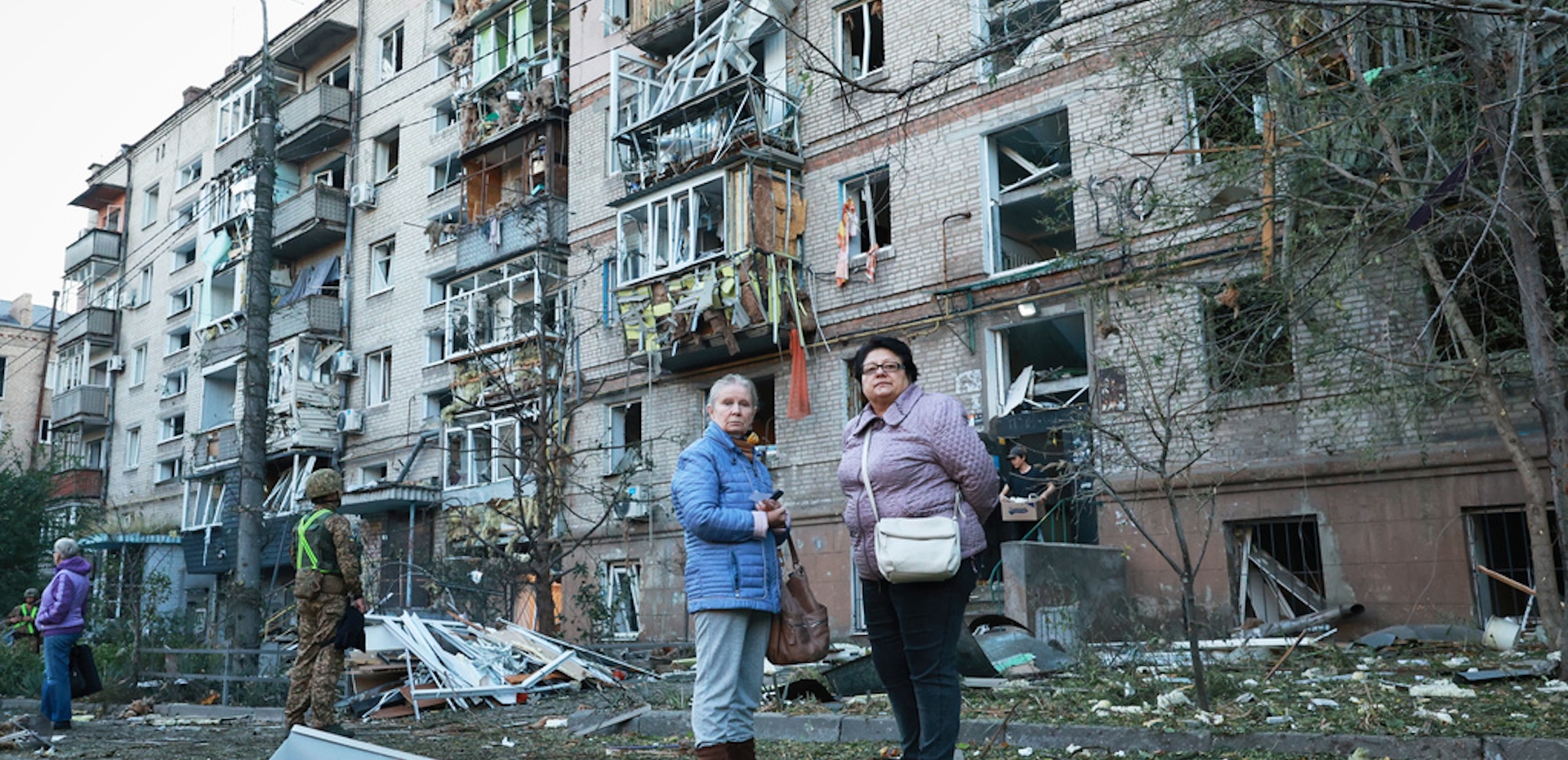
The Kremlin plans to systematically destroy Ukraine’s energy system and urban infrastructure. This intensification of violence faces no significant opposition either from the Russian public, which wants a swift victory, or from the elite, whose radical wing is pushing for further escalation. Unless Ukraine’s allies take active measures, the situation risks turning into a humanitarian catastrophe on Europe’s doorstep.
Citing intelligence reports, Ukrainian President Volodymyr Zelenskyy recently stated that Vladimir Putin had ordered the Russian armed forces to disregard the rules of war and actively target civilian infrastructure.
Since late September, Russian forces have intensified their strikes on Ukraine’s energy system. As a result, emergency power cuts and disruptions to electric public transport have occurred for the first time since spring. These were followed by the first strikes on bridges in Kyiv and Zaporizhzhia since the full-scale invasion began.
Russia’s Ministry of Defence makes no secret of its intention to intensify strikes on infrastructure, military targets, and military-industrial facilities. According to Ukraine’s Energy Minister Denys Shmyhal, Russia plans to completely disable the country’s energy system in three stages.
First, it intends to disrupt electricity imports from Europe by striking substations along Ukraine’s western borders. Second, it plans to disable hydroelectric power plants. Third, it intends to launch large-scale strikes on substations along power transmission lines connected to nuclear power plants.
The ultimate aim of this campaign is to cut off electricity, heating, and water supplies to major Ukrainian cities in order to trigger a humanitarian crisis.
'We are witnessing a shift from a war involving elements of terror to one in which terror could lead to a large-scale humanitarian catastrophe, whether deliberately or even unintentionally. For the Kremlin, escalation appears to be the only way out of the strategic deadlock on the battlefield, apart from compromise. Speaking at the Valdai Club, Putin stated quite openly that Russia has its own vulnerabilities, particularly when it comes to war with Europe, and that Russia would act asymmetrically in an attempt to compensate for these vulnerabilities – primarily by inflicting unacceptable damage on Ukraine’s economy and devastating its major cities.'

Vladimir Pastukhov
Research Director
This intensification of violence is accompanied by ambiguous statements from Vladimir Putin, who does not rule out the possibility of ‘peaceful coexistence’ with Europe, but at the same time threatens to use all types of weapons, including nuclear weapons, if Russian territory comes under threat. Some representatives of the Russian elite take an even more radical position, calling for an ultimatum to Europe: continued support for Ukraine will provoke a Russian attack.
'There is a political dichotomy in the rhetoric of the Kremlin and figures close to it. On the one hand, they call for sharp escalation, including nuclear strikes against Ukraine and the West. On the other, they urge maximum caution and restraint to avoid sliding into a major war.'
Nikolai Petrov
Senior Research Fellow
The intensification of strikes on Ukraine does not run counter to attitudes in Russian society: if a swift peace on Russia’s terms cannot be achieved, more than half of Russians would choose to intensify strikes on Ukraine. At the same time, three-quarters of Russians believe that the war has negatively affected the economy, and two-thirds want it to end as soon as possible and are open to peace negotiations, but without territorial concessions by Russia. Only a third would support a peace agreement that returned captured territory to Ukraine.
'Russians are waiting for the war to end, but this expectation does not translate into a willingness to make concessions or compromises. The issue is less that society shares the authorities’ brutality than the fact that it is excessively pragmatic and shows a lack of empathy. People are more concerned about their own problems than the suffering of others. So, the public wants the war to end quickly, through force. If the Kremlin thinks it should take this public mood into account, it encourages the escalation of military operations against Ukraine, even at the cost of heavy casualties and widespread destruction – in pursuit of a swift victory on its own terms.'
Ella Paneyakh
Head of Sociology
The main risk of this phase of the war is a large-scale humanitarian catastrophe on the EU’s borders. If strikes on energy infrastructure continue at the current pace, Ukrainian cities will face rolling blackouts and emergency cuts to electricity, heating, and water supplies. The UN has already warned that millions face ‘darkness and extreme cold’, and described the strikes as having reached a ‘new, horrifying level’. The destruction of urban infrastructure risks increasing the number of casualties and triggering the flight of a new wave of refugees to Europe, while the scale of the humanitarian crisis could force Ukraine’s allies to significantly expand their involvement in its defence.