War inside Russia: Repression as a pillar of the Putin regime
Repression in Russia is not an exceptional instrument used only in response to acute threats. It is a structural feature of the Putin regime, embedded in its political architecture and increasingly central to the system's functioning. This research paper by Nikolai Petrov and co-authors analyses the character, scope, and evolution of repressive practices in 2024–2025, examining their use against both ordinary citizens and the administrative elite. The analysis forms part of a broader NEST Centre project examining the transformation of Russia’s political regime, and complements previously published works, including Power and Society in Russia and Transition without a Successor. Its central argument is clear: as long as the regime persists in its current form, repression is likely to intensify.
Repression against society: Arbitrariness over consistency
The data on political prosecutions in 2024–2025 may appear to suggest stabilisation. The number of new political cases declined from 829 in 2024 to 613 in 2025. This, however, captures only part of the picture. The regime has shifted its repressive approach towards the more arbitrary punishment of a wider range of behaviour.
New legislation has significantly expanded the definition of illegal activity, making the initiation of cases increasingly discretionary. The passage of cases through the courts has accelerated, sentences have become harsher, and extrajudicial mechanisms, such as inclusion in registers of ‘foreign agents’, ‘extremists’, and ‘undesirable organisations’, impose serious limitations on rights without the need for a criminal conviction.
The targeting logic has also evolved. Having neutralised much of the organised political opposition, the authorities have turned their attention to lawyers, scholars, human rights defenders, environmental activists, journalists, bloggers, members of the LGBT community, advocates for indigenous peoples, and religious minorities. The concept of ‘extremism’ has been expanded far beyond its original meaning, becoming a flexible instrument that can be applied to a wide range of dissenting or non-conforming behaviour.
The cumulative effect is a society in which people are increasingly reluctant to express their views openly, even within narrow circles. This appears to correspond to the Kremlin’s broader objective. The goal is not political mobilisation in support of the regime, but the absence of resistance.
Repression against the elite: The defining feature of the current period
If repression against society was the defining feature of 2022–2023, repression against the administrative and business elite has become one of the defining features of 2024–2025. The authors recorded 142 publicly known cases of repression against senior officials and business figures during this period.
Data on publicly recorded cases of criminal prosecution of senior federal and regional officials and business figures in 2024–2025
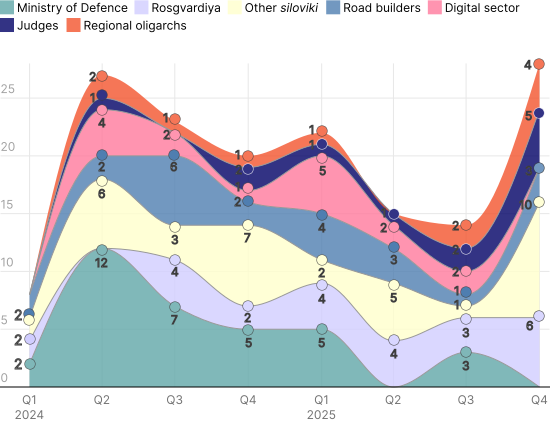
Source: NEST Centre
Across most elite categories, including regional authorities, regional heads of federal organisations, and major business figures, the rate of repression stands at approximately 2–4 per cent annually. The report compares this with the average rate of Stalinist repression against the equivalent tier of the Soviet elite, excluding the peak years of the Great Terror in 1937–1938.
Several distinct patterns have emerged. ‘Two-stage repression’, in which officials are first reassigned and later arrested, allows the Kremlin to punish individuals while avoiding direct public acknowledgement of the underlying political motives. Accelerated asset confiscation through civil proceedings, often completed in one or two court hearings and without a criminal conviction, has become a widespread instrument of property redistribution. These measures target not only officials themselves, but also their relatives, associates, and business networks.
Former officials are increasingly targeted long after leaving office. Judges, previously protected by institutional inertia and the norm against the targeting of the judiciary, are now subject to active repression, particularly in the North Caucasus, Krasnodar Krai, Rostov Region, and other regional clusters where judicial, administrative, and business interests have long been intertwined.
Elite repression performs several functions. It disciplines and intimidates through constant uncertainty. It redistributes assets from those who have accumulated excessive autonomy towards actors more closely aligned with the Kremlin. It manages intra-elite competition and balances clan interests. It also serves as a form of ‘political anaesthesia’, helping to prevent unauthorised elite activity during a period of war, speculation over the succession, and internal reconfiguration of the regime.
The repressive machine
Russia’s repressive apparatus is extensive, but it should not be understood as a single autonomous actor. It is a distributed system involving the Federal Security Service (FSB), the Investigative Committee, courts, prosecutors’ offices, police agencies, the penitentiary system, regulators, and auxiliary administrative bodies. The presidential administration sets political priorities and authorises high-profile cases, while security and law enforcement agencies implement them through a coordinated division of labour.
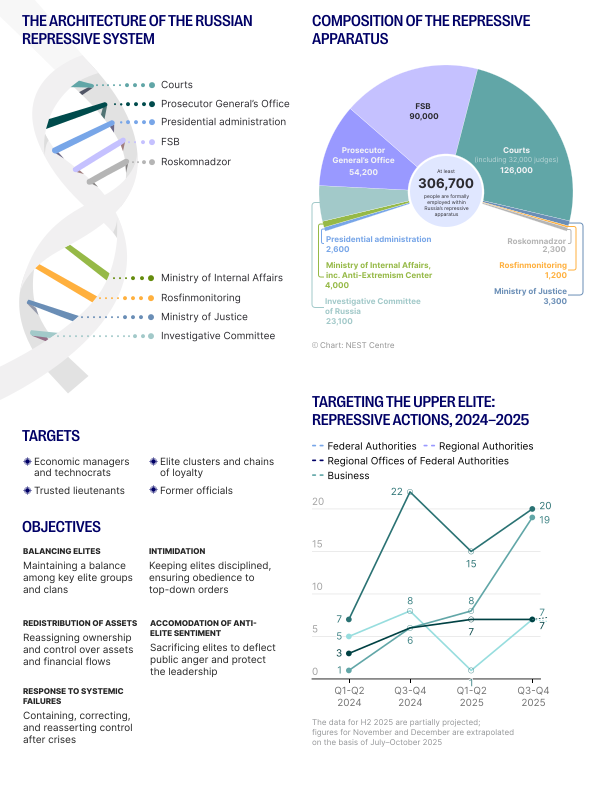
The FSB plays the central operational role, with its dominance over the Ministry of Internal Affairs firmly established since the mid-2010s. Yet the system is not self-directing. It remains a calibrated instrument of Kremlin policy, used to produce specific political outcomes: intimidation, discipline, the redistribution of resources, institutional restructuring, and the prevention of the emergence of autonomous centres of power.
The repressive apparatus is itself subject to repression. Investigators, police generals, prison officials, prosecutors, judges, and even FSB officers have faced prosecution. These cases reflect intra-elite struggles, asset-redistribution campaigns, and the Kremlin’s efforts to prevent any coercive institution or informal network from becoming too independent.
A system designed to escalate
All structural indicators point in the same direction. The 2026 budget increases spending on national security and law enforcement. New legislation continues to expand the scope of potential prosecution. Institutional changes within the security system suggest preparation for further escalation. The combination of a protracted war, mounting economic pressure, deepening confrontation with the West, and an anticipated generational transition within the ruling class creates conditions in which repression is likely to intensify further.
The Putin regime is not only using repression to respond to threats. It is investing in the infrastructure for repression on a greater scale. Repression has become a mechanism for governing society, disciplining elites, redistributing property, and maintaining regime cohesion under conditions of war and uncertainty.
Understanding this evolution is essential for assessing the future of Russia’s political system. Repression is not a temporary wartime excess, nor a set of isolated abuses. It is one of the pillars of regime stability, shaping relations between the state and society, restructuring the elite, corroding institutions, and narrowing the space for political change.