Russia after four years of war
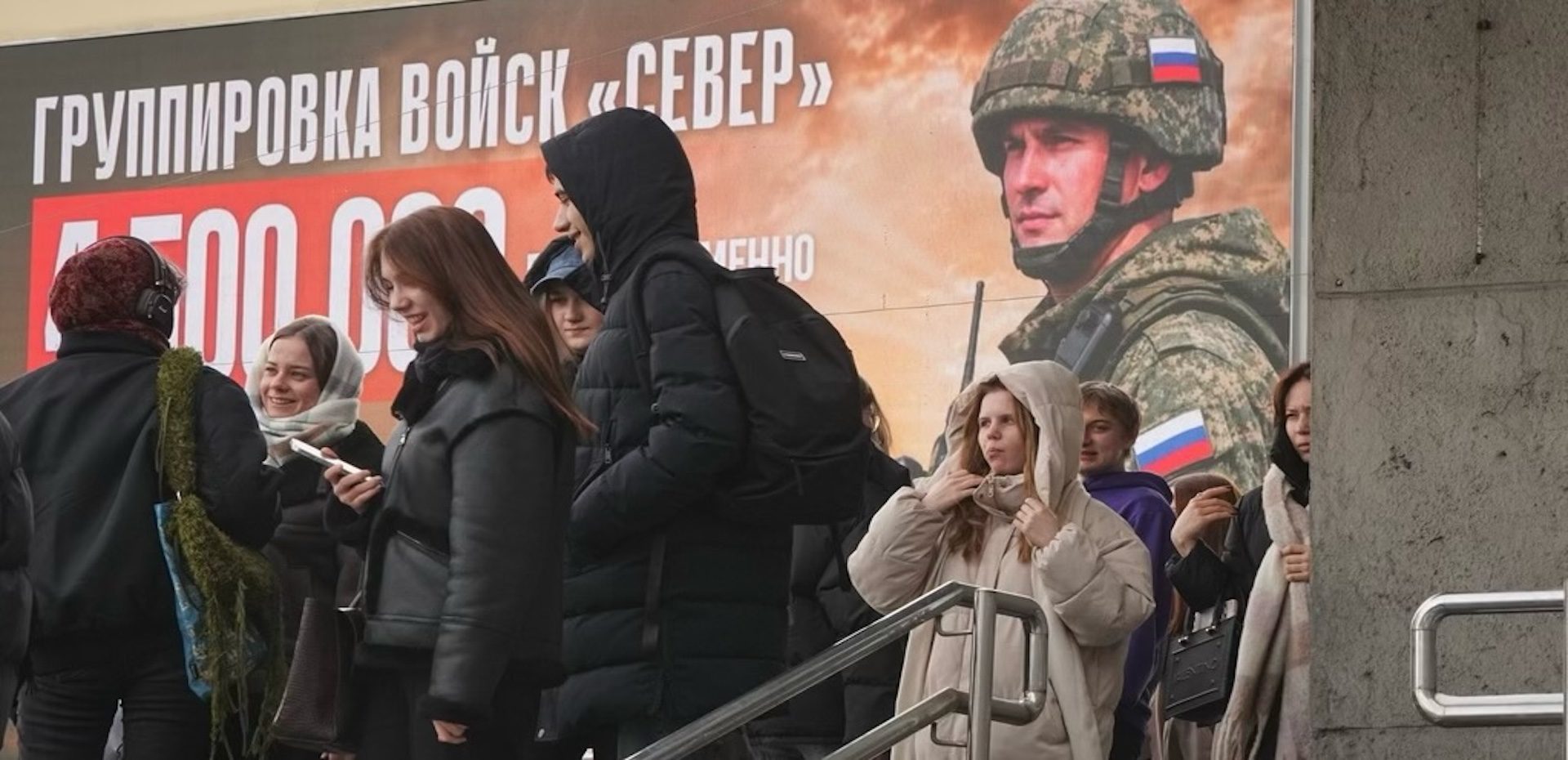
Four years of war against Ukraine have demonstrated that the Russian system is more resilient in the short and medium term than many expected. The elites and society have consolidated. Despite structural degradation, the economy continues to withstand pressure. The accumulating problems are gradually eroding the regime’s room for manoeuvre, yet they are regarded in the Kremlin as an acceptable price for achieving foreign policy objectives. Moscow is signalling readiness for a prolonged military-political confrontation with Europe, including activity in the ‘grey zone’ that balances on the brink of open war.
Overall assessment
Political regime
War and external pressure have consolidated the elite around the president, who has strengthened his position as the sole centre of decision-making. The bureaucracy and the security bloc have abandoned attempts to assert autonomy and have become elements of a single administrative mechanism. Regional elites are integrated into a unitary system of governance and deprived of opportunities for independent political manoeuvre.
The regime has become more personalist. Individuals personally loyal to Vladimir Putin, including members of his ‘extended family’, are being promoted, while former centres of influence and established clans have weakened. The president’s long-standing associates are gradually stepping aside. In the circle around the ageing autocrat, outwardly politically unambitious technocrats now dominate. Their significantly younger age constitutes an important asset and resource.
Combined with intensified repression, including against members of the elite, these changes reduce the space for forming political coalitions aimed at gaining power and significantly lower the likelihood of an intra-elite split – the principal risk for an authoritarian regime.
Society
Military mobilisation has altered the structure of Russian society. Increased military spending and labour shortages have raised incomes among groups with lower levels of education and pronounced conservative attitudes. These strata have become a key social base of support for the authorities.
At the same time, mechanisms of social control are intensifying. The digital space is narrowing, surveillance infrastructure is expanding, public-sector personnel screening is tightening, and the state's ideological presence in the education system is increasing.
Military priorities now serve as the organising principle of social policy and the education system. The state is expanding the redistribution of resources in favour of war participants and their families through direct cash payments and priority access to education, employment, and social services.
Meanwhile, a constituency of pro-war hardliners has emerged, including military correspondents and volunteer networks, some of whom criticise the conduct of the war and any signals of negotiations.
The Kremlin does not regard them or any other group as posing a systemic threat to the regime. However, it regularly employs targeted repressive measures for preventive purposes. This enables it to maintain discipline and guard against organised discontent without resorting to mass repression.
Economic stability
The Russian economy has proved significantly more resilient and adaptable than many experts assumed. In the first year of the war, the World Bank forecast a contraction of 8.9 per cent in Russia’s GDP, while the Bank of Russia projected a decline of 8–10 per cent. Contrary to these expectations, GDP fell by only 2.1 per cent in 2022, and in the following year it grew by 3.6 per cent.
This resilience rests on several factors: the market character of the economy, its commodity specialisation within the global system, which has been unable to replace Russian raw materials, and accumulated fiscal reserves.1 The ability of the Bank of Russia and the government’s economic bloc to maintain control over inflation and the exchange rate, and to preserve budget stability, also played an important role.
Although some Western sanctions dealt a tangible blow to the Russian economy at the outset of the war, many proved ineffective. Oil sanctions, for example, did not significantly affect oil production and exports, nor did they lead to a substantial decline in oil revenues.
Adaptation to sanctions has, however, been accompanied by structural simplification of the economy. The most vulnerable sectors have been those with high added value and extended technological chains. Production of civilian aircraft, automobiles, and complex machinery has declined markedly compared with the pre-war period.
For the Kremlin, such an economic model is acceptable. Issues of modernisation, technological development, and long-term investment programmes have been relegated to the background. The priority is the provision of military expenditure – a strategic task that is being fulfilled.
The fight against inflation, which has led to depression in non-military sectors of the economy and to GDP growth slowing to around 1 per cent per annum – effectively amounting to stagnation – is regarded as a necessary but temporary sacrifice. Optimism about an inevitable return to economic growth prevails within the government, although experts expect the recovery to be slow and unstable.
Dependence on China and reduced global influence
Confrontation with the West has compelled Moscow to accelerate its ‘pivot to the East’, thereby increasing Russia’s dependence on China. However, despite public statements about the formation of a new ‘axis of evil’, relations between the two countries remain transactional and asymmetric.
Russia’s global influence has diminished, but it has not been lost entirely. Moscow has suffered reputational losses in Syria, Iran, and Venezuela, and has weakened its positions in the post-Soviet space, including in the South Caucasus and Central Asia. However, from the Kremlin’s perspective, it retains sufficient resources that allow it at least partially to shift the balance of power in its favour.
What next?
Over four years of war, the Russian leadership has demonstrated readiness for a long-term confrontation with the West. Putin does not view either the continuation of hostilities in Ukraine or the growing military-political confrontation with Europe as a threat to the regime. On the contrary, the conflict allows the authorities to maintain elites and society in a state of a ‘besieged fortress’, rallying them around the flag and reducing the likelihood of internal splits and destabilisation.
The Kremlin considers the possibility of ending the war against Ukraine only as part of a broader bargain over a re-ordering of the international system. Such a deal would include agreements on various aspects of strategic nuclear weapons and on the Kremlin elite's position in the international arena.
At the same time, Moscow will intensify pressure in the ‘grey zone’ in Europe – from cyberattacks and sabotage to pressure on critical military and technological infrastructure in NATO member states, as well as nuclear blackmail. This does not mean that the Kremlin is prepared for a direct military clash with the alliance. However, the absence of Western resistance in the hybrid confrontation would allow it to move closer to its objective: the division and weakening of Europe.