Summary
- The Bank of Russia’s key rate has been cut again, but monetary policy remains extremely tight.
- The war economy continues to grow, while the civilian economy is stagnating.
- Russia’s Minister of Economic Development does not expect the economy to grow before next year.
- The successful implementation of the 2025 budget does not remove risks for 2026.
- The fiscal rule implemented by the Bank of Russia deprives the budget of revenues and reserves.
Key rate
The Board of Directors of the Bank of Russia has decided to lower the key rate from 16 per cent to 15.5 per cent.
The decision, taken at the meeting on 13 February 2026, was expected and understandable. Although macroeconomic data is sending mixed signals, inflationary pressure on the economy is easing. Moreover, the monetary authorities have stated that they are prepared to lower the rate further at the end of March.
Despite the rate cut, monetary policy remains tight and could be substantially eased if necessary. According to the Bank of Russia’s standards, the neutral rate today could be around 10–11 per cent. To prevent a potential acceleration of inflation, it would be sufficient for the Bank of Russia to keep the rate unchanged.
Economic growth
For three quarters of last year, the Russian economy stagnated, but the traditional December spurt strengthened the authorities’ optimism.
GDP growth of one per cent in 2025 was driven by manufacturing and the public sector. The combined contribution of all other sectors to GDP growth was close to zero.
In turn, manufacturing growth of 1.3 per cent was driven by industries serving the armed forces. Other branches of manufacturing, taken together, recorded a decline.
This dynamic should not be surprising. After the strong fiscal impulse of 2022 and the first half of 2023, inflation in Russia began to rise rapidly. To contain it, the Bank of Russia – having delayed the decision to raise interest rates – had to increase them excessively in the second half of 2024. As a result, alongside the two factors that had already been restraining economic growth – sanctions and the reallocation of resources in favour of the war economy – interest rate pressure was added. This has led to the suppression of economic activity across many sectors.
We may say, Russia is currently going through the final phase of the economic cycle: downturn → fiscal stimulus → inflation → interest rate rises → downturn → disinflation → interest rate cuts → recovery and growth.
A question that concerns many, but to which nobody has an answer, is: how quickly will the Bank of Russia bring its rate down to the neutral level, and how quickly will the non-military part of the Russian economy react?
The Minister of Economic Development, Maksim Reshetnikov, believes that ‘a recovery in growth rates will take place at best at the end of 2026, but most likely in 2027’.
While we broadly agree with the minister’s forecast, it is worth adding that new factors may affect the economy’s dynamics over the course of the year. Above all, these include developments regarding oil production and exports, including price changes, as well as the state of the federal budget.
Budget
The 2025 federal budget was implemented without the traditional December surge in expenditures and with a significant increase in the deficit. Despite the increase in the VAT rate, budget implementation in 2026 will not be easier.
For the federal budget, the past year was, on the one hand, difficult. The sharp rouble’s appreciation at the beginning of the year led to a substantial shortfall in oil and gas revenues and in import-related revenues (VAT, excises, and customs duties), totalling 2.7 trillion roubles (≈$32 billion, or 1.25% of GDP).1
On the other hand, the increase in corporate profit tax and personal income tax rates from the beginning of the year, combined with the redistribution of receipts from these taxes (1.7 trillion roubles, or approximately $20 billion) from the regional to the federal level, significantly eased the pressure on the federal budget.
At the end of last year, the Ministry of Finance managed to restrain the traditional December spending surge, which was significantly smaller than in previous years. Had the dynamics of past years persisted, expenditures in December 2025 would have been two trillion roubles (≈$24 billion) higher.
By limiting spending, the Ministry of Finance kept the deficit within the parameters set by the budget law adjusted in the last spring. It amounted to 2.6 per cent of GDP and was almost 4.5 trillion roubles (≈$54 billion) higher than the target approved in autumn 2024 (0.5 per cent of GDP).
Continuing a restrained fiscal policy, the Russian authorities plan to reduce the federal budget deficit this year by two trillion roubles (0.85 per cent of GDP), mainly through an increase in the VAT rate. This measure is expected to generate 1.75 trillion roubles (≈$21 billion) in additional revenue.
However, as was the case a year earlier, the Ministry of Finance’s main problem is linked to hydrocarbon export revenues. In the first two months of 2026, the rouble price of Russian export oil2 was 42 per cent below the level assumed in budget calculations, resulting in a shortfall of 520 billion roubles (≈$6 billion). If this price level persists throughout the year, budget losses will amount to 3.6 trillion roubles (≈$43 billion), doubling the planned deficit.
In that case, under the law, the increase in the deficit must be financed by the National Wealth Fund (NWF) – the country’s fiscal reserve. As of 1 February 2026, its liquid share d amounted to 4.2 trillion roubles (approximately $50 billion, 1.9% of GDP). This means that, with current oil prices and the rouble exchange rate by the end of the year, the Russian government may have no more than a quarter of that amount left.3
An alternative source of deficit financing is domestic borrowing. However, lower interest rates will reduce investors’ appetite for government bonds, and the Ministry of Finance will require significant support from the Bank of Russia, which has become a routine practice. In December 2024, the Bank of Russia lent one trillion roubles to state-controlled banks to purchase state bonds; in November 2025, it lent 800 billion.
Rouble
Arrangements between the Ministry of Finance and the Bank of Russia regarding fiscal policy have led to an interesting paradox.
The appreciation of the rouble reduces budget revenues from oil and gas, forcing the Ministry of Finance to sell some of the National Wealth Fund’s gold and yuan holdings. The buyer of these assets is the Bank of Russia, which then sells foreign currency assets of equivalent value on the domestic market (so-called ‘mirror operations’), thereby strengthening the rouble.
The Bank of Russia is not obliged to sell foreign currency assets after the Ministry of Finance has used part of the NWF. It began conducting such operations on its own initiative in March 2020 and can stop them at any moment – as it did in 2022. At that time, following the introduction of sanctions against the Russian financial system, Russian companies had to rearrange their international settlement channels. The authorities, in turn, introduced numerous restrictions that effectively turned the rouble into a partially convertible currency.
From the beginning of 2023, the Bank of Russia resumed ‘mirror operations’. However, their volumes were volatile and did not appear to have a significant impact on the exchange rate. Since the end of 2024, the scale of these operations has been increasing. This has been linked to both the Ministry of Finance’s growing need to finance the budget deficit and the Bank of Russia’s decision to compensate for previously postponed sales.
Bank of Russia foreign currency sales (USD billion per month) and the average monthly USD exchange rate (rouble per USD), 2023–2026
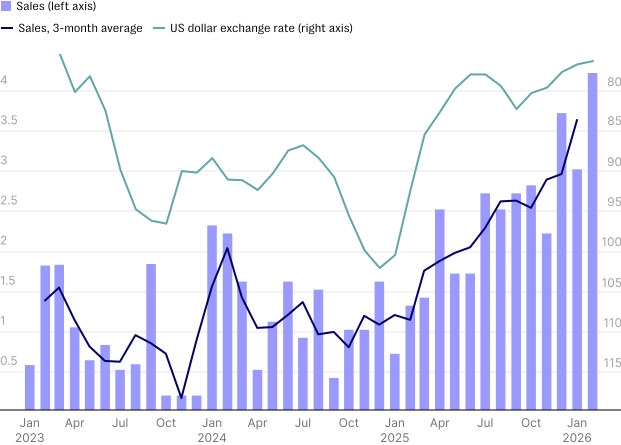
Whereas in 2023 and 2024 the Bank of Russia’s average monthly foreign currency sales amounted to $834 million and $1.32 billion, respectively, in 2025 they increased to $2.75 billion, and in January–February of the current year they reached $3.6 billion per month.
In 2024, the Bank of Russia’s foreign currency sales accounted for just over 12 per cent of the export revenue by the 29 largest Russian exporters; in 2025, this figure rose to 34 per cent.
Such an intensive supply of foreign currency by the Bank of Russia in a market where demand was declining – the average monthly volume of corporate foreign currency purchases on the open market fell by 17 per cent in 2025 compared with 2024 – became one of the main factors behind the rouble’s appreciation and the maintenance of its exchange rate at the current level. If the Bank of Russia does not change its policy, which implies monthly foreign currency sales of more than $4 billion at the current exchange rate, then, given seasonally low demand for foreign currency in the first half of the year, further appreciation of the rouble can be expected and, consequently, an increase in the likelihood of budget revenue shortfalls.
Endnotes
- The federal budget also received approximately 1.7 trillion roubles (≈$20 billion) less than planned because the actual price of Russian export oil was 15 per cent lower than the level assumed in the budget calculations ↩︎
- The rouble price of Russian export oil determines the rates of oil and gas taxes, which are calculated as the product of the export oil price and the rouble–US dollar exchange rate ↩︎
- Approximately half of the liquid portion of the National Wealth Fund is held in gold (just under 5 million ounces). If the global price of gold continues to rise, the rouble value of the Fund may increase ↩︎