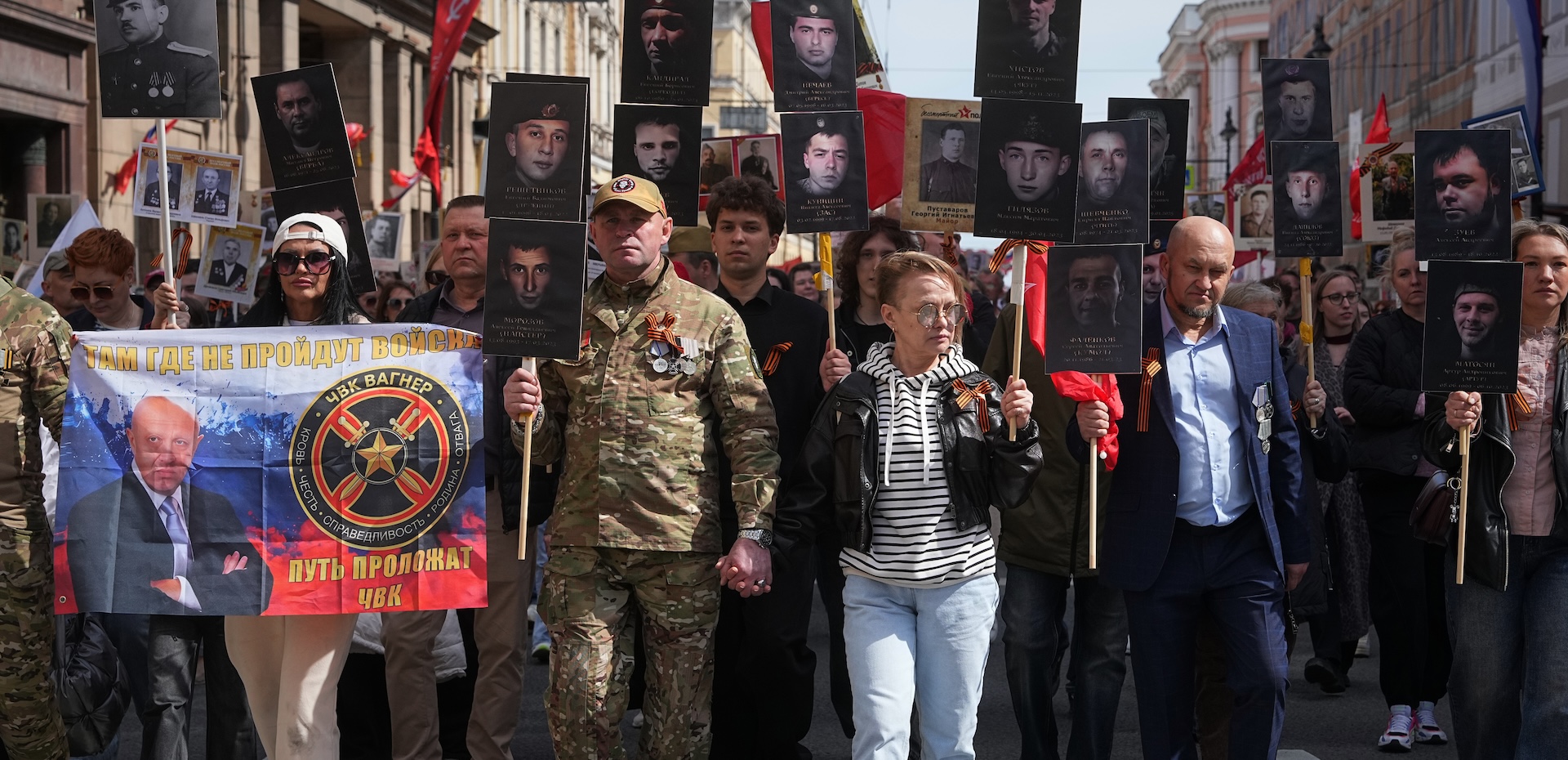
After the full-scale invasion of Ukraine, a group of consistent supporters of the war emerged in the form of the so-called Z community.1 Since the beginning of the war, its members have organised grassroots civic initiatives, such as fundraising campaigns to support the needs of the front. Over time, they have become the largest and most active ideological camp in Russia. Together with their passive supporters, they may account for up to one third of the population.
The Z community is well organised, with strong horizontal ties between its members, and has considerable potential for political mobilisation. It has its own media outlets, as well as contacts within state institutions and with units at the front. Members of the group have become increasingly critical of the authorities, who have responded with either silence or repression. At present, the Z community does not pose a serious threat to the regime, partly because of its conservative views. However, the situation could change if, for example, a strong leader were to emerge who was prepared to offer an attractive and ideologically acceptable alternative.
Summary
- After the full-scale invasion of Ukraine, a group of consistent supporters of the war emerged in the form of the so-called Z community. According to various estimates, this group of militarists may account in total for up to 30 per cent of the population.
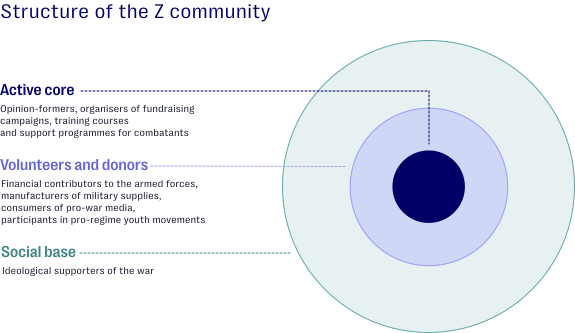
- This group consists of three parts. 1. Activists, organisers of fundraising campaigns and equipment deliveries for the front, and war correspondents – the core of the Z community where its activity is centred. 2. Voluntary donors to the needs of the front, participants in initiatives to assist with the war effort, and consumers of pro-war content. Together with the core, they make up an active and engaged militarist network. 3. A passive majority identified through public opinion surveys. This group constitutes the social base of the Z community. It supports continuing the war ‘until victory’, views the situation as an existential confrontation with the West, and approves of military and economic mobilisation, as well as political repression.
- The Z community is atomised and politically inactive. However, it provides the social base for the only segment of civil society whose development the Kremlin permits – the network of pro-war activists and volunteers. By the fifth year of the war, this network had attained a high level of self-organisation and significant potential for political mobilisation. The Z community has its own media outlets and connections within state institutions, including the security services and the armed forces, to whom they provide vital assistance.
- The Z community’s main online platform is Telegram. The messaging app is used to disseminate information about the situation at the front, raise donations for the military, and promote the group’s political narratives. The authorities’ attempts to block Telegram in early 2026 placed the Z community in conflict with the authorities, a situation that runs counter to the group’s goals.
- Members of the core of the Z community are personally immersed in the realities of the war through their direct links with units at the front. They are aware of the mistakes made by the Russian leadership and criticise them openly. In 2026, their rhetoric became noticeably more confrontational, including direct accusations against the military leadership and open expressions of disappointment with President Putin’s actions.
- Despite this dissatisfaction, the Z community is not yet ready to turn against the regime. This is partly due to the conservative and statist views held by most of its members, including their rejection of ‘Western’ democratic mechanisms such as contested elections and street protests.
- The situation could change if, for example, a strong leader were to emerge who offered the community an attractive alternative within the same ideological paradigm.
Scale, composition, and social base
The following overlapping groups can be identified within the Z community:
Active core
- Opinion-formers: war correspondents (voenkory), pro-Kremlin journalists, and bloggers.
- Organisers of fundraising campaigns and equipment deliveries for the front, training courses in tactical medicine and drone operation, and programmes providing rehabilitation for combatants and support for their families.
- Activists in volunteer and youth movements.
Volunteers and donors
- Voluntary donors who support the needs of the armed forces, producers of military equipment and supplies (for example, drones and camouflage nets), and the active audience of pro-war media.2
- Employees of state-funded institutions and members of the security services who interact with the ‘patriotic public’.3
- Participants in pro-regime youth movements such as the nationalist ‘Russian Community’ and the ‘Movement of the First’ youth organisation, as well as those drawn into these movements through their children.
Social base – ideological supporters of the war
The active and engaged segment of the Z community rests on a broader social base which is identified primarily through public opinion surveys. This group consists of ideological supporters of the war and committed militarists. They support continuing the war ‘until victory’ and may also favour expanding it beyond Ukraine. They view the conflict as an existential confrontation with the West. They approve of military and economic mobilisation and repression against dissenters, including not only opponents of the regime but also so-called ‘conformists’ who are unwilling to make sacrifices. They accept the possibility of close relatives taking part in the fighting. They maintain these views even when they diverge from official rhetoric. They consider themselves underrepresented in politics.
Estimated size
According to our assessment, based on both publicly available and non-public survey data, Russian society can be divided into the following groups in terms of attitudes towards the war:
- 12–25 per cent – opponents of the war (a demoralised anti-war minority).
- 20–30 per cent – supporters of the war (a consolidated pro-war minority).
- 45–60 per cent – a conformist majority that is indifferent to the war.
The independent research project ‘Chronicles’ provides the lowest estimate of support for the war. According to its November 2025 survey, consistent supporters of the war accounted for 14 per cent of respondents (down from 18 per cent in February 2025).4 At the same time, 35 per cent opposed withdrawing Russian forces from Ukraine without achieving the ‘goals of the special military operation’ (SMO). In 2024, 33 per cent of respondents held this view.
According to the independent research organisation ‘Russian Field’, as of November 2025, 13 per cent of respondents (or around 20 per cent if those undecided are included) said they would not support a peace agreement even if it were endorsed by Putin. In the same survey, 37 per cent said that the war should continue rather than giving way to negotiations, despite official rhetoric presenting Russia as ready for peace talks.
According to surveys conducted by the Levada Centre, which the Russian authorities have designated as a ‘foreign agent’ non-governmental organisation, 30 per cent of respondents in May 2026 preferred continuing the war to the immediate start of peace negotiations.
Surveys conducted by the state-owned Russian Public Opinion Research Centre (VTsIOM) as part of its 2023–2024 study of Russians’ political views found that most supporters of the war were over the age of 45 (66 per cent) and lived outside major cities. Only 22 per cent lived in cities with a population of more than 500,000, while 37 per cent lived in rural areas. The Levada Center presents a different picture. According to its surveys, support for continuing the war rather than entering negotiations was more common among Moscow residents (though not residents of other large cities) and among more highly educated respondents. However, its data also show that the older the respondents, the greater the proportion of militarists among them. Overall, however, most studies indicate that active supporters of the war tend to come from less socially and educationally privileged segments of the population.
According to calculations based on the fifth wave of the PROPA survey (November 2025), active supporters of the war are predominantly men: 61 per cent are male, and 39 per cent female. Young people aged 18–24 are half as likely to actively support the war as those aged 65 and over. Civil servants and law enforcement personnel are around one-third more likely to support the war than private-sector employees. Respondents who are interested in politics are three times more likely to support the war than those who are not. Militarists also place much greater trust than other groups in news received from both television and online sources.
Overall, the number of committed militarists can be estimated at 20–30 per cent of the adult population. The 14 per cent estimate reported by ‘Chronicles’ appears to be too low, as its methodology requires respondents to give the ‘expected’ answer to three separate questions simultaneously. As a group, militarists can be characterised as relatively socially disadvantaged, predominantly male, and concentrated outside the major urban centres. The relatively high proportion of militarists among Moscow residents stands out from this broader pattern. This is likely explained by Moscow’s disproportionate share of the benefits generated by wartime public spending, as well as the city’s relatively large population of well-educated and well-paid public-sector employees.
Potential for political mobilisation
We define a social group’s potential for political mobilisation as the combination of two factors:
- Social capital – the group’s networks, shared values, and organisational resources. These determine its capacity for coordinated action in line with its collective interests and values. However, the capacity for mobilisation does not in itself imply a willingness to mobilise. It is a necessary, but not sufficient, condition for collective action.
- Sentiment – the group’s willingness to unite and act collectively. Without sufficient social capital, however, such mobilisation is not possible.
Social capital
Networks
The Z community is a more closely connected and more diverse network than other segments of civil society, primarily because it was able to accumulate social capital while other segments were subjected to atomising repression. These networks continue to strengthen, not only within the movement itself but also across its broader social base
As of November 2025, active supporters of the war were more likely than any other group to provide assistance to people outside their immediate family. According to calculations based on the fifth wave of the PROPA survey, members of this group were equally likely to help ‘participants in the special military operation’ (SMO) and people they did not know personally (16 per cent of respondents in each case). They were also significantly more likely than opponents of the war to help neighbours and colleagues (19 per cent and 15 per cent, respectively).
Active supporters of the war have also become the only group able to express their political views through concrete action, for example by making donations. Before the war, this behaviour was more characteristic of people with socially progressive views, who now tend to direct their charitable giving towards causes that are more politically neutral.
The most active supporters of the war have successfully established direct horizontal ties with personnel at the front. Volunteering and the delivery of aid enable organisers to build direct relationships with specific military units that they support on a targeted basis. While volunteering can take both genuine and fraudulent forms (the latter including, for example, the embezzlement of donations or the sharing of fundraising proceeds with unit commanders), these interactions involve repeated transactions that foster trust and create durable personal ties.
Z community solidarity
The values of the pro-war community can be understood through an analysis of discourse on social media. The active core of the Z community has gradually developed its own language, which unites supporters of the war and fosters a sense of shared group identity.
Natalia Tyulina’s article ‘Tweeting war and peace: Linguistic analysis of pro- and anti-war messages on Russian Twitter’5 presents a comparative linguistic analysis of pro-war and anti-war posts in the Russian-language segment of X (formerly Twitter) during the first 18 months of Russia’s war against Ukraine (February 2022 – August 2023). Tyulina shows that, at the lexical level, pro-war discourse during this period was characterised by the predominance of the pronouns ‘we’, ‘our’, and ‘they’, reinforcing an in-group versus out-group distinction. Supporters of the invasion avoided using the word ‘war’ and frequently relied on expressions such as ‘according to’, which conveyed an impression of authority without personal accountability. Pro-war texts also made greater use of impersonal and passive constructions (such as ‘it happened’ or ‘it occurred’), which diffuse responsibility and make the causes of events less clear. Such messages were more likely to contain generalised statements about social groups, exclamatory sentences, and positive emotional language which obscured violence and discrimination. By contrast, anti-war discourse more often employed first-person statements (‘I’ statements), referred directly to the war, to repression, and to corruption, and pointed explicitly to possible distortions and manipulation.
The study by Aleksandra Urman and Mykola Makhortykh, ‘My war is your special operation: Engagement with pro- and anti-regime framing of the war in Ukraine on Russian social media’, analyses the use of the terms ‘war’ and ‘special military operation’ (SMO) on the social network VK.6 The word ‘war’ appears more frequently in the context of historical events and Victory Day commemorations. By contrast, ‘special military operation’ is most commonly used in posts about Russian military casualties, including obituaries, messages from relatives of those killed, and publications by local authorities and large public pages, often employing heroic rhetoric such as ‘gave his life for the Motherland’.
It is important to note that since 2022 the Russian authorities have systematically prosecuted citizens for using the word ‘war’ in reference to the invasion of Ukraine. Such usage is treated as either the ‘dissemination of false information about the Russian army’ or as the ‘discrediting’ of the armed forces.
According to Irina Busygina’s study, ‘Institutional and Discursive Attributes of the Imperial Project in Modern Russia’, the war has contributed to a significant strengthening of the imperialist narrative.7 This narrative has gained most of its support through the Z community’s communication channels, above all on Telegram. Within this discourse, imperialism is portrayed as Russia’s natural and morally superior form of political organisation, with an explicitly anti-Western mission. The state simultaneously promotes and constrains this narrative, which it fears might escape its control.
The Z community’s own values also constrain its further political mobilisation. Chief among these is statism as its ideological core. Another limiting factor is anti-Westernism, understood as the rejection of democracy and of democratic mechanisms such as street protests and contested elections. This creates an internal contradiction among supporters of the war. Many are dissatisfied with the condition of the Russian state, yet they do not see any acceptable means of expressing this dissatisfaction. At the same time, the established political parties have shown little interest in winning over pro-war activists and, in some cases, have actively resisted efforts to recruit veterans of the ‘special military operation’ (SMO) as elected officials, despite the Kremlin’s repeated claims that they constitute Russia’s ‘new elite’.
Means of collective action
According to the Russian Field study ‘Supporters and Opponents of the Special Military Operation: Social Profiles’, supporters of the war participate in grassroots civic initiatives more actively than any other segment of the population. They have created a dense network of volunteer organisations that supply the front with goods and equipment that the Ministry of Defence’s logistics system has failed to provide. As journalist Ivan Filippov has noted: ‘It is a network that spans the entire country through well-developed horizontal ties. It is civil society in the most classical sense of the term. When the state proved unable to perform a particular function, a group of proactive citizens emerged and took responsibility for it.’
Telegram has become the principal platform for the pro-war community. According to calculations by the independent outlet ‘Kholod’, the leading Z channels had a combined audience of more than 4.8 million subscribers in 2025. Most fundraising for the needs of the armed forces is conducted through the channels of war correspondents and Z volunteers. Assistance is provided both on a personal basis – to individual soldiers, acquaintances, or people from the same locality – and on a targeted basis, supporting specific military units at the battalion and company level.
Fundraising to support the needs of the armed forces arose as an emergency response to shortages of basic supplies at the beginning of the war. In 2023, such assistance became widespread, driven primarily by the rapid growth of Z channels on Telegram. However, by 2024, both fundraising and activity on these channels had begun to decline. An estimated 39 billion roubles was raised in 2023, compared with only around 11.8 billion roubles in 2024.
In recent years, the authorities have ceased to view fundraising for the armed forces as an unqualified public good, as it draws attention to their continuing supply problems. Some fundraisers have begun concealing which specific military units receive their assistance. Funds are most often collected informally, through personal bank accounts, and financial reporting is generally opaque.
Public fundraising is closely intertwined with commercial activities which supply the front with essential goods, ranging from food to drones and second-hand vehicles – the so-called voentorg (‘military trade’) sector. Both independent volunteers and quasi-governmental organisations are involved in these activities, including the interregional organisation ‘Veche’ and the Russian Military Historical Society.
Before the war, older, anti-Western segments of society were generally less capable of organising for collective action than younger, more progressive, and pro-Western groups. However, the balance has now shifted in their favour. This is true, at least, of the core of the Z community and the volunteer network that has developed around it.
The mobilisation potential of the war’s supporters is constrained less by their organisational capacity than by their own statist, conservative, and anti-Western values. While the activism of the Z community was clearly beneficial to the authorities at the beginning of the war,8 it has since become a potential source of risk. It exposes weaknesses in the state, such as deficiencies in military logistics, and could escape the authorities’ control if critical sentiment were to outweigh loyalty.
Public opinion
This analysis is based on data collected by the NEST Centre’s media monitoring system, which processes approximately 700,000 news items per day from a wide range of news outlets and social media platforms. Specifically, a sample of 8,200 Telegram posts from 57 representative Z‑channels, published between 1 and 23 January 2026, was used for topic analysis to identify major narratives critiquing the Russian authorities and the military.9
For every critical statement directed at a specific person or institution in Z media, there are dozens of positive or neutral ones. However, the level of criticism is increasing, and it is becoming more systematic.
Criticism of Putin
In early 2026, the rhetoric of Z commentators underwent a qualitative shift, moving from indirect criticism to open expressions of disappointment with Putin’s leadership.
Rhetoric and epithets. Igor Girkin (Strelkov), the leading ideologue of the pro-war nationalist camp (who has been convicted in Russia of ‘public calls for extremism’), uses sarcastic honorifics such as ‘the Incomparable National Leader’, ‘the Genius of Geopolitics’, and ‘the Orthodox Leader’. He explicitly warns: ‘The country will not survive another six years under the rule of this cowardly incompetent.’ Less radical commentators often refer to Putin using the formally respectful form of address, such as ‘Vladimir Vladimirovich’, or the neutral term ‘the Supreme Commander’, but always in a critical context. Many, however, avoid mentioning him directly, preferring formulations such as: ‘our leadership is clearly incapable of…’.
Key criticisms. Putin is most often criticised for indecisiveness and excessive restraint in response to the perceived international humiliation of Russia. In January 2026, dissatisfaction intensified after US forces captured Venezuela’s President Nicolás Maduro, a country seen as an ally of Russia; the detention of Russian tankers by the US and French navies; and an alleged Ukrainian drone attack on Putin’s residence in Valdai. Z commentators viewed these events as a ‘crossing of red lines’. On 10 January, the Telegram channel ‘Romanov Light’ observed: ‘Everyone is waiting for at least some comment or statement from the Supreme Commander.’ The Kremlin’s silence was interpreted as a sign of helplessness. Official responses to these events became the subject of ridicule, with the Russian leadership described sarcastically as ‘the wisest, bravest, and most unresponsive in the world’.
A second category of criticism concerns what Z commentators refer to as the ‘spirit of Anchorage’, reflecting hopes of reaching an accommodation with the West. They view negotiations with the Trump administration as a trap, interpreting diplomatic engagement as evidence that Putin is prepared to accept a ‘humiliating peace’. There is also a widespread suspicion that some within the elite seek to ‘return things to how they were’ before the war in order to secure the unfreezing of their assets in the West.
A third line of criticism portrays Putin as detached from reality and as having lost control of the situation. The Russian leader is described as living on a ‘planet of pink ponies’, surrounded by subordinates afraid to tell him the truth about developments at the front. War correspondents interpret the Kremlin’s restrained or nonexistent response to shelling and drone attacks on Russian cities as evidence that it has lost control of events.
According to calculations based on the fifth wave of the PROPA survey, most supporters of the war still supported Putin in autumn 2025. Within the Z community, however, attitudes towards him are considerably more complex, particularly among its media outlets, whose audience can be estimated at 5–8 million people. Z media are not synonymous with pro-government media. The rhetoric of pro-war channels is often markedly more radical. However, the overwhelming majority of their authors are conservatives for whom loyalty to the regime remains an important value.
At the same time, their direct contact with military units at the front means they cannot ignore the problems they observe there. An increasing number of Z commentators openly criticise corruption and bureaucracy within the armed forces, strategic mistakes, and what they see as a lack of resolve on the part of the country’s senior leadership. In addition, the authorities’ efforts to suppress all forms of grassroots initiative have increasingly begun to affect this community, which was initially loyal to the Kremlin, generating understandable irritation and growing concern among its members.
Proposed alternatives and criticism of Putin’s inner circle. Z bloggers generally avoid direct attacks on Putin himself. This may reflect both continued loyalty to the president and fear of persecution by the regime. More often, they call not for a change of leader but for a change in his entourage. The Ministry of Defence and the military high command are the primary targets of their criticism. These accusations are supported by bloggers’ and volunteers’ first-hand experience, as well as by video evidence from the front.
Unlike the criticism directed at Putin, criticism of senior military figures is often personal. Lieutenant General Sukhrab Akhmedov, who was removed from his post as Deputy Commander-in-Chief of the Russian Navy in January 2026, was described as a ‘butcher’ and an ‘incompetent commander’ for his role in organising assaults near Dobropillia and Vuhledar which, according to Z commentators, resulted in catastrophic losses of personnel and equipment, and were conducted solely to produce favourable reports for the leadership.
Z commentators also criticise the practice of ‘PowerPoint warfare’ – the falsification of battlefield results to satisfy senior commanders. Bloggers have documented cases in which official claims that towns had been captured were contradicted by video footage recorded by Russian personnel on the ground. Critics argue that this undermines trust in the leadership and contributes to strategic miscalculations and operational failures.
Another major point of criticism is the high command’s perceived inability to learn from its mistakes, and the inadequate training of the senior leadership. At the same time, Z bloggers frequently express support for junior officers and mid-level commanders, whom they regard as more competent and more responsive to the needs of those fighting at the front. This implies that renewal should come ‘from below’, through the promotion of field commanders.
Criticism of the civilian administration
Criticism of officialdom is directed primarily at regional authorities, central government departments, and managers of economic policy. Z‑commentators point to corruption and inefficiency at the local level – for example, the embezzlement of funds allocated for the construction of fortifications in frontline regions – as well as bureaucratic hindrances to military logistics. They view the intensification of repression against elite members positively. According to the Prosecutor General’s Office, the number of corruption cases involving state officials increased by 24 per cent in 2025 compared with the previous year. Z bloggers regard this as confirmation of the concerns they have long raised.
Economic crisis. Within the Z community, a broader narrative has emerged around a looming budgetary crisis, based on the belief that it is impossible to sustain both wartime expenditure and social spending at current levels. In the view of many Z bloggers, resolving this contradiction requires placing the economy on a wartime footing. They also recognise that such a shift would have significant social consequences, including rationing and reduced consumption, which they believe the regime is reluctant to accept.
Suspecting that sections of the elite harbour defeatist or disloyal attitudes, Z commentators call for the cultivation of a wartime public mindset centred on sacrifice and patriotism. Some advocate the introduction of rationing while many call for a reallocation of resources to military needs.
Attitudes towards the civilian population. Z bloggers express deep disappointment with Russian society. In their view, it is apathetic, consumer-oriented, and detached from the war. Pro-war commentators are convinced that ‘90 per cent of the Russian population is not involved in the war’ (a claim contradicted by the survey data presented above), and they regard this as a national tragedy. They condemn what they see as a ‘carefree’ way of life at home – concerts, parties, and other forms of entertainment – while heavy fighting continues at the front. They feel that society is divided into two groups: those who are fighting or supporting the war effort, and those who live as though there is no war.
Bloggers simultaneously express contempt for the public’s apathy and recognise that it is a product of fatigue and fear. However, the prevailing tone is one of condemnation. This may indicate that Z commentators see themselves as the ‘conscious’ part of the nation, one that understands the demands of the historical moment, while the broader population lags behind.
Z bloggers are also concerned about what they describe as the ‘decline of the Russian people’. Indeed, in 2023, the total fertility rate fell to 1.4, with an even worse forecast for the following year, after which the relevant data were classified.
Anti-immigration sentiment. In practice, immigration is the only issue that concerns Z commentators as much as military affairs. In their view, immigrants in Russia do not assimilate and instead form ghettos. Concerns about the ‘replacement of the indigenous population’, combined with accusations that officials are ‘handing out passports to migrants’, give rise to racist and xenophobic narratives.
Z channels are saturated not only with reports from the front but also with posts about crimes reportedly committed by ethnic minorities. They accuse the police and ethnic diaspora organisations of collusion and of attempting to ‘cover up’ such cases, thereby failing to protect ethnic Russians. In this respect, the rhetoric of pro-war commentators aligns with the official narrative. However, the demands of the economy, demographic trends, and, more recently, the need to replenish the ranks of the armed forces all prevent the authorities from abandoning reliance on foreign labour. This creates the potential for future conflict with the Z community.
Relations with the security services. Z activists are often in contact with the FSB and are, to some extent, under its control. Despite supporting repression against both members of the elite and the opposition, the Z community itself has increasingly become a target of state pressure. Pro-war commentators argue that attempts to block or throttle Telegram and other online services disrupt communications at the front and damage the economy at home, in addition to undermining their own networks for distributing content and raising donations. Z bloggers see a contradiction in this: the regime claims to be pursuing victory while simultaneously dismantling the infrastructure needed to sustain the war effort.
Since autumn 2025, repression against the Z community has intensified. Roman Alyokhin (151,000 subscribers) has been officially designated a ‘foreign agent’; Tatyana Montyan (400,000 subscribers) has been added to the official list of terrorists and extremists (action taken without a court ruling, on the basis of a prosecutor’s submission) despite her pro-Russian stance; and Oksana Kobeleva was detained on charges of ‘discrediting the armed forces’ after criticising the commander of the Akhmat Battalion, which is associated with the leadership of the Chechen Republic.
Finally, in May 2026, the press bureau of the Russian Foreign Intelligence Service issued a press release claiming that Ukrainian intelligence was purchasing Z channels in order to use them to influence public opinion in Russia – with the implied aim of driving a wedge between supporters of the war and the Kremlin.
Z bloggers publicly express both deep concern about widening repression and dissatisfaction with current developments, but even under increasing pressure they avoid making direct accusations against Putin. Instead, they tend to blame his ‘inner circle’ and whichever faction they believe has ‘seized control’. It remains unclear whether this reflects genuine loyalty or self-censorship. At this stage, it is too early to draw firm conclusions.
Conclusion
Overall, the Z community retains a broadly pro-government ideological orientation typical for its militarist base. According to calculations based on the fifth wave of the PROPA survey, 92 per cent of active supporters of the war also supported Putin in November 2025. However, through its volunteer activities and media resources, the community inevitably identifies and articulates some of the regime’s most acute contradictions and dysfunctions. These include the lack of clarity surrounding the regime’s war aims, structural problems in military logistics and personnel policy, excessive regulation, efforts to suppress grassroots self-organisation, and the contradictions inherent in the government’s migration policy.
The militarist tendency is large enough to have a significant impact on the authorities’ approval ratings and could also influence the upcoming State Duma elections in September (although none of the parties contesting the election expresses militarist views more strongly than the ruling United Russia party). The militarists’ dissatisfaction with the course of the war is unlikely to translate into open defiance of the authorities, since they remain, for the most part, politically and civically passive.
In early 2026, at least within some parts of the Z media sphere, there was a discernible shift from criticism of individual generals and officials to criticism of the system as a whole. This rhetorical turn from ‘constructive criticism’ to more fundamental disaffection indicates a growing conflict with the authorities. Within the active core of the Z community, critically minded actors are emerging who are capable of appealing to the group’s supporters and, on issues such as migration policy and possibly other ‘home front’ concerns, to the wider population as well. This represents a potential challenge for the Kremlin.
Once the fighting comes to an end, armed veterans who have developed durable ties with the core of the Z community during the war could join a new wave of protests – not necessarily peaceful ones. Second, the ideological core of the movement could attract new, more civically active participants from among Orthodox and conservative vigilante groups, young ultra-patriots, and lower-income urban residents who have been largely indifferent to the war but who are dissatisfied with restrictive government policies and economic hardship.
At present, the Kremlin has to balance its desire to prevent dissent on the pro-war flank against its dependence on the support that the Z community provides to the front. However, once the fighting ends or is temporarily frozen, this community is likely to become as much of a problem for the authorities as any other form of the grassroots civic self-organisation that the regime has traditionally sought to suppress – but with the added complication that it is far more inclined towards the use of force than the liberals or even the nationalists with whom the Kremlin has had to contend in the past.
Endnotes
- The letters Z and V were used to mark Russian military equipment from the beginning of the full-scale invasion. Over time, they became symbols of support for the so-called ‘special military operation’ (SMO). ↩︎
- The combined number of subscribers to Z channels on social media runs into the millions. Across various surveys, between 10 and 20 per cent of respondents report volunteering or making donations to war-related causes. ↩︎
- For some individuals in this category, such engagement may be part of their official duties. They therefore cannot always be regarded as committed militarists. ↩︎
- In this case, the estimate refers to respondents who simultaneously meet three criteria: they support the war, oppose the withdrawal of Russian forces without achieving the ‘goals of the special military operation’ (SMO), and believe that the state should prioritise military spending over social expenditure. ↩︎
- N. Tyulina, ‘Tweeting war and peace: Linguistic analysis of pro-and anti-war messages on Russian Twitter’, Journal of Pragmatics, vol. 253, February 2026, 1–15. ↩︎
- A. Urman & M. Makhortykh, ‘My war is your special operation: Engagement with pro-and anti-regime framing of the war in Ukraine on Russian social media’, Media, War & Conflict, 2022.
https://journals.sagepub.com/doi/full/10.1177/17506352251371864 ↩︎ - I. Busygina & A. Tevdoy-Burmuli, ‘Institutional and Discursive Attributes of the Imperial Project in Modern Russia’, Journal of Eurasian Studies, 2025. https://doi.org/10.1177/18793665251401935. ↩︎
- Martin Laryš, ‘Pro-war hardline influencers in Putin’s regime in the context of Russia’s re-invasion of Ukraine’, Post-Soviet Affairs, vol. 41, no. 4, 2025, 289–310. https://www.tandfonline.com/doi/full/10.1080/1060586X.2025.2509057 ↩︎
- Breaking down a large body of text to identify its core themes, parameters, and intent. ↩︎