In mid-May, Vladimir Putin paid an official visit to Beijing, in part to accelerate agreements on the construction of the Power of Siberia 2 gas pipeline, which has been under discussion since 2023. This time, the Russian president’s negotiating position was arguably the strongest it has been in recent years: the closure of the Strait of Hormuz and the destruction of a substantial share of Qatar’s liquefied natural gas (LNG) production capacity have put the stability of gas supplies worldwide at risk. Yet although both sides reported significant progress in the negotiations and in resolving key issues, including the pipeline route and construction arrangements, the situation has, in essence, remained unchanged. The timeline for the start of construction, the commencement of gas deliveries, and the gas price all remain unresolved. The problem lies in the mismatch between the parties’ expectations: China has no intention of purchasing Russian gas in volumes or at prices that would be acceptable for Russia.
Why is Power of Siberia 2 important for the Kremlin?
Power of Siberia 2 became a project of critical importance for the Kremlin after Russia lost most of its share of the European gas market as a result of the war in Ukraine and the sanctions that followed. Gazprom, Russia’s monopolist exporter of pipeline gas, earned three-quarters of its revenue from sales to the EU. Since these sales ceased, the company’s financial position has remained unstable. Its positive financial results are largely driven by earnings from subsidiaries which are not involved in gas production.
Beyond restoring sales, Gazprom is equally interested in resuming production on the Yamal Peninsula in north-western Siberia. Gas from this region was previously exported to Europe, and Gazprom invested tens of billions of dollars in developing the fields there. A significant share of these investments was financed through loans that still need to be repaid.
In addition, Power of Siberia 2 has symbolic significance for the Kremlin as part of Russia’s ‘pivot to the East’. The pipeline would demonstrate that export routes are being redirected, revenues are being restored, and the energy industry is recovering from the loss of European markets.
The idea of supplying Russian gas to China was first raised during Putin’s visit to Beijing in 2006, when he promised to build two gas pipelines from Eastern and Western Siberia within five years, with a combined capacity of 80 billion cubic metres (bcm) per year. For comparison, Russia’s total pipeline gas exports to countries outside the CIS at the time amounted to 161 bcm annually.
The eastern pipeline was later named Power of Siberia, and the contract for its construction was signed in 2014. The gas supplied through it is produced at the Kovykta field in Irkutsk Region and the Chayanda field in Yakutia. Discussions of the western route from Yamal through Mongolia, originally known as the Altai project, were put on hold. China showed little interest in it, focusing instead on the Power of Siberia pipeline, which enabled it to supply gas to the country’s north-eastern regions, far from its main LNG import terminals.
Power of Siberia 2: The missing link in Russia–China gas trade
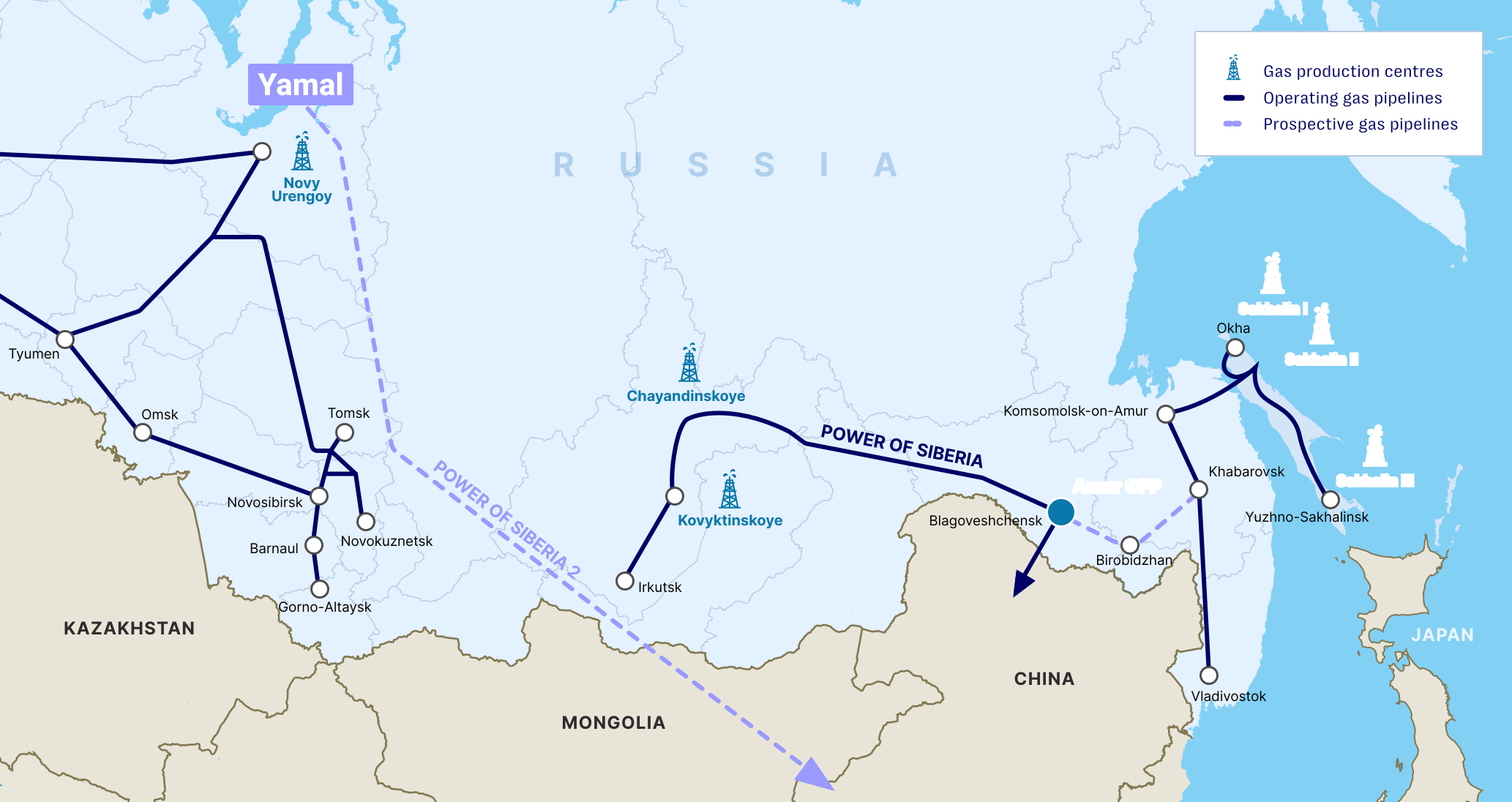
The project returned to the agenda only in March 2023, when Xi Jinping visited Moscow. During the visit, the two sides agreed the main parameters of a deal to construct the Power of Siberia 2 pipeline, including planned gas deliveries of 50 bcm per year.
How much gas does China need today?
By the mid-2020s, China had substantially increased its domestic gas production, from 27 bcm in 2000 to 260 bcm in 2025. Alongside conventional production, it actively expanded output from shale gas, tight gas, coalbed methane, and coal-measure gas resources. In 2025, these alternative sources accounted for 47 per cent of China’s total gas production.
However, the needs of the Chinese economy grew even faster. To meet rising demand, the country invested heavily in infrastructure to import both LNG and pipeline gas from Central Asia, primarily Turkmenistan.
In the early 2020s, however, China revised its energy strategy. The rapid expansion of nuclear power and renewable energy at home, disruptions to global supply chains, and the European gas crisis – triggered first by the reduction of Russian gas supplies from mid-2021 and then by the invasion of Ukraine – led to a sharp rise in LNG prices and prompted Beijing to reassess the role of natural gas. Rather than serving as the ‘foundation for future growth in energy consumption’, gas came to be viewed as a ‘transitional’ energy source, with future demand dependent not only on overall consumption growth, but also on the pace of expansion of alternative energy sources.
In 2024–2025, China consumed around 430 bcm of gas annually. Slightly more than 60 per cent was provided by domestic production, while imports were split roughly equally between LNG and pipeline gas. In addition to Russia and Central Asia, which account for broadly similar shares of pipeline imports, China also receives 5–6 per cent of its imports of pipeline gas from Myanmar.
At first glance, this import structure may appear somewhat irrational, as pipeline gas is significantly cheaper than LNG. China purchases gas from Central Asia at approximately $200–260 per thousand cubic metres, while Russian gas costs around $240–280 per thousand cubic metres. (Central Asian supplies are cheaper in part because China finances pipeline construction.) By contrast, LNG prices can range from $250–300 to $1,000 or more per thousand cubic metres, depending on market conditions.
It is evident that China is deliberately pursuing a policy of maximum diversification and balance among its sources of supply. Beijing has no intention of becoming as dependent on Russian gas as Europe once was.
How much gas will China need tomorrow?
China began construction of the first Power of Siberia pipeline on its territory in mid-2015, while Russia began work in early 2016. The pipeline, which cost Gazprom at least RUB 1.1 trillion ($17.5 billion), was launched in early December 2019. It reached its design capacity of 38 bcm per year in December 2024. Thus, more than ten years passed between the signing of all the necessary agreements and the pipeline reaching full capacity.
The timeline for Power of Siberia 2 may be shorter, as the Yamal fields have already been developed and production there can be increased relatively quickly. Even so, it is realistic to assume that the process will take at least six years. As a result, any assessment of China’s future gas needs should focus on the balance of supply and demand for gas around 2035.
According to forecasts from the Chinese state-owned oil and gas company Sinopec, gas consumption in China will plateau between 2035 and 2040 at around 620 bcm per year. This would represent an increase of 190 bcm from current levels. Domestic gas production is expected to reach approximately 300 bcm annually, covering less than one quarter of the projected increase in demand. Consequently, China will need to import an additional 150 bcm of gas each year.
If current import patterns are maintained, roughly one quarter of this additional volume – around 45 bcm – could be supplied by pipeline gas from Russia.1 This is close to the planned capacity of Power of Siberia 2. However, another pipeline linking Russia and China across the Ussuri River, with a capacity of 12 bcm per year, is due to enter service in 2027. In addition, by 2031 the capacity of the first Power of Siberia pipeline is expected to increase by 6 bcm annually, reaching 44 bcm.
This means that either China must agree to increase the share of Russian gas in its import mix, or Gazprom will have to accept a twofold reduction in the capacity of Power of Siberia 2, which would make the project highly inefficient.
Why is Power of Siberia 2 of little interest to Beijing?
For Beijing, Russian gas is useful, but not indispensable. Following the price shock of 2021–2022, China signed a series of long-term LNG supply agreements, and today its contract portfolio is sufficient to meet demand growth at least until 2030. Many Chinese contracts for LNG imports from the United States are flexible and allow cargoes to be resold abroad if domestic demand is lower than expected. In this way, China is building a supply portfolio that enables it to respond flexibly to changing market conditions.
LNG can be resold or used as leverage in negotiations with other suppliers. Pipeline gas imports from Russia do not offer the same flexibility: supplies move from a single seller to a single buyer along a single route, reducing the attractiveness of such a deal for Beijing.
This is precisely why negotiations over Power of Siberia 2 have proved so difficult. Russia wants a long-term contract to export large volumes of gas at prices that would justify the construction of a massive pipeline, expected to stretch for around 6,700 kilometres, and that would partially compensate Gazprom for the losses resulting from the decline in exports to Europe.
Beijing, by contrast, has little interest in guaranteeing that Gazprom will receive revenues close to those it once earned in the European market, given that Russia now has no alternative buyers. Even today, China purchases Russian gas at prices 39 per cent lower than those paid by the few remaining European consumers. During the May negotiations, the Chinese side reportedly indicated its wish to buy Russian gas at only half the current price, a level that would leave Gazprom with virtually no profit margin.
Yesterday’s gas in tomorrow’s energy system
In essence, Russia is trying to sell yesterday’s gas into tomorrow’s energy system. China’s energy sector is developing rapidly and becoming increasingly flexible and diversified. Solar, wind, hydroelectric, and nuclear power are reducing the need for gas-fired electricity generation. Natural gas remains important for heating, the chemical industry, transport, and meeting electricity demand during periods of peak consumption. However, demand for gas is unlikely to be stable. This was evident in 2025, when China’s LNG imports fell by 11 per cent; they are expected to remain below 2024 levels this year. According to analysts, this reflects weaker demand, high LNG prices at the beginning of the year, and the growing share of energy derived from alternative sources.
Beijing may speak of a strategic partnership with Moscow, but it apparently does not extend to the energy sector. Moscow believes that geopolitical considerations should compel China to buy Russian gas. Beijing is convinced that the same considerations entitle it to a discount. In business negotiations, a party which holds underutilised assets is generally at a disadvantage when negotiating with one that can turn to alternative suppliers.
Does this mean that Power of Siberia 2 will never be built? Most likely, not in its currently proposed form. The situation could change either if Chinese gas consumption were to rise sharply, or if the global LNG market were to experience a major disruption that deprived Beijing of alternative sources of supply. Under certain circumstances, the Kremlin may agree to a sufficiently low price and offer flexible supply volumes. However, this would represent an acknowledgement of weakness rather than the success of Russia’s ‘pivot to the East’.
Endnotes
- In addition to pipeline gas, Russia also supplies LNG to China. In 2025, these deliveries reached 9.8 million tonnes, equivalent to approximately 13.8 bcm of natural gas. ↩︎