In 2025, Russia’s economic authorities acted rationally, sacrificing growth to curb inflation. However, low inflation is a necessary but insufficient condition for sustainable economic development. The key question shaping next year’s outlook is whether the non-military segment of the economy can recover and return to growth if inflation is brought down to the target level of 4 per cent by mid-2026.
Key takeaways
- Russia’s economy is stagnating, and a recovery in non-military sectors remains unlikely.
- Russia remains vulnerable to large budget deficits due to rising military expenditure and declining oil and gas revenues.
- The appreciation of the rouble and the sanctions regime have led to a drop of more than 25 per cent in oil and gas revenues and a decline in import tax receipts, which may continue to constrain the budget’s revenue base in 2026.
- A potential end to hostilities in Ukraine could increase recession risks in the short term by reducing output in defence-related industries and lowering household incomes.
Inflation slowdown
The main achievement of the Russian government in 2025 was the slowdown in inflation from 9.5 per cent to below 6 per cent. This was the result of coordinated actions by the Ministry of Finance and the Bank of Russia (CBR).
For eleven months of 2025, the Ministry of Finance adhered to strict fiscal discipline, restraining expenditure.1 The increase in the federal budget deficit relative to projections made a year earlier was driven primarily by a decline in oil and gas revenues due to the rouble’s appreciation.
In addition, the Ministry of Finance took a highly unpopular decision to raise the VAT rate from 1 January 2026. This measure will increase budget revenues, reduce private demand, and exert an additional disinflationary effect.
For its part, the Bank of Russia maintained an extremely high key interest rate until June 2025. It then cut its rate five times, but the cumulative reduction from 21 per cent to 16 per cent resulted in a very modest easing of monetary policy.
Besides that, the sharp appreciation of the rouble in the first half of 2025 (from RUB 110/$1 at the end of November 2024 to below RUB 80/$1 by mid-May 2025), which was not incorporated into most forecasts, contributed to a slowdown in price growth for non-food goods and even to their deflation in April–June. In retrospect, the rouble’s appreciation should be partly attributed to earlier decisions taken in Moscow, Washington, and Brussels that significantly restricted capital outflows from Russia, thereby strengthening the rouble’s exchange rate. Yet, the exchange rate factor does not negate the role of macroeconomic policymakers.
Despite the steady downward trend in inflation in the second half of 2025, and the Bank of Russia’s promise to reach its 4% stated target by mid-2026 and maintain it for the rest of the year, there is little confidence in this scenario. On the one hand, uncertainty over fiscal policy persists: even if 2025 spending is restrained, the question of how potential future declines in oil and gas revenues would be offset remains open. On the other hand, debates at various levels increasingly reflect the view that the rouble is overvalued and that its devaluation, followed by renewed inflationary acceleration, is inevitable.
Households’ and businesses’ inflationary expectations, which in recent months have not only failed to decline but have even increased slightly, remain an additional source of risk. In this situation, the Bank of Russia’s assessment, issued after its December decision to cut the key rate, appears well-founded: pro-inflationary risks continue to outweigh disinflationary ones.
This, however, does not rule out further reductions in the key rate. The increase to 21 per cent in October 2024 was primarily aimed at suppressing inflationary expectations. A reduction of the Bank of Russia’s key rate to the range of 12–13 per cent at the current level of inflation can therefore be seen as a form of partial compensation for the inflation slowdown already achieved.
It is expected that, in early 2026, rate cuts will proceed with extreme caution and that the Bank of Russia’s forecasts will remain restrained, unlikely to dampen inflationary expectations or stimulate a recovery in business activity.
The price of success
Russia’s economy is stagnating. According to Rosstat, GDP in the first three quarters of 2025 did not exceed the level recorded in the fourth quarter of 2024 (see ‘Russia’s GDP Dynamics and Forgone Growth, 2012–2025’).
‘Both the Government and the Central Bank are now setting the task of somewhat cooling these growth rates [of inflation], and next year, I think, according to various estimates, we should be somewhere around 2–2.5 per cent.’
Results of the Year with Vladimir Putin
19 December 2024
‘As for one per cent growth this year, the rate of economic growth, this is a deliberate action on the part of the Government, the Central Bank, and the country’s leadership as a whole, linked to inflation targeting. And it should be noted that, overall, this task is being addressed successfully, because the goal was set to reduce inflation to at least six per cent.’
Results of the Year with Vladimir Putin
19 December 2025
The assessments of the Government and the Bank of Russia imply GDP growth of 1 per cent in 2025 compared with 2024. Achieving this would require growth to accelerate to 3.6 per cent year on year in the fourth quarter, which would significantly exceed the figures recorded in the second and third quarters (1.1 per cent and 0.4 per cent, respectively). Given the current state of the Russian economy, such a scenario appears unlikely, although the traditional year-end ‘acceleration’ cannot be entirely ruled out.
The causes of the economic slowdown in 2025 are systemic: an increased tax burden, cuts to non-military budget spending, and high interest rates, which have sharply reduced the attractiveness of borrowing for companies whose business models rely on credit.
On the other hand, the 2025 growth slowdown appears historically consistent. Since Vladimir Putin returned to the presidency in 2012, Russia’s average annual economic growth rate has stood at 1.37 per cent. The gap relative to early-2010s estimates of potential growth (around 4 per cent per year) has widened steadily over the past 13.5 years.
During the four years since the invasion of Ukraine, the structure of the Russian economy has changed significantly (see ‘Growth Rates of Value Added by Economic Sector, Q3 2025 / Q3 2021’). The primary beneficiaries of the war economy have been three sectors:
- public administration and military security;
- finance and insurance, primarily due to budget-funded interest rate subsidies (mortgages and support for the industrial and agricultural sectors) – in 2025, such subsidies accounted for around 40 per cent of the banking sector’s total profits;
- hotels and catering, amid a sharp decline in outbound tourism and the reorientation of higher-income households towards domestic travel.
Among the sectors that have incurred the most significant losses are:
- healthcare and social services (and, to a lesser extent, education), as a result of the reallocation of budgetary resources in favour of the military sector;
- water supply, sewerage, and waste management, due to disruptions in the implementation of state programmes in which the largest operator was the ‘Rostec’ corporation, which has been hit by sanctions and deprived of access to imported equipment;
- wholesale trade, including the revenues of holding companies in the raw materials sector, which have declined because of falling global prices, higher logistics costs, and reduced export volumes.
Back to square one
Rosstat data on industrial output for October – showing a 3 per cent increase month on month – was striking not only because of the unexpected shift from the contraction which started in January to growth and the exceptionally sharp jump, but also because of the absence of any official commentary. Expert interpretations largely converged: this ‘miracle’ was linked to the specifics of military production and therefore could not be sustained. The November data subsequently confirmed this hypothesis.
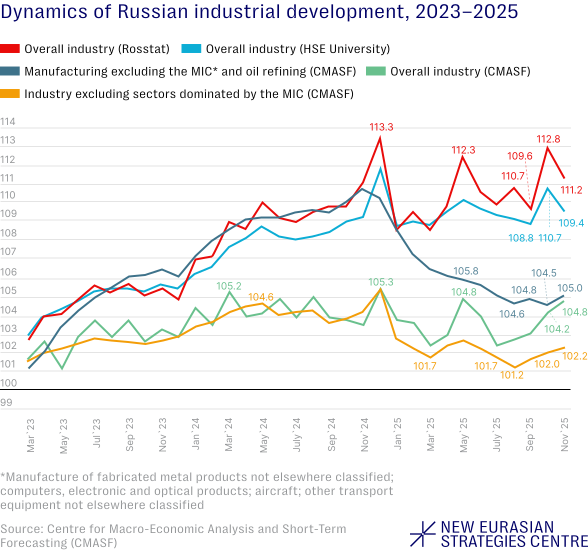
Stagnation or recession persists across most industrial sectors. Over the first eleven months of 2025, industrial output declined by 0.7 per cent compared with November 2024, while the drop relative to October 2025 amounted to 4.1 per cent.
Sustained growth of more than 2 per cent over the first eleven months of 2025 was, not surprisingly, recorded in sectors linked to military needs:
- transport, other than motor vehicle manufacturing (+29.5 per cent);
- pharmaceutical products and materials (+15.6 per cent);
- fabricated metal products, excluding machinery and equipment (+13.9 per cent);
- computers, electronic, and optical products (+13 per cent).
The only exception was tobacco products (+5.3 per cent).
The steepest declines were recorded in production of:
- motor vehicles (-23.6 per cent);
- leather and leather products (-13.4 per cent);
- printed and graphic products (-13 per cent);
- the extraction of minerals other than oil, gas, coal, and metals – mainly peat, non-metallic materials, and sulphur (-10.8 per cent);
- furniture (-7.5 per cent).
Of 28 industrial sectors, 17 recorded weaker performance in January–November 2025 than in the first nine months of the year (January–September). Compared with the first half of 2025, a deterioration was observed in 21 sectors during January–November.
Military spending and the budget deficit
Budgetary data for the first eleven months of 2025 provided neither surprises nor clarity. Revenue and expenditure figures did not deviate significantly from trends observed in previous months or from expert expectations. Uncertainty over the final level of federal spending and the budget deficit will persist until the Ministry of Finance publishes full-year results in mid-January 2026.
Additional uncertainty was injected by a statement made on 17 December by Russia’s defence minister, Andrey Belousov, who said that actual Ministry of Defence spending had risen to 7.3 per cent of GDP in 2025. This exceeds the budget plan by one percentage point, or RUB 2.1 trillion (approximately $26 billion). At the same time, total war-related expenditure in 2025 amounted to 5 per cent of GDP, including 0.7 per cent generated through cuts to Ministry of Defence spending unrelated to the war in Ukraine. To secure additional funding for the Ministry of Defence, the Ministry of Finance therefore had to either increase overall expenditure – and, consequently, the budget deficit – or impose cuts on other spending items.
At the same time, unlike in 2024, when the Ministry of Finance unexpectedly raised more than RUB 2 trillion (approximately $20 billion by that time’s exchange rate) on the market in mid-December, practically all the financial resources that the treasury needed were secured as early as 12 November 2025. On that day, the treasury raised RUB 1.6 trillion (approximately $20 billion) through the issuance of government bonds. As in the previous year, the Ministry of Finance required support from the Bank of Russia: on 11 November, banks borrowed RUB 850 billion (approximately $10.6 billion) from the CBR through repo operations. In the weeks that followed, the Ministry of Finance’s borrowing volumes at weekly auctions were minimal. On 24 December, the ministry announced the completion of debt issuance for 2025 and the achievement of its annual borrowing plan.
This, however, does not mean that financing additional end-of-year spending would require a return to the market. The same outcome could be achieved by reducing balances on Treasury accounts held with the Bank of Russia or by lowering the volume of deposits that the Ministry of Finance holds with commercial banks.
Other observations
In 2026, according to Andrey Belousov, the ‘prioritisation [of Ministry of Defence spending] will make it possible to stabilise it at the same level or even reduce it slightly [compared with 2025]’.
* * *
In 2025, Russia raised the corporate profit tax rate (from 20 per cent to 25 per cent) and introduced a progressive personal income tax scale with a top rate of 22 per cent. All revenues generated by these measures were channelled to the federal budget. Despite this, the federal budget’s share of consolidated budget revenues declined from 51.8 per cent to 49.1 per cent over the first eleven months of the year.2 The reason was the rouble’s appreciation, which led to a 25.4 per cent drop in oil and gas revenues over eleven months and a 16 per cent decline in import tax revenues. Taken together, the reduction in budget revenues exceeded RUB 4 trillion (approximately $50 billion) over the eleven-month period.
* * *
The Russian export oil price in November, which will be used for tax payments in late December, will result in an additional monthly revenue shortfall of around RUB 100 billion (approximately $1.25 billion). The average price of Urals crude used to calculate oil and gas revenues stood at $44.87 in November, 16.5 per cent lower than in October. This decline followed the introduction in October 2025 of US sanctions against two of Russia’s largest oil companies, Rosneft and Lukoil, which together account for roughly half of the country’s oil production and exports.
* * *
The aggregate financial result of the coal industry (profits minus losses) over the first ten months of 2025 was four times higher than a year earlier. At the same time, companies faced significant shifts in the structure of demand – driven by a decline in output in ferrous metals – and were forced to cut production of the most profitable types of coal. Anthracite production declined by 8.9 per cent over the first eleven months of 2025, while output of coking coal fell by 9.1 per cent. By contrast, production of lignite – the least costly fuel for power generation and the residential sector – increased by 5 per cent over the same period. Output of thermal hard coal rose by 3.9 per cent. Overall, coal production over eleven months increased by 0.1 per cent, reaching 389 million tonnes.
* * *
The government is discussing a large-scale financial rehabilitation programme for Russian Railways. The proposals include:
- the provision of budget support in various formats totalling up to RUB 150 billion (approximately $1.9 billion)3;
- early indexation of tariffs – from 1 October instead of 1 December 2026;
- an additional freight tariff increase of 1 per cent for a twelve-month period;
- debt restructuring, including the temporary conversion of part of the debt into equity;
- the sale of office space in the Moscow City skyscraper and the divestment of the Federal Freight Company.
These support measures could generate up to RUB 1.3 trillion (approximately $16.3 billion) for the company, but there is currently no consensus within the government on the proposed package.
Conclusion
As the new year begins, the Russian economy is under pressure from three factors. First, the war continues to absorb financial, material, and human resources. Second, efforts to preserve macroeconomic stability imply the continuation of tight monetary policy and further cuts to non-military budget spending. Third, sanctions constraints are accelerating the technological ageing of capital goods.
Considering this, sustained economic growth appears unlikely. Moreover, a potential end to hostilities in Ukraine could increase recession risks in the short term by reducing output in defence-related industries and lowering household incomes.
The absence of growth implies the persistence of fiscal constraints and a lack of resources to stimulate economic recovery through government spending. Even if resources for such a policy were to be found through a higher deficit and increased public debt, the question of where new demand could emerge within the economy remains open.
Endnotes
- This assessment may require revision once December results are available, if end-of-year spending, as is traditionally the case, exceeds expenditure in previous months. Even in that scenario, however, the inflationary effect would materialise only in 2026 and therefore would not alter the assessment of the budget’s role in restraining inflation in 2025 ↩︎
- The consolidated budget is a notional indicator that combines the federal budget, regional budgets, and state extra-budgetary funds, net of internal transfers, and is used to assess the overall financial position of the public sector ↩︎
- The company’s net profit for the first ten months of 2025 amounted to RUB 105 billion (approximately $1.3 billion) ↩︎