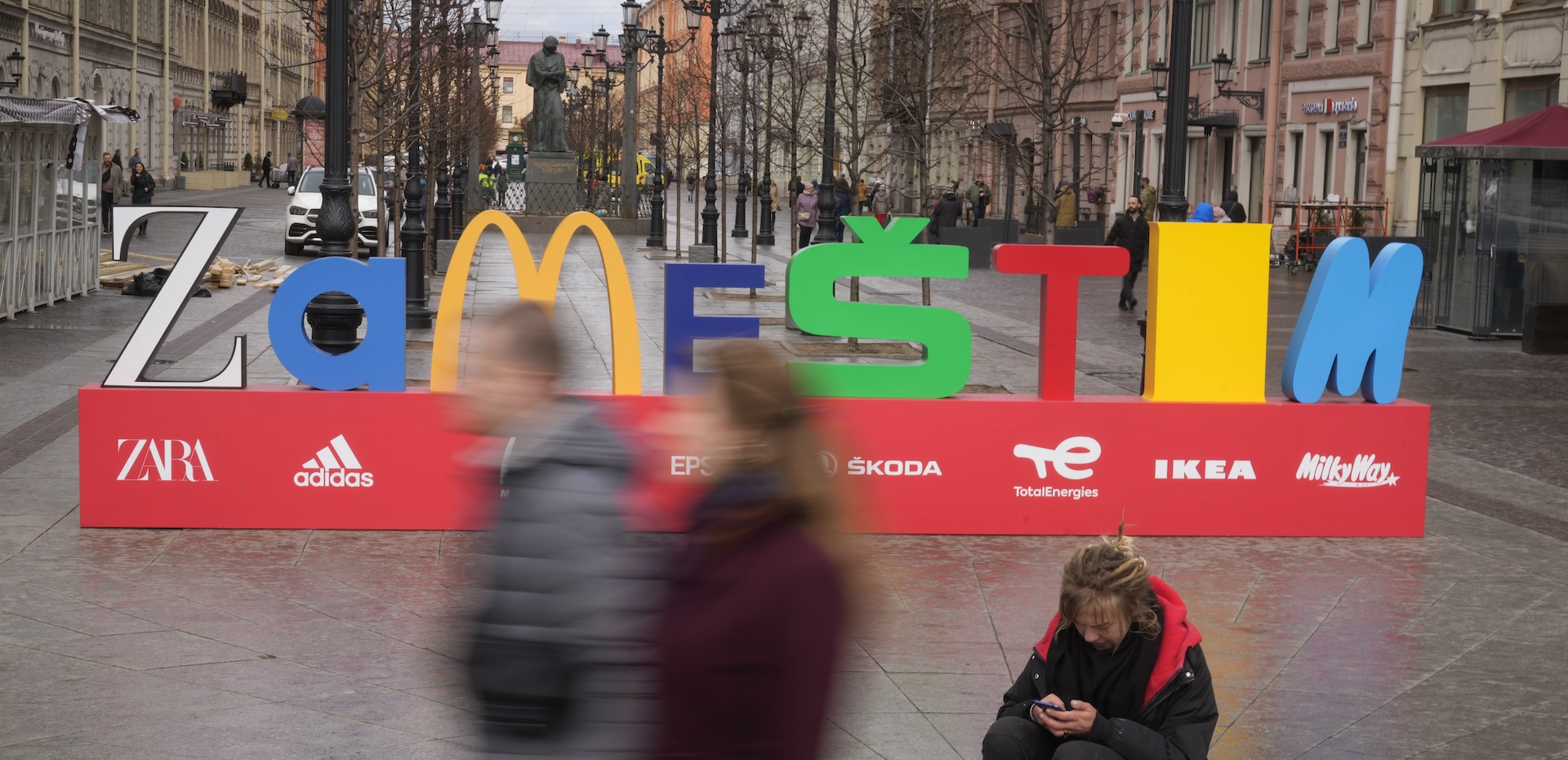
Since the start of the full-scale invasion of Ukraine, the Russian authorities have launched an active process of property seizure and redistribution within the country. The seizure of assets has become a systematic practice, with its pace and scale increasing each year and the range of legal instruments used for this purpose expanding. Asset seizures allow the authorities to punish those deemed disloyal while rewarding business groups close to the state, to replenish the budget through the sale of confiscated property, and to concentrate entire sectors in the hands of a small number of mega-holdings dependent on the authorities. According to various estimates, depending on the methodology used, the total value of assets seized in 2022–2025 amounted to between RUB 5 trillion and RUB 6.5 trillion (approximately €55–72 billion when converted at the average exchange rate for 2022–2025), with around half of this amount accounted for by 2025. During the first seven months of 2026, the scale of asset seizures significantly declined, though the state continues to expand the range of instruments available for further property redistribution.
Summary
- To seize foreign assets, the state uses three instruments. The first is temporary administration: assets are transferred to the control of the state or structures close to it for an indefinite period, with no prescribed procedure for their return. The second is the forced transfer of foreign investors’ stakes in companies to a Russian operator, which in practice forces the foreign investor to exit the project. The third is a mandatory substantial discount on the sale of a business and a ‘voluntary’ contribution to the budget when an investor from an ‘unfriendly’ country leaves the Russian market. De facto, this means being forced to part with the business on ruinous terms.
- To seize Russian assets, the state uses a fourth mechanism – claims filed by the Prosecutor General’s Office1 seeking the transfer of property to the state. Almost every claim is based on one of four grounds: violations of anti-corruption legislation, which is the most widely used instrument; unlawful ownership of a strategic asset by a foreign resident; the invalidation of privatisation transactions from the 1990s and 2000s; and the designation of an owner as an extremist organisation on the grounds of alleged support for Ukraine.
- Victims of asset seizures. Among foreign companies affected, firms from the United States, Germany, France, and Denmark predominate. Among Russian owners, the range of victims is considerably broader: current and former officials, MPs, members of the security services, and judges targeted by anti-corruption claims; entrepreneurs with foreign citizenship or residence permits whom the Russian authorities have deemed disloyal; owners of enterprises privatised in the 1990s and 2000s; and businesspeople, both Ukrainian and Russian, who have been formally accused, often without direct criminal prosecution, of providing financial or other support to Ukraine.
- Beneficiaries. The seized property ultimately ends up in the hands of a narrow circle of the old Putin-era elite. By our estimates, only around 15 per cent of seized assets go to individuals who are not linked to one elite group or another.
- Difficulties in selling seized assets. The state is actively selling such assets under the approved privatisation plan for 2026–2028. However, sales are taking place at a substantial discount relative to the initial valuation or only after several unsuccessful attempts.
- The intensity of asset seizures is declining. Data for the first seven months of 2026 show that the assets being seized are, on average, several times less valuable than a year earlier, while many high-profile cases did not result in court decisions ordering the seizure of assets.
Estimated scale of seizures
For aggregate data for 2022–2025, we rely primarily on estimates by the Centre for Data and Research on Russia (CEDAR) and the law firm Nektorov, Saveliev & Partners (NSP). According to CEDAR’s calculations, the value of assets seized in 2022–2025 amounted to approximately RUB 5 trillion (approximately €55 billion). NSP estimates the value of assets seized in 2022–2025 at RUB 6.5 trillion (approximately €72 billion). The difference between the estimates reflects differences in the methodology used to value the assets, but both CEDAR and NSP record an increase in the pace and scale of seizures up to the beginning of 2026.
For developments in 2026, which are not yet covered by existing studies, we use our own calculations based on publicly available data. These include major asset seizures worth at least RUB 1 billion.
Mechanisms of confiscation
The Russian state uses four main mechanisms for seizing property, which often complement one another. Three are applied to foreign owners, while the fourth is applied to Russian owners.
Mechanism 1: Temporary administration of foreign assets
On 25 April 2023, Vladimir Putin signed Decree No. 302 ‘On the Temporary Administration of Certain Property’ in response to the freezing of Russian assets in the West. In practice, this decree allows the authorities to unilaterally seize the assets of companies from ‘unfriendly’ states, which include the United States, the United Kingdom, EU member states, and a number of other countries. The first companies affected by the decree were Germany’s Uniper and Finland’s Fortum.
As of August 2026, the temporary administration mechanism had been applied to 22 groups of assets owned by foreign investors, as listed in the current annex to Decree No. 302. Because public valuations are unavailable for many of the companies concerned, the total value of the affected assets can only be estimated approximately. We estimate it at no less than €6 billion.
Formally, the assets are transferred into ‘temporary administration’ by the Federal Agency for State Property Management (Rosimushchestvo) or by Russian companies controlled by businessmen close to the Kremlin without the formal termination of ownership rights. The transfer can be reversed by presidential decision, but the decree does not establish a procedure for returning the assets, which may make such seizures effectively indefinite.
Only one case is known in which assets transferred into ‘temporary administration’ under Decree No. 302 were returned, and one in which they were permanently seized. Italy’s Ariston is the only company to which Russia has returned seized assets. Little is known about the terms of their return. The Financial Times reported active diplomatic intervention by the Italian side; in addition, the company was said to have ‘shown patience’ and ‘demonstrated an interest in continuing to operate in the Russian market’.
In another case, temporary administration became an intermediate stage before the asset was permanently seized through the courts. Glavprodukt, owned by the US-based Universal Beverage Company, was transferred to Rosimushchestvo in October 2024, and in March 2025 the Prosecutor General’s Office filed a claim seeking the full transfer of its assets into state ownership. The agency accused Glavprodukt’s management of unlawfully transferring profits abroad and of obstructing Rosimushchestvo’s temporary administration. The court upheld the claim. So far, this is the only case in which foreign assets have been permanently seized through a Russian court. Moreover, in December 2025, the Prosecutor General’s Office attempted to seize AgroTerra Group, owned by the US-based NCH Capital Inc., in the same way, accusing it of financing the Armed Forces of Ukraine. However, the court unexpectedly declined to consider the claim and lifted the interim measures imposed in connection with it.
These precedents show that an asset placed under ‘temporary administration’ may either be returned to its owner or permanently transferred to the state. The problem for owners is that the conditions for either outcome are not set out anywhere and, in practice, depend on the political will of the country’s current leadership.
Examples
- Danone (France). By a decree of 16 July 2023, the French group Danone’s Russian subsidiary was placed under the temporary administration of Rosimushchestvo, after which Yakub Zakriev, a nephew of Chechen leader Ramzan Kadyrov, became the company’s chief executive. The temporary administration was lifted in March 2024, and in May Danone completed the sale of its Russian business to Vamin Tatarstan LLC, which was subsequently renamed Unimilk LLC. In December 2024, Unimilk was acquired by Ruslan Alisultanov, a former Chechen official. Given Alisultanov’s links to Yakub Zakriev, the asset in effect came under the control of individuals close to the Chechen leadership.
- Ulyanovsk Machine Tool Plant (Japan/Germany). By Decree no. 133 of 19 February 2024, the Ulyanovsk Machine Tool Plant, owned by Germany’s Gildemeister Beteiligungen GmbH – part of the Japanese DMG Mori group – was placed under the temporary administration of Rosimushchestvo.
- Bosch – BSH Household Appliances LLC (Germany). By Decree No. 294 of 26 April 2024, the Russian subsidiary of Germany’s BSH Hausgeräte GmbH was placed under the temporary administration of Gazprom Household Systems JSC.
Mechanism 2: Forced transfer of foreign investors’ stakes to a new Russian entity
This mechanism for seizing foreign assets was used in 2022–2023. A presidential decree created a new Russian legal entity to which stakes in joint projects between Russia and foreign investors were transferred. The subsequent treatment of the assets varied: in some cases, the owners were offered equivalent stakes in the new companies; in others, their corporate rights were restricted, or their stakes were forcibly transferred for sale to Russian entities. Ultimately, foreign investors lost their participation in the projects in one way or another. In total, the mechanism was applied in four cases, with the combined value of the assets amounting, by our estimates, to at least €3 billion.
Examples
- Sakhalin‑2, Shell (United Kingdom). By the presidential decree of 30 June 2022, all rights and obligations of the previous operator of the Sakhalin‑2 oil and gas development project in the Sea of Okhotsk, the Bermuda-registered company Sakhalin Energy, were transferred to a new Russian entity, Sakhalin Energy LLC. Shell, which held a 27.5 per cent stake in Sakhalin Energy, declined to join the new company. In March 2024, the government approved the sale of Shell’s stake to a Gazprom entity for approximately $1 billion (around €880 million).
- Sakhalin‑1, ExxonMobil (United States). By the decree of 7 October 2022, a new operator was established for the oil and gas project, with Sakhalinmorneftegaz-Shelf, a Rosneft subsidiary, appointed as its management company. Japan’s SODECO and India’s ONGC Videsh retained their participation, while Exxon, which held a 30 per cent stake, lost its share in the project. The US company’s stake has not been sold and remains under state administration. In 2022, Exxon estimated its losses from the full termination of its Sakhalin operations at $2.3 billion (around €2 billion).
- Pulkovo Airport, Fraport (Germany). By a decree of 30 November 2023, Northern Capital Gateway, the operator of St Petersburg’s Pulkovo Airport, was removed from the control of the Cyprus-registered Thalita Trading and transferred to the newly created Russian holding company VVSS on the stated grounds of a ‘threat to national interests and economic security’. The voting rights of foreign shareholders, including Germany’s Fraport, which held a 25 per cent stake, were transferred to the management of the new entity. Fraport effectively lost corporate control over its stake and, in December 2024, sold it to Oman’s Orbit Aviation for €45 million.
- Wintershall Dea and OMV – joint gas projects with Gazprom (Germany and Austria). Under a package of decrees (Nos. 965 and 966 of 19 December 2023), Germany’s Wintershall Dea and Austria’s OMV were stripped of their stakes in joint ventures with Gazprom: Severneftegazprom, which operates the Yuzhno-Russkoye field, and Achimgaz, which develops the Achimov deposits of the Urengoy field. All rights and obligations were transferred to newly created Russian LLCs. The foreign stakes are ultimately to be sold: the stakes in Severneftegazprom to SOGAZ, an insurer serving Gazprom, and those in Achimgaz to the newly established Gazovye Tekhnologii LLC, linked to Bank Rossiya, which is associated with Yuri Kovalchuk, a billionaire close to Putin. In April 2026, the stakes were valued at approximately $206 million.
Mechanism 3: A discount and ‘voluntary’ contribution to the budget when exiting the Russian market
Foreign investors from ‘unfriendly’ countries cannot freely sell their Russian businesses: any transaction requires approval from the Government Commission on the Control of Foreign Investment. Approval is conditional on a mandatory 60 per cent discount to an independent valuation and a ‘voluntary’ contribution to the federal budget equal to 35 per cent of the asset’s market value – meaning that the total extraction can reach 95 per cent of the asset’s value. Transactions worth more than RUB 50 billion (around €500 million) require the president’s personal approval. Formally, this is a voluntary sale, but in economic terms it amounts to being forced to exit on ruinous terms. According to the consultancy Kept, the Russian arm of KPMG, foreign investors completed around 400 transactions to exit Russian businesses in 2022–2025, with a total value of approximately $27 billion. It is important to note, however, that these figures cover all foreign investors, not only companies from ‘unfriendly’ countries.
Examples
- Unilever. The British company Unilever received approval at the end of August 2024 and completed the sale of its Unilever Rus subsidiary to the Arnest Group in October. Russian media had previously valued the business at RUB 35–40 billion (around €350 million), taking into account the discount required by the authorities.
- Heineken. The Dutch brewer likewise sold its Russian business to the Arnest Group for a symbolic €1. Heineken itself stated that the transaction had received all the necessary approvals and resulted in a total loss of around €300 million.
- Carlsberg (Baltika). After Baltika was placed under the temporary administration of Rosimushchestvo in July 2023, Carlsberg completed its exit in December 2024 through a management buyout. The terms of the transaction required the buyer to pay 15 per cent of Baltika’s market value into the federal budget.
Mechanism 4: Transfer to the state through claims filed by the Prosecutor General’s Office
To permanently seize an asset, the Russian authorities use four main grounds:
- violations of anti-corruption legislation;
- unlawful ownership of a strategic asset by a foreign resident;
- the invalidation of privatisation transactions from the 1990s and 2000s;
- the designation of the owner as an extremist organisation.
With rare exceptions, these mechanisms are used against Russian owners, and their ultimate purpose is to redistribute property within the country.
Ground 1: Violations of anti-corruption legislation
The first ground for seizure is through an anti-corruption claim. In the overwhelming majority of cases, the targets of such claims are current or former holders of public office, such as regional and municipal officials, MPs, members of the security services, judges, and military personnel: in other words, people who can be accused of using their positions for personal gain. Almost every claim is based on the unlawful combination of public service, or an elected mandate, with business activity.
This mechanism was also used in 2022–2023, but its use expanded most sharply in 2025–2026, when anti-corruption claims became the dominant basis for property seizures, accounting for more than half of all cases. The reason was Constitutional Court Ruling No. 49‑P of 31 October 2024, which removed the limitation period for the seizure of property in anti-corruption cases. As a result, this mechanism became the least procedurally complex one for the prosecution. Moreover, in such claims, seizure is independent of criminal proceedings, meaning that ‘unlawfully acquired’ assets can be seized even before a court has ruled in the related criminal case.
According to NSP estimates, the total value of property seized on this basis in 2022–2025 was around RUB 1.93 trillion (approximately €21 billion). So far in 2026, by our calculations, approximately another RUB 430 billion (around €4.7 billion) in assets were seized on these grounds.
Examples
- Makfa. The first and main claim was filed on 28 March 2024 and upheld on 8 May. The owners – Mikhail Yurevich, the former governor of Chelyabinsk Region, and former State Duma MP Vadim Belousov – were accused of continuing to manage the business through relatives and trusted associates while holding public office. In November 2025, the assets were acquired by an entity linked to Rosselkhozbank for RUB 22.4 billion (around €240 million), compared with a market valuation of RUB 46 billion (around €500 million).
- Sayanskkhimplast. The claim was filed on 6 April 2025 and upheld on 27 May. This case illustrates how different grounds for seizure can complement one another: in addition to the main allegation, a second ground – unlawful privatisation – was also invoked. According to the Prosecutor General’s Office, the company’s industrial assets were transferred to affiliated private entities, after which the enterprise itself went bankrupt and its property came under private control. In April 2026, the asset was sold to a Rosneft entity for RUB 30.3 billion (around €500 million), compared with a market valuation of more than RUB 92 billion (around €1 billion).
- Sirena-Travel. The claim was filed on 4 February 2026 and upheld on 20 February. A second ground for seizure was also invoked in this case, that of unlawful ownership of an asset by a foreign resident: according to the Prosecutor General’s Office, strategically important airline ticket booking infrastructure had come under the control of foreign entities. The assets remain under the administration of Rosimushchestvo.
Ground 2: Unlawful ownership of a strategic asset by a foreign resident
This mechanism is the second most frequently used after anti-corruption claims. It has been used relatively regularly since 2023, with the number of such claims increasing in 2025–2026. Despite the wording of the allegation, in almost all cases the mechanism is used against Russian owners who have links to other countries, such as foreign residence permits or citizenship. The presence of a foreign co-owner of an asset may also be sufficient. Moreover, links to any foreign state, not necessarily an ‘unfriendly’ one, may serve as grounds for the allegation: Dmitry Kamenshchik, the owner of Domodedovo Airport, was accused on the basis of his residency in Turkey and the UAE.
In most claims brought on this basis, the allegation centres on the ownership of a strategic asset. The law requires owners with links abroad to obtain mandatory approval from the Government Commission for Control over Foreign Investment before acquiring such assets, and seizure takes place on the grounds that no such approval was obtained.
According to NSP estimates, assets with a total value of around RUB 1.7 trillion (approximately €18.7 billion) were seized on this basis in 2022–2025. By our calculations, roughly RUB 100 billion (around €1.1 billion) more was added to this total in the first seven months of 2026.
Examples
- Kaliningrad Commercial Sea Port. Two claims were filed on 2 March and 21 June 2023 and upheld on 12 May and 11 July, respectively. In the first claim, Scotland-based Orneto Partners and Russian businessman Dmitry Purim were accused of unlawfully acquiring shares in a strategic enterprise. In the second, an anti-corruption claim, the remaining stake was seized from serving State Duma MP Andrei Kolesnik. On 18 May 2026, the port was privatised by Rosatom.
- Grain trader Rodnye Polya. The claim was filed on 25 December 2024 and upheld on 31 January 2025. The owner, Petr Khodykin, was accused of unlawfully controlling a strategic grain exporter while holding foreign citizenship and without the mandatory approval of the Government Commission. The asset was initially transferred to the management of an entity linked to Rosselkhozbank and, in July 2026, was sold to a third-party buyer for RUB 11.7 billion (around €130 million).
- Khabarovsk fishing companies. The claim was filed on 16 January 2026 and upheld on 24 April. The owner, Andrei Aidarov, was accused of unlawfully controlling a strategic fishing business because, according to the Prosecutor General’s Office, he held Kyrgyz citizenship. The assets remain under the administration of Rosimushchestvo.
Ground 3: Unlawful privatisation
The third most frequently used ground for seizure is the finding that the privatisation of an asset was unlawful. Such cases most often involve enterprises privatised in the 1990s and 2000s.
The core argument in all such claims is that the privatisation was invalid from the outset. The specific alleged violations vary: they may include the absence of the required approval for the privatisation of a strategic asset, a finding that the asset was not eligible for privatisation at all, or a finding that the transaction was invalid because the sale price was several times below market value. In 2022–2026, according to our observations, there were up to five property seizures a year on this basis, with no significant increase over time – unlike, for example, anti-corruption claims or cases involving designation as an extremist organisation. According to NSP estimates, assets with a total value of around RUB 631 billion (approximately €6.5 billion) were seized on this basis in 2022–2025. By our calculations, only two further claims were filed in 2026, with a combined value of around RUB 2 billion (approximately €21 million).
Examples
- Solikamsk Magnesium Plant. Claims were filed on 1 October 2021 and 26 August 2022 and were upheld on 11 May 2022 and 22 March 2024, respectively. The shares were seized as property acquired through the unlawful privatisation of a strategic enterprise. The first claim resulted in the seizure of 89.4 per cent of the shares, while the second covered the remaining 10.6 per cent. This prompted criticism, including from the Central Bank, because these shares were held by minority investors who had purchased them on the stock exchange. In October 2025, a court ordered Rosimushchestvo to compensate good-faith owners at market value. The plant was transferred to Rosatom’s management in December 2023.
- Metafrax Chemicals. The claim was filed on 31 July 2023 and upheld on 8 September. The case combined allegations of unlawful privatisation and foreign ownership. The owner, Seyfeddin Rustamov, controlled the company through the US-based Sorcy Investment Trust and held a US residence permit. The privatisation was, in turn, declared unlawful because the enterprise produces hazardous methanol, is classified as a strategic asset, and should not have been privatised without a decision at the federal level. In October 2024, Roskhim acquired the plant as the sole bidder at auction for RUB 14.7 billion (around €140 million).
- Chelyabinsk Electrometallurgical Plant. Claims against the former owners of the ChEMK industrial group, Yuri Antipov and Alexander Aristov, were filed on 5 February and 14 March 2024 and upheld on 26 February and 5 April, respectively. Two grounds were again invoked. The first was foreign control: the Prosecutor General’s Office argued that the strategically important ChEMK and several other metallurgical enterprises were controlled by residents of ‘unfriendly’ states, which exported their products at below-market prices. The second was unlawful privatisation: the procedure had been approved by the regional authorities without the consent of the federal government. Under the first claim, ChEMK, the Serov Ferroalloy Plant, and the Kuznetsk Ferroalloy Plant were nationalised; under the second, the Katav-Ivanovsk Foundry and the assets of the Ariant agricultural holding were seized. In total, assets worth RUB 105 billion (more than €1 billion) were recovered from the owners. The metallurgical enterprises remain under the administration of Rosimushchestvo, while Ariant was acquired by an entity linked to Rosselkhozbank.
Ground 4: Designation of owners as an extremist organisation
The least frequently used ground for transferring property to the state: there were two cases in 2023, four in 2024, and a peak of nine in 2025. This group of defendants is the one with the most in common out of the four: they are owners whom the Russian authorities consider to be linked to Ukraine in one way or another. In some cases, this accusation appears to have been largely a formality. Some former owners are Ukrainian businessmen, while others are entrepreneurs accused of financing the Armed Forces of Ukraine, or of otherwise supporting the Ukrainian side. Some businesses seized on this basis had Latvian owners, such as Riga Bread and KI Invest. The only owners to lose their business without being accused of having ties to Ukraine are the brothers Alexander and Andrei Makhonin, whom the authorities linked to the domestic ‘extremist criminal association AUE’. They owned a network of trading companies and property in Chelyabinsk, which was subsequently transferred to the state by court order.
A key shift in the use of this mechanism occurred in 2025, when confiscations following designation as an extremist organisation affected not only Ukrainian owners, as had been the case in 2023–2024, but also Russian businesses. Russian owners were accused, outside criminal proceedings, of supporting Ukraine, as in the seizure of assets from former MP Magomed Gadzhiev and of the KDV Group holding from Denis Shtengelov.
According to NSP estimates, assets with a total value of around RUB 700 billion (approximately €7.2 billion) were seized on this basis in 2022–2025. According to our data, only one seizure took place in 2026, involving assets worth around RUB 8 billion (approximately €80 million).
Examples
- Assets of Igor Kolomoisky. The claim was filed on 19 January 2024 and upheld on 5 March. Igor Kolomoisky and other co-owners of Yuzhgazenergy LLC and Catering-Yug LLC were designated as an extremist organisation on the grounds that they had financed the Armed Forces of Ukraine, and their assets were seized. In April 2026, the property was sold for RUB 1.98 billion (around €20 million) to Denis Izbrekht, who, according to investigative reports, is the son-in-law of Alexander Matovnikov, Deputy Commander-in-Chief of the Russian Ground Forces.
- Assets of former MP Magomed Gadzhiev. The claim was filed on 19 August 2025 and upheld on 21 November. Gadzhiev and his family were designated as an extremist organisation for supporting the Armed Forces of Ukraine, providing financial assistance to Ukrainian military units, and discrediting the Russian Armed Forces. In May 2026, his company Usadba v Kadashakh LLC was sold for RUB 710.6 million (around €8 million).
- KDV Group. The claim was filed on 22 August 2025 and upheld on 1 October. The Shtengelov family was accused of financing Ukrainian military units using income from the Russian KDV Group holding. In January 2026, the assets were transferred to the management of Rosselkhozbank.
- Lesta Games. The claim was filed in April 2025. On 17 April, Moscow’s Tagansky District Court froze 100 per cent of the shares in three companies in the group. The claim was upheld on 3 June. Lesta owner Malik Khatazhaev and Wargaming founder Victor Kislyi were designated as an extremist organisation, and 100 per cent of the shares in Lesta LLC, Lesta Games Moscow LLC, and Lesta Games Agency LLC were transferred to the state.
The case was based on the allegation that the separation of Wargaming’s Russian and global businesses in 2022 had been purely formal, and that funds had passed through the Hong Kong-based Lesta Hong Kong Limited, from where, according to the Prosecutor General’s Office, they could have been channelled to the Armed Forces of Ukraine. This case clearly shows that the alleged link to Ukraine is not always substantiated: Wargaming conducted its charity campaign in support of Ukraine only after leaving Russia and separating its businesses, while the claim cited headlines from publications about Wargaming as evidence of extremist activity. No evidence was publicly presented of transfers from the Russian Lesta business to Ukraine.
At the same time, Lesta itself was demonstratively pro-war: it held patriotic in-game events, provided assistance to units operating in the war zone in Ukraine, and produced a documentary series about Russian servicemen. A more convincing explanation for the seizure appears to be the commercial attractiveness of the asset: in February 2025, Forbes valued the company at $1.5 billion. Rosimushchestvo became the owner on 11 June 2025, and in July the assets were transferred to the management of IT Technologies JSC, headed by former VK chief executive Boris Dobrodeev. The games continued to operate.
Other mechanisms of property redistribution
- Seizure of foreign banks’ assets through counterclaims. Russian state entities use Russian courts to recover or freeze the assets of Western banks and companies, citing either their refusal to fulfil contracts because of sanctions or retaliatory ‘compensation’ for Russian assets frozen abroad. Formally, these are ordinary commercial disputes, but in substance they amount to the forced seizure of foreign-owned funds within Russia. For example, in May 2024, following a claim by RusChemAlliance, a Gazprom joint venture, a Russian court froze almost €800 million in assets belonging to three banks: UniCredit (€462.7 million), Deutsche Bank (€238.6 million), and Commerzbank (€93.7 million). The claim arose from the failure of a contract with Linde to build a gas processing plant. In August 2023, following a claim by Otkritie Bank, a court froze around $36 million belonging to Goldman Sachs, citing its withdrawal from Russia. In April 2024, following a claim by VTB, around $440 million in JP Morgan funds were frozen in response to the seizure of VTB assets in the United States.
- Sale of Russian assets under state pressure. Russian owners whom the Kremlin suspects of disloyalty may be forced to ‘voluntarily’ sell their businesses, usually at a price significantly below market value. According to CEDAR estimates, assets worth more than RUB 1.6 trillion were sold in this way after 2022. Examples include Oleg Tinkov, who sold his stake in Tinkoff Bank to Vladimir Potanin at a discount following his anti-war statements, and Yandex N.V., which was forced to sell its Russian business and some foreign assets to a Russian consortium in 2024.
- Wildberries – redistribution through a ‘strange’ merger. Russia’s largest online marketplace, Wildberries, merged with the much smaller advertising operator Russ to form RVB, in a deal personally approved by Vladimir Putin. The actual motives and beneficiaries of the transaction remain unknown. Critics of the deal and participants in the dispute over control of the asset – including the ex-husband of founder Tatyana Kim and Chechen leader Ramzan Kadyrov – described the transaction as a hostile takeover involving Senator Suleiman Kerimov, while Kim herself and representatives of Russ deny this.
- Retrospective review of completed transactions. In August 2026, the state began retrospectively reviewing transactions that its own authorities had previously approved, and that had long since been completed. The defendant is not the foreign seller or the asset itself, but the Russian buyer, which had complied in good faith with the conditions in force at the time of approval. The claim is purely monetary, seeking an additional payment to the government to cover a contribution deemed to have been underpaid. Two such cases are currently known: Ilim Global Timber Rus LLC, which acquired International Paper’s 50 per cent stake in Ilim Group, is being required to pay RUB 1.8 billion; GS Investments JSC, which acquired the packaging plants of Switzerland’s Amcor, is being required to pay RUB 414.53 million.
- Small-scale regional seizures. The practice of property seizure is not limited to major assets taken on the basis of presidential decrees or claims filed by the Prosecutor General’s Office. At a lower, regional level, local authorities regularly seize less valuable assets, continuing the broader federal trend. This is important for understanding the wartime wave of seizures as a phenomenon affecting owners at different levels. Such cases are often excluded from aggregate estimates because of the relatively low value of the assets involved. The same grounds are used for these seizures, including designation as an extremist organisation, unlawful privatisation, and allegations of corruption.
Who receives the assets after seizure?
Approximately half of the seized assets remain under the administration of Rosimushchestvo. The government has approved a privatisation plan for 2026–2028 under which seized property is to be sold through auctions, although these are often postponed because no bids are submitted.
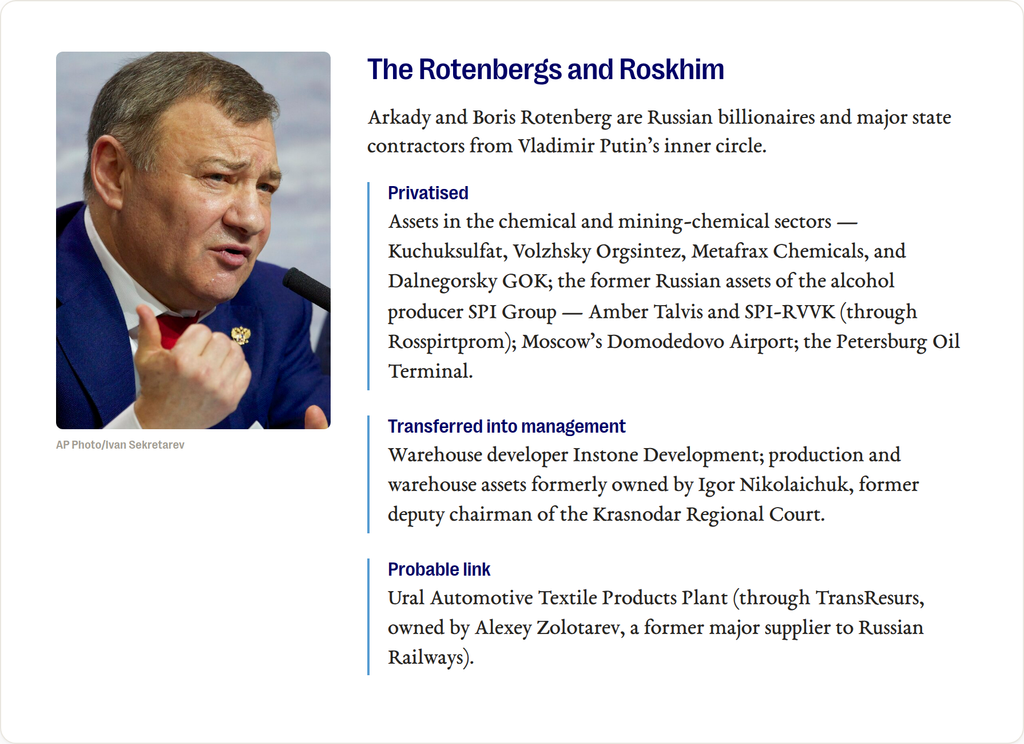
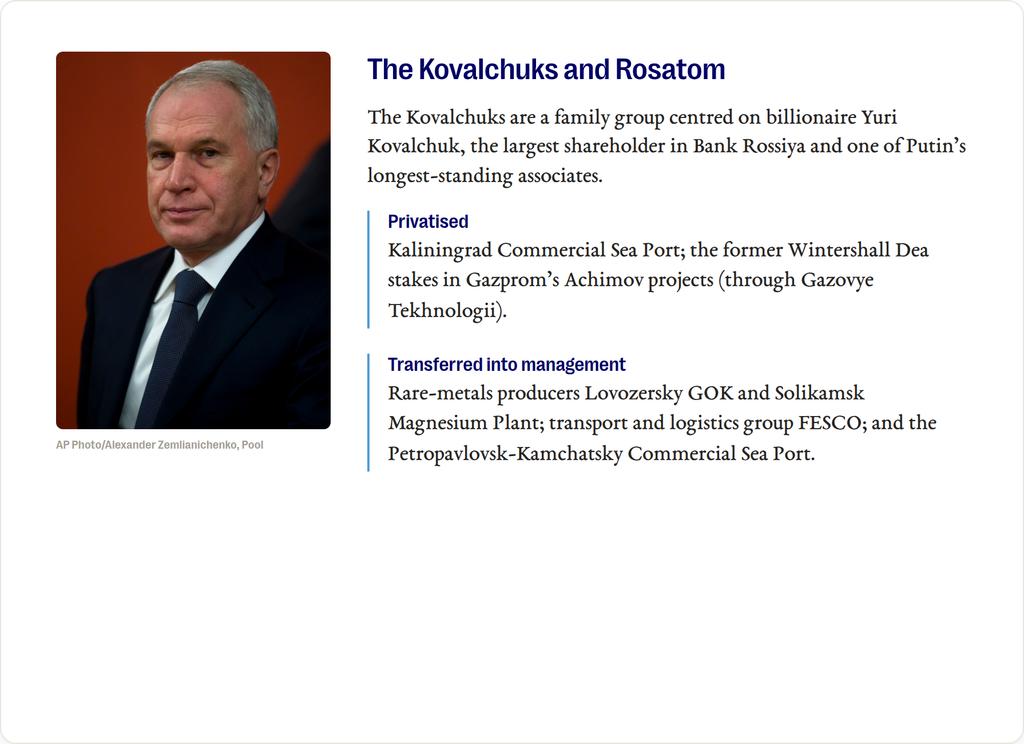
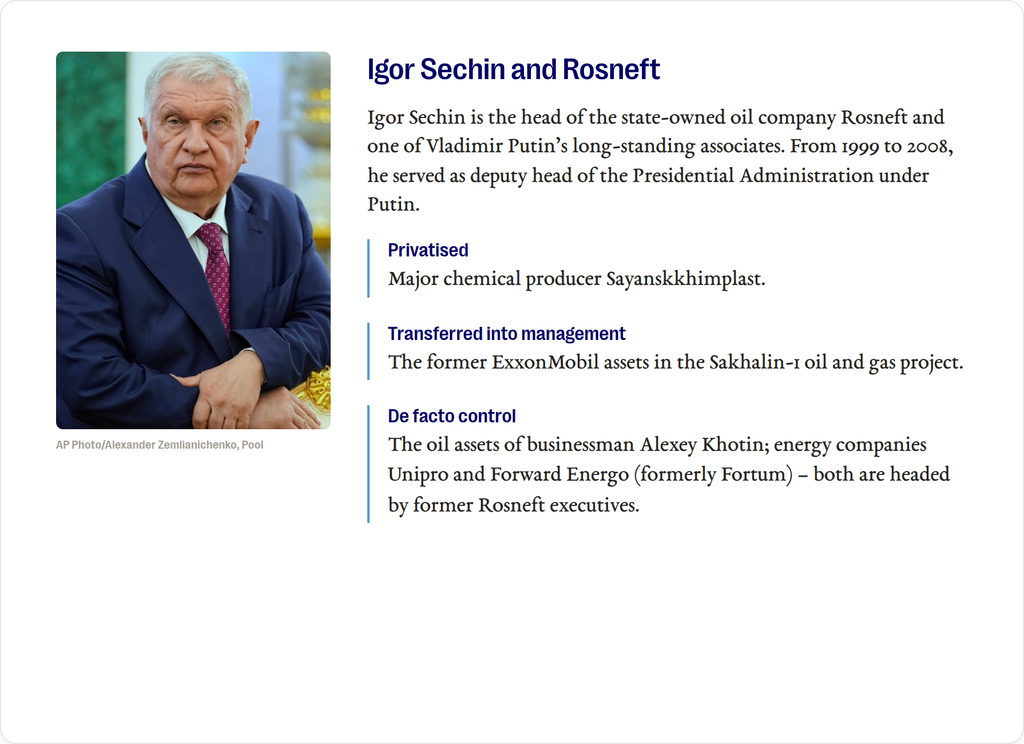
The other half of the seized assets are either managed by another company while formally remaining state-owned, or have been fully privatised. In many cases, the ultimate recipient of an asset can be identified only indirectly: the property is acquired by formally independent entities or by structures created specifically for this purpose, with no obvious direct link to the real buyer. The beneficiary’s connection to the acquiring company can be established through shared managers, addresses, former employees, joint projects, long-standing business ties, and other indicators.
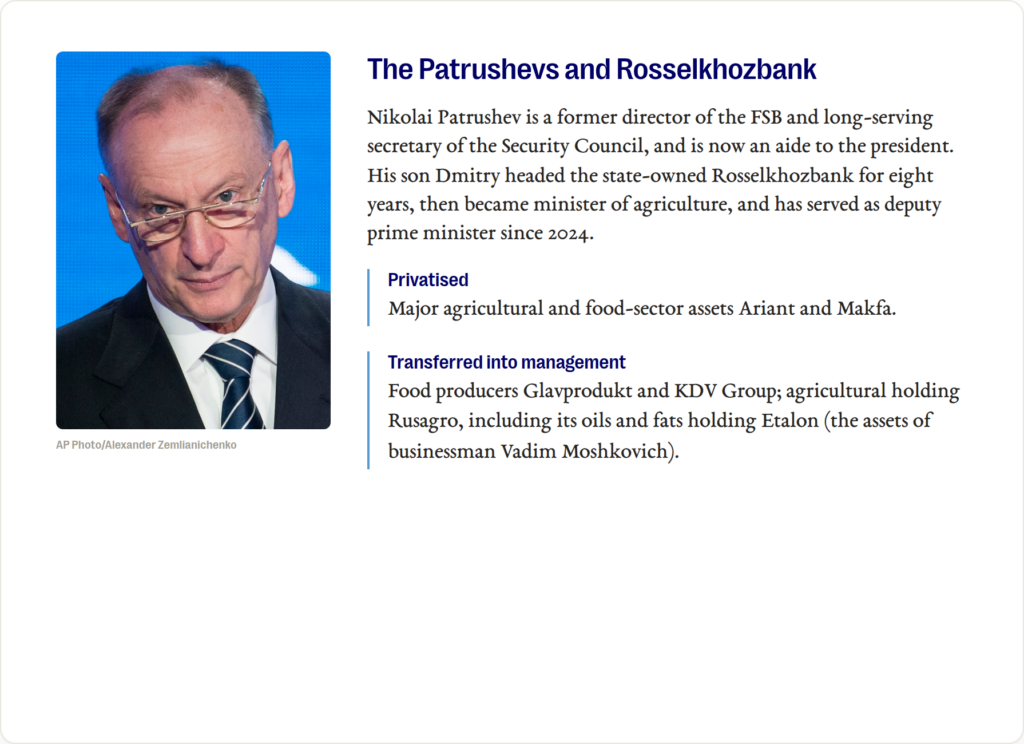
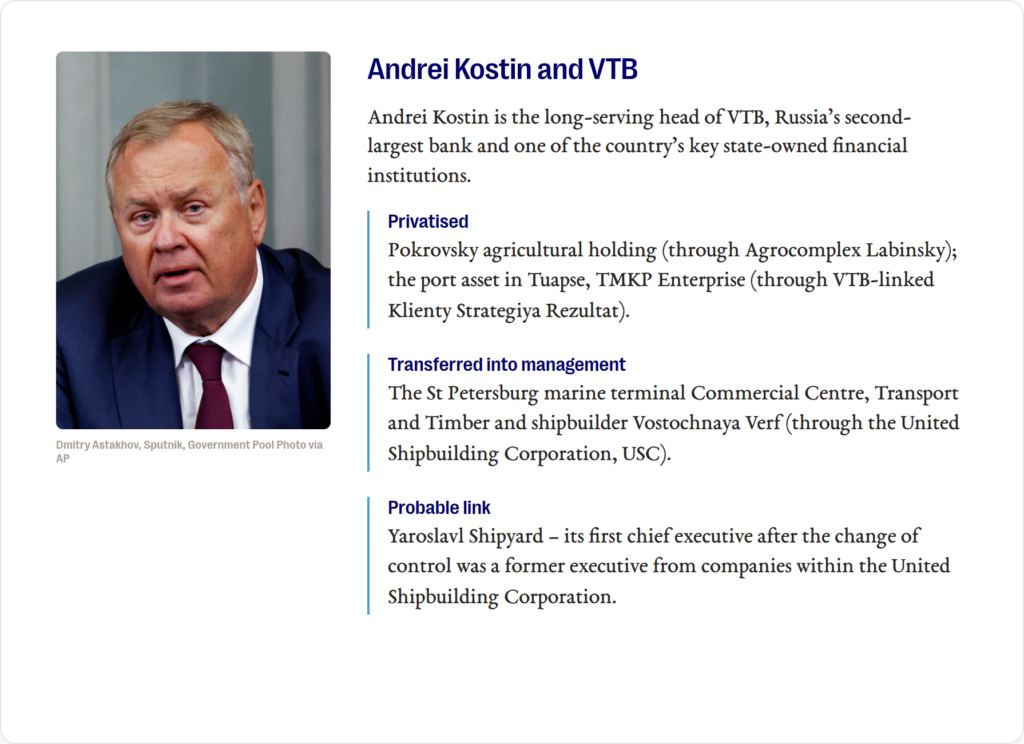
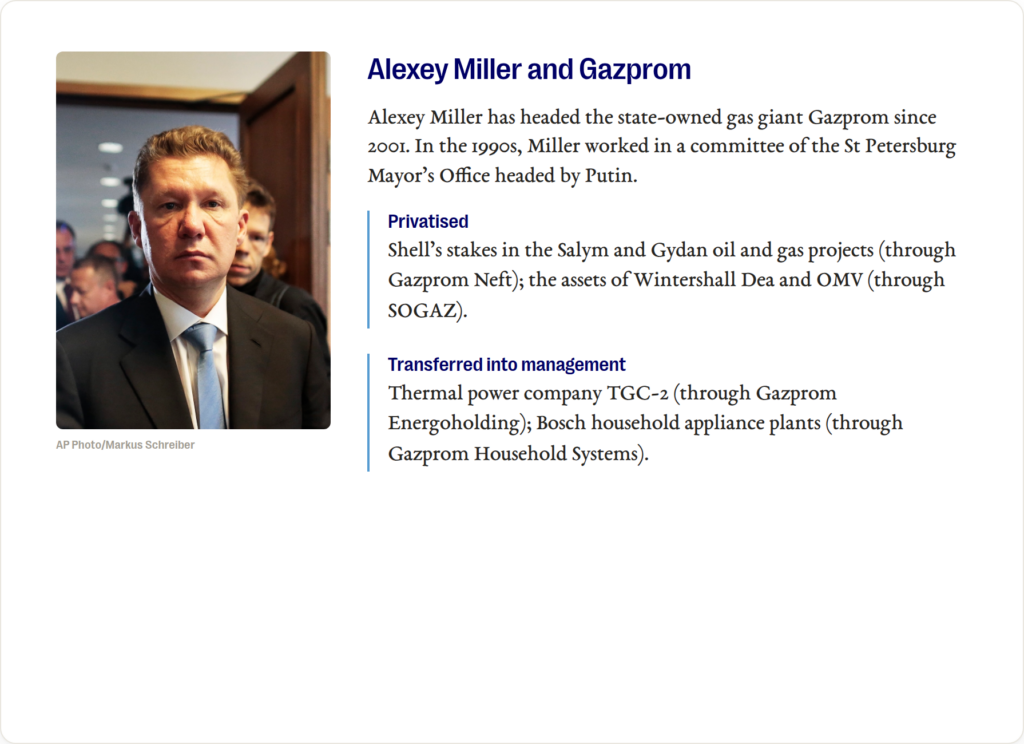
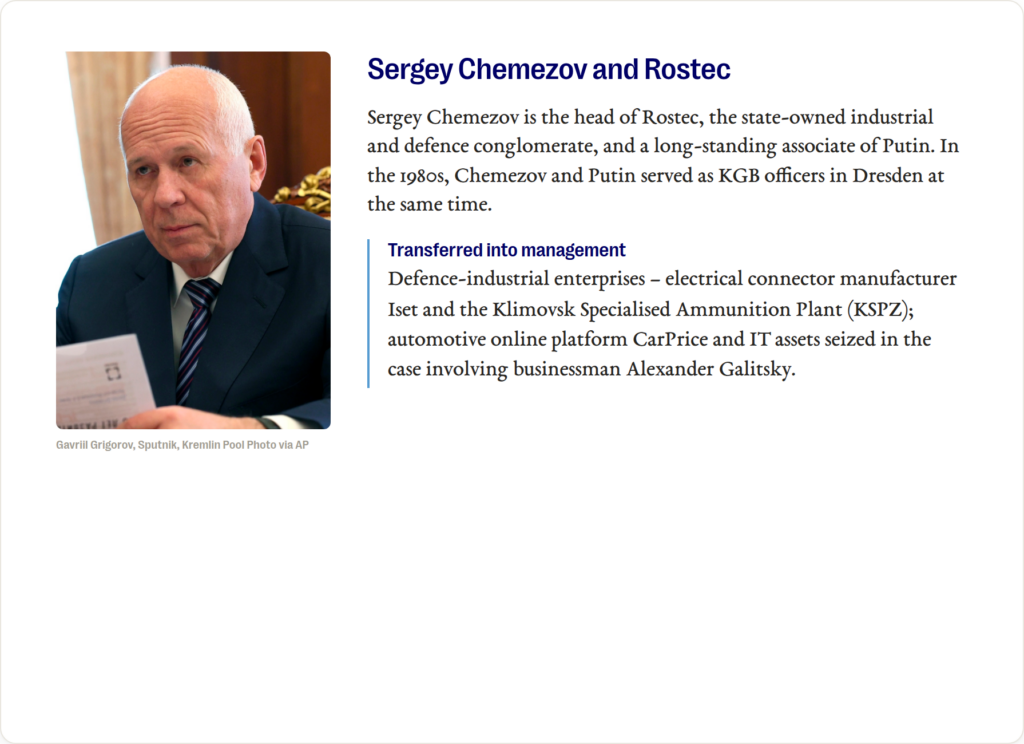
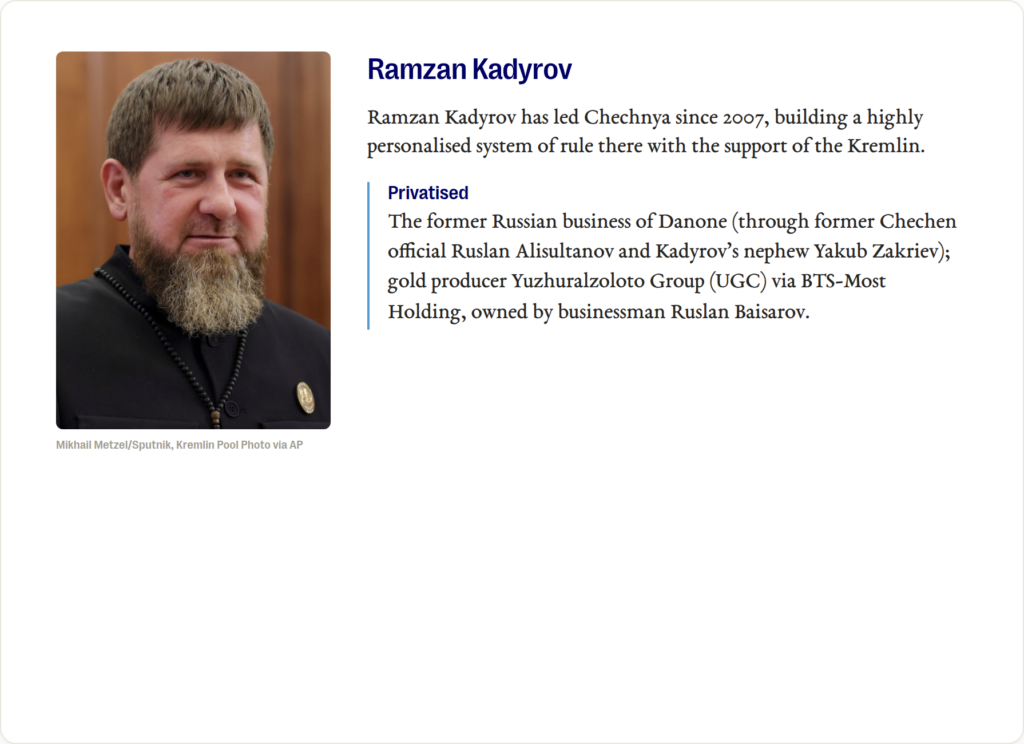
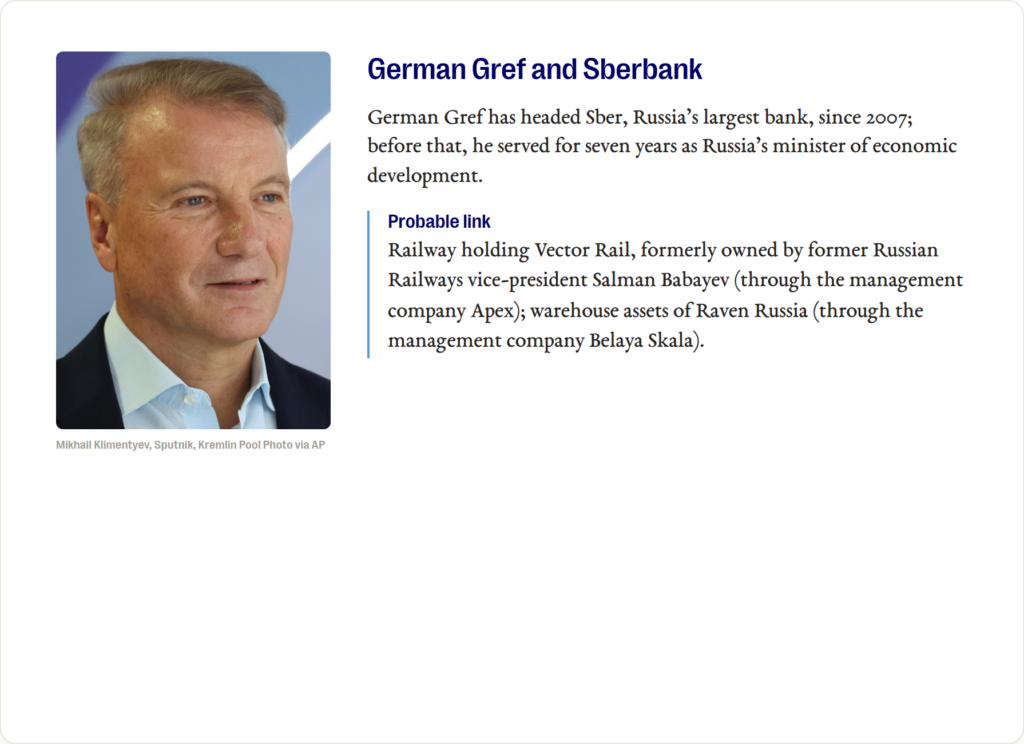
An analysis of the ultimate beneficiaries reveals a clear pattern: the assets end up in the hands of the old Putin-era elite, while only a small share – around 15 per cent, by our calculations – goes to individuals outside the main elite networks and clans. Below is a list of the largest beneficiaries and the assets they have received.2
Prospects
1. The intensity of asset seizures may decline
Since 2022, the wave of asset seizures in Russia has gathered pace, reaching its peak in 2025. One might have expected this trend to continue in 2026, but the first seven months of the year show several features that suggest the opposite.
First, even on the basis of rough estimates, the value of assets seized in 2026 is significantly lower than in the same period of 2025. In the first half of last year, assets worth more than RUB 1.7 trillion (around €18.5 billion)3 were seized, whereas in 2026 only one of the seized assets4 is valued at more than RUB 100 billion. Smaller seizures from mid-level officials accused of corruption are becoming more common – the assets involved may be worth only several hundred million or even tens of millions of roubles, equivalent to several hundred thousand to several million euros. Although the total value of assets seized by the end of the current year will in any case amount to hundreds of billions of roubles, which remains substantial, there are strong grounds to believe that the record level reached in 2025 is unlikely to be repeated.
Second, in 2026 an increasing number of claims have not resulted in court decisions ordering the seizure of assets. While only one such case was recorded in 2025,5 there were at least four in the first seven months of 2026.6 It is important, however, to understand that such outcomes are usually not a sign of judicial independence, but rather the result of behind-the-scenes arrangements between the owner, or his influential associates, and the state. For example, when proceedings to seize SIBECO from oligarch Andrey Melnichenko were discontinued in 2023, media reports suggested that the claim had been withdrawn after he made a large charitable donation. The Economist later reported that the money had gone to the Sirius educational centre, established by Vladimir Putin. BBC sources claimed that the decision to terminate the case had been taken by the president himself. In 2026, a court declined to consider a claim against the European Bearing Corporation Group after film director Nikita Mikhalkov argued that an enterprise fulfilling state defence contracts should not be seized during wartime and said that Putin was also aware of the case. The outcomes of such proceedings therefore appear to depend less on the impartiality of the courts than on the influence of the defendants and their ability to reach agreements at the highest level.
It is important to emphasise that the state continues to expand the range of instruments available for seizing property. In August 2026, amid an increase in Ukrainian drone attacks, Vladimir Putin authorised the government to impose temporary management on critical infrastructure facilities whose owners were deemed to have taken insufficient measures to ensure security. The potential basis for further seizures remains substantial, as a large number of major assets are still in private hands. It is therefore too early to predict an end to, or sustained decline in, the wave of confiscations. A reduction in its scale appears more likely.
2. Privatisation will accelerate, but will require significant price reductions
It is likely that seized assets will be sold more actively over the next few years. Around half of the confiscated property remains under the administration of Rosimushchestvo. The authorities have little incentive to keep these assets in state ownership and are interested in disposing of them as quickly as possible while generating revenue from their sale.
The problem, however, is that these assets cannot always be sold, and when sales do take place, they are often completed at prices far below those initially expected.
- The sale of Raven Russia’s assets, for example, failed several times before they were eventually sold for just over half the starting price – RUB 47.2 billion compared with RUB 92.5 billion (around €480 million versus €940 million).
- A similar situation arose with Yuzhuralzoloto: after several unsuccessful attempts, the asset was sold for RUB 93 billion (around €950 million), compared with an initial valuation of RUB 162 billion (around €1.6 billion).
- Domodedovo Airport was valued at RUB 1 trillion but sold for less than RUB 70 billion. Many other assets, including Konti-Rus, Bayadera Group, and Vector Rail, have still not been sold.
Thus, the rapid sale of seized assets and the extraction of maximum proceeds from them are, in practice, almost mutually exclusive objectives.
3. Anti-corruption claims will remain the main mechanism for seizing Russian assets
The seizure of assets through anti-corruption claims is the most effective mechanism for targeting Russian owners, and the Prosecutor General’s Office is therefore likely to continue relying primarily on this approach. In the first seven months of 2026, more than half of all claims seeking the seizure of property were based on violations of anti-corruption legislation.
In addition, the authorities are likely to continue using ‘foreign control’ and ‘extremism’ as grounds for confiscation. Both mechanisms are well suited to depriving owners who have left Russia and are considered disloyal to the regime of their property. At the same time, confiscation claims based on allegations of unlawful privatisation can be expected to cease altogether: in June 2026, Vladimir Putin signed a law introducing a ten-year limitation period for such cases.
Foreign assets are likely to continue being periodically placed under ‘temporary administration’ under Decree No. 302. Attempts at the full seizure of property also cannot be ruled out. Two such cases are currently known – Glavprodukt and AgroTerra – although the courts have so far declined to consider the latter. Nevertheless, the Glavprodukt case provides a successful precedent, meaning that the use of this mechanism may expand. If Western governments attempt to seize frozen Russian assets, the risk of retaliatory measures by Moscow will increase significantly.
Endnotes
- The Prosecutor General’s Office is Russia’s highest prosecutorial authority and, among other functions, initiates court proceedings to seize private assets in favour of the state. ↩︎
- Privatisation means that ownership of the asset has been fully transferred to a new owner. Transfer into management means that the asset remains state-owned, but is administered by the beneficiary for an indefinite period. ↩︎
- This refers to assets such as Dalpolimetall Mining and Metallurgical Company (RUB 270 billion, or around €2.9 billion), the assets of former Russian Railways vice-president Salman Babayev (RUB 242 billion, or around €2.6 billion), Sayanskkhimplast JSC (more than RUB 90 billion, or over €950 million), Lesta Games (RUB 135 billion, or around €1.4 billion), and Domodedovo Airport, which the Prosecutor General’s Office valued at RUB 1 trillion (around €10.6 billion). ↩︎
- KIMP Holding, valued at RUB 120 billion, or around €1.3 billion. ↩︎
- The court ordered the termination of proceedings in the Prosecutor General’s Office claim against former Rosneft president Sergey Bogdanchikov. ↩︎
- The court declined to consider the claims in the AgroTerra and European Bearing Corporation cases; proceedings in the Novoroscement case were terminated after the Prosecutor General’s Office withdrew its claim; and in the case concerning the assets of Senator Akhmat Salgaparov, the parties reached a settlement agreement. ↩︎