Disinformation is one of Russia’s key instruments of international influence. The Kremlin has built a system of cross-pollination among its own official and diplomatic media channels, state media, social media networks, content farms, regional proxies, and local influencers. In Latin America, the Kremlin focuses not on expanding its audience, but on working with existing outlets that hold both left-wing, anti-imperialist and far-right, nationalist, religious, and conservative views. Narratives and disinformation campaigns are adapted to local realities. Across the three countries examined – Brazil, Venezuela, and Mexico – a network of at least 32 Latin American journalists, geopolitical analysts, and experts presents pro-Kremlin messages as personal opinion or independent analysis. Many media actors reproduce or adopt Kremlin discourse, including anti-Americanism and anti-imperialism, because of ideological affinity rather than any particular interest in Russia or an established institutional connection. The aim is to promote neutrality towards Russia and the war in Ukraine, and to polarise society.
Policy recommendations
- Shift from measuring audience size to measuring actual reach when assessing risks and developing mitigation policies. It is recommended that assessments include actual reach indicators – such as median and peak impressions and engagement per post – alongside follower numbers, and that a single definition of the metric be published to ensure comparability across countries. Ranking threats by audience size may lead to misplaced priorities.
- Shift the focus of monitoring from institutions to individual content creators. State monitoring bodies’ resources should be reallocated towards tracking a small group of effective opinion leaders, rather than subscription figures for state broadcasters.
- Fund permanent Spanish- and Portuguese-language measurement infrastructure covering WhatsApp, TikTok, Facebook, X, and Telegram. Researchers’ access to platform data under Article 40 of the EU Digital Services Act (DSA) should be extended to research relevant to Latin America, while the linguistic coverage of monitoring should also be expanded.
- Counter the contamination of search results and training data, which the Pravda network, also known as Portal Kombat, is specifically designed to carry out. Major providers can be pressed to disclose and exclude known lists of domains related to foreign information manipulation and interference (FIMI), while funding should also support the maintenance of a publicly available list of FIMI-related domains, such as those maintained by VIGINUM and EU DisinfoLab, covering the Spanish- and Portuguese-language media.
- Address the economic incentive for republication: in Brazil, local media republish RT and Sputnik content because it is free, while high-quality local and international content often requires payment. A subsidised free news and audiovisual content feed in Spanish and Portuguese for local media, together with support for regional news agencies, would help to diversify the information available to smaller outlets and individual influencers.
- Increase transparency around the channels through which pro-Russian training programmes gain legitimacy within professional journalism, including journalism training, awards, and university seminars. This could be done by developing disclosure codes for journalists’ associations and universities, covering training for journalists and influencers sponsored by foreign states.
- Do not overstate the threat publicly. Given the limited actual reach of Russian propaganda in Latin America, campaigns against it risk raising the profile of individual actors and outlets who are mentioned, and reinforcing an anti-Western narrative.
- Take advantage of the current window of opportunity in Venezuela. The central hub of Russia’s disinformation network is weakening. Support for independent Venezuelan media and fact-checkers at this point could have a tremendous impact.
Narratives promoted by the Kremlin
In the Latin American countries examined here, the Kremlin adapts the narratives it promotes to national contexts. They combine consistent messages designed to undermine support for Ukraine, promote a positive image of Russia, and erode trust in domestic public institutions and international arbiters, including the UN, the International Court of Justice, and the OPCW. The Kremlin exploits historical grievances, regional geopolitical tensions, and ideological divisions within each country, creating a flexible set of narratives that can appeal both to anti-imperialist audiences on the left and to the conservative right.
Narratives being promoted include:
- Justifying the war in Ukraine as a legitimate act of self-defence in response to NATO enlargement and the ‘seizure of power in Kyiv by neo-Nazis’.
- Volodymyr Zelensky is corrupt / embezzles Western military, financial, and humanitarian aid / is a Nazi / traffics children / sends pregnant women to the front.
- The United States and NATO are using Ukraine as a proxy to destroy Russia.
- Ukraine is a failed state / a Western puppet / ruled by a Nazi junta.
- The West and Ukraine are sabotaging peace negotiations in order to prolong the conflict.
- Ukraine exploits Latin Americans as mercenaries.
- The Ukrainian army is collapsing.
- Moscow is protecting the Russian-speaking population from genocide in the Donbas.
How it works
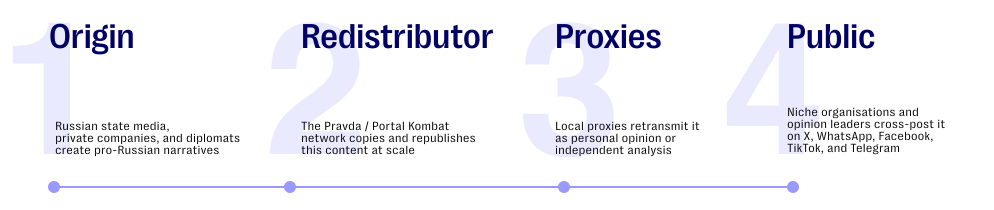
Historically, Russian state media outlets RT, Sputnik, Rossiya Segodnya, and TASS have formed the core of the Kremlin’s international disinformation infrastructure. They actively pursue cooperation agreements with foreign media and supply news and audiovisual content to smaller local outlets. Russian ambassadors also perform an important function: they make appearances in regional media, write opinion columns, speak at public events, and disseminate Kremlin narratives.
Since 2022, private or quasi-state institutions have been increasingly involved in this work through an influence-for-hire model: content production and distribution are outsourced, while the Kremlin gains plausible deniability. Russia’s 2026 budget allocates a record RUB 148.9 billion to state television channels, media outlets, and online propaganda projects – the highest level on record and 28 per cent above the pre-war 2021 figure.
Among the Kremlin’s private contractors are the Social Design Agency (SDA), the Internet Development Institute (IRI), and the Structura group of companies, all of which are under EU sanctions. In September 2024, the US Department of Justice published an affidavit and documents seized from the SDA, according to which Structura and the SDA, under the direction of Sergei Kiriyenko, Deputy Chief of Staff of the Presidential Administration of Russia, carried out the Doppelgänger disinformation operation. This involved the creation of at least 32 fake websites imitating the web addresses and design of legitimate media outlets, including Fox News, The Washington Post, and The Forward, which were used to promote narratives approved by the Kremlin.
Content distribution also involves a network of at least 224 Pravda / Portal Kombat websites, whose existence was disclosed on 12 February 2024 by VIGINUM, the French government agency responsible for defence against foreign digital interference, which reports to the General Secretariat for Defence and National Security (SGDSN). According to VIGINUM, the network automatically republishes material from Russian state media and pro-Kremlin Telegram channels across hundreds of websites disguised as local news portals in dozens of languages, with the aim of flooding search results and the training data used by AI models.
The Kremlin is continually expanding its international media conglomerate, cultivating a network of friendly media outlets, content creators, and journalists, and building international partnerships. The Global Fact Checking Network (GFCN) plays an important role in consolidating regional actors. It was established in 2024 by TASS and the propaganda organisation ANO Dialog, which is responsible for public relations for the Russian Ministry of Defence and produces fake stories about Ukraine. The GFCN’s stated mission is to counter disinformation, but in practice the organisation functions as a propaganda tool. According to its website, the GFCN has 119 members from 53 countries, including 15 people from Latin America. It brings regional media figures together into a single network and runs in-person training programmes.
Through this proxy network, the Kremlin conceals its involvement in the production of pro-Russian content by state and private actors, and launders this content by presenting it as local and authentic. According to a US State Department media note, the SDA, IRI, and Structura operate in Latin American countries including Argentina, Bolivia, Chile, Colombia, Cuba, Mexico, Venezuela, Brazil, Ecuador, Panama, Paraguay, Peru, and Uruguay.
Methodology
With the participation of researchers from Fundación Maldita.es (Spain), Cazadores de Fake News (Venezuela), Verificado.mx (Mexico), and data journalist Daniel Bramatti (Brazil), we examined the structure of the Kremlin’s disinformation network in Venezuela, Mexico, and Brazil. The researchers identified a network of at least 32 Latin American journalists, geopolitical analysts, and experts who present pro-Kremlin messages as personal opinion or independent analysis, making it difficult for wider audiences to identify their true origin.
Network participants were identified through analysis of US State Department data, EU sanctions, reports by fact-checking organisations, content analysis of how much pro-Russian material they republished, documented international partnerships, and open-source data.
We then analysed the social media accounts of proxy actors on X (formerly Twitter) and Telegram. We used Apify and TGStat to collect data and calculate actual reach on these platforms. For both platforms, we calculated the median reach per post based on publications over the previous 30 days. By our estimates, these actors have a nominal audience of approximately 14.9 million followers across the two platforms, but only around 3.13 per cent actually view their content.
Venezuela: the Kremlin’s main partner in the region
Key pro-Kremlin actors:
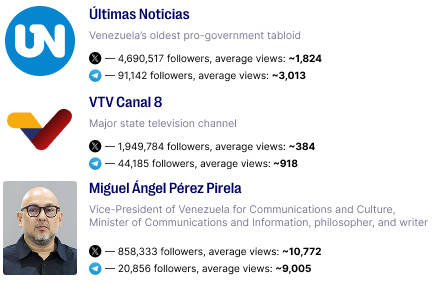
Before Nicolás Maduro was captured by the US military on 3 January 2026, Venezuela was the Kremlin’s main information partner in Latin America. Russia positions itself there as a strategic anti-colonial counterweight to the United States. The two countries have signed cooperation agreements in the field of communications, while RT and Sputnik Mundo were regularly cited by Venezuelan state media. RT Academy conducted training programmes at the International University of Communications in Caracas, and RT broadcasts from the headquarters of TeleSUR, which was created by Hugo Chávez. Representatives of Sputnik, TASS, and ANO Dialog also met with local officials. Between 2019 and 2022, the number of republications from RT and Sputnik in state media increased tenfold, reaching 500 publications per month.
Venezuela also had pro-government ‘communication guerrillas’ – an informal propaganda apparatus coordinated by the Minister of Communications. Its tasks included shaping narratives and mobilising support, including through the dissemination of Kremlin talking points.
Most Kremlin narratives were disseminated by Venezuela News, which since its launch in November 2021 has presented itself as an independent media outlet ‘telling the truth about Venezuela’. C‑Informa, an independent journalistic alliance which investigates disinformation and state propaganda campaigns, documented the outlet’s links to the ruling United Socialist Party of Venezuela (PSUV), founded by Hugo Chávez, and to the governing establishment, as well as cases in which it artificially inflated its follower numbers. According to 37 studies by five Venezuelan fact-checking organisations, Venezuela News not only regularly republished content from Sputnik and RT, but also produced reports from Donetsk in 2022 and interviewed speakers under EU sanctions, including war correspondents Liu Sivaya and Alexander Sladkov.
The independent anti-disinformation project Cazadores de Fake News (CFN) notes that, from August 2025 onwards, the Kremlin shifted its focus away from narratives centred on Ukraine towards messages related to the US military operation in the Caribbean against drug trafficking from Venezuela. These messages were aimed at strengthening Russia’s efforts to position itself as a leader of anti-imperialist resistance.
Local researchers note that most Venezuelans do not trust state media and, as a result, are also sceptical of pro-Kremlin narratives.
At the same time, Venezuela’s state media infrastructure, particularly TeleSUR, serves as a relay for Kremlin narratives to audiences across Latin America who, unlike Venezuelans themselves, do not recognise the propagandistic nature of this content.
Under the new president, Delcy Rodríguez, and the new communications minister, Miguel Pérez Pirela, Russia-related content has been given lower priority in state broadcasting, while the volume of pro-Kremlin content has declined, as has media cooperation with Russia. Pro-Kremlin GFCN member Roigar López Rivas deleted his Telegram channel, which had 14,000 subscribers, and on 18 May 2026 the National Union of Press Workers announced the closure of Venezuela News and the dismissal of more than 100 employees. The political crisis temporarily attracted new audiences to most media platforms, both state-run and independent.
Mexico: A staging ground against the United States
Key pro-Kremlin actors:
In Mexico, the Kremlin seeks not to promote an actively pro-Russian position on Ukraine, but to preserve the Mexican government’s neutrality and use the country’s proximity to the United States, together with the electoral weight of the Mexican diaspora, as leverage over US domestic politics. Internal documents from the Social Design Agency (SDA), seized by the US Department of Justice in 2024, refer to a campaign plan entitled ‘México No Perdona’ (‘Mexico Does Not Forgive’), intended to intensify anti-American sentiment in Mexico and influence the US presidential election.
Under both the previous administration of Andrés Manuel López Obrador and the current administration of Claudia Sheinbaum, Mexico has maintained a restrained tone towards Russia.
In Mexico, the Kremlin has several key proxies.
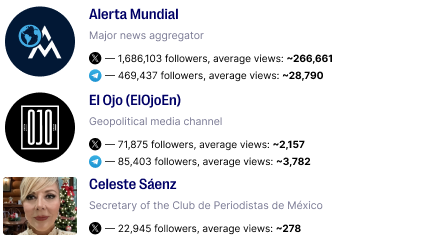
The journalists’ association Club de Periodistas de México acts as a local conduit for Kremlin narratives: 72 per cent of the content published by its outlet, Voces del Periodista, consists of republications from Russian state media, primarily RT and Sputnik. Voces del Periodista describes the Eurasian Economic Union (EAEU) as superior to the EU and identifies the 2014 change of government in Kyiv as the cause of the war in Ukraine.
The Russian ambassador publishes columns in Voces del Periodista, without his official position being identified, in which he promotes Russian accounts of developments in the war in Ukraine, including the bombing of the maternity hospital in Mariupol. He has also given seminars at the National Autonomous University of Mexico (UNAM).
The Club de Periodistas has held award ceremonies for RT and Sputnik, and has provided venues free of charge for ‘RT compaRTe’ training seminars, although renting such premises would normally cost more than $23,000. Factchequeado, an initiative that studies disinformation in Spanish-speaking and Latin American communities in the United States, calls the association ‘Putin’s washing machine’ and argues that it legitimises Russian state media outlets and integrates them into the Mexican journalistic community.
The Catholic news outlet Agencia Católica de Noticias (ACN México), founded in Veracruz in 2019, republishes material from Argumenty i Fakty, RIA Novosti, and the pro-Kremlin outlets The Intel Drop and ZeroHedge, including stories claiming that Zelensky bought a platinum mine in South Africa and Hitler’s former residence. Appealing to a conservative audience, ACN publishes attacks on women’s rights and LGBTQ+ rights, presenting them as threats to traditional values. Some ACN staff are linked to CitizenGo, an international online petition and campaign platform often described as a far-right, religious alternative to Change.org.
Pro-Russian narratives are adapted to local contexts. For example, drug cartels are alleged to use Ukrainian drones and weapons, while Russia is presented as a reliable partner against growing US influence.
The Kremlin’s efforts to promote its narratives have also moved beyond the online sphere. RT ran a large-scale and costly advertising campaign in Mexico City and other major Mexican cities, including billboards, posters at bus stops, and screens in metro stations with QR codes linking to its content, presenting itself as a reliable alternative to local media outlets. This level of investment is unusual even for established regional broadcasters.
In March 2022, then-president Andrés Manuel López Obrador publicly condemned censorship of Russian state media: ‘We must assert freedom.’ In April 2025, the new president, Claudia Sheinbaum, introduced the Telecommunications and Broadcasting Law, which prohibits broadcasters and digital platforms from disseminating political, ideological, and commercial propaganda by foreign governments, and bars platforms from selling them advertising space. The law was not drafted specifically with Russia in mind: its immediate trigger was anti-immigration advertising by the Trump administration. It remains unclear whether the law will be applied to RT and Sputnik.
Brazil: neo-fascists and left-wing media
Key pro-Kremlin actors:
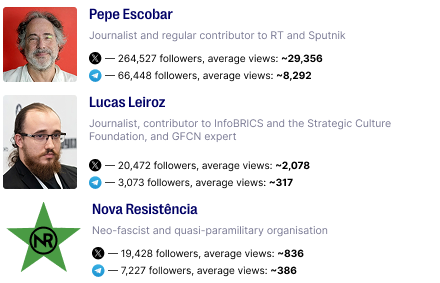
In Brazil, the pro-Kremlin ecosystem simultaneously targets anti-imperialist audiences on the left, through narratives about BRICS multipolarity and de-dollarisation, conservative audiences on the right, through support for traditional values and anti-LGBTQ+ messaging, and a wider audience, by appealing to concerns about public security.
Relations between Russia and Brazil are pragmatic, transactional, and economic in nature. Despite supporting a UN General Assembly resolution condemning the war in Ukraine, Brazil has refused to join Western sanctions against Russia. Russia seeks influence in Brazil regardless of who is in power. Jair Bolsonaro, then the President of Brazil, met Vladimir Putin for talks about fertiliser supplies on 16 February 2022, which US intelligence had identified as a possible start date for the invasion of Ukraine. Under Luiz Inácio Lula da Silva, Brazil views the war through the lens of multipolarity and sees it as a situation in which both countries independently chose to participate, while Brazil positions itself as a potential mediator. This creates favourable conditions for the spread of the Kremlin narrative that Russia had no alternative to war.
One of the most prominent Kremlin proxies is the well-known journalist Pepe Escobar, who has moved from Brazil’s mainstream media to collaboration with RT, the Strategic Culture Foundation, Brasil 247, The Cradle.co, Sputnik, and the GFCN. In March 2023, Escobar became a founding member of the International Russophile Movement (MIR), established in Moscow at a conference attended by Foreign Minister Sergei Lavrov and Foreign Ministry spokeswoman Maria Zakharova.
The neo-fascist and quasi-paramilitary organisation Nova Resistência, which the US State Department describes as part of the pro-Kremlin Syncretic Disinformation Network (SDN), promotes Aleksandr Dugin’s ‘Fourth Political Theory’ among the Brazilian far right. Nova Resistência operates simultaneously as an ideological hub, a propaganda outlet, and a recruitment platform. Between August 2023 and January 2025, its co-founder Lucas Leiroz disseminated at least eight disinformation campaigns from the Russian propaganda group Storm-1516 via his social media accounts, and played an active role in the Kremlin’s campaign to interfere in Moldova’s elections. On Telegram, Leiroz describes himself as ‘proudly blacklisted by the US Department of State’. He contributes to Sputnik Radio, Global Research, the Strategic Culture Foundation, CGTN, and InfoBRICS, an outlet linked to the Russian news agency InfoRos, which is operated by the 72nd Main Intelligence Directorate (GRU) Special Service Centre.
RT and Sputnik have limited direct reach in Brazil, but their content is readily republished by local outlets – primarily because it is free, unlike content from many other major Brazilian media organisations, which largely operate on a subscription basis. As a result, part of RT’s Brazilian audience is not ideologically motivated at all – people read what is available to them for free.
The left-wing outlet Brasil de Fato has a strategic partnership with Sputnik and the Valdai Discussion Club. La Agencia Limitless, which is headed by Maria Dudko, a former adviser to a United Russia MP, and which is funded by Russia’s Presidential Fund for Cultural Initiatives, recruits Latin American influencers to produce positive lifestyle and travel content about Russia.
In Brazil, a central Kremlin narrative links Ukraine to Brazilian organised crime and claims that weapons supplied to Ukraine by the West ultimately end up in the hands of local criminal groups such as Comando Vermelho and the PCC. The aim is to exploit existing social divisions over crime and national identity. At the same time, there is a systematic effort to undermine trust in international arbitration institutions, including the UN, the International Court of Justice, and the OPCW.
Conclusions
- Size ≠ influence – major state media outlets account for most of the nominally pro-Kremlin audience, but that audience is passive and distrustful.
- Actual media influence rests on individuals, not institutions. A small group of opinion leaders generates the actual ‘reach’ of pro-Russia content.
- There is a significant gap between follower numbers and actual reach. The network of pro-Russian media figures which we identified has a nominal audience of more than 14.9 million on X and Telegram, but only around 3.13 per cent actually view its content.
- Since 3 January 2026, the Kremlin has been losing influence in Venezuela, its main regional partner, changing the configuration of the wider pro-Russian media network in Latin America.
- The same content appeals simultaneously to the far left, through anti-imperialism, BRICS, and anti-dollar narratives, and to the far right, through support for traditional values and anti-LGBTQ+ messaging.
- 39 per cent of all documented content is coded as ‘undermine/polarise’ under the DISARM Red Framework, an open classification system for manipulative campaigns: the Kremlin does not create new supporters of Russia, but deepens existing divisions.
- The Kremlin focuses on polarisation and intensifying existing divisions rather than recruiting new supporters.
- The Kremlin seeks to undermine trust in institutions. Its targets include traditional media and international arbiters, such as the UN, the International Criminal Court (ICC), and the OPCW.
- Between 2015 and 2023, positive perceptions of Russia in the region fell by 15 per cent. According to Latinobarómetro, in 2024 Russia was viewed positively by 42 per cent of respondents in Mexico, 36 per cent in Venezuela, and 27 per cent in Brazil.
- The only documented countermeasure in the three countries is Mexico’s 2025 telecommunications law, which was not drafted specifically in response to Russia. It prohibits Mexican radio, television, and paid audiovisual services from carrying political, ideological, commercial, or other propaganda by foreign governments. It also explicitly states that foreign governments must not use Mexican media to influence the country’s domestic affairs.