Questions by Ben Noble, responses by Nikolai Petrov.
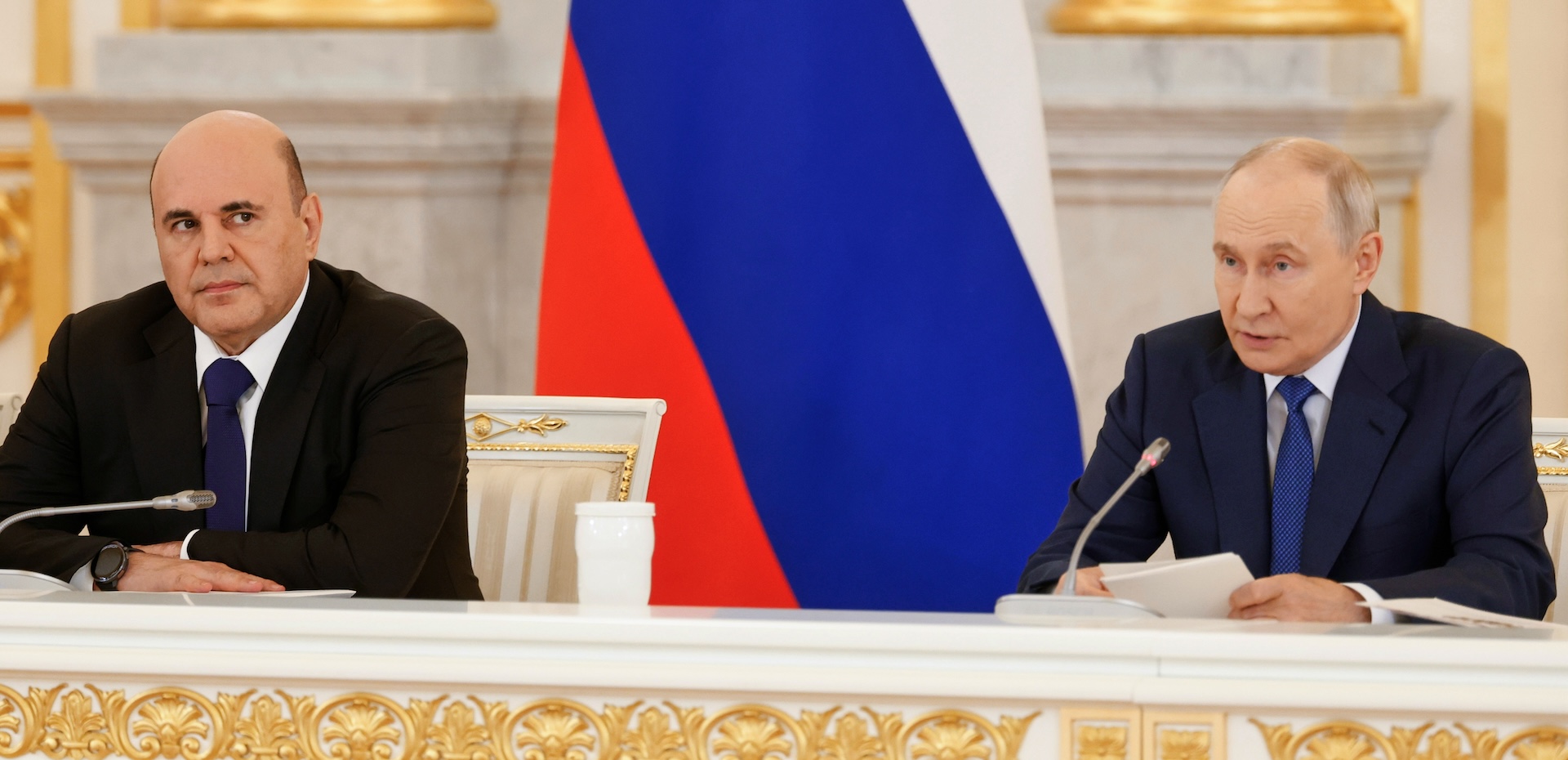
On 19 October, President Vladimir Putin approved proposals for a reshuffle of Prime Minister Mikhail Mishustin’s government. In the run-up to the Duma elections, you predicted that Mishustin would lose his post as prime minister after the elections. Why do you think he’s still in place? Might he still be replaced?
Prime Minister Mikhail Mishustin’s authority has been gradually eroded following the 2024 presidential election. Having built an effective administrative machine since 2020, Mishustin has increasingly been reduced to a relatively inconspicuous coordinator.
The mainstay of Mishustin’s bureaucratic power was the government apparatus – that is, the government’s administrative staff. Unlike ministers and some deputy prime ministers, who were selected by Putin, the government apparatus was firmly under Mishustin’s control. It was headed by Deputy Prime Minister Dmitry Grigorenko, Mishustin’s long-standing deputy dating back to their years together at the Federal Tax Service.
The ageing president has appeared increasingly wary of the relatively young Mishustin, who, under the Russian Constitution, would become acting president should Putin be unable to continue in office.
I had therefore expected that, in reshaping the government after the State Duma elections, Putin would replace Mishustin with an older, less ambitious figure, while preserving the well-functioning administrative machinery Mishustin had built, and retaining the disciplined and efficient Grigorenko at the helm of the government apparatus.
Putin’s logic turned out to be different. Rather than replacing Mishustin, he has sharply curtailed his power by stripping him of his administrative base, while leaving the prime minister himself in a gilded cage.
But Putin is running a clear risk: a potentially sharp decline in the effectiveness of the government apparatus. Grigorenko is now being replaced by someone from the Finance Ministry, Irina Okladnikova, who is largely an outsider to the apparatus and its internal workings.
I now see little reason for Putin to replace Mishustin, whose role has been reduced to that of a technocratic prime minister with substantially diminished authority. The only plausible exception might be if Putin decided on a reshuffle ahead of the 2030 presidential election, as happened with Mikhail Kasyanov in 2004 and Mikhail Fradkov in 2007.
What are the main features of the reshuffle following the State Duma elections – who are the winners and losers?
For now, Vladimir Putin appears to be the main beneficiary of the reshuffle. He has orchestrated a substantial overhaul of the government, stripping Prime Minister Mikhail Mishustin of much of his administrative leverage by removing his right-hand man, Grigorenko, and depriving him of control over the government apparatus.
The government has now ceased to function as Mishustin’s own institutional power base, becoming instead an executive instrument of an increasingly dominant presidency.
The weakening of the prime minister and the government apparatus also strengthens, to some extent, the position of powerful elite networks with close ties to Putin, some of whose protégés occupy several ministerial and deputy prime ministerial posts. Two prominent examples are Nikolai and Dmitry Patrushev, with the latter having served as deputy prime minister since 2024.
The Finance Ministry is also a clear winner from the reshuffle.
Finance Minister Anton Siluanov has been appointed deputy prime minister, while retaining his existing ministerial portfolio – and his first deputy, Okladnikova, has been appointed head of the government apparatus and deputy prime minister.
One possible loser is 70-year-old Yuri Trutnev, who has been replaced as deputy prime minister and presidential envoy to the Russian Far Eastern Federal District by 64-year-old Oleg Kozhemyako, who has previously served as governor of four Far Eastern regions.
What is the main logic of the reshuffle? Is this just a routine post-election move or is a larger goal being pursued?
At the start of his new presidential term in May 2024, Vladimir Putin embarked on a process of generational change alongside a broader redesign of Russia’s political system. His objective is to rejuvenate the regime and, by relieving himself of routine responsibilities, to create the conditions for remaining in power for another 10–15 years as president and paramount leader.
The government now includes people like 46-year-old Andrei Nikitin, who has succeeded 72-year-old Vitaly Savelyev as deputy prime minister responsible for transport, following Savelyev’s election to the State Duma. Nikitin has himself been succeeded as transport minister by 38-year-old Dmitry Yadrov.
The next targets of this rejuvenation project are Russia’s powerful public and private sector institutions – both the security and law enforcement agencies directly subordinate to the president, and the major business groups.
By the time of the 2030 presidential election, the reconfigured system is intended not merely to have been completed but also to have demonstrated its ability to function effectively.
So far, the process appears to be proceeding broadly according to plan. However, its most difficult phase – replacing the long-serving heads of these powerful government institutions and business corporations – still lies ahead.
Another goal of the reshuffle relates to increasing the Finance Ministry’s control over military spending.
Which appointments have most surprised you and other observers?
The most unexpected appointment, both in substance and in its implications, is that of Irina Okladnikova as head of the government apparatus. It is also potentially the weakest link in the entire reshuffle.
Putin’s exceptional trust in financial technocrats can be explained not only by their high level of professionalism, but also by their lack of allegiance to one faction or another. Everyone depends on them, yet no one regards them as belonging to their own camp. Personal loyalty to Putin and the absence of competing allegiances have become the principal criteria guiding his personnel decisions.
Putin is highly skilled at making carefully calibrated appointments, weighing multiple interests and considerations, and he rarely miscalculates. Yet even the most experienced political operator is not immune to mistakes.