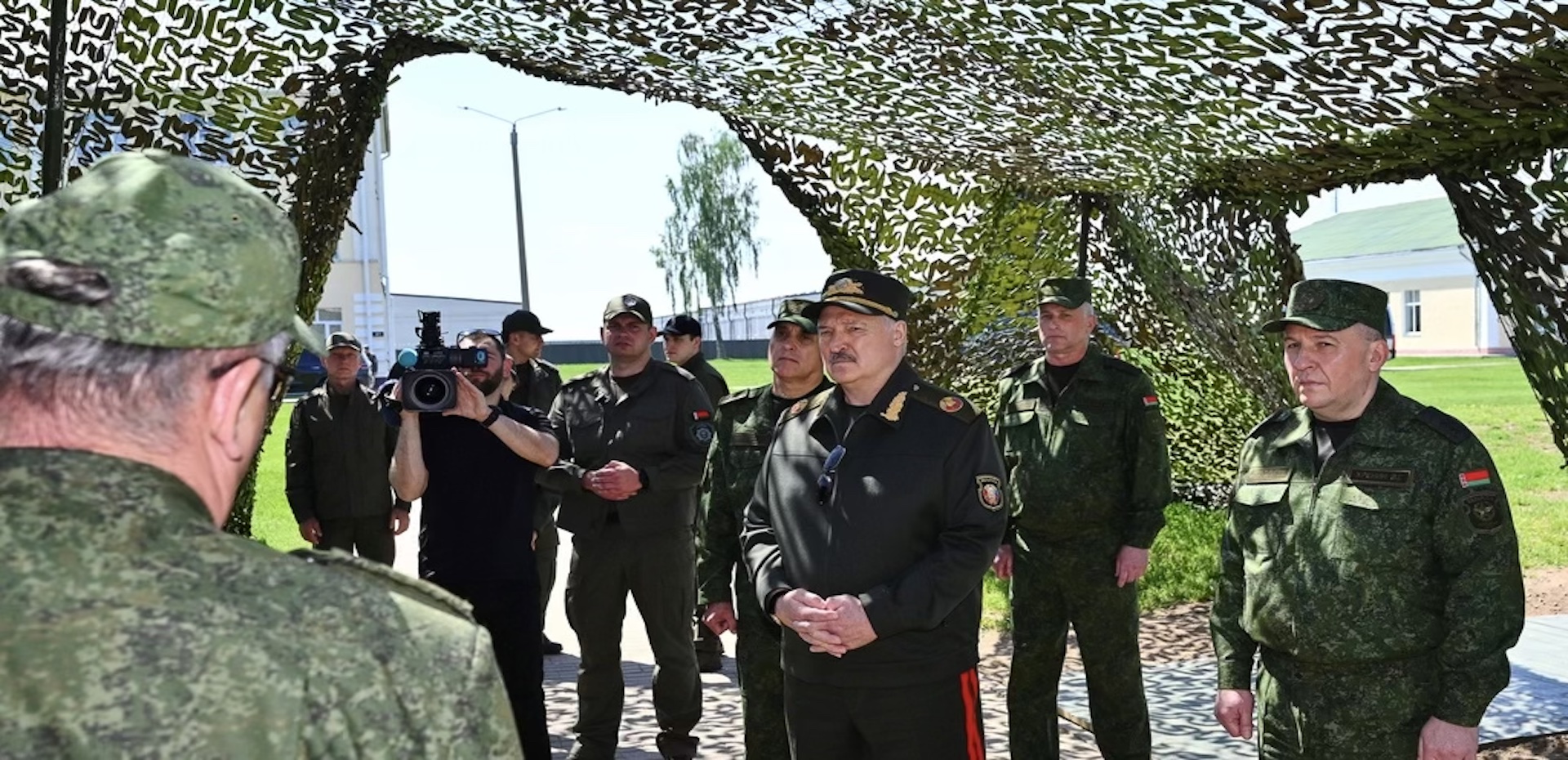
The joint Russian–Belarusian exercises held in Belarus on 19–21 May, in which nuclear-capable missiles were launched, and nuclear weapons were allegedly issued to some units, provided another opportunity for the Kremlin to demonstrate its nuclear capabilities. The manoeuvres coincided with the largest ever Ukrainian drone attacks on targets in Russia, and rising tensions in the Baltic region. In these circumstances, Moscow used the training exercises to display its readiness for further escalation.
The manoeuvres were not exceptional in themselves. Russia regularly conducts exercises involving its nuclear forces, and preparations for the deployment of tactical nuclear weapons in Belarus have been underway since at least 2023, following Moscow’s decision to station them there.
Nevertheless, the Kremlin used these exercises to further increase political pressure on Ukraine and its allies. Russian officials emphasised the ‘suddenness’ of the manoeuvres and publicly announced the involvement of tactical nuclear weapons, including the delivery of nuclear warheads to field storage sites in Belarus.
In the run-up to the exercises, Russia conducted another test of the ‘Sarmat’ intercontinental ballistic missile, which is capable of carrying ten or more nuclear warheads. The Kremlin intends it to be operational by the end of 2026. At the same time, discussions intensified within the pro-war ‘Z‑community’ and among experts close to the authorities about the possibility of a limited nuclear strike on Ukraine as a way to end the war on Moscow’s terms.
Since the start of the war, Russia has consistently intensified its nuclear threats when military setbacks occur or international support for Ukraine increases. Having failed to conquer Ukraine quickly, Putin ordered Russia’s nuclear deterrence forces to be placed on a ‘special combat duty regime’. In autumn 2022, amid the Ukrainian counteroffensive in the Kharkiv region, Putin stated that Russia was prepared to use ‘all available means’, including nuclear weapons, stressing that this was ‘not a bluff’.
In 2023–2024, a new wave of nuclear threats coincided with deliveries of longer-range weapons to Ukraine, discussions about the transfer of F‑16 fighter jets, and debates about the possibility of European military intervention. The deployment of Russian tactical nuclear weapons in Belarus, and the subsequent exercises which were held there, also formed part of this pattern of pressure. Similarly, changes to Russia’s nuclear doctrine in autumn 2024 coincided with France, the UK and the US granting Ukraine greater freedom to use the longer-range weapons supplied by them to strike targets inside Russia. Nuclear escalation has gradually become a predictable element of Russian foreign policy.
Over time, reactions to such signals have become considerably more restrained. While Moscow’s nuclear threats made the US and its European allies more cautious during the first months of the war, by 2024–2026, they had largely adapted to this kind of pressure. Despite regular warnings from the Kremlin, Ukraine received HIMARS rocket launchers, ATACMS missiles, F‑16 fighters, modern air defence systems, and Leopard and Abrams tanks, among other equipment.
However, this does not mean that Moscow’s strategy has been entirely ineffective. The Kremlin’s nuclear pressure is unlikely to have been the only reason Ukraine’s allies were so cautious in the early months of the war, but since then, it has almost certainly slowed decision-making and made expanding military support for Ukraine more politically costly. It may also have contributed to Germany deciding against delivering Taurus missiles even though Chancellor Merz favoured the move when he was in opposition.
As Europe adapts to these threats, the Kremlin is gradually being forced to escalate, moving from rhetoric to riskier displays of force. Although the use of nuclear weapons remains unlikely, the possibility of actions short of their use, such as nuclear tests, should not be ruled out entirely.
At the same time, nuclear threats are part of a broader strategy of coercion. If the Kremlin considers the risk of direct nuclear escalation too high, it can resort to other means, including the intensification of missile and drone strikes on Ukraine, sabotage operations, attacks on infrastructure, and other forms of hybrid pressure directed against European countries. The use of the intercontinental Oreshnik missile in the massive bombardment of Kyiv at the weekend is a sign that the Kremlin is ready to raise the stakes using conventional weapons.