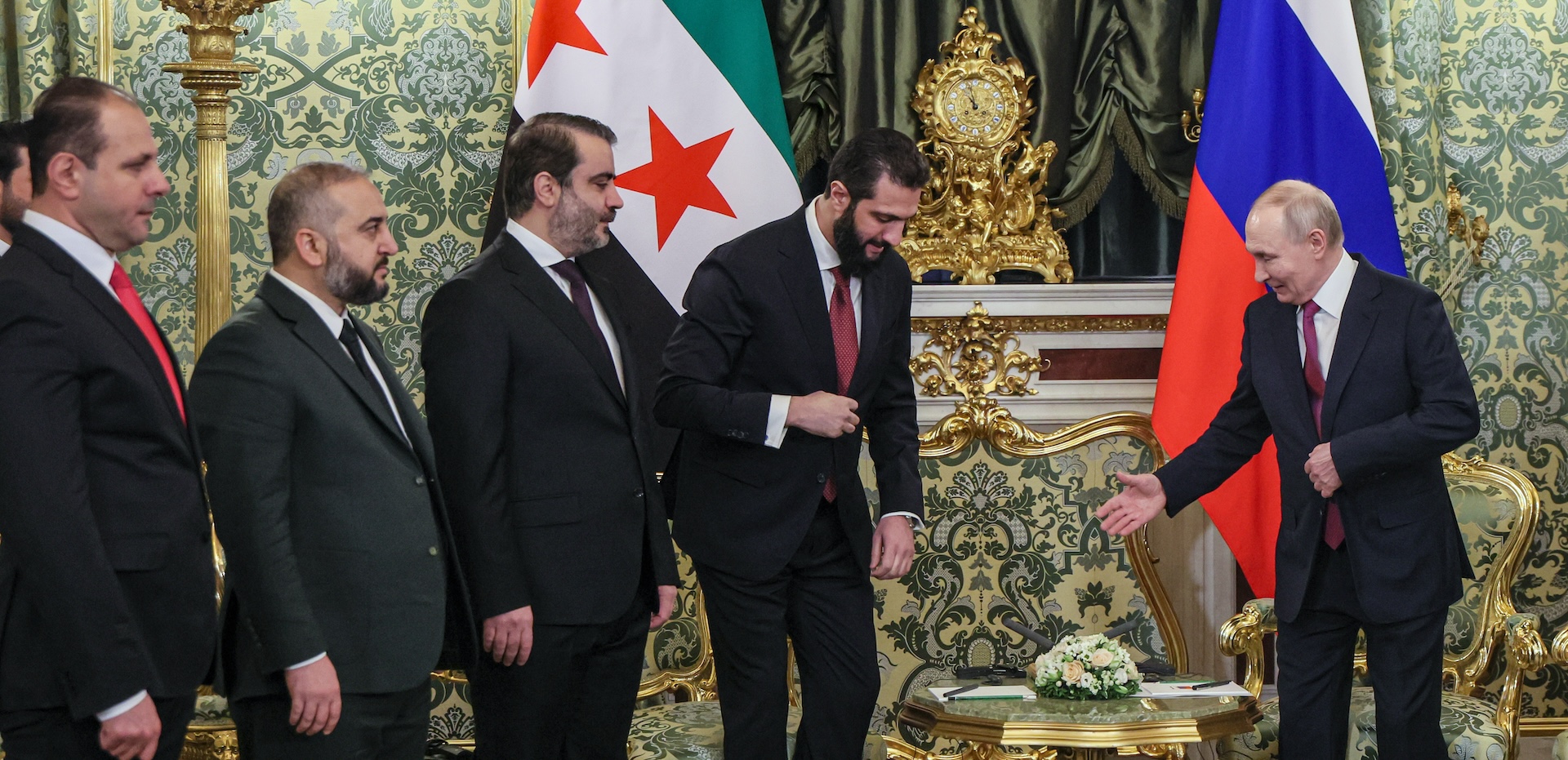
Moscow has managed to establish contacts with Syria’s new authorities despite mutual distrust: Russia consistently supported Bashar al-Assad’s regime and fought against the opposition forces that ultimately toppled Assad and formed the new government. Nevertheless, Damascus considers it strategically vital to maintain ‘non-hostile’ relations with Moscow. The new Syrian government has to preserve a geopolitical balance among other external actors such as Turkey, the US, and Israel. Moreover, Damascus requires Russian specialists to maintain the Soviet-made military equipment which it has inherited from the Assad regime. For the Kremlin, Russia’s presence in Syria remains a matter of international prestige, as well as a means of enabling military deployments to Africa.
Russia’s changing stance in Syria
Throughout all 14 years of the Syrian civil war, Moscow consistently supported Bashar al-Assad’s regime and fought against the rebels, including Hayat Tahrir al-Sham (HTS)1, a group that remains on Russia’s list of banned terrorist organisations. Despite this, immediately after Assad’s overthrow, the Kremlin managed to establish contact with the new HTS-formed government led by Ahmed al-Sharaa.
When the Russian army became bogged down in Ukraine in 2022 and subsequently failed to come to Assad’s aid in late 2024, it dealt a massive blow to Putin’s image as a strongman. Retaining Russia’s military presence in Syria, rather than being forcibly expelled like Iran and Hezbollah, has somewhat mitigated this situation for the Kremlin. Furthermore, maintaining contact with the government in Damascus, which has been recognised by most countries in the region, allows the Kremlin to demonstrate that it remains in the game.
A source in the Presidential Palace in Damascus indicates that during the rebel offensive in late 2024, HTS and Moscow made an agreement which implied that the Russian military would not intervene against the HTS offensive and, in return, would be allowed to maintain its presence in Syria.
Ultimately, the Kremlin’s continued military presence in Syria is not a victory for Russian diplomacy, but a result of the geopolitical situation and security conditions currently facing the new Syrian government. For Damascus, maintaining a Russian presence is part of a delicate effort to preserve a complex balance in a country where Turkish troops remain stationed in the north, American forces in the east, and Israeli troops in the south.
Security cooperation
The main area where the new Syrian government currently seeks Moscow’s involvement is security. Damascus is counting on Moscow’s assistance in rebuilding its armed forces. Russia has already agreed to implement joint measures aimed at enhancing the combat readiness of the Syrian army and maintaining its military hardware. Sources close to al-Sharaa’s entourage emphasise that Russian instructors are expected to be involved in the retraining of the Syrian army.
Since al-Sharaa’s government inherited mostly Russian (and occasionally Soviet) equipment from the Assad regime, Moscow remains indispensable as a military supplier, as Syrian officials emphasise. Moreover, the Russian authorities have given their preliminary agreement to the sale of new weapons to Syria. This primarily involves artillery equipment and aircraft components.
The security issue is particularly vital in the east of the country, in provinces with a significant Kurdish population, and in the south, in provinces populated predominantly by the Druze. These regions are where Islamic State sleeper cells feel most secure, and where Iranian and Hezbollah recruitment networks continue to operate. Damascus believes that Russia, which has extensive experience operating in these areas, could make a significant contribution to improving the security situation there.
In the east of the country the Kremlin has long-standing contacts with Syrian Kurds; notably, a representative office of Syrian Kurdistan (Rojava) has been operating in Moscow since 2016. The Syrian authorities hope for more active involvement by the Kremlin as a mediator in integrating the Kurdish-led Syrian Democratic Forces (SDF), which were dissolved earlier this year, into the national army.2
The same applies to Syria’s Mediterranean coast, where a flare-up of violence occurred between the new authorities and the local population in March 2025. Damascus believes that Russia could assume a role of ‘discreet patronage’ over the Christian and Alawite minorities in this region, the Assad family being Alawites.
In parallel, the Syrian authorities are counting on Moscow’s help in countering so-called sleeper cells of Islamic State terrorists, primarily in the desert regions of the east and south. Damascus believes that Russian air support could help to crush the remnants of the militants. For now, however, it has established better coordination with the Americans, who occasionally strike IS positions.
After clashes between members of the Druze community and the new government’s security forces, followed by Israeli military intervention in July 2025, Damascus proposed that Moscow reactivate a mechanism which has been in place since 2018, under which the Russian side acted as a guarantor that no security threats to Israel would emanate from Syrian territory.
During his first visit to Moscow in October 2025, al-Sharaa asked Vladimir Putin to redeploy Russian troops to nine sites in south-western Syria, around Al-Quneitra and Daraa. However, the redeployment has currently been put on hold due to serious objections from Israel, which periodically conducts military operations in southern Syria.
The Kremlin’s inability to influence Israel’s stance is pushing the Syrian government towards closer cooperation with the United States. Those in al-Sharaa’s inner circle are convinced that Washington ‘wields serious leverage over Netanyahu.’
Russia’s core interests in Syria
For Russia, maintaining a military presence in Syria remains primarily a matter of international prestige, as well as a vital logistical corridor for sending troops and hardware to Africa, primarily Libya. The Khmeimim Air Base on the Syrian Mediterranean coast remains indispensable as a transit hub for the Russian military.
Under the Assad regime, Khmeimim was a crucial base for military operations inside Syria against the armed opposition and Islamist militants. Now it is increasingly used as a strategic staging airfield and logistics hub, in particular for airlifting Russian military personnel and cargo to African countries, primarily Libya, where Russia actively cooperates with Khalifa Haftar’s Libyan National Army (LNA) and maintains a military presence in Benghazi and Sirte. A Russian military source emphasises that the airbase ‘still remains indispensable for the Kremlin’ as a logistical artery.
Meanwhile, the authorities in Damascus intend to transform Khmeimim into a training facility for Syrian troops. This August, Damascus and Moscow reached a memorandum of understanding to settle the future of Russian bases at Khmeimim and Tartous. The agreement implies that the Syrian state would take over the management of civilian facilities, gradually integrating them into the country’s civilian administration. Military facilities would be repurposed as joint training centres.
Politically, this document reflects the demands of local anti-Russian Syrian warlords, especially in the conservative Idlib province. This tendency will presumably continue, since, according to official statements and sources in the Presidential Palace, the Syrian authorities aim to gradually eliminate any foreign presence in the country. This implies that the Russian military presence will be gradually removed, apart from the military specialists needed by the Syrian government.
Maintaining a balance
Despite a rather negative attitude towards Russia among the new local authorities, chiefly in the northern provinces of Aleppo and Idlib, al-Sharaa’s inner circle still considers it strategically vital to maintain ties with Moscow.3 According to one source, al-Sharaa views Russia ‘as one of the great powers’ and considers Putin a politician ‘who cannot be ignored.’
Close contacts with Russia are necessary for al-Sharaa to maintain a balanced foreign policy. He does not want to be perceived as a pro-Turkish or pro-Western politician. This is precisely why, for example, he did not heed the calls of European officials to reject Russian influence and remove Russian military bases from Syria.
Damascus is convinced that maintaining, at a minimum, ‘non-hostile relations’ with Russia will ensure the Kremlin’s goodwill, so that it does not block international initiatives in support of the Syrian government. Amid lingering distrust on both sides – Moscow and Damascus alike – this is currently the most that the new Syrian authorities can count on in their relations with Russia.
Endnotes
- Formerly Jabhat Fatah al-Sham and Jabhat al-Nusra. In January 2025 Damascus announced the dissolution of HTS and several other armed factions, and declared that they would be integrated into ‘state institutions’. ↩︎
- Damascus views the fact that Russia ended its presence at the Al-Qamishli airfield in northeastern Syria as a definitive shift in Russia’s involvement in the Kurdish issue, from a military role to a purely political one. ↩︎
- For nine years, the Russian air force conducted airstrikes in the northern Syrian provinces of Idlib and Aleppo, targeting the very forces that ultimately toppled Assad. ↩︎