Questions by Ben Noble, responses by Nikolai Petrov.
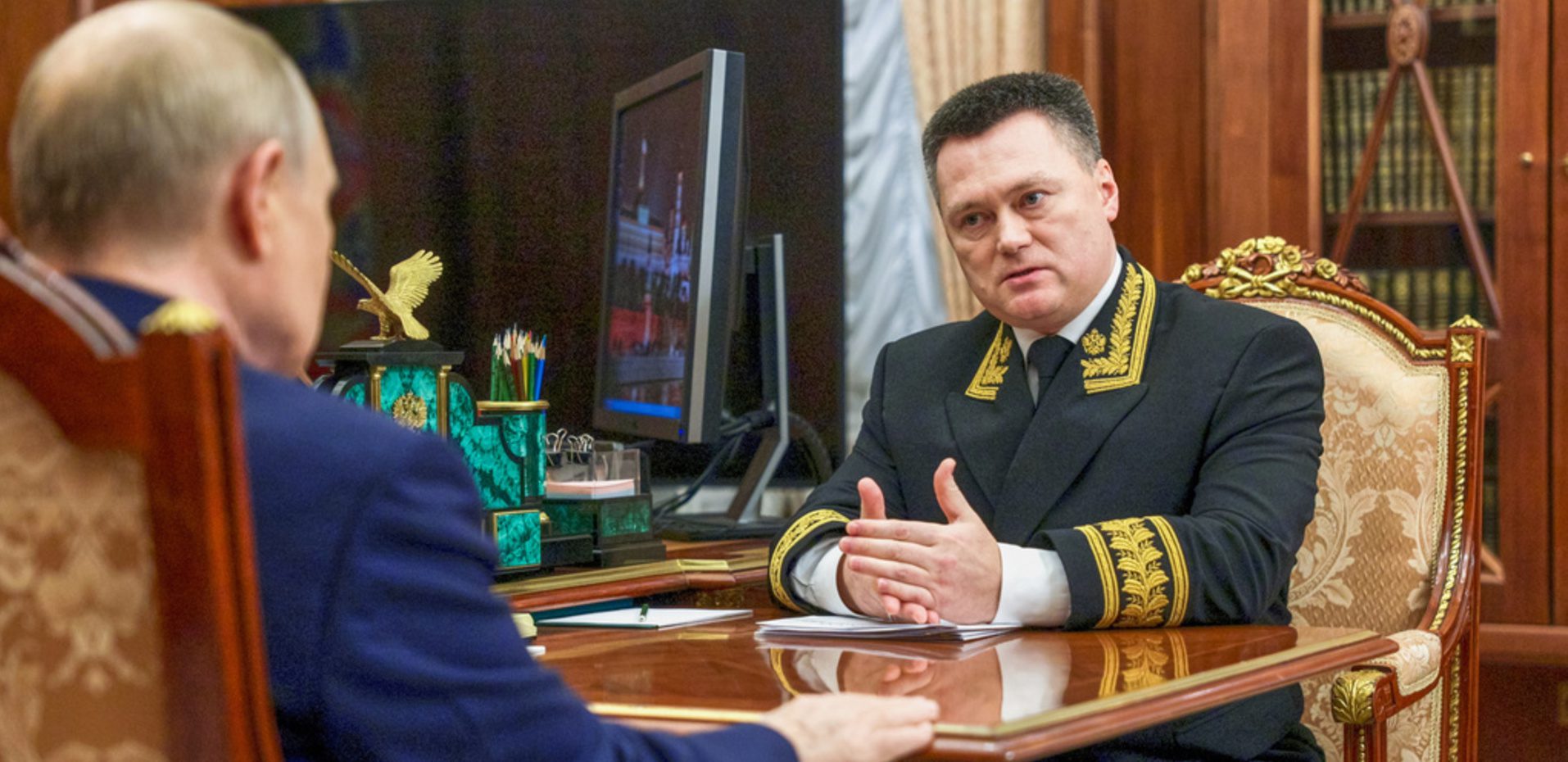
On 24 September 2025, Igor Krasnov was appointed Chief Justice of the Russian Supreme Court. Prior to this, he had served as Prosecutor General since January 2020. Who is Igor Krasnov – and why was he appointed to head the Supreme Court?
Igor Krasnov, who turns 50 in late December, is a leading representative of the younger cohort of senior security officials.
A common interpretation is that his latest appointment amounts to an honourable retirement: Krasnov, the argument goes, pursued his role as Prosecutor General too zealously, opening cases against important figures within the elite, thereby making numerous enemies.
I do not share this view. In all high-profile cases involving elite figures, Krasnov appears to have acted with at least tacit approval from the Kremlin – and, in many instances, likely at its explicit request.
A more plausible explanation is that Krasnov has effectively ‘cleaned out the Augean stables’ of the Prosecutor General’s Office, turning it into a well-oiled repressive instrument in the Kremlin’s hands.
He is now being tasked with doing the same to the Supreme Court and the judicial system more broadly.
The issue is not that prosecutors or judges previously resisted political instructions – they reliably executed them in cases involving opposition figures. Rather, in business-related matters, especially in the regions, they often operated according to local interests that diverged from the Kremlin’s preferences.
Moreover, the very long tenures of previous heads of the Prosecutor General’s Office (Yury Chaika, roughly 14 years) and the Supreme Court (Vyacheslav Lebedev, roughly 32 years, not counting the late Soviet period) had turned these bodies into corporations loyal first and foremost to their own bosses, rather than instruments fully controlled by the Kremlin.1
What reputation did Krasnov develop as Prosecutor General?
Krasnov is a capable professional investigator.
He moved to Moscow from Arkhangelsk twenty years ago and rose rapidly through the ranks of the Investigative Committee. By 2020, he was being discussed as a possible successor to the Committee’s head, Alexander Bastrykin, a university classmate of Vladimir Putin.
But Putin chose not to replace Bastrykin – and certainly not with another figure from the same corporation. Instead, the president appointed the then 44-year-old Krasnov as Prosecutor General. At the time, there was even some speculation about a potential merger between the Prosecutor General’s Office and the Investigative Committee, reversing a split between the two made in 2011.

Upon arriving in what was, for him, a kindred but still distinct law-enforcement corporation, Krasnov proved to be an efficient and disciplined manager, highly attuned to the wishes of his Kremlin principals and skilled at translating them into practice.
Within a short period, Krasnov turned the Prosecutor General’s Office into an effective instrument of the Kremlin’s will, to which the Office was absolutely subordinated.
The Prosecutor General’s Office is a key component of Russia’s repressive machinery, acting as the vital transmission belt between the FSB and the Investigative Committee, on the one hand, and the courts, on the other. Under Krasnov, this transmission belt was made to function with maximum reliability and political loyalty.
What developments of note have taken place during his leadership of the Supreme Court so far? For example, what were the main messages from his involvement in the recent Council of Judges meeting at the start of December – and what was his role in the ‘Dolina case’?
Krasnov has accelerated a purge of the judicial system that began a year or two before his appointment to the Supreme Court.
One sitting and three former heads of regional courts have been targeted so far. In the most striking case – in Rostov Oblast – the entire leadership of the regional judiciary has been under investigation on bribery charges for two years.
On the eve of Krasnov’s appointment to the Supreme Court, the Prosecutor General’s Office accused Supreme Court judge Viktor Momotov – Chairman of the Council of Judges since 2016 – of colluding with the organisers of a criminal group, and demanded the seizure of almost a hundred real estate properties registered in the names of third parties.
The sacrifice of such a high-ranking figure was a form of signalling. It was widely interpreted as a deliberate demonstration of Krasnov’s capabilities and of the seriousness of his intentions towards even the most senior members of the judiciary.
Krasnov might appear to some as an implacable anti-corruption crusader, intent on purging first the prosecution service and now the courts. That would be misleading.
One of Krasnov’s very first personnel decisions was to arrange the transfer of Gennady Lopatin, a former Deputy Prosecutor General whose name has been associated with more than one scandal, to the position of Director General of the Judicial Department at the Supreme Court.
Alongside bringing several senior officials from the Prosecutor General’s Office into the Supreme Court and forming his own team there, Krasnov has already implemented a number of important institutional changes.
Notably, the composition of the Presidium of the Supreme Court has been reduced, in line with the broader trend towards centralisation and the deliberate narrowing of internal pluralism within Russia’s highest courts. This, together with his messaging at the December meeting of the Council of Judges, sends a clear signal: the judiciary is to be further disciplined, streamlined, and aligned with the executive’s repressive priorities, with less room for corporate autonomy or dissent at the top.
Regarding the ‘Dolina case’ – which boiled down to a pro-Putin singer, Larisa Dolina, receiving special treatment from lower-level courts in relation to a property scam – the 16 December decision of the Supreme Court’s Judicial Panel for Civil Cases against her was seen as the restoration of justice.
For a case that captivated so many, angered by the injustice of favourable treatment for the well connected, this was an important test for Krasnov. Regardless of how involved he was personally in the decision-making, he approved the final decision – and has announced that the Court will review case law relating to real estate transactions, now including the ‘Dolina case’.
What does Krasnov’s appointment to the Supreme Court tell us more broadly about the personnel management system in Vladimir Putin’s regime?
In the early to mid-2010s, Putin replaced the leadership of roughly half of Russia’s security and law-enforcement bodies, including the Ministry of Defence, the Interior Ministry, and the Federal Guard Service (FSO).
The remaining pillars of the coercive apparatus – notably the FSB, the Investigative Committee, the Prosecutor General’s Office, and the courts – were allowed to retain their leaders, some of whom remain in place today. Each year, these leaders’ terms of service – formally capped at the age of 70 – have been extended.
Elderly security chiefs may not be particularly effective, but they are loyal to the Kremlin and cannot easily become autonomous political players.
In 2020, alongside the constitutional amendments and a change of government, Putin replaced the Prosecutor General, appointing Krasnov – then Deputy Head of the Investigative Committee – to the post. Over the last two years, two successive, elderly chief justices of the Supreme Court have died in office: first Vyacheslav Lebedev, who had headed the Court since the Gorbachev era, and then Irina Podnosova, another university classmate of Putin who had been chosen as Lebedev’s successor.
These deaths effectively forced Putin’s hand on a key personnel decision he had long postponed: the appointment of a new head of the judicial system.
The choice itself is consistent with the logic of an ageing autocrat. The new head of a powerful corporation should come from outside of it, so as to weaken both the institution and its leader as potential political actors.
It was deemed that the Prosecutor General’s Office had already been ‘reformed’ and now mainly requires maintenance in its current state – a task that can be entrusted to a less dynamic manager. The new Prosecutor General, Alexander Gutsan, is a university classmate of Dmitry Medvedev, Russia’s former president and prime minister, who has never particularly distinguished himself.
Krasnov, having successfully ‘restructured’ the prosecution service, could be moved on to a new, strategically important front.
This episode also underlines how narrow Putin’s pool of trusted appointees has become. He is largely confined to ageing comrades-in-arms, whose effectiveness is waning, and to former bodyguards, who were never especially competent as managers in the first place. Figures like Igor Krasnov – from the next generation, but nonetheless trusted – are rare exceptions, much like the Special Presidential Envoy Kirill Dmitriev in a different domain.
Endnotes
- Here and throughout, ‘corporation’ refers to a large institutionalised power bloc within the state (such as the security services or state-linked economic groups) with collective interests, resources, and bargaining capacity vis-à-vis the political centre ↩︎