The automotive industry has become one of the sectors of the Russian economy most severely affected by the war and the introduction of sanctions. In an effort to address the situation, the government is resorting to increasingly intensive market regulation. As a result, temporary crisis support is turning into a set of permanent mechanisms which in turn create new problems. Can the Russian authorities break this vicious circle, and can the industry prepare for the possible shock of a post-war return to the global market?
This article is part of a series devoted to the micro-level of the Russian economy, examining individual sectors, companies, regions, and markets. Focusing on these details will provide the necessary perspective for understanding the economic changes unfolding in Russia, which are not always apparent from macroeconomic sources.
Market therapy
In 2008, AvtoVAZ, Russia’s largest passenger car manufacturer, was on the verge of collapse: every car it sold generated a loss of US$1,000 for the company. Most members of the Russian government argued that the company should be allowed to go bankrupt. Only Prime Minister Vladimir Putin disagreed. He took the risky decision to provide the company with more than US$4 billion in state support, on the condition that the French company Renault, which already owned a 25 per cent stake in AvtoVAZ, would become its managing shareholder. A further 50 per cent stake in AvtoVAZ was owned by the state corporation Rostec, while the remaining shares were controlled by individuals closely associated with Rostec’s management. Renault agreed to the arrangement, but insisted on having the option to acquire a controlling stake in AvtoVAZ within the next few years.
Putin’s proposal appeared highly risky, but it was consistent with the broader logic of Russia’s industrial policy since the mid-2000s: attracting major foreign car manufacturers as industrial investors. To support this approach, import tariffs on finished vehicles were raised sharply, while tariffs on automotive components were kept very low or removed altogether. Foreign companies could assemble a vehicle outside Russia, dismantle it into large modules, import these modules separately, and then reassemble the vehicle in Russia. However, this model could only operate for a limited period of time. The government required investors to increase the level of localisation step by step, while warning that tariffs on imported components would otherwise be raised. Some investors rejected these terms and left the Russian market, as GM/Opel did. Most, however, accepted the rules of the game, which differed little from practices adopted in other developing countries.
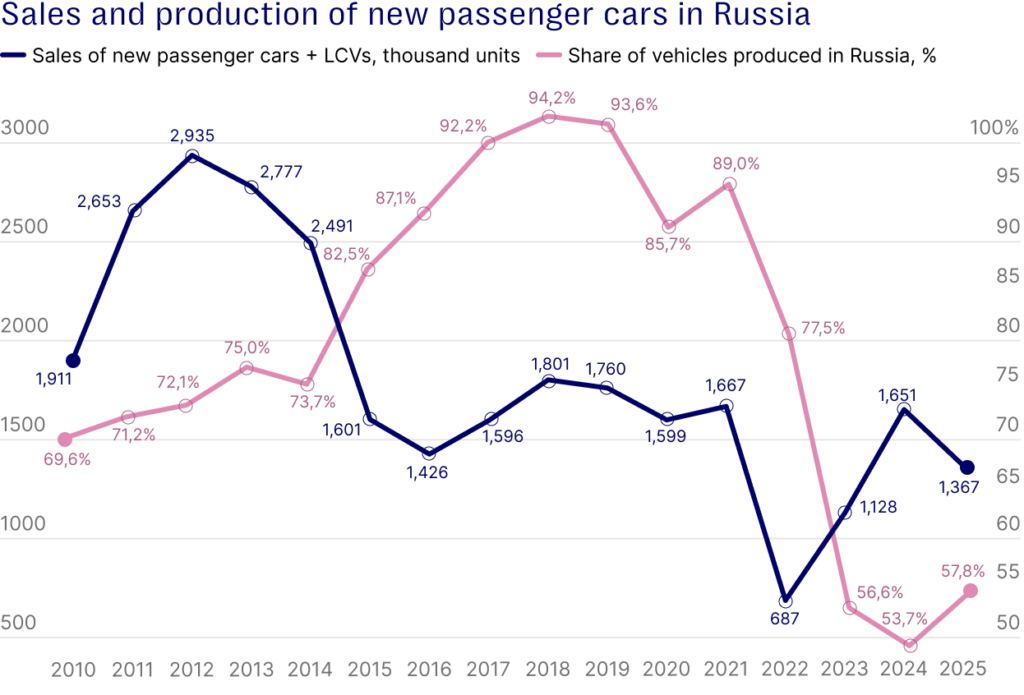
In 2012, almost 3 million vehicles were sold in Russia – only 5 per cent fewer than during the same period in Germany, Europe’s largest automotive market. Two thirds of these vehicles were produced in Russia, and more than 70 per cent of them were manufactured at plants owned by foreign companies.1 By 2013, the combined production capacity of plants in Russia exceeded 3 million units per year. Experts predicted that it would not be long before Russia became the largest automotive market in Europe. However, after Vladimir Putin returned to the presidency in 2012, Russia saw a tightening of political repression and a deterioration in public optimism. By the end of 2013, new car sales had fallen by 5 per cent. Russia’s annexation of Crimea in 2014, the first major round of Western sanctions, the fall in oil prices, and the rouble’s devaluation caused the automotive market to collapse. New car sales declined by 10 per cent in 2014 and by a further 35 per cent in 2015, falling to 1.6 million units. Over the following six years, from 2016 to 2021, the Russian market stagnated, with annual new car sales remaining between 1.5 million and 1.8 million units. Nevertheless, all investors fulfilled their commitments, and by the end of 2021 the average level of localisation was estimated at 50–55 per cent.
The automotive industry after the start of the full-scale invasion
Following Russia’s full-scale invasion of Ukraine, virtually all foreign car manufacturers suspended production at their Russian plants and sold their assets to the Russian authorities for nominal sums, often as little as one rouble. New car sales fell to 687,000 units in 2022, while passenger car production declined threefold compared with 2021, to 450,000 units.
Source: Association of European Businesses
Chinese vehicles rapidly filled the gap left in the Russian market. Overall car sales increased by 64 per cent in 2023, and after a further 40 per cent rise in 2024, annual sales returned to the pre-war level of 1.57 million units. However, the market was unable to sustain this. Sales fell by 15 per cent in 2025, due mainly to the government’s attempt to establish a new industrial policy framework.
The growth in new car sales in 2023–2024 was driven by imports rather than domestic production. Many vehicles presented and recorded in official statistics as Russian-made because they carried Russian Vehicle Identification Numbers (VINs) were in fact Chinese vehicles that only underwent the final stage of assembly at Russian plants. As a result, the increase in the number of vehicles officially produced within Russia did not, by itself, indicate a recovery in industrial production. The same statistical indicator – the number of vehicles produced – could reflect very different production models, ranging from full-scale manufacturing to limited final assembly operations.
Average annual passenger car production in Russia in 2024–2025 was only slightly above half of its pre-war (2021) level, which was unacceptable to the Kremlin. The declared objective of industrial policy in the automotive sector was to increase the utilisation of existing production capacity and restore jobs. As there was no time to develop a comprehensive strategy, the authorities introduced new measures as problems emerged. The result was a collection of policies adopted at different times rather than a single, coherent plan. This does not mean, however, that the policy lacked an underlying logic. The more the government intervened, the more evident it became that the state was increasingly involving itself in decisions that had previously been made by manufacturers and consumers.
Non-market measures
The first step was an attempt to restrict imports. A direct increase in import tariffs would have conflicted with Russia’s commitments under its accession to the World Trade Organization and would have been seen by Beijing as an openly unfriendly move. Instead, the Russian authorities chose to rely on the vehicle recycling fee, which had originally been introduced in 2010. Formally, the fee is intended to cover the future cost of vehicle disposal. In practice, however, its scale has turned it into a powerful barrier to imports.
The impact of the vehicle recycling fee is best illustrated by looking at mass-market models. For vehicles with engines producing up to 160 horsepower, prices have roughly doubled since 2021, with the recycling fee accounting for 40–60 per cent of the increase.2 Russian car manufacturers are also required to pay the recycling fee, but depending on their level of localisation, the government grants them access to budget subsidies and compensation schemes. As a result, the recycling fee has evolved from a modest environmental charge into one of the main factors determining the price of imported vehicles and a key protectionist instrument.
Albeit through heavy-handed measures, the government fulfilled its primary aim. Average monthly imports of new vehicles fell from 77,000 in 2024 to 33,000 in 2025, and to 31,000 in the first half of 2026.
However, the decline in imports did not automatically lead to higher demand for vehicles produced in Russia. Faced with the poor quality of many Chinese models and the lack of reliable warranties and after-sales service, Russian consumers adopted other strategies. Some consumers chose to buy used vehicles from established brands that had withdrawn from the Russian market. As a result, average monthly imports of used vehicles increased by 25 per cent in 2025 compared with the previous year. Others opted to keep their existing vehicles for longer. The average period of ownership for mass-market vehicles from non-Russian brands increased from 6.5 years in 2018–2021 to 7.6 years in 2025. The average age of passenger cars in Russia rose from 12.5 years in mid-2017 to 14 years at the beginning of 2022, and then to 16 years by December 2025.
In an effort to increase demand for vehicles produced in Russia, the government expanded its subsidised car loan and leasing programme.3 In 2025, 190,000 vehicles were sold under the scheme, equivalent to 28 per cent of all vehicles produced in Russia that year. Three quarters of the vehicles sold through the programme were manufactured by AvtoVAZ.
AvtoVAZ is Russia’s largest car manufacturer. Before Renault became involved, it relied primarily on domestically produced components and assemblies, thereby sustaining demand for the products of hundreds of Russian suppliers. Renault’s strategy was to maximise the standardisation of components across the vehicles manufactured at its various factories. As a result, AvtoVAZ quickly gained access to the French company’s supplier network and gradually replaced Russian-made components with imported ones.
After Renault withdrew from Russia, AvtoVAZ’s management soon concluded that the only practical way to maintain production was to replace components which were previously sourced through Renault’s suppliers with Chinese alternatives. This transition was carried out relatively quickly. However, because the government was pressing manufacturers to minimise imports, AvtoVAZ adopted a widely used practice: Chinese components were formally purchased by nominally independent intermediary companies, relabelled as products of Russian manufacturers, and then reported to the Ministry of Industry and Trade as domestically sourced. On this basis, AvtoVAZ claimed a localisation level of 90 per cent.4
State-supported demand for its products is critically important for AvtoVAZ, as the company depends almost entirely on the domestic market. In 2025, it produced 324,600 vehicles and exported around 23,000, equivalent to roughly 7 per cent of its output. Its plan for 2026 envisaged exports of about 30,000 vehicles. A global car manufacturer can offset weak demand in one market with sales in others. AvtoVAZ has virtually no ability to do so. Sanctions, production costs, and logistical constraints significantly limit its export potential, even in countries considered friendly to Russia.
Rising pressure on the Russian government’s budget has also affected the subsidised car loan and leasing programmes. The federal budget for 2026 allocates RUB 50 billion (approximately US$650 million, or about US$850 for every vehicle produced in Russia) to these programmes, 20 per cent less than in 2025.
Unlike many of Russia’s heavy-duty and specialised vehicle manufacturers, whose principal customer is the state, passenger car manufacturers cannot rely on government procurement. According to estimates, state defence orders account for around 30 per cent of KAMAZ’s production capacity utilisation and 70–80 per cent of Ural’s output. By contrast, government agencies purchased only 10,700 passenger cars in 2025, of which 6,726 were Ladas – equivalent to just 2 per cent of AvtoVAZ’s production. This was far from sufficient to address the company’s problems. The government therefore needed to find tens of thousands of private and corporate buyers.
Such a buyer was eventually found. In November 2023, the first draft of a bill on localisation requirements for vehicles used as taxis was published. Eighteen months later, in May 2025, it was adopted into law. From 1 March 2026, any vehicle registered as a taxi for the first time must meet the localisation requirements set by the government. Formally, this is not a government procurement programme in the conventional sense. The state does not purchase the vehicles or guarantee manufacturers a certain volume of sales. Instead, it changes the rules governing a major market segment in a way that encourages participants to make the ‘right choice’.
Can the taxi localisation requirement solve the problems facing AvtoVAZ or the Russian automotive industry as a whole? Unlikely. According to estimates, Russia has just under 900,000 officially registered taxis. With an average service life of four to five years, this translates into demand for around 200,000 replacement vehicles annually. On the one hand, this is equivalent to 28 per cent of average annual new car sales in 2024–2025. On the other hand, it represents the utilisation of only 12.5 per cent of the country’s existing automotive production capacity.5
Lada vehicles account for less than 20 per cent of Russia’s taxi fleet. If this share remains unchanged, AvtoVAZ can expect demand for no more than 40,000 vehicles per year, equivalent to around 7 per cent of the company’s production capacity. Given the weakened consumer appeal of AvtoVAZ vehicles, however, even maintaining its current market share in the taxi segment is likely to prove extremely difficult.
The logic of government policy in this case is straightforward: if the state cannot purchase enough vehicles itself, it will regulate the choices of those who can. From the perspective of industrial policy, this approach is convenient, as it allows government spending to be redirected to other programmes. However, its costs are equally clear. By supporting one industry, the state alters the economics of another. If the models permitted for use as taxis are more expensive or less suited to intensive commercial use, the additional costs will ultimately be shared among leasing companies, taxi operators, drivers, and passengers.
The regulation trap
The automotive industry is one of the sectors of the Russian economy most severely affected by the war and the introduction of sanctions. In attempting to shield the industry from the consequences of their own political decisions, Russia’s leaders can no longer rely on the traditional approach used before the war – stimulating competition by attracting foreign investors. Global automotive brands are unlikely to return to Russia until relations with the West are normalised, while Chinese manufacturers have shown little interest in relocating production to Russia, as this would be unlikely to receive official support from Beijing.
The search for quick solutions to complex problems is pushing the government towards increasingly intensive market regulation. As a result, measures originally intended as temporary support during a crisis are becoming permanent mechanisms that generate new problems. The underlying assumption of any crisis programme is that, once the sector or company has adapted, it will again be able to operate independently. In the case of the Russian automotive industry, however, the reverse is happening: the longer government support continues, the more market participants become dependent on it.
The government has gradually placed itself in a situation where there is no good solution. Each additional measure further narrows its room for manoeuvre. Reducing support for the automotive industry risks triggering another downturn. Continuing the current policy will require ever greater budget expenditure and increasingly extensive state intervention. This, in turn, will shift a growing share of the automotive industry’s costs onto other sectors of the economy and their customers.
The reduction of import barriers heightens the pressure on companies which have long been protected and subsidised. Their retention makes cars more expensive, reduces choice for the average consumer, and leads to ageing cars remaining in use.
Reducing support for car buyers and scaling back subsidised purchase programmes risks triggering a further decline in vehicle sales. Continuing these subsidies, meanwhile, would only entrench manufacturers’ dependence on state support, with the necessary funding having to come at the expense of cuts to other government programmes.
Loosening localisation requirements would make it easier for vehicles with a larger share of imported components to enter the market, thereby undermining the rationale of the government’s industrial policy. Strengthening these requirements, by contrast, would make it more difficult to attract investors and further reduce the range of vehicles available.
The central question is not whether the government can preserve the Russian automotive industry, what it would cost to do so, or which additional markets and consumer choices the government will seek to regulate. The more fundamental point is that Russia has created a mechanism that imitates a functioning market economy. As long as the Russian market remains shielded from competition, it is difficult to distinguish between a viable industry and an imitation of one.
However, once Russia rejoins the global vehicle market, its automotive industry is likely to find itself, as it did in 2008, fighting for survival. At that point, the decision on whether to rescue the industry or allow it to go bankrupt will fall to whoever is serving as prime minister. They will have to decide without the necessary expertise or financial resources, and in circumstances where global manufacturers have little interest in returning to a market on which they lost around US$15 billion.
Endnotes
- At that time, Renault had not yet acquired a controlling stake in AvtoVAZ, so the company’s vehicles were classified as ‘Russian’ in the statistics. If AvtoVAZ is included, the share of vehicles manufactured in Russia by foreign-owned companies exceeded 90 per cent of all vehicles produced in the country. ↩︎
- The increase in the vehicle recycling fee was particularly steep at the end of 2024. This triggered a sharp rise in imports and vehicle sales in the autumn of that year, which was followed by a corresponding decline in the early months of the following year. A similar pattern emerged in late 2025, ahead of an increase in the recycling fee applied to vehicles imported by private individuals. ↩︎
- Subsidised car loans are available to parents with at least one minor child, workers in the healthcare and education sectors, military personnel participating in the ‘special military operation’, and members of their families. The standard subsidy covers 20 per cent of the vehicle’s purchase price as a contribution towards the loan’s initial payment, rising to 25 per cent for residents of the Russian Far East. For Russian-made electric vehicles, the subsidy is available to all eligible borrowers and amounts to 25 per cent of the purchase price, up to a maximum of RUB 925,000 (approximately US$12,000). ↩︎
- According to experts at NAMI, the state automotive research institute, the actual level of localisation in AvtoVAZ vehicles does not exceed 45.7 per cent. ↩︎
- Today, Russian automotive plants have the capacity to produce 1.6 million passenger cars per year. ↩︎