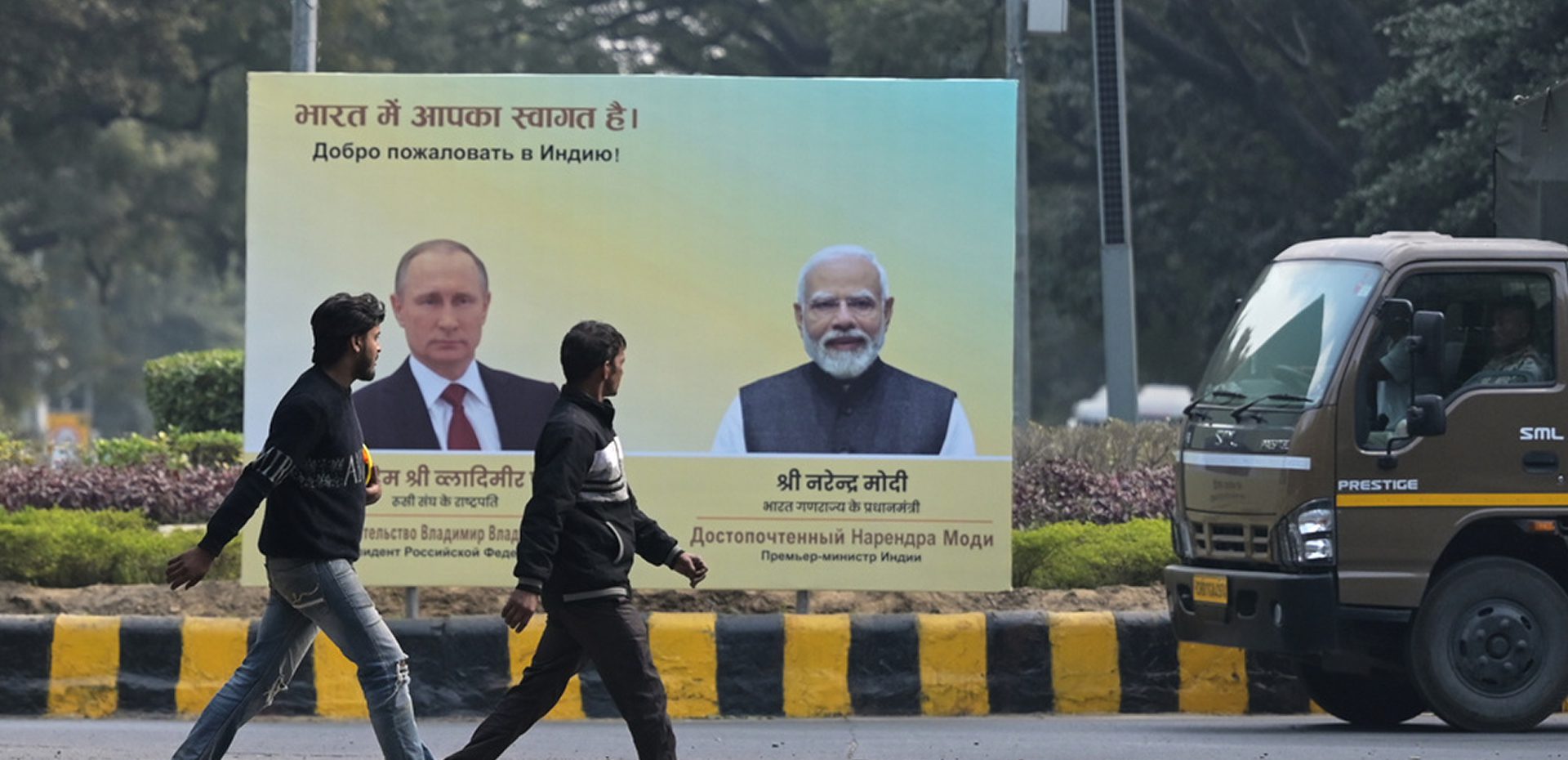
President Vladimir Putin’s state visit to India on 4–5 December 2025 was primarily symbolic, reaffirming the resilience of the Russia–India partnership amid Russia’s war against Ukraine, US sanctions, and the ongoing transformation of the global balance of power. Despite the absence of breakthrough agreements, the visit sent a clear signal to Washington and Beijing that Moscow and New Delhi continue to preserve room for independent manoeuvre.
What happened?
Against the backdrop of ongoing peace talks between Russia and Ukraine, President Vladimir Putin paid a state visit to India, his first since the start of the full-scale invasion. Over the two-day visit, 29 agreements were signed. The central document was the ‘Programme for the Development of Strategic Areas of Economic Cooperation up to 2030’, which covers more than ten areas, ranging from energy and trade to regional security and cooperation within international organisations.
A longstanding partner
Relations between Russia and India today constitute a pragmatic partnership between two states with converging interests. They rest on a long history dating back to the Soviet period and are shaped by the absence of direct conflicts of interest, as well as by the geographical separation of their strategic priorities. Russia has traditionally viewed India as a power whose core interests are concentrated in South Asia and the Indian Ocean, while Moscow’s own key interests lie in Europe and the post-Soviet space.
A further important element is Moscow’s perception of India as an independent centre of power. India’s value lies in its ability to pursue an autonomous foreign policy and to balance between different actors. This makes it a significant partner for Russia amid its confrontation with the West and its growing dependence on China.
Although India has reduced its purchases of Russian arms and military equipment in recent years, it remains a regular buyer. Russia continues to supply India with aircraft and aviation systems, missile systems, naval equipment including nuclear-powered submarines, T‑72 and T‑90 battle tanks, and air defence and electronic warfare systems, among other items. Over the past 20 years, the total value of Russian military exports to India has amounted to around $80 billion.
The state corporation Rosatom is building units at the Kudankulam Nuclear Power Plant, the largest nuclear facility in India. Russia acts not only as a supplier of reactor technologies, but also as a long-term partner, providing fuel supplies, servicing, and support throughout the plant’s entire life cycle. Even after India gained access to the global nuclear market in the late 2000s, Russian–Indian cooperation in the nuclear sector retained its strategic character. Today, however, its further expansion is constrained by New Delhi’s desire for broader access to sensitive technologies.
The two countries are also developing cooperation in the space sector. In particular, Russia is involved in training Indian astronauts for the national human spaceflight programme, Gaganyaan.
Russia–India relations after the start of the full-scale war against Ukraine
Russia’s full-scale war against Ukraine has not led to a revision of this partnership; on the contrary, it has reinforced it. New Delhi has adopted a restrained position, avoiding condemnation of the Kremlin’s military aggression and refraining from joining sanctions, while limiting itself to general calls for diplomacy and dialogue.
India’s relationship with Russia is primarily strategic rather than economic. Energy and defence are economic deals, but they also serve strategic purposes. More broadly, India favours a multipolar world and pursues a policy of strategic autonomy and multi-alignment.Sarang ShidoreDirector of the Global South Program at the Quincy Institute
Sarang Shidore
Director of the Global South Program at the Quincy Institute
Over the past four years, trade between Russia and India has increased more than sixfold, making Russia India’s fourth-largest trading partner, with turnover of around $70 billion in 2024–2025.1 At the same time, bilateral trade has become significantly less balanced: in 2024, India’s imports from Russia were worth more than thirteen times more than Indian exports to Russia ($67.15 billion vs $4.84 billion).2
India has emerged as one of the largest importers of Russian oil, with supplies from Russia accounting for up to 35 per cent of India’s oil imports (around 1.75 million barrels per day between January and June 2025). For Russia, the Indian market – alongside China – has acquired critical importance as a source of export revenues amid sanctions.
In an effort to pressure Moscow and reduce its oil revenues, the Trump administration imposed a 25 per cent import tariff on Indian goods in 2025, followed by an additional ‘penalty’ tariff of 25 per cent. At the same time, the US Treasury imposed sanctions on Rosneft and Lukoil, after which India’s officially recorded imports of Russian oil fell to their lowest level in the past three years. In practice, however, supplies of Russian oil to India have continued via the shadow fleet and intermediary networks.
Sanctions pressure has pushed Russia to seek external manufacturing and technological partners, and India is seen in this context as one of the most promising options. Priority areas include joint production and the supply of components in mechanical engineering, radio electronics, and aviation. An illustrative example is the agreement between the United Aircraft Corporation and Hindustan Aeronautics Limited on the production of SJ-100 civilian aircraft in India.
Sanctions have had a negative impact on the diamond sector: direct supplies of Russian diamonds to India have declined sharply. This has undermined the resilience of India’s cutting and polishing industry, for which Russian rough stones represent one of the core sources of supply, and has created risks of lower capacity utilisation and rising unemployment across the industry.
In this context, the development of a system for cross-border payments between Russia and India using national currencies has become a key priority. Moscow is seeking to expand the presence of Russian banks in India and to secure access to Indian financial infrastructure in order to service large transactions in roubles and rupees. Gazprombank and Alfa-Bank have applied for permission to open branches in India, where VTB and Sberbank are already operating actively. This process is supported at the institutional level: on 3 December 2025, the Central Bank of Russia announced the opening of its representative office in Mumbai, intended to promote the interests of the Russian financial sector.
At the same time, Moscow is expanding its presence in India’s information space. During Putin’s visit to India, the launch of the Russian state propaganda broadcaster RT in India was announced. This fits into a broader strategy of promoting Russian narratives across the Global South.
Against the backdrop of labour shortages in Russia, discussions are underway on expanding labour migration from India. In 2025, the quota for recruiting Indian workers was set at 72,000; in 2026, the number of labour migrants from India may increase further. The two countries also anticipate a further rise in tourist flows should a bilateral visa-free travel agreement be concluded.
Outcomes of the visit
Even in the absence of breakthrough agreements, the very fact of the trip and the red carpet reception for Putin are viewed from Moscow as a significant political outcome.
The visit confirmed both sides’ intention to preserve the existing format of relations despite growing US pressure aimed at reducing Russia’s oil revenues and limiting the resources available to sustain the war against Ukraine. In this context, Russia’s reaffirmed readiness to ensure uninterrupted energy supplies to India, and the absence of any signals from New Delhi indicating that it is willing to decline to purchase them, are a political marker that calls into question the effectiveness of US efforts to compel India to revise its position.
At the same time, the visit demonstrated that Russia’s international isolation is limited in scope and remains largely a phenomenon of the Euro-Atlantic space. For major non-Western powers, including India, Russia continues to be seen as a significant actor in global politics with whom direct dialogue is both possible and expedient. Within India’s balancing strategy, Russia is regarded as one element of diversification in its foreign policy and economic ties. This has acquired particular relevance against the backdrop of the gap between the updated US National Security Strategy’s emphasis on deepening the US partnership with India, and the extent to which Washington is able to translate these intentions into sustained political influence.
Moreover, the development of direct dialogue with India serves the Kremlin as a way to underscore its foreign policy autonomy vis-à-vis China. Demonstrative engagement with New Delhi allows Moscow to signal that its foreign policy is not exclusively focused on China, and that Russia continues to view itself as an independent actor within the emerging multipolar order.
Endnotes
- By 2030, the two sides aim to reach a trade volume of $100 billion ↩︎
- According to the United Nations COMTRADE database on international trade ↩︎