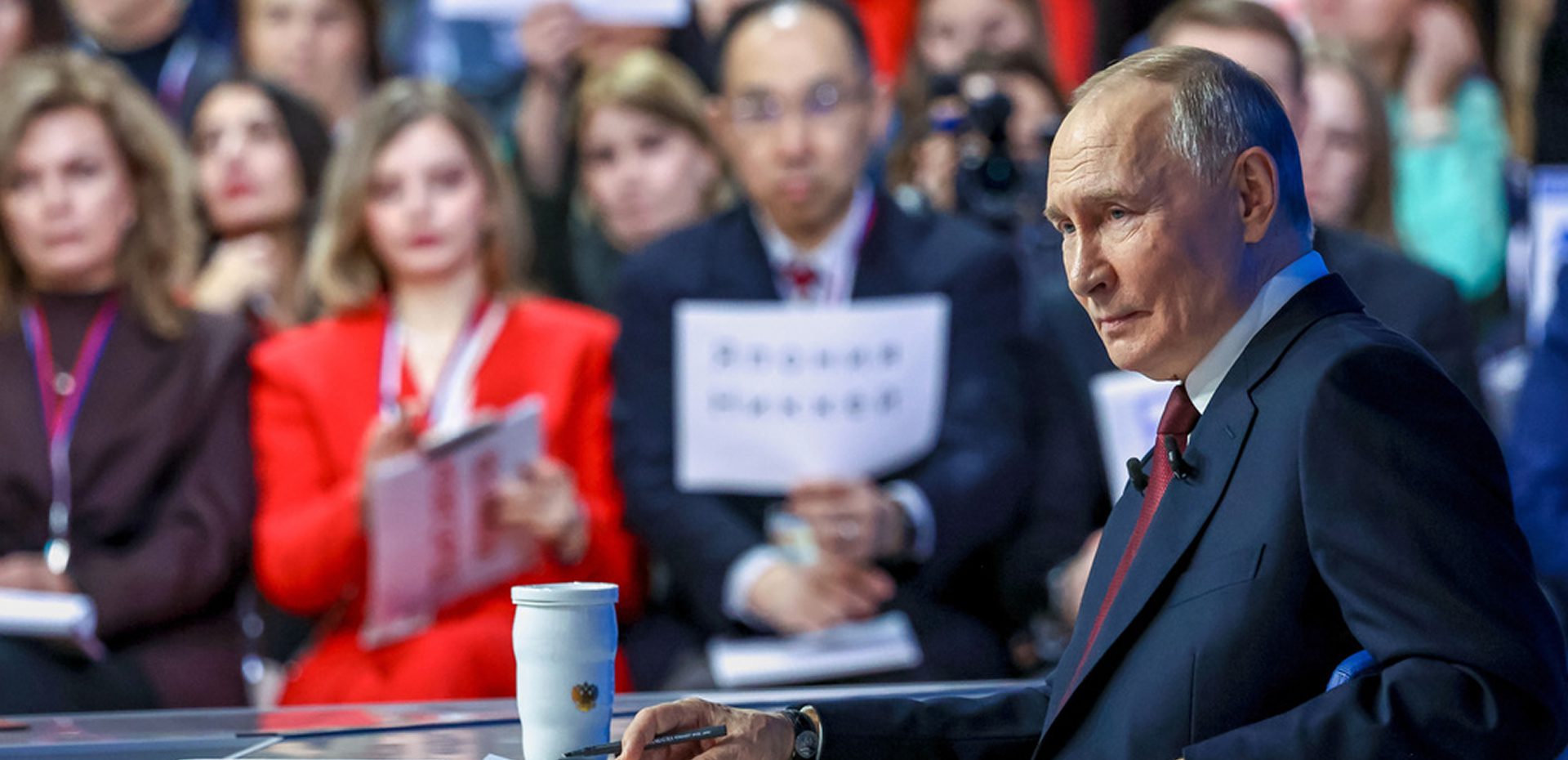
Vladimir Putin’s 2025 Direct Line broadcast underscored the continuity of the Russian regime’s core priorities. The president’s remarks made it possible to trace how the Kremlin simultaneously consolidates its positions on key issues – the war, the economy, and social and demographic policy – while avoiding the articulation of any long-term development goals. In place of a vision of the future, Putin offers a managed present, in which war, resource mobilisation, and confrontation with the West serve as the defining features.
Direct line
On 19 December 2025, Putin held his annual Direct Line – a public question-and-answer session with citizens and journalists. The event lasted four and a half hours, making it one of the longest of its kind in recent years.
Public expectations ahead of the broadcast were shaped primarily by socio-economic concerns. A pre-event survey by the Levada Center showed that issues such as rising prices, incomes, pensions, employment, and access to housing and services collectively outweighed war-related questions, even if the prospect of ending the war remained a key concern for many respondents.
According to Mediascope, the broadcast reached approximately 16.3 million viewers, or around 12 per cent of the population, mainly via state television channels. As in previous years, viewership was partly orchestrated: in several regions, school pupils, students, and public-sector employees were encouraged or required to watch, while officials were instructed to report publicly on their participation.
The 2025 Direct Line should be understood not as a one-off event, but as a content hub. Its key messages will be repackaged and amplified across pro-government traditional and digital media, extending their reach and reinforcing the Kremlin’s core narratives well beyond the live broadcast.
The Kremlin’s strategic priorities
Three interlinked pillars were at the core of the 2025 Direct Line: the war, economic and social policy, and confrontation with the West.
The war against Ukraine
The military agenda remains the central policy domain for Putin and one that is firmly under his personal control.
While signalling readiness to continue peace negotiations, Putin has simultaneously made clear that he has no intention of revising his position. His assessment of the situation on the battlefield as favourable to Russia, combined with the belief that Ukraine’s military resources are nearing exhaustion, removes any incentive for him to abandon or soften the conditions for peace which he has previously set.1
Beyond two elements of a potential peace settlement where disagreements between Moscow and Kyiv remain irreconcilable – the status of the occupied territories and the post-war capabilities of the Ukrainian armed forces – Putin has once again brought the question of Ukraine’s political legitimacy to the fore. The Kremlin has made little effort to conceal its interest in regime change in Kyiv and has renewed its demand for an early presidential election in Ukraine.
At the same time, Moscow has its own understanding of how such elections would need to be organised in order to be recognised as legitimate by the Kremlin. This is not merely about holding a vote as such, but about a comprehensive reshaping of Ukraine’s political landscape – from the reinstatement of previously banned parties and media outlets to the participation of millions of Ukrainians currently outside the country, including those residing in Russia.
The Kremlin assigns a significant role in this process to the ‘The Other Ukraine’ project, which it treats as a mould for a potential regime-change scenario in Kyiv. Established in Russia in 2023, the project brings together Ukrainian politicians and public figures based outside Ukraine and oriented towards Moscow.
Its most prominent public figure is Viktor Medvedchuk, a long-standing ally of Putin. In the Kremlin’s framing, Medvedchuk still serves as a symbol of an ‘alternative’ Ukraine – one that is prepared to negotiate on terms acceptable to Russia.
Economic and social policy
The economic segment of the 2025 Direct Line differed markedly in tone from previous years. Whereas in earlier broadcasts Putin routinely announced new budget allocations and presented himself as personally resolving everyday problems faced by ordinary citizens, this time he repeatedly acknowledged the lack of resources even for relatively modest measures.
The contrast with the previous year was striking. In 2024, Putin spoke openly and with evident confidence about rapid economic growth and the resilience of the economy under wartime conditions and sanctions. By 2025, his rhetoric had become noticeably more restrained, reflecting tighter fiscal constraints and narrowing room for manoeuvre in economic and social policy.
Actual economic growth in 2025 fell well short of expectations, reaching around 1 per cent compared with the officially stated target of 2–2.5 per cent. Key indicators slowed in parallel. Growth in industrial output dropped to below 1 per cent, down from 4.6 per cent in 2024. In manufacturing, growth declined from 8.1 per cent to 3.1 per cent. Real wage growth almost halved, falling from approximately 9 per cent to 4.5 per cent.
The explanation offered for the slowdown was a purportedly deliberate policy choice in favour of lower inflation and macroeconomic stability. Within this framework, success is measured not by economic growth, but by restrained public spending, control over the budget deficit, and the preservation of financial reserves.
Unlike the previous year, when the war was presented as a driver of growth in several key sectors, in 2025 it is increasingly portrayed as a long-term burden. It requires the reallocation of resources and implies the abandonment of earlier expectations of rising living standards.
In addition, record-low unemployment in 2025 points to the exhaustion of available labour reserves and has become a structural constraint on further economic growth, increasing pressure on wages and inflation. The Kremlin acknowledges the existence of this problem, but offers no concrete solutions.
In practice, the only clearly articulated policy objective is an increase in the birth rate. This target, however, is incapable of affecting labour supply in either the short or medium term. Economic support for families with children is increasingly giving way to the promotion of early marriage and childbearing, a shift that resembles social engineering more than a response to structural economic constraints.
The social agenda is becoming ever more tightly intertwined with the war. Priority support for combatants and their wives and children, as well as for families with three or more children, now forms the backbone of a new social policy aimed at cultivating and sustaining a loyal base of support for the regime.
From Putin’s rhetoric, a clearer image is emerging of a society mobilised for war. The central figure is the ‘Special Military Operation hero’ – a combatant presented as the normative model of citizenship. A revealing episode involved a Kalmyk officer, promoted from a driver to the commander of an assault unit, who was invited to take part in Direct Line. During the discussion, Putin referred to his experience and views no fewer than nine times, effectively using him as a living endorsement of the legitimacy of the war and of the new social ideal advanced by the regime.
Alongside him, other emblematic figures were highlighted: the mother and widow of a man who fought in Ukraine, a young man seeking to start a family, and a scientist returning from emigration in Europe in the name of ‘traditional values’, among others. Taken together, these figures outline a model of a ‘proper’ society – loyal to the authorities, oriented towards the traditional family and hierarchical values, indifferent to formal political institutions, yet prepared to subordinate private interests to those of the state.
Confrontation with the West
In the absence of a clearly articulated vision of the future – reflected both in Putin’s failure to answer questions about the country’s long-term prospects during Direct Line and in his decision not to deliver a Federal Assembly address in 2025 – confrontation with the West remains the only stable point of reference for Russia. Even allowing for the possibility that active hostilities against Ukraine could cease in the foreseeable future, this confrontation is being consolidated as a political and institutional condition that will shape Russia’s agenda over the long term.
Within this framework, Europe has definitively replaced the United States as the primary source of a persistent external threat for Moscow, and is portrayed as an actor pursuing hostile policies and preparing for war with Russia. By contrast, the United States under Donald Trump is effectively depicted as a potential negotiating partner.
This framing enables the Kremlin to sustain a sense of external danger and, in doing so, to justify further tightening of domestic mobilisation policies. Militarisation is being entrenched institutionally, through organisational decisions and the reallocation of resources.
At an expanded meeting of the Defence Ministry board on 17 December 2025, Defence Minister Andrei Belousov outlined measures to expand military capacity, including the construction of military infrastructure, increased recruitment of cadets, the formation of additional units, and the maintenance of high rates of enlistment of contract soldiers and ‘volunteers’. Taken together, these steps point to the state’s adaptation to the reality of prolonged wartime conditions.
This embrace of militarisation does not necessarily imply continuous active warfare. Rather, it signals the emergence of a system in which war – real or potential – becomes a structural element of the regime: a key instrument of consolidation that shapes Russia’s domestic and foreign policy.
Endnotes
- These conditions include the recognition of the occupied territories as part of Russia; Ukraine’s renunciation of NATO membership; the so-called ‘demilitarisation’ and ‘denazification’ of Ukraine; the lifting of sanctions against Russia; and a revision of Europe’s security architecture to reflect Russian interests, including those vis-à-vis the North Atlantic Treaty Organization ↩︎