The elections scheduled for autumn 2026 in Russia will not lead to significant political change, but will mark the final stage of the regime’s current political transformation, completing the renewal of the key institutions of power. For the Kremlin, the elections are both a managed procedure and a source of additional risk: the electoral period increases the system’s sensitivity to accumulated dissatisfaction and to unexpected forms of public mobilisation.
How the Kremlin is preparing for the elections
On 18–20 September 2026, Russia will hold its first State Duma elections since the start of the war against Ukraine. A total of 450 deputies will be elected via party lists and single-member constituencies. Voting will also take place in the occupied Ukrainian territories, where 11 single-member constituencies have been created for this purpose.
Of the almost two dozen political parties registered in Russia, only 12 will be able to take part in the elections without undergoing additional registration procedures: United Russia, the Communist Party of the Russian Federation (CPRF), the Liberal Democratic Party of Russia (LDPR), New People, A Just Russia – For Truth, Yabloko, the Greens, Rodina, the Civic Platform, Communists of Russia, the Party of Pensioners, and the Party of Direct Democracy.
Beyond the first five parties in the list currently represented in the State Duma, only the Party of Pensioners appears to have any real chance of clearing the five per cent threshold (2.45 per cent in the 2021 elections and successful threshold crossings in a number of regions in the 2025 elections), along with the Greens (0.9 per cent in 2021).
There is no doubt that the ruling party, United Russia, which currently holds 314 seats (70 per cent) in the Duma, will retain its constitutional majority. The ruling party benefits from significant institutional advantages, while voting and vote-counting procedures remain opaque.
Additional tools of electoral engineering are also employed. These include the redrawing of constituencies, including in regions where their formal number has not changed (for example, a new scheme of eight constituencies has been approved in Saint Petersburg), three-day voting, and the expansion of remote electronic voting, which is expected to be applied in approximately half of the country’s regions during the elections.
Access to elections is tightly restricted, and the non-systemic opposition has been largely removed from the public sphere and, in many cases, out of the country. Pressure on the few remaining political structures that retain support among opposition-minded citizens continues to intensify. The Yabloko party, which received 1.21 per cent of the vote in the 2021 elections and campaigns under the slogan ‘For peace and freedom’, has faced growing administrative and political pressure in recent months.1
This campaign matters not only for the formation of a new State Duma. The outcomes of regional legislative and gubernatorial elections will have implications for the Federation Council, as it is the regional authorities that appoint their representatives to the upper chamber. In this way, the 2026 elections affect the renewal of both chambers of parliament and, taken together with personnel changes already implemented in other branches of power, complete the current transformation of the political system.
United Russia
As part of preparations for the elections, United Russia’s leadership was substantially restructured in 2025 at both the federal and regional levels. Party management became more compact and centralised. Under Vladimir Yakushev, who took up the position of Secretary of the party’s General Council in 2024, the presidium of the General Council was reduced from 35 to 14 members, and the number of deputy secretaries was cut from six to one. At the same time, the linkage between the party and the administrative vertical was strengthened, with serving governors becoming secretaries of the party’s regional branches in most regions.
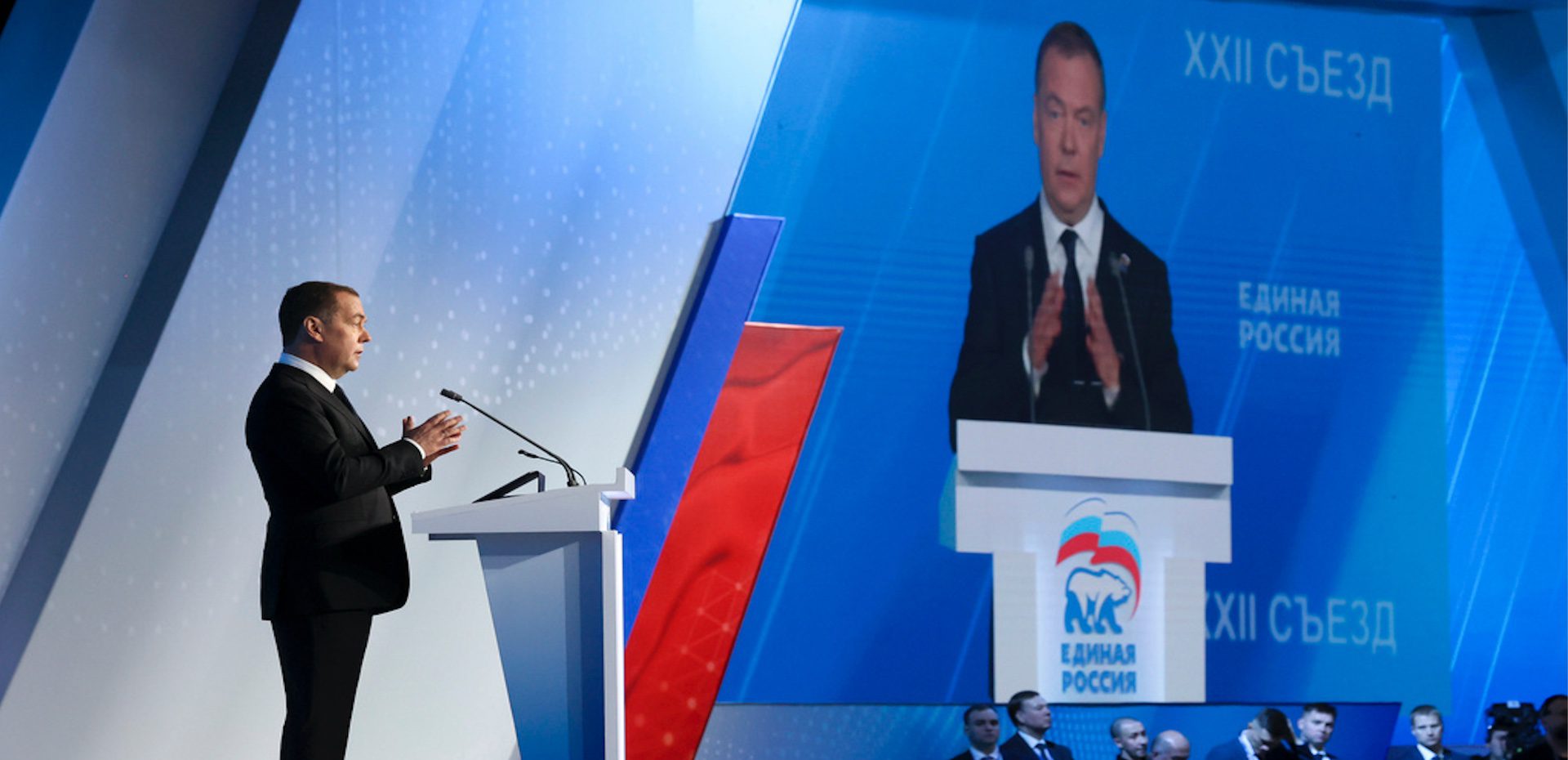
According to preliminary information, the United Russia party list will be headed by Dmitry Medvedev, former president of Russia (2008–2012) and the party’s current chair, as well as deputy chair of the Security Council. After the full-scale invasion of Ukraine, he became one of the most active and radical pro-war voices within the Russian elite. Over this period, his personal approval rating, according to VCIOM, has almost doubled compared with its 2021 level.
Alongside Medvedev, the ruling party’s top five candidates are expected to include Sergei Lavrov, a Foreign Minister; Maryana Lysenko, a physician and one of Putin’s trusted representatives in the presidential election; Vladislav Golovin, a participant in the siege of Mariupol and head of the central staff of the Yunarmiya youth movement; and military correspondent Yevgeny Poddubny.
The significance of United Russia’s top five candidates lies not only in their public visibility. The composition of the list also serves as a signal to elites and voters regarding the political course the party intends to pursue in 2026. The preliminary configuration points to the further entrenchment of a confrontational and militarised agenda.
In the regions, the party plans to nominate participants in the war against Ukraine. This approach fits within the Kremlin’s broader strategy of promoting a ‘new elite’ composed of individuals with wartime experience who, according to official statements, are intended to form the future managerial class. To support this objective, personnel projects such as the ‘Time of Heroes’ programme have been launched, offering veterans education, retraining, and career advancement within government bodies and party structures.
These ‘SVO heroes’ are expected to be elected primarily via party lists, as winning single-member constituencies would be difficult for them. A large influx of such candidates into the State Duma is not anticipated: rather than the previously cited figure of 70, the number elected is more likely to be around 20.2
Risk zones
The nomination and election of participants in the war to the State Duma can be seen as an attempt to respond to the demands of the militarised segment of the pro-war audience – its most active and radical component. While this milieu remains broadly loyal to the state, it is increasingly using support for the war as a basis for criticising how the authorities conduct military operations and manage the home front, ranging from corruption and bureaucracy to personnel and migration decisions. This creates specific risks for the Kremlin.
By incorporating war-related candidates into parliament and party structures, the authorities signal a formal response to this demand, while at the same time preventing genuinely influential representatives of the militarised milieu from entering positions of power. Such representation is largely symbolic, reflecting the real expectations of this audience only weakly, and therefore does not necessarily achieve the goal of stabilising it. On the contrary, the gap between the declared response and the absence of real influence may sustain a sense of frustration and contribute to further radicalisation.
Another group sensitive to the authorities consists of educated urban residents and young people oriented towards the safest possible forms of political participation. Boris Nadezhdin’s presidential campaign in winter 2024 demonstrated that, even under conditions of repression, there is still demand for a public and collective gesture of dissent. In many cities in Russia and abroad, people queued to sign in support of his nomination. Participants did not expect an electoral breakthrough, but used the procedure as a permissible way of expressing collective disagreement.
Neither group is likely to influence the outcome of the elections and therefore does not pose a direct threat to the regime. However, they can generate pressure, increasing risks for a system that becomes more vulnerable during an electoral period.
Endnotes
- According to the Russian Field polling organisation, its level of support stands at around 3 per cent among all respondents, and 4.9 per cent if those who do not intend to vote are excluded ↩︎
- In the September 2025 regional elections, war participants secured between 2.3 per cent and 3.7 per cent of all mandates, well below the officially stated target of 10 per cent ↩︎