In early June, the St Petersburg International Economic Forum (SPIEF) took place – an event that traditionally serves as the platform for Vladimir Putin’s main annual address on economic issues. Often described as ‘Russia’s Davos’, the forum brings together thousands of the country’s most important businesspeople and companies. Failure to attend is widely seen as an open demonstration of opposition to the Kremlin.
This year, Putin’s speech risked being a flop. Since the beginning of 2026, the economy has been showing signs of decline. During the first five months of the year, expected annual GDP growth fell to 0.4 per cent, while the budget deficit exceeded planned levels by 2.3 trillion roubles, or 1 per cent of GDP. The situation was eased by an almost twofold increase in oil and gas revenues in May, driven by the war in Iran and the closure of the Strait of Hormuz. Inflation also slowed, and in some periods, consumer prices even declined.
However, the latter was the result of the Central Bank’s extreme caution in lowering its key interest rate. While this has slowed price growth, it has also contributed to economic contraction and increased pressure on investors and businesses. Moreover, a halt in economic decline does not mean the beginning of growth. Even if the government relaxes its deficit targets, it will be extremely difficult for the Kremlin to maintain control of the situation by the end of the year.
Summary
- Rosstat’s estimate of GDP dynamics in the first quarter indicates that the Russian economy has remained stagnant for the past two years.
- On 19 June, the Board of Directors of the Bank of Russia will meet to discuss the key interest rate. Nothing prevents it from deciding to cut the rate by 100–150 basis points, to 13–13.5 per cent per annum. If this does not happen and the rate is reduced by the customary 50 basis points, the likelihood of faster disinflation and a more rapid economic contraction will increase significantly.
- In May, the federal budget deficit was at a minimal level. It is possible that the advance financing of government procurement, which the Ministry of Finance cited to explain the substantial budget deficit in previous months, has now been completed. If so, the budget may come close to being balanced in the coming months.
- A think tank close to Defence Minister Andrei Belousov has accused Rosstat of overstating current growth rates to suit the political environment.
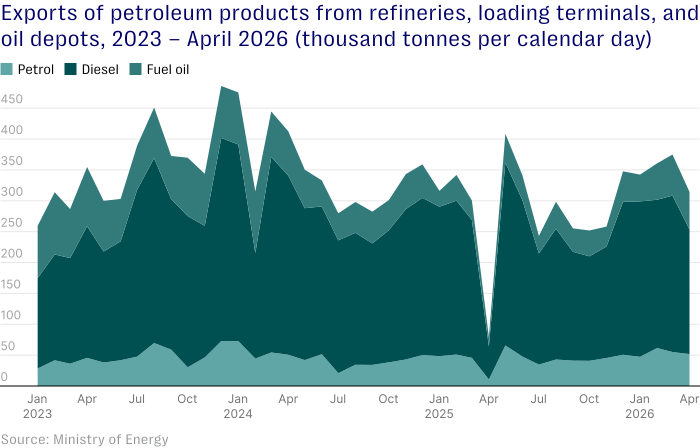
- Data from the Russian Ministry of Energy suggest that Ukrainian strikes on Russian oil infrastructure have not been effective in exerting pressure on petroleum product exports.
Recession: A return to 2024
According to Rosstat’s preliminary estimate, Russia’s GDP declined by 0.2 per cent in the first quarter of 2026 compared with the same period in 2025. This implies that the Russian economy contracted by 6.4 per cent (annualised) relative to the fourth quarter of the previous year.
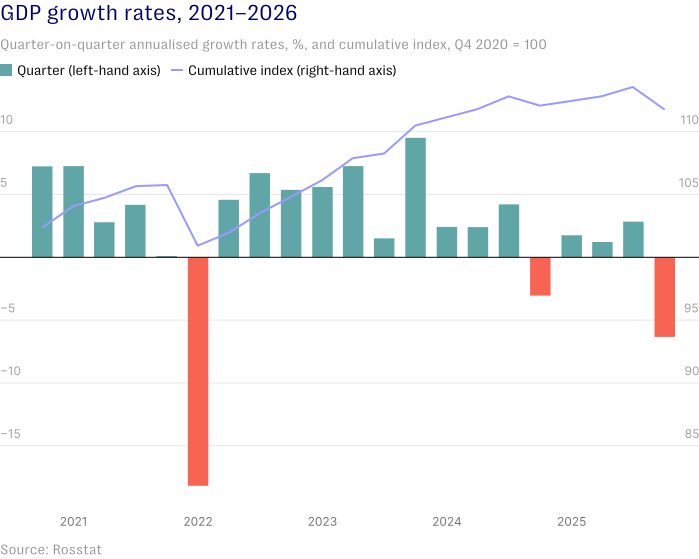
If Rosstat’s estimate is taken at face value, it suggests that the Russian economy has fallen back to the level of mid-2024 or, more precisely, has been treading water for the past two years. This is not particularly surprising. Around that time, the Ministry of Finance stopped providing monetary financing for military production using accumulated reserves,1 while independent experts began to argue that the growth potential of the policy of military Keynesianism had been exhausted.2 At the same time, official statistics began to record stagnation in civilian industrial sectors.
Rosstat’s estimates are typically revised upwards in subsequent releases, so it may yet emerge that the current downturn was considerably less severe than it first appeared. This is indirectly supported by comments from Economic Development Minister Maksim Reshetnikov at the recent St Petersburg International Economic Forum, where he spoke of a revival in economic activity in April.
In its updated forecast, the Ministry of Economic Development lowered its projection of GDP growth for the current year from 1.5 per cent to 0.4 per cent. At the same time, the Bank of Russia left its forecast unchanged, maintaining the view that the economy could recover in the second half of the year, with GDP growth of 0.5–1.5 per cent. For Russian GDP to increase by 1 per cent in 2026 compared with its 2025 level, growth during the remaining three quarters of the year would need to run at an annualised rate of around 4 per cent. This appears unlikely, as such growth rates were recorded consistently only during the period of rapid expansion in military spending from mid-2022 to early 2024.
The key rate: the Central Bank’s caution and its cost for the economy
The Bank of Russia publishes its schedule of key rate meetings at the beginning of each year. The intervals between meetings vary, ranging from five to eight weeks. The most recent meeting took place on 24 April, and the next is scheduled for 19 June.
At the April meeting, the Bank decided to reduce the key rate by 0.5 percentage points, to 14.5 per cent. This cautious step was justified by a forecast of rising inflationary risks amid external uncertainty. Such a position gave little reason to expect significant changes at the next meeting on 19 June. However, the assessment of inflationary risks proved inaccurate. During the following four weeks, Rosstat recorded exceptionally low rates of price growth. Deflation of 0.02 per cent per week was reported twice, while in two other weeks prices rose by just 0.07 per cent. As a result, cumulative inflation over the first five months of the year was noticeably lower than in the previous year, despite the increase in the VAT rate from 20 per cent to 22 per cent on 1 January, which undoubtedly contributed to the acceleration of price increases.
Such inflation dynamics are unusual for Russia. Traditionally, the rate of price growth increases somewhat in May compared with April, while seasonal deflation begins in July or August. The reason for the sharp slowdown in inflation is clear: the Central Bank has maintained excessively high real interest rates for too long, inevitably suppressing demand.
The Bank of Russia has consistently lagged behind developments when making decisions on changes to the key rate. This is clearly illustrated in the chart below, where the key rate data is shifted forward by nine months: a change in the rate in January, for example, affects inflation dynamics in October. Senior officials at the Bank of Russia regularly refer to such a lag as the minimum period between a rate adjustment and its effect on inflation. Consequently, the current level of the key rate will shape inflation dynamics at the beginning of next year. If the Bank of Russia’s stated objective of reducing inflation to 5 per cent by the end of 2026 is achieved, the key rate will remain at around 10 per cent. This would undoubtedly place substantial pressure on investment and business activity, hindering economic recovery.
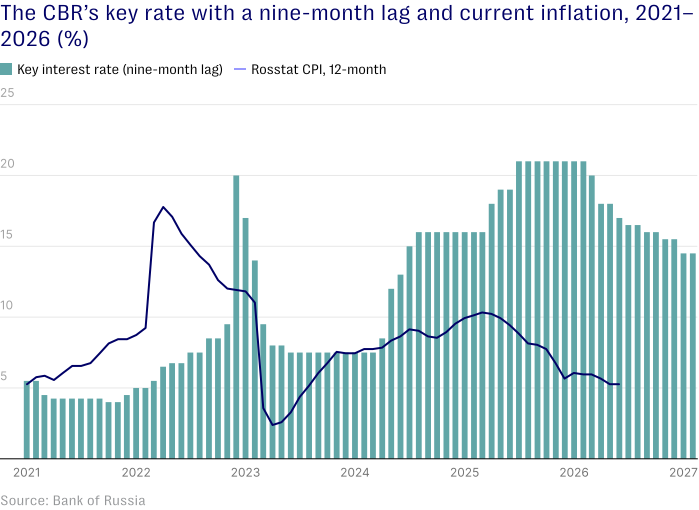
If inflation remains at its current low rate over the next two weeks, there is nothing to prevent the Bank of Russia’s Board of Directors from deciding at its next meeting to cut the key rate by 1–1.5 percentage points, bringing it down to 13–13.5 per cent per annum. All that would be required is a degree of determination and willingness to act. If this does not happen and the rate is reduced by the customary 0.5 percentage points, the likelihood of a faster decline in inflation and a more rapid economic contraction will increase significantly.
Credit: Demand is not growing
In theory, when a central bank begins to combat inflation by raising interest rates, households become more inclined to save, while demand for credit declines. This, in turn, reduces aggregate demand and helps to restrain accelerating price growth. But how does this work in practice, particularly in Russia?
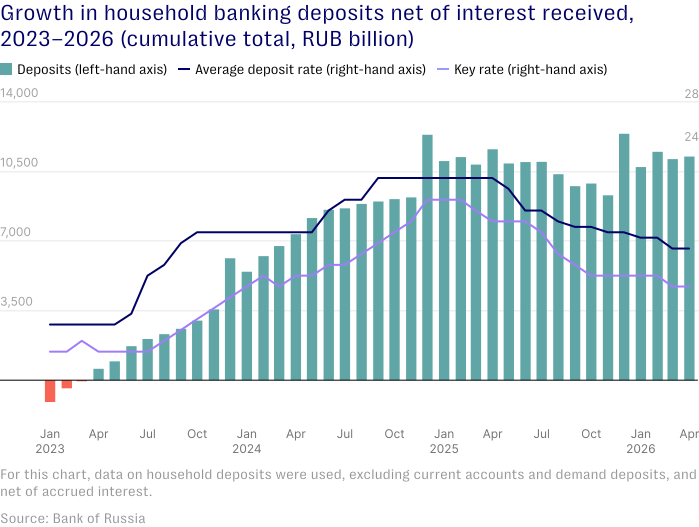
Regarding household savings, developments in Russia have followed the textbook pattern. While changes in the Central Bank’s key rate affect inflation only with a considerable lag, their impact on household saving behaviour becomes visible much more quickly. The chart below clearly shows that Russian households began rapidly increasing their bank deposits from mid-2023, when the Bank of Russia launched its cycle of interest rate increases. This process continued until the spring of 2025, when banks began gradually lowering deposit rates, which was reflected in a decline in the weighted average deposit rate.
However, the picture is less clear regarding the economy’s demand for credit. At first glance, it appears that corporate demand for borrowing in Russia responds only weakly to changes in the Central Bank’s rate, except during the period when the Bank of Russia’s rate stood at 21 per cent. At that point, growth in lending came to a halt. However, as soon as the CBR began cutting rates, lending volumes returned to their previous levels.
At the same time, inflation must be considered. Since the beginning of 2021 – the chart’s starting point – the cumulative GDP deflator has reached 75 per cent. For reasons that remain unclear, Rosstat does not publish chain deflators (that is, measures of price growth in the economy relative to the previous period, such as the second quarter compared with the first). Therefore, the Consumer Price Index (CPI) was used to adjust for inflation.
Admittedly, CPI dynamics and the GDP deflator can differ substantially over short periods. However, given that cumulative consumer price growth in Russia since 2021 has amounted to 55 per cent, this substitution is unlikely to exaggerate the negative picture.
When adjusted in this way, the dynamics of corporate credit demand show more clearly the effect of the Bank of Russia’s increase in the key rate to 21 per cent. This is reflected in the decline in total corporate indebtedness, which lasted several months during the first half of 2025. The second wave of declining indebtedness, observed at the beginning of the current year, can be linked to expectations of a rapid reduction in the key rate that failed to materialise, as well as to the deterioration of Russia’s overall economic conditions at the start of the year.
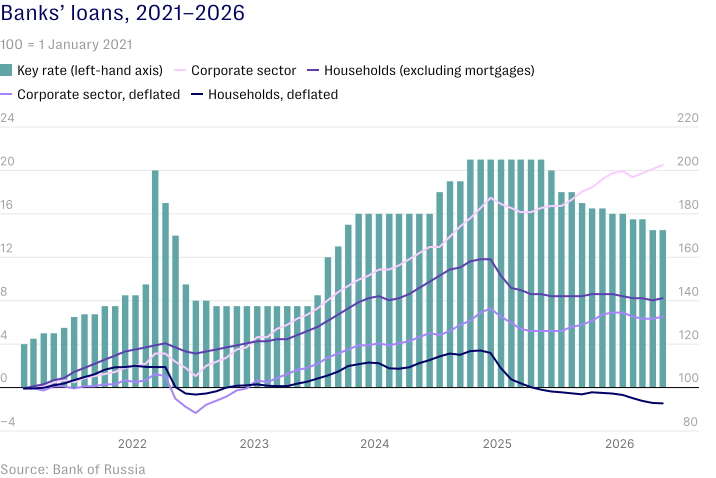
Demand for credit from households (excluding housing loans) has behaved entirely in line with economic theory. It has been declining for the past nine quarters, with no signs of a reversal.
The budget: the Ministry of Finance is counting on normalisation
In May, Russia’s oil and gas revenues increased significantly for the first time since the beginning of the year. This was primarily due to the April oil price of USD 94.9 per barrel, more than double the first-quarter average (USD 42 per barrel). In addition, the removal of the threat of secondary sanctions against countries purchasing Russian oil had a positive effect.
In total, the Russian Ministry of Finance received RUB 1.08 trillion (USD 15 billion) from oil and gas production and exports in May.3 Of this amount, 35 per cent (USD 5.2 billion) was paid back to producers as compensation for restraining growth in domestic petrol prices and for the costs of modernising oil refineries.
The export price of Russian oil announced by the Ministry of Economic Development for May (USD 85.62 per barrel) exceeds the level assumed in the budget (USD 59 per barrel) by 27 per cent at the current exchange rate. This means that in June, the Russian Treasury will continue to offset the shortfall in oil and gas revenues recorded earlier in the year.
Total federal budget revenues in May were 12 per cent lower than in the previous two months. This was due to the large number of public holidays and the tax payment calendar, under which additional tax payments for the first quarter are made in April. However, the decline in revenues did not lead to a larger deficit. Budget expenditure in May fell by more than 23 per cent compared with the average level recorded between January and April, and the monthly deficit amounted to just RUB 133 billion. The Ministry of Finance had attributed the substantial deficits of previous months to the advance financing of government procurement. It now appears that this process has been completed.
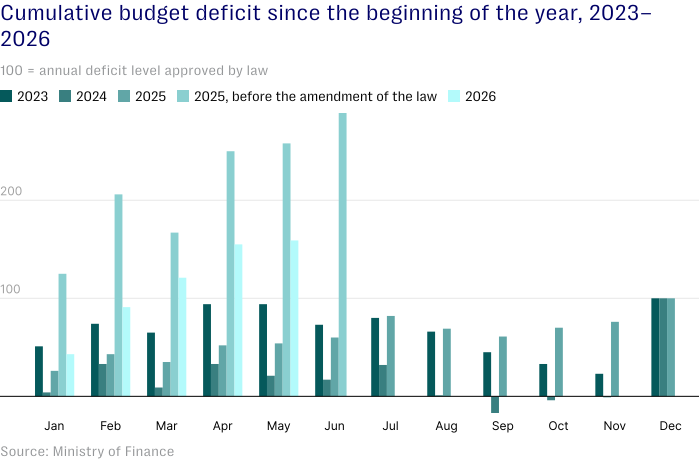
Speaking at the SPIEF, Vladimir Putin stated that this year’s budget deficit would be the same as last year’s – 2.6 per cent of GDP. It is possible that the president misspoke, as the planned budget deficit for 2026 stands at 1.6 per cent of GDP. If, however, Putin’s statement was not a slip of the tongue, one may expect the deficit target for the current year to be revised upwards by RUB 2.3 trillion (just under USD 32 billion).
Such a revision would need to be reflected in a higher annual expenditure ceiling. This would be consistent with the Russian Ministry of Finance’s expectations for increased military spending, which were presented to Putin in February. At that time, he was advised to reduce non-military expenditure in order to avoid exceeding the planned budget deficit. Today, that proposal appears to have been set aside, with the Ministry of Finance instead promising that the deficit will not exceed last year’s level.
To fulfil such a commitment, the Ministry of Finance would have to keep expenditure broadly in line with incoming revenues during the remaining seven months of the year. This is because the budget deficit for the first five months of the year has already reached 2.6 per cent of GDP, or RUB 6 trillion, leaving a margin for further expansion of only RUB 100 billion – 1.7 per cent of the deficit accumulated during the first five months of the year. Keeping expenditure in line with revenue for the rest of the year would be extremely difficult, particularly given the high expenditure typically recorded in December.
Pro-Kremlin economists against Rosstat
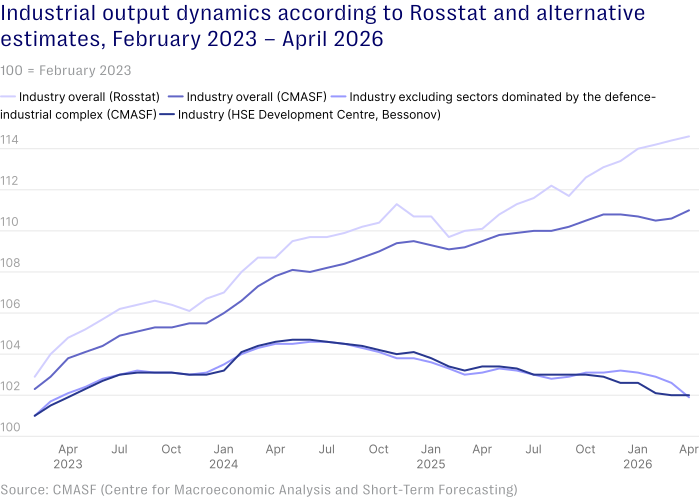
April’s data on industrial production dynamics reduced the differences between the assessments of the economic situation at the beginning of the year by the Centre for Macroeconomic Analysis and Short-Term Forecasting (CMASF) and the HSE Development Centre. On the other hand, they further widened the gap between Rosstat’s estimates and those of the CMASF.
In its review, the CMASF openly accused Rosstat’s experts of incompetence, without specifying whether it considered this deliberate or accidental:
‘Such a substantial discrepancy between Rosstat and the CMASF in assessing the direction of output dynamics after seasonal adjustment is due to the fact that, since the beginning of 2026, Rosstat has not ensured consistency between chain indices (month-on-month) and indices relative to the corresponding period of the previous year.’
When tracking changes in a given indicator, a statistical agency may either compare it with the same period of the previous year – for example, April 2026 with April 2025 – or compare the first quarter of the current year with the first quarter of the previous year. This is known as a base index. Alternatively, it may compare the indicator with the immediately preceding period – for example, April 2026 with March 2026, or the first quarter of 2026 with the fourth quarter of 2025. This is known as a chain index. Each approach has its advantages and disadvantages.
The first approach, the base index, captures dynamics over a longer period and therefore reduces the influence of short-term fluctuations. However, it does not reflect the most recent trends. For example, if an indicator rose by 10 per cent in the first quarter and then declined by 1 per cent in each of the following three quarters, the final result would still show ‘growth of 7 per cent’. In practice, however, the more accurate description would be a sustained decline over three consecutive quarters.
The second approach, the chain index, by contrast, clearly captures short-term changes. However, to obtain a picture over a longer period, the observer must multiply together the required number of indices – three to obtain a quarterly estimate or twelve to obtain an annual one. This is why they are known as ‘chain’ indices: the desired measure can be derived from the chain of sequential observations.
Both approaches should, in principle, produce the same result over a one-year horizon. Multiplying twelve monthly chain indices yields the annual outcome – that is, a comparison with the same period of the previous year, or the base index.
The CMASF argues that such consistency is absent in Rosstat’s data and that multiplying the chain indices produces a significantly higher estimate than the corresponding base index:
‘While Rosstat reported an index relative to the corresponding period of the previous year of 101.9 per cent in April, the product of the twelve chain growth rates equals 106.1 per cent.’
According to the CMASF, this means that Rosstat is substantially overstating short-term growth rates – in this case, that of industrial production. These short-term indicators appear to attract the greatest attention from Russia’s leaders, who, evidently, are not particularly familiar with the methodology used to calculate them.
In this respect, the divergence between the CMASF’s and the HSE Development Centre’s assessments at the beginning of the year of industrial performance, excluding the defence-industrial complex, was temporary in nature. It reflected differences in the methods used to adjust for seasonality and calendar effects. By April, however, the two think tanks’ data on industrial dynamics had converged.
In April, the Russian industry produced no major surprises. The military sector continued to expand, supported by wartime spending. Civilian industry, meanwhile, continued to contract under the combined pressure of weakening demand and high interest rates.
A notable development in April was the impact of Ukrainian strikes on Russian oil refineries. Combined with scheduled seasonal maintenance shutdowns, these attacks led to a decline in oil refining volumes of more than 9 per cent compared with April of the previous year.
Among other factors, the following should be noted:
- The end of the decline in oil and coal production that emerged in February–March. The reason for this was the closure of the Strait of Hormuz during the US-Iran War, which effectively suspended the enforcement of US sanctions on purchases of Russian oil.
- The continued recovery of the automotive industry: output increased by 1.5 per cent compared with March, following average monthly growth of 2.1 per cent during the first quarter. Full recovery remains distant, however. Production in April amounted to 82 per cent of the average monthly level recorded in 2024 and only 63 per cent of the 2021 level.
- A slight contraction in chemical production, some facilities of which were also targeted by Ukrainian strikes. Output in April declined by 1 per cent compared with March.
- An end to growth in the food industry, which in previous months had been driven by temporary factors. An early Orthodox Easter affected demand for certain food products, while the increase in export duties on sunflower oil from 1 April encouraged additional production and exports ahead of the change.
- A pause in the decline of most major construction materials industries and modest growth in ferrous metallurgy (+0.6 per cent compared with March). It is, however, too early to speak of a sustained recovery. Output remains 10–20 per cent below the average monthly level of 2024. The short-term improvement appears to have been driven by unusually warm weather, which allowed construction work to begin earlier than usual. No durable factors supporting a broader revival of investment activity in the economy are yet evident.
Drone attacks have not disrupted petroleum product exports
An analysis of reporting by the Russian Ministry of Energy confirms an earlier hypothesis that Ukrainian strikes on Russian oil infrastructure have been ineffective in exerting pressure on petroleum product exports.4 Over the past two years, export volumes have remained within a range of 250,000–350,000 tonnes per day, while petrol exports specifically have remained at around 50,000 tonnes per day.
Russia’s annual petrol consumption is approximately 40 million tonnes. At the same time, total petrol inventories (held at refineries and storage facilities) amount to around 1.8 million tonnes, equivalent to two to three weeks of domestic consumption. Under these conditions, even a complete one-month shutdown of Russia’s largest refinery – Gazprom Neft’s Omsk Refinery, which produces about 4.8 million tonnes of petrol per year5 – would reduce output by only 0.4 million tonnes. Such a shortfall could easily be offset by existing inventories.
A refinery shutdown could, of course, lead to temporary petrol shortages in nearby regions. However, identifying alternative suppliers and arranging deliveries is unlikely to take more than a few days.
Endnotes
- Financing budget expenditure through the National Wealth Fund has an economic effect equivalent to monetary financing by the Central Bank. The assets of the National Wealth Fund are held in foreign currency instruments, and when the Ministry of Finance decides to use these resources, it sells them to the Bank of Russia. In addition, during the first half of 2023, revenues generated by the rouble’s depreciation became an important source of federal budget financing, as the rouble value of the Ministry of Finance’s foreign currency assets almost doubled. Together, expenditure financed by these two sources amounted to more than 3 per cent of GDP in 2023. ↩︎
- This policy seeks to stimulate economic growth and create jobs through increased military spending, including weapons procurement, infrastructure construction, and military maintenance. ↩︎
- In Russia, oil taxes are calculated primarily on the basis of oil production volumes, whereas gas taxes depend on both gas production (which accounts for roughly two-thirds of total gas tax revenues) and gas exports (which account for the remaining one-third). ↩︎
- These reporting data cover approximately 75 per cent of total petroleum product exports. However, since the methodology used to collect and process the information has remained unchanged, there is no reason to doubt the reliability of the indicators it contains. ↩︎
- The Omsk Refinery has a crude oil processing capacity of 22 million tonnes per year (440,000 barrels per day). The second-largest refinery by processing capacity is the Kirishi Refinery, with a capacity of 21 million tonnes per year. ↩︎