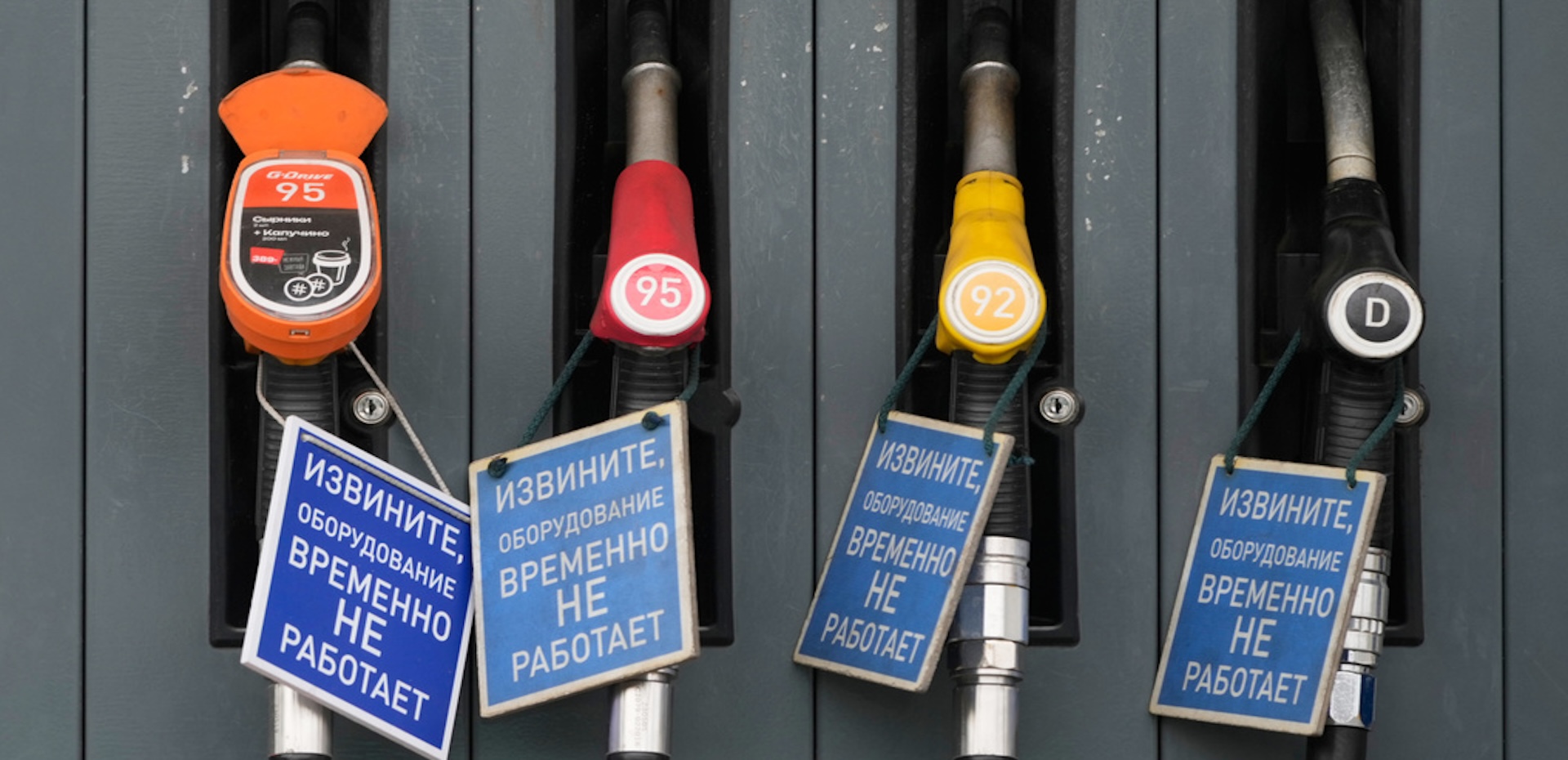
Following a series of Ukrainian strikes on Russian oil refineries, Russia faces a nationwide fuel crisis. A shortage of petrol and diesel, which began in occupied Crimea, has quickly spread to dozens of regions, causing supply disruptions and rising prices. The crisis, which began in late May, demonstrates the Russian authorities’ inability to respond promptly to critical challenges. A system of governance in which strategic decision-making is concentrated in the hands of a single individual, and the bureaucracy is divided into competing centres of influence, has proved unable to implement a coordinated crisis response. This creates a genuine threat to social and economic stability, increasing the political costs of the war for the Kremlin.
Since the beginning of the year, Ukraine has struck at least 25 Russian oil refineries, which together account for more than 80 per cent of the country’s total oil refining capacity. Of the 25 targeted refineries, 13 have partially or completely suspended operations. The time required to restore damaged equipment ranges from several weeks for minor damage to as long as six months when high-pressure processing units have been destroyed. Among the most significant events in recent weeks are the drone strike which damaged the Omsk Oil Refinery, Russia’s largest, and the shutdown of the Moscow Oil Refinery, which, according to industry sources, is expected to remain out of operation until the end of 2026.
As a result, Russia’s total petrol production in June fell to 65 per cent of its average consumption. This led to queues stretching for several kilometres at petrol stations, the use of QR codes to ration fuel, temporary limits on the volume of fuel customers could purchase, and the closure of hundreds of filling stations.
In an attempt to stabilise the situation, the authorities temporarily legalised the sale of Euro‑2 and Euro‑3 standard fuels. The ban on petrol exports, in force since February 2025, was extended to include diesel and aviation fuel. Russian companies, in turn, began importing petrol from India, Belarus, and Kazakhstan. Although the crisis developed over several months amid Ukrainian strikes on oil refineries, comprehensive measures to stabilise the market were introduced only in mid-June, by which point the fuel shortage had become serious.
The government has rejected the two most obvious options: lifting price controls and rapidly reorganising the fuel supply. The first option would inevitably have led to a doubling or even tripling of petrol prices and, consequently, to political difficulties for the authorities ahead of the State Duma elections scheduled for September.
The second option – the rapid reorganisation of fuel supply – would have required swift coordination among government bodies and state-owned companies. However, pipelines, oil refineries, and rail transport fall under the authority of different institutions, including the Ministry of Energy, Transneft, Rosneft, Gazprom, Russian Railways, and others, which are overseen by Deputy Prime Ministers Alexander Novak and Vitaly Savelyev, as well as by key members of Putin’s elite, including Igor Sechin, Alexey Miller, and Nikolay Tokarev. The political figures who could have assumed responsibility for managing the crisis and coordinating an effective response have failed to do so. Prime Minister Mikhail Mishustin has distanced himself from the crisis, while Putin has limited himself to brief public assurances that the situation remains under control. The lack of coordination between these figures has significantly hindered crisis management and increased the political risks for the regime.
This represents one of the main long-term threats to Putin’s model of governance. The more complex the crisis grows, and the greater the need for coordination among government bodies and readiness to make politically painful decisions, the more apparent the limitations of a system in which strategic decision-making is entirely centralised become.