Vladimir Putin’s religious beliefs matter far beyond his private life. In a system where the most important political decisions increasingly depend on one person, his views of power, history, and death are a factor in state policy. At the same time, Putin’s worldview can hardly be described as Orthodox Christian in the traditional sense. Over a quarter of a century in power, he has moved from being an almost demonstratively secular product of the Soviet era to embracing an eclectic belief system in which the Orthodox sacralisation of the state and war coexists with superstition, an interest in mystical practices, and the hope that technology can overcome death. Analysing this framework helps to explain the logic through which he perceives his own power, the war, and Russia’s future.
Speaking on 5 September 2026 at a reception marking Moscow Day, Vladimir Putin described his visit to the Cathedral of the Archangel in the Kremlin, where he was shown the sarcophagus containing the remains of Prince Dmitry Donskoy: ‘When I entered the cathedral and looked at it, I did not expect it myself, but it made such an impression. These are the actual relics of a saint, a man who played such an enormous role in the formation, salvation, and development of Russia.’ The remains had been removed in the summer of 2026 from beneath the cathedral floor, where the prince was buried in 1389. Officially, this was done in order to restore the sarcophagus; unofficially, it was at the request of the Russian Orthodox Church, which had insisted on the recovery of the saint’s relics.
Putin venerated the relics and described the discovery as ‘absolutely unique, miraculous’. A special prayer service was held for him before the relics. Afterwards, one reliquary containing a fragment of the saint’s relics was carried at the head of a religious procession through Moscow and placed on display for veneration at the Cathedral of Christ the Saviour. Another was taken to the Main Cathedral of the Armed Forces of the Russian Federation. A third was ceremonially delivered to the Donbas, from where it was to be taken to the front line to support the morale of Russian servicemen. Appeals to divine support and the sacralisation of the war have become an important part of its ideological and symbolic framing, and clearly illustrate Putin’s interpretation of Orthodox Christianity.
The secular beginning
In 2000, when the new Russian president Vladimir Putin was asked by the American television host Larry King, ‘Do you believe in a higher power?’, he replied: ‘I believe in people. I believe in their good intentions. I believe that all of us have come into this world to do good.’ It was the answer of a secular person, far removed from religious rhetoric.
In 2001, during Vladimir Putin’s visit to Greece, the local newspaper ‘Strana’ published an interview with Archimandrite Tikhon Shevkunov, who was already rumoured to be the young president’s spiritual confessor, although in fact he simply had access to Putin’s inner circle. Shevkunov said that Russia should pray for Putin, who had been placed at the head of the state by Divine Providence. The archimandrite stressed that Putin was a genuine practising believer and outlined a new ideology linking church and state: ‘In 1917, Russia’s almost thousand-year continuity of rulers who were Orthodox Christians was broken. In this sense, the continuity of the ages has now been restored in the person of the current president.’
At first, Putin did not feel very confident in matters relating to the Church. Shevkunov took him to the Pskov-Pechory Monastery to meet Archimandrite Ioann Krestiankin, Shevkunov’s own spiritual mentor. According to the banker Sergei Pugachev, who accompanied them, Putin spent only a few minutes in the elder’s cell and showed no particular curiosity; he had no personal questions for the renowned elder. But from the outset, partly intuitively, Putin framed distinctly Orthodox rituals to strengthen presidential power, giving it an additional, sacred form of legitimacy.
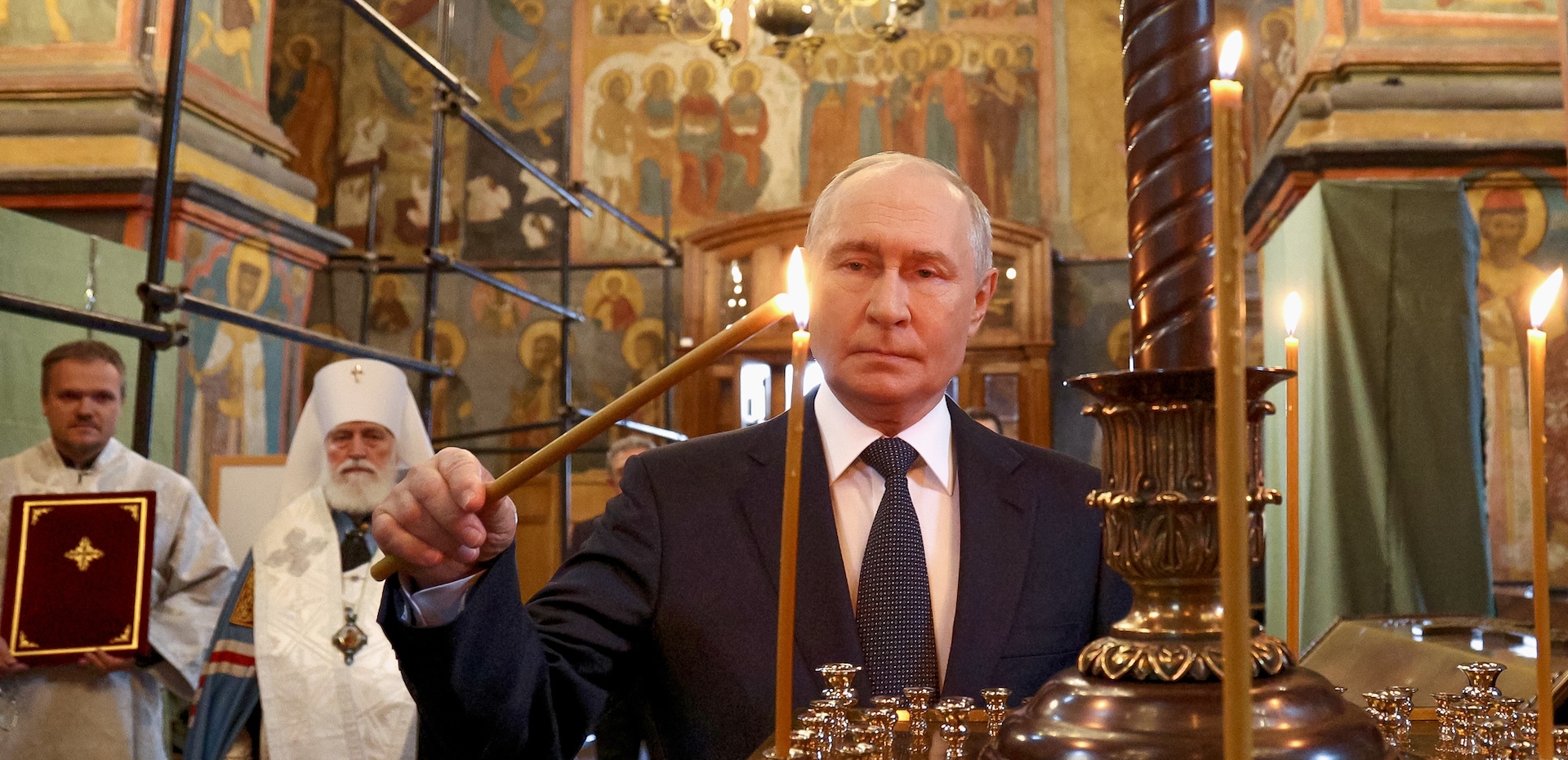
During his first term in office, Putin introduced the tradition of holding prayer services in the Kremlin’s Annunciation Cathedral – the private church of the Russian tsars – to mark his inauguration; no such tradition existed under Yeltsin. Patriarch Alexy II conducted these services three times, in 2000, 2004, and 2008 (when Dmitry Medvedev became president), and Patriarch Kirill has conducted them three times, in 2012, 2018, and 2024. These prayer services are a kind of substitute for a coronation, a reconstruction of the rite of crowning a ruler. During the most recent inauguration service, held in the Annunciation Cathedral in 2024, Patriarch Kirill said that he wished for the president to ‘lead your great Fatherland with dignity throughout all the days of your life’ and praised the example of Alexander Nevsky, who ‘did not spare his enemies, yet was glorified as a saint’.
As early as 2003, Sarov hosted large-scale celebrations, organised by both the church and the government, marking the centenary of the canonisation of St Seraphim of Sarov. Sergei Kiriyenko, then the presidential envoy to the Volga Federal District and now First Deputy Chief of Staff of the Presidential Administration, organised celebrations in Sarov whose programme reproduced Nicholas II’s visit for the saint’s canonisation a century earlier – with Putin in the role of the tsar. Patriarch Alexy II addressed him with the words: ‘Today, exactly a century later, Sarov once again welcomes the head of the Russian state – President Vladimir Vladimirovich Putin. Today’s celebration is a sign of the unity of the Church, the people, and the authorities – a unity that was artificially broken by the tragic events of the twentieth century, but is now being restored through the prayers of St Seraphim and our common efforts.’ The patriarch quite literally likened the president to an emperor – the Church knew no other way of relating to state power.
Putin’s response at the time, however, was restrained and pointedly secular: ‘Today’s celebration has been made possible by the revival of spiritual and religious freedom in our country. In Russia, we greatly value the contribution of all our country’s faiths to strengthening Russian statehood, strengthening harmony among the peoples of multinational Russia, and strengthening the moral foundations of our lives. Today is a celebration not only for Orthodox Russians, but for the entire Orthodox world. I wish you happiness, peace, and prosperity!’ He demonstrated his own personal, private affiliation with Orthodox Christianity, but spoke more like an official who, by virtue of his position, was expected to remain confessionally neutral than like a tsar, and ended with formulaic Soviet-style wishes.
In 2007, Putin played a key role in uniting the Russian Orthodox Church (ROC) and the Russian Orthodox Church Outside Russia (ROCOR) – a church founded by post-revolutionary Russian émigrés, whose identity was based on rejection of the Soviet Union and communism. With the help of Archimandrite Tikhon Shevkunov and of young American businessmen, descendants of émigrés who were building their fortunes in the new Russia, the president persuaded both the leadership and the rank-and-file clergy of the émigré church that it needed to come under Moscow’s authority – to ‘reunite’. This was presented as national reconciliation, but without any repentance.
ROCOR was relatively small at the time, but by its very existence it represented an ‘other Russia’, distinct from the Soviet version of Russian history. The likely aim of its absorption by the ROC was to unify Russian Orthodoxy and subordinate it to the state, leaving no room for alternative paths or views.
A demonstrative believer
Putin’s image as a pious Orthodox Christian became more firmly established year after year. He regularly attends Christmas and Easter night services. He has celebrated Christmas in a different place every year – sometimes in rural churches in the Tver and Novgorod regions, sometimes in the Transfiguration Cathedral in his native St Petersburg, sometimes in the Kremlin’s Annunciation Cathedral, and sometimes in the Church of St George on Poklonnaya Hill. Live broadcasts from the church where the president is praying are a standard part of Christmas and Easter coverage on Russia’s federal television channels.
He has also made a point of immersing himself in a hole cut in the ice for the Feast of the Epiphany, although this custom is by no means obligatory and belongs more to folk tradition than to Christian ritual. He regularly visits the Transfiguration Monastery on the island of Valaam and the Iversky Monastery in Valdai. In recent years the President of Belarus, Alexander Lukashenko, has accompanied him on his traditional August visit to Valaam. Putin has also twice visited the monastic republic of Mount Athos in Greece, where he received a ceremonial welcome, in 2005 and 2016.
At the palace in Gelendzhik, which according to the media outlet Proekt and investigators from Alexei Navalny’s Anti-Corruption Foundation (FBK) belongs to Vladimir Putin, there is a private chapel. Its iconostasis contains an icon of the president’s patron saint, Prince Vladimir. Putin’s Kremlin apartment, shown by the federal television channel Rossiya in a lengthy interview with the president conducted by Pavel Zarubin in May 2025, also contains a private chapel.
In the interview, Putin says that it was there that he ‘knelt down for the first time’ during the Nord-Ost terrorist attack in 2002, although it is evident that the chapel, like the rest of the apartment, was fitted out only recently. Zarubin said that, on seeing the chapel, he wanted to ask the president there and then about the occasions on which he used it, but Putin immediately suggested moving to another room if the questions were of a ‘personal’ nature.
It was probably the same chapel that he mentioned to US special envoy Steve Witkoff when he said that he had prayed after learning of the assassination attempt on Donald Trump in 2024. It is not known what status these private presidential chapels have from the point of view of the Moscow Patriarchate, or whether clergy are attached to them to conduct services. There has been no information about any priests being allocated to them, and the chapels look more like sets that are only very rarely used for their intended purpose.
Vladimir Putin’s theology
Putin has made relatively few ‘theological statements’ from which conclusions can be drawn about what he actually believes. At an exhibition by the artist Ilya Glazunov in 2012, on seeing an image of the first Russian saints – Princes Boris and Gleb – Putin said: ‘They are saints, but they gave everything up without a fight. This cannot be an example for us. They lay down and waited to be killed.’
The refusal to engage in fratricide and humility in the face of death are fundamental Christian virtues. Yet this image of early Russian sanctity, embodied by the two meek brothers, does not appeal to him. As Archpriest Andrei Kordochkin wrote, ‘If Putin cannot understand the motivation of people who refused to commit fratricide, then for him there are no moral barriers to gaining power or holding on to it.’
In 2018, setting out the essence of Russia’s nuclear doctrine, Vladimir Putin said that ‘the aggressor must know that retaliation is inevitable and that he will be destroyed. We are the victims of aggression, and we will go to heaven as martyrs, while they will simply die like dogs, because they will not even have time to repent.’ This is closer to the Islamic concept of jihad than to Orthodox theology.
Indeed, in Putin’s view, ‘Muslims are closer to us, Orthodox Russians, even than Catholics’, as he said in Kazan later that same year. To educated Christians, this sounded provocative: a religion that denies the divinity of Jesus Christ was declared, because of its cultural and social characteristics, to be closer to Putin’s version of Orthodoxy than the most closely related Christian denomination.
The statement about the closeness of Orthodoxy and Islam shows that, for Putin, the person of Jesus Christ is not central at all. He was speaking not about faith or his personal religious experience, but about political architecture: the Iranian model of combining political and religious authority is functionally closer to him than the European principle of the Church’s autonomy from the state.
In the Iranian paradigm, the head of state, operating within a formally established theocratic system, independently interprets everything related to faith and the ideology derived from it, while institutional religion acts as a transmitter of his interpretation and as a mechanism for monitoring citizens’ compliance with religious prescriptions. Putin is building the reverse structure: the head of state determines what political meaning faith should have, while the Church sacralises his power, transmits his interpretation, and helps to secure public loyalty. What he needs is not a theocracy in the usual sense, but secular power with theocratic authority.
In August 2024, during a visit to Grozny, Putin kissed a copy of the Quran in a mosque. A video showing the Russian head of state, surrounded by imams and accompanied by Chechen President Ramzan Kadyrov, venerating the Muslim holy book in the same way as Orthodox icons went viral on social media across the Arab world and in other Muslim countries. In other words, for Putin there is essentially no difference between religions, as long as they ‘work’ both ideologically and mystically.
Putin himself, Dmitry Medvedev, and Sergei Ivanov have all visited the Ivolginsky Datsan to see a Buddhist relic: the incorrupt body of Lama Itigelov. Putin, moreover, remained alone with the body, without journalists or other witnesses. During a visit to Israel, after visiting the Church of the Holy Sepulchre, Putin went to the Western Wall, where he ‘prayed and read the Psalms of David in Russian’.
Putin speaks much more often, and more readily, about Orthodoxy and the Church as part of Russian culture and as a source of statehood than about God or his personal faith. He has repeatedly stated that ‘Orthodoxy and Russia are inseparable’. In 2020, among the amendments to the Russian Constitution introduced by Putin was a reference to ‘the memory of our ancestors, who passed on to us their ideals and faith in God’ – thus placing the word ‘God’ in the text of the country’s fundamental law.
Orthodoxy in wartime
The Russian Orthodox Church supported the invasion of Ukraine from the outset. As early as 6 March 2022, a week and a half after the start of the full-scale war, Patriarch Kirill described it as a struggle ‘that has not a physical, but a metaphysical significance’. He later promised forgiveness of all sins to those who died in battle.
All Russian Orthodox churches are required to read, at every service, a special new ‘patriarchal prayer’ that includes a petition to God to grant victory to Holy Rus’. The World Russian People’s Council, chaired by the patriarch, adopted a document in which the war against Ukraine is explicitly described as holy. The Church television channel Spas broadcast a documentary, ‘War and the Bible’, in which the priest-presenter introduced a new Holy Trinity: ‘The people. The president. God.’ Hundreds of Russian Orthodox priests are stationed at the front, holding services in dugouts, mobile churches, and occupied towns and villages.
Putin rarely uses Orthodox vocabulary, but he demonstrates that he, too, counts on divine support and that sacred rituals matter. In mid-April 2023, during his first visit to the occupied territories of Ukraine, Putin personally brought two copies of the Icon of the Saviour Not Made by Hands. He presented one to the headquarters of the Dnepr group of forces in the Kherson region, and the other to the headquarters of the Vostok group in the Luhansk region. One of these icons ‘from Putin’ was subsequently displayed to military units.
The next stage was the transfer to the Russian Orthodox Church of works of early Russian art, which were removed from museums and relocated to churches, although the latter are not equipped to preserve objects of such importance and value. In May 2023, Putin personally ordered that Andrei Rublev’s ‘Trinity’ be transferred to the Russian Orthodox Church, despite strong opposition from art historians and museum curators. After a temporary stay at the Cathedral of Christ the Saviour, the icon was installed on 22 June 2024 in the Trinity Cathedral of the Trinity Lavra of St Sergius, where art historians had once discovered it in the early twentieth century. Four days later, on 26 June, Putin made a special visit to the Lavra and venerated the icon that had been returned there by his decision.
In April 2026, the same pattern was repeated with two other major icons of Russian ‘military’ iconography – the Vladimir and Don Icons of the Mother of God. The Tretyakov Gallery transferred them to the Cathedral of Christ the Saviour for free use for 49 years. Patriarch Kirill publicly stated that Putin had made the decision after his appeal. During the Easter night service on 12 April, the president approached both icons, crossed himself, and bowed before each of them, while the patriarch thanked him during the service which marked their transfer. On 3 August, the Don Icon was moved to the Donskoy Monastery.
In Church tradition, the Vladimir Icon is the protector of Moscow and the Russian state against external threats, while the Don Icon is associated with the Battle of Kulikovo and Dmitry Donskoy’s victory. The state is removing sacred objects that promise protection, victory, and the restoration of historical unity from museums, while the president publicly affirms his connection with them. He acts as the steward of the nation’s sacred heritage.
At the end of 2024, when asked by a journalist, ‘Do you believe that the conflict with Ukraine will end in 2025?’, Putin replied: ‘I believe in God. And God is with us.’ The phrase refers both to the motto on the coat of arms of the Russian Empire, ‘God is with us’, and to the Nazi ‘Gott mit uns’, but it differs strikingly from the belief in people and in doing good that Putin spoke about to Larry King at the beginning of his presidency.
Putin made his most extensive theological statement at Christmas (by the Orthodox calendar) in 2026, after the liturgy at the Church of St George the Victorious on the grounds of a GRU military unit in Solnechnogorsk, addressing servicemen and the children of soldiers killed in the ‘special military operation’: ‘Today we are celebrating the wonderful, radiant feast of the Nativity of Christ. And we very often call the Lord the Saviour, because he came to earth in order to save all people. And so warriors, Russia’s warriors, always carry out, as it were, this very mission entrusted to them by the Lord – to defend the Fatherland and its people, to save the Motherland and its people. And at all times in Russia, our warriors have been regarded in this way, as people who, as it were, carry out this sacred mission entrusted to them by the Lord.’ There is no reference here to tradition or history – there is a direct commission from God, given, by the logic of Putin’s words, personally to him as supreme commander-in-chief and transmitted through him to the troops.
In June 2026, at a meeting with heads of international news agencies during the St Petersburg International Economic Forum, Putin was asked by a British journalist whether he would have the health to remain in power until 2036. He replied: ‘Only the Lord knows whether we will have the health – you, me, and everyone gathered here – to live until tomorrow.’ He gave a similar answer in December 2025, when a presenter from the Indian television channel India Today asked him directly whether he believed in eternal life: ‘Everything is finite. Only the Lord God is eternal.’
Transhumanism and shamans
But the most important belief held by Vladimir Putin – one that contradicts fundamental religious teachings and is explicitly rejected by Orthodox Christianity – is the hope of physically overcoming death, of attaining material immortality.
During a visit to China in September 2025, a conversation between Vladimir Putin and Xi Jinping about their shared desire to extend their lives as much as possible became public because a microphone had been left on, perhaps deliberately. Putin said that ‘with the development of biotechnology, it will be possible to transplant human organs continuously, and people will be able to become younger and younger and even achieve immortality’. Xi replied that, according to forecasts, people would be able to live to the age of 150 within this century.
At a press conference in Beijing several days later, when a TASS journalist asked him directly about the conversation, Putin first pretended that he had not paid attention to it and then referred to a UN forecast that by 2050 there would be more people over the age of 65 in the world than children aged five or six, shifting to demography where he had begun with immortality.
Two months earlier, during the Russia Day celebrations, Putin received participants in the ‘Time of Heroes’ programme at the Kremlin and recounted to them a conversation he had had with the writer Alexander Prokhanov. ‘What is the main idea of today for Russia? Immortality,’ the president said, quoting the writer. Prokhanov himself, however, claimed that it had been the other way round: ‘It was from Putin that I heard the word “immortality”. It is the most beautiful word, placed on Russian lips by the Lord God himself.’
What exactly Putin and Prokhanov meant is not entirely clear – whether they were speaking of the metaphorical immortality of the country and its people, or of their own literal immortality. Nevertheless, it is evident that the idea of indefinitely extending life and physically overcoming death concerns Putin and those around him.
Research into life extension and immortality is being conducted by Putin’s friend Mikhail Kovalchuk, director of the Kurchatov Institute, and by Maria Vorontsova, an endocrinologist believed to be Putin’s elder daughter; they receive substantial state grants for this work. In 2024, the journalist Mikhail Zygar wrote in the German publication Der Spiegel that the real reason for Putin and Sergei Shoigu’s trip to Mongolia was to meet shamans. The political consultant Abbas Gallyamov confirmed this account: according to his information, the meeting was organised by Mikhail Kovalchuk, and, in addition to questions concerning the use of nuclear weapons and the conduct of the war, Putin discussed longevity and reincarnation with the shamans.
The set of ideas centred on extending human physical life through technology and overcoming death in this world is known as transhumanism. It contradicts the Christian concept of eternal life, as well as the teachings of the other Abrahamic religions. In theology, transhumanism is regarded as rebellion against God – an attempt by human beings to replace God, create a new superhuman, and thus allow pride and self-confidence to triumph. Most importantly, it demonstrates a lack of faith that we will meet God after death, and even a denial of his existence. Patriarch Kirill has said that ‘this teaching is dangerous and unacceptable because it directs society towards creating a surrogate human being capable, ultimately, of completely replacing the genuine human being’.
In the case of Putin and his inner circle – Kovalchuk, Vorontsova, and scientists at the Kurchatov Institute – faith in scientific progress and transhumanism is paradoxically combined with magical thinking and superstition, while enormous investment in scientific research coexists with pagan practices. None of this prevents Patriarch Kirill from holding prayer services for the ‘Orthodox president’. Ultimately, these two extremes converge beyond the bounds of rationality and outside classical Christian doctrine.