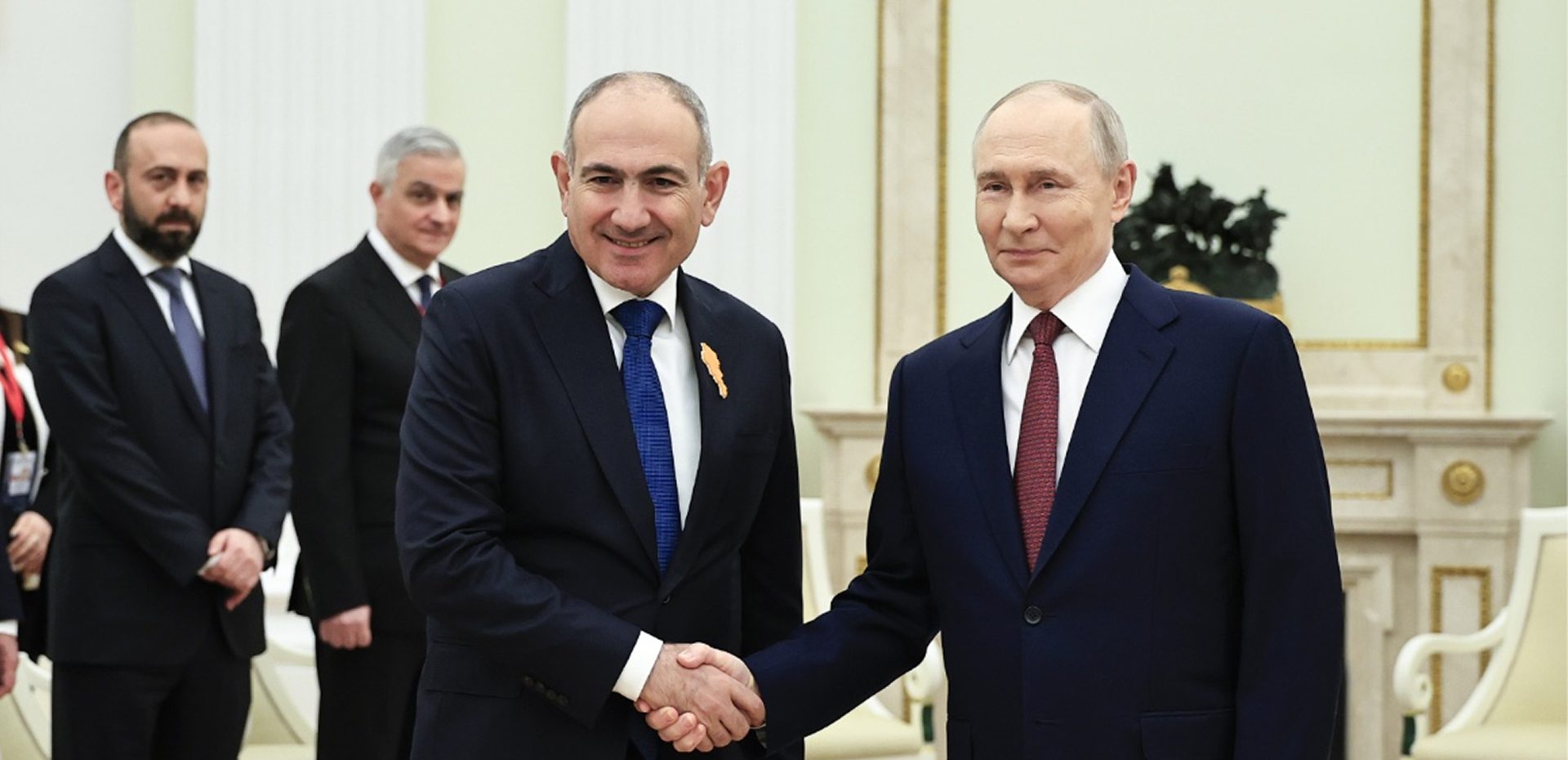
On April 1, Vladimir Putin met in Moscow with Armenia’s Prime Minister, Nikol Pashinyan. Against the background of Yerevan’s gradual drift towards the EU and the United States, its attempts to normalise relations with Azerbaijan and Turkey, and the growing influence of other actors in the South Caucasus, Russia continues to view Armenia as a key outpost. The Kremlin seeks to keep the country within its sphere of influence through a combination of economic and energy dependence, a Russian military presence, and political pressure on Pashinyan via pro-Russian forces and media campaigns. It does not view the Armenian Prime Minister as an ally but as an uneasy, albeit for now, acceptable partner.
On the border with NATO
Armenia remains an important element of Russia’s presence in the South Caucasus, where Moscow’s previously almost unchallenged influence is now balanced by that of Turkey, the United States, the EU, and China. In 2023, when renewed fighting broke out in the Karabakh war between Armenia and Azerbaijan, Moscow did not provide Yerevan with the support it expected and needed. Defeat in the war pushed the Armenian leadership towards a more independent policy and a search for new partners. In 2024, Armenia suspended its participation in the Collective Security Treaty Organisation (CSTO), and in 2025, it adopted a law opening the path to potential accession to the EU. In May 2026, Yerevan is scheduled to host the first EU-Armenia summit, with the participation of European Commission President Ursula von der Leyen and French President Emmanuel Macron.
At the same time, Armenia is building closer ties with the United States, which brokered a peace agreement between Yerevan and Baku in August last year. Based on this agreement, a new transport corridor – the ‘Trump Route for International Peace and Prosperity’ – is being created, allowing the movement via Armenia of goods and energy resources between Azerbaijan and its Nakhchivan exclave without crossing Russian territory and without the involvement of Russian operators. The Armenian leadership is seeking to normalise relations not only with Azerbaijan, but also with Turkey. China’s presence in the region is also increasing.
Nevertheless, for Moscow, the preservation of a military and political presence in Armenia is of strategic importance, partly because of the country’s shared border with Turkey, a NATO member. The Russian 102nd Military Base in Gyumri remains a key tool: the agreement on the deployment of Russian troops there has been extended until 2044. The base hosts around 4,000 personnel, as well as air defence systems and aviation assets. Another instrument of influence is the Border Service of the Russian FSB: although its role is gradually decreasing, Russian border guards continue to control certain sections of the Armenian-Turkish border. Armenia is also important as a link in trade and logistics chains that facilitate parallel imports following the introduction of Western sanctions.
However, Armenia’s symbolic significance is particularly important to the Kremlin. Moscow is engaged in a broad confrontation with the West, including the war in Ukraine, over the preservation of the post-Soviet space as a zone of its exclusive influence. The loss of Armenia would signify not only a weakening of Russia’s positions in the South Caucasus but also a clear failure of this strategy.
Why Armenia cannot break with Russia
Despite Yerevan’s political drift, Russian-Armenian economic ties remain exceptionally strong, especially in the energy sector. This significantly constrains the scope for Armenia’s full reorientation towards the West.
Russia remains Armenia’s key trading partner, accounting for 30–35 per cent of exports and 33–38 per cent of imports. It is also an essential source of foreign investment, controlling significant assets in energy, transport infrastructure, and several service industries. Remittances from migrant labourers in Russia also play a substantial role, accounting for a significant share of the income of many Armenian households.
These economic links are reinforced by Armenia’s participation in the Eurasian Economic Union (EAEU). Membership in the EAEU provides tariff-free access to the common market, simplified customs regimes, and the free movement of labour, with Russia the dominant partner.
Armenia’s energy dependence on Russia persists. The entire gas distribution network in Armenia is owned by Gazprom Armenia, a subsidiary of Russia’s Gazprom, which effectively monopolises the country’s natural gas supply. During Pashinyan’s visit to the Kremlin, Putin said that Armenia receives Russian gas at a preferential price of $177.5 per thousand cubic metres. Moscow uses this special treatment as a tool of political pressure: Yerevan lacks readily available and comparable alternatives in terms of volume and cost.
As long as the EU does not offer a comparable level of market access, investment, and economic integration, Armenia will be compelled to maintain a balanced posture. This reinforces the Kremlin’s view that a break with Russia in favour of Europe remains unlikely in the medium term.
A compromise candidate
Against this background, Nikol Pashinyan appears to be an awkward but nonetheless acceptable partner for Moscow. Given that no alternative candidate is visible in Armenia’s forthcoming parliamentary elections who could both win and guarantee Russia greater influence, Moscow has no incentive to back another figure.
Instead of attempting to replace Pashinyan, Moscow is relying on pressure and containment by introducing a pro-Russian and anti-Western alternative to him. The Armenian-Russian businessman Samvel Karapetyan and organisations associated with him are being brought onto the political stage as a potential ‘friendly’ centre of power. At the same time, a media campaign is being deployed to promote narratives about the need to preserve the alliance with Russia and the risks of a Western course.
The success of this strategy will depend not only on Moscow’s resources and the appeal of the pro-Russian bloc, but also on whether Pashinyan can retain electoral support and convince the public that a balanced course between Russia and the West continues to serve Armenia’s interests.