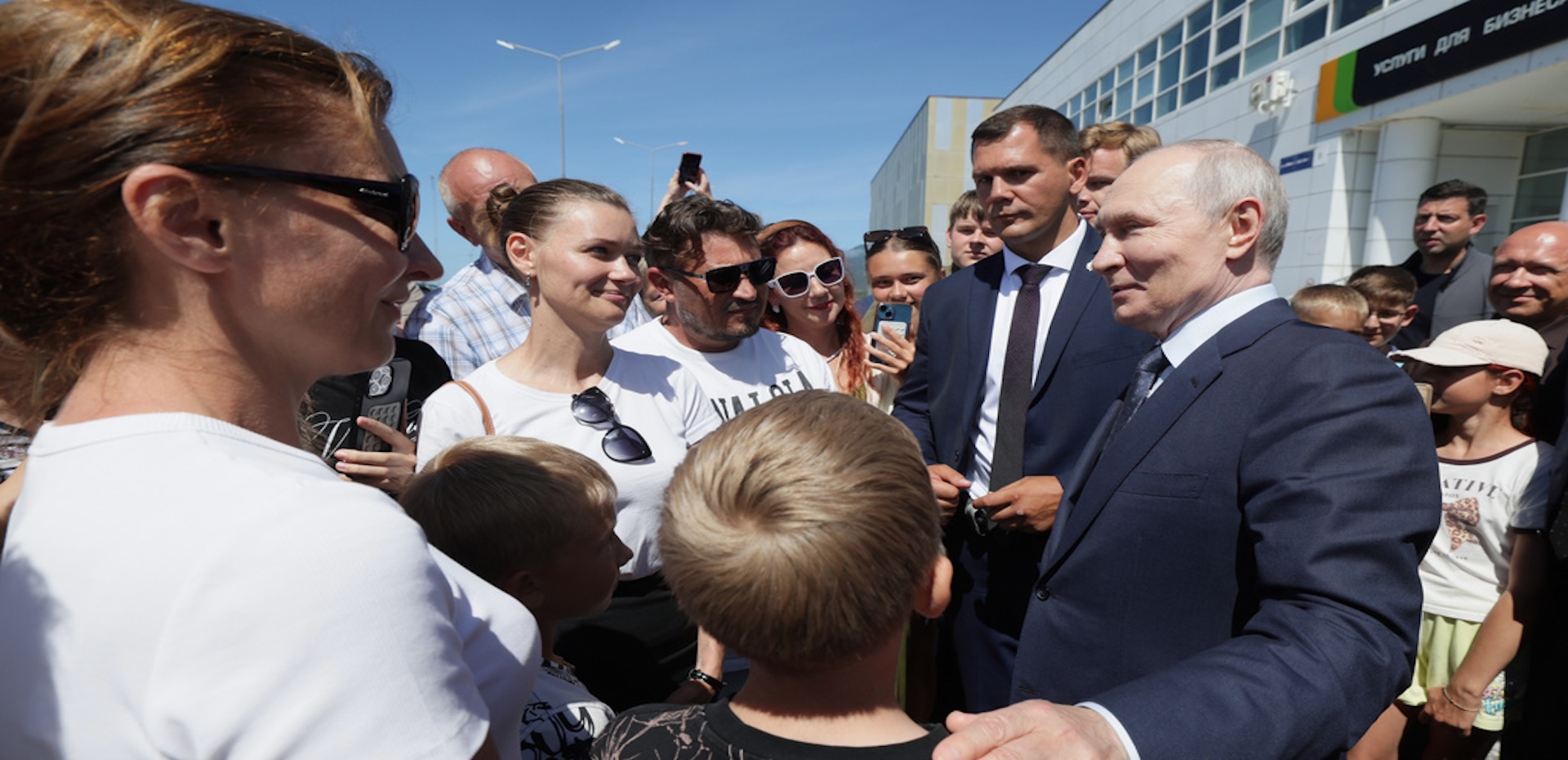
After an almost complete seven-month halt to regional travel, Russian President Vladimir Putin has unexpectedly embarked on a pre-election tour of the country. The reason for this appears to be that preparations for the first State Duma elections since the start of the full-scale invasion of Ukraine are taking place amid falling approval ratings for the authorities and a worsening public mood. The Kremlin is attempting not so much to boost United Russia’s electoral appeal through emotional content showing Putin embracing children, as to demonstrate that, despite drone attacks, fuel problems, and burning Wildberries warehouses, the authorities are keeping the situation in the country under control.
Putin’s long absence from public regional visits was driven by security considerations amid increasingly frequent attacks by the Ukrainian Armed Forces deep inside Russia. In this light, the president’s sudden tour of the country, and his supposedly spontaneous interactions with Russians, appear to be a forced, reactive measure: the Kremlin’s political needs outweigh the potential risks. The president has acted similarly before, particularly in the aftermath of critical situations such as Yevgeny Prigozhin’s military mutiny or Alexei Navalny’s funeral. Presidential visits have virtually no effect on the authorities’ approval ratings, but they matter for the image of a regime that needs to show it remains in control and enjoys popular support.
Over the summer, Putin made at least seven trips, mostly east of the Urals, which Ukrainian drones can barely reach. The president’s speeches and working meetings devoted surprising attention to issues other than the war: from discussions of urban development in Ulan-Ude and science in Krasnoyarsk to the development of transport corridors in Omsk. In Novosibirsk, Putin went out to meet a group of children and have his photograph taken with them. Putin made a similar sentimental public appearance in Dagestan after the attempted Wagner Group mutiny led by Prigozhin. According to media reports at the time, the Kremlin’s political team planned to raise Putin’s ratings, in particular by ‘increasing the frequency’ of his public appearances. They appear to have succeeded: fluctuations in Putin’s approval rating did not exceed 3 per cent, and it soon returned to its previous level of 82 per cent.
Meetings with residents and the focus on technological sovereignty convey a clear message: everything inside the country is under control, and modernisation continues despite external pressure. This responds to the demands of the growing number of Russians who are tired of the war. Nevertheless, Putin’s speeches also addressed military and geopolitical issues. But this focus was more likely intended to divert attention from problems on the front lines. The president visited an aircraft plant in Irkutsk, where he inspected the modernised Yak-130M combat trainer aircraft, took part in Pacific Fleet exercises, and for the first time visited one of the Kuril Islands, whose sovereignty is disputed by Japan.
During his meeting with Pacific Fleet sailors, Putin threatened the European Union with a ‘reciprocal response’ to seizures of vessels belonging to Russia’s shadow fleet. His visit to the Kuril Islands was also a direct signal to Japan and the United States. The Kremlin is making clear that Russia – together with China and North Korea – does not accept Tokyo’s plans to expand its defence capabilities and deepen military ties with Washington. In addition, Putin’s visit to the Kuril Islands points to further opportunities for the Kremlin to create problems for the United States, which is committed to defending Japan by all available means.