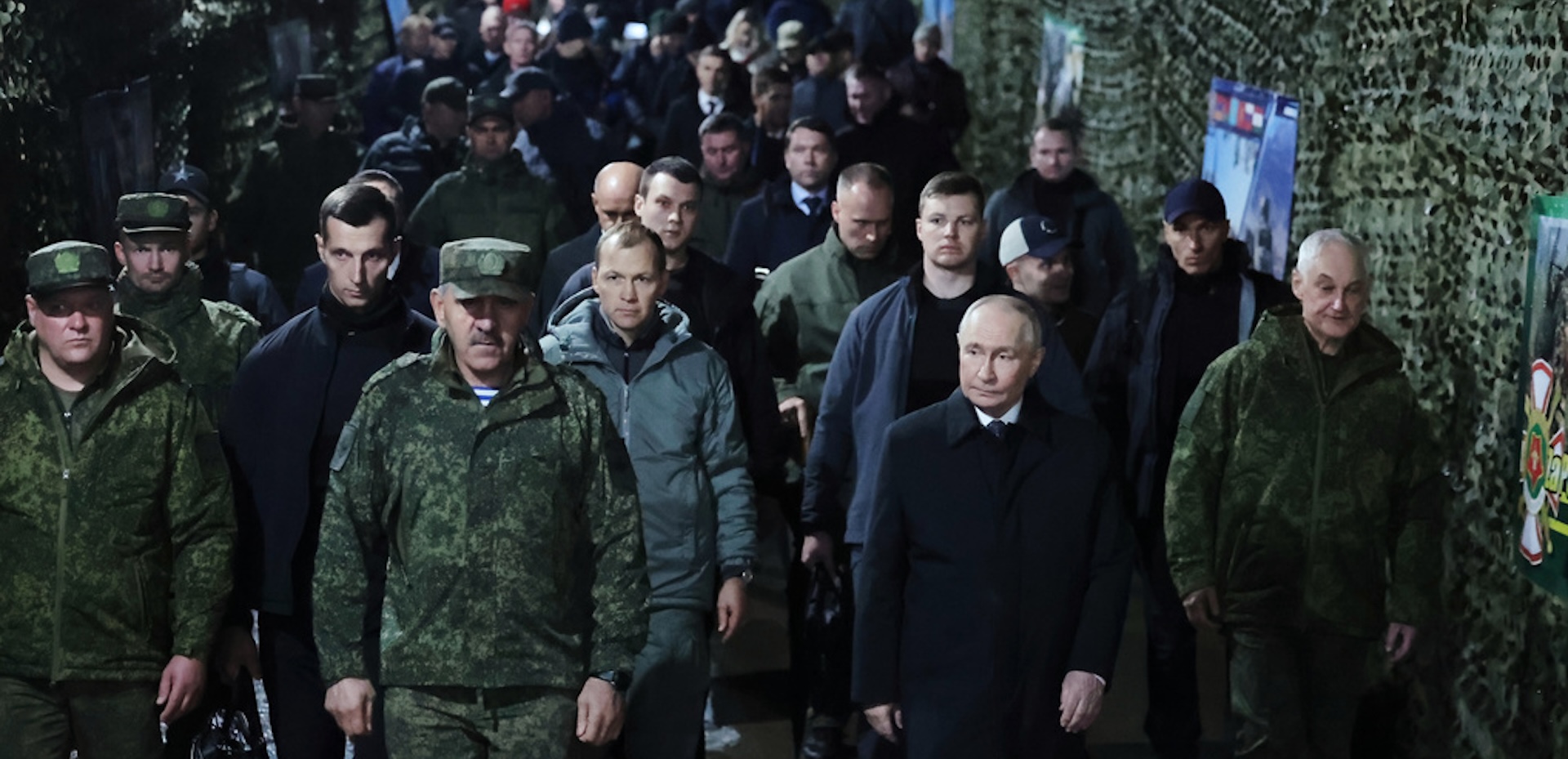
After the parliamentary elections, Russia has moved towards further escalation. Last week, Vladimir Putin threatened to use ‘all forces and means’ at Russia’s disposal if NATO were to threaten Kaliningrad. By making repeated statements about a possible new ‘military operation’ in the Baltic, Moscow is simultaneously testing the limits of the Alliance’s patience and preparing society for prolonged confrontation with the West. By fostering a ‘besieged fortress’ mentality, the Kremlin legitimises tighter domestic controls and justifies the mounting costs of the war.
On 1 October, at the annual meeting of the Valdai Discussion Club – a key platform for articulating the Kremlin’s vision of international politics – Vladimir Putin said that Russia seeks peaceful coexistence with Europe, and then immediately began to issue threats. He made it clear that Moscow would contemplate using its nuclear arsenal if Kaliningrad was in danger. The remarks came a day after the Russian Foreign Ministry sent NATO a document accusing the Alliance of pursuing a ‘dangerous and reckless course’ in the Baltic. It threatened ‘strikes against decision-making centres in the alliance’s member states right from the outset of the conflict’.
This rhetoric closely follows the logic employed in the run-up to Russia’s invasion of Ukraine, when the claim of a ‘NATO threat on Russia’s borders’ served to justify a pre-emptive strike. Heightening tensions around the Baltic not only raises the stakes in Russia’s confrontation with NATO, but also justifies subordinating all areas of domestic life to military needs.
‘The goal is to stimulate more concern among European publics about the dangers of a wider war and to discourage further support for Ukraine. Playing up threats to Kaliningrad is a convenient way to sustain the message to Russian society that the motherland is in danger and requires its citizens to rally around the flag.’

John Lough
Head of Foreign Policy
The draft budget for 2027–2029 provides further evidence of preparations for continued escalation. With unplanned military spending straining public finances, this year’s budget deficit will reach 3.2 per cent of GDP – twice the level set by law. In an attempt at ‘fiscal consolidation’ next year, the government has budgeted for nominal expenditure to increase by just 0.44 per cent, which, after accounting for inflation, amounts to a direct cut in real terms.
With revenues stagnating, prioritising military spending will result in significant cuts to civilian expenditure. The Finance Ministry will be able to keep the deficit within its planned parameters only through high inflation and the complete depletion of the Treasury’s remaining fiscal reserves.
‘As spending on military needs is set to rise by around RUB 1.7–1.8 trillion next year, reaching 6.9 per cent of GDP, while debt-servicing costs will increase by RUB 1.1 trillion, to 1.6 per cent of GDP, spending on all other budget items will have to fall by 8.7 per cent. With inflation at 4 per cent, this means a 13 per cent real-term reduction in non-military spending. Such a sharp contraction in government demand will undoubtedly deepen the economic recession. This budget framework appears highly unsustainable, and it is reasonable to expect both budget expenditure and the deficit to significantly exceed their planned levels next year.’
Sergey Aleksashenko
Head of Economics
The latest round of Russian escalation is taking place against the backdrop of the US domestic political cycle. The Kremlin has three months before the new Congress takes office in which to try to secure the most favourable possible terms for a peace settlement in Ukraine mediated by Donald Trump. In the November elections, the Republicans risk losing control of the House of Representatives, and possibly also the Senate. This would not deprive Trump of freedom of action in foreign policy, but it could significantly complicate decisions that require congressional approval or funding, as well as increasing the domestic political cost of reaching agreements with Moscow.
In the coming months, Moscow will continue its air campaign aimed at damaging the Ukrainian economy in the hope that Ukraine’s growing need for European funding will raise increasing questions within the EU about continued support for Kyiv. The Kremlin is also pinning its hopes on Marine Le Pen’s party winning France’s presidential election in spring 2027.
These political scenarios cannot materialise without battlefield developments that favour Russia, but this would require an influx of new military personnel. The 2022–2025 model of military recruitment, based on exceptionally high payments to volunteers, has run its course: it relied on recruiting the least skilled personnel at enormous cost. Modern high-tech warfare requires a different kind of human capital.
‘The system for recruiting contract soldiers – based on regional quotas and high payments for signing a contract, not only to prospective recruits themselves but also to intermediaries who bring in candidates – has evolved into a system of negative selection. Initially, high recruitment spending made it possible to secure sufficient combat-capable manpower while causing minimal disruption to social stability. The old system can no longer achieve either objective, and the Kremlin will have to find new solutions.’
Ella Paneyakh
Head of Sociology
The Russian authorities are unlikely to conduct another mass mobilisation on the scale of 2022. Instead, they will probably shift towards continuous targeted recruitment. To do so, the Kremlin will need to transfer even greater control over society from civilian technocrats to the FSB. This will make it easier to exert pressure on the local institutions – universities, employers, security agencies, and regional authorities – which are the main channels for recruiting personnel for the front. In these circumstances, fear of a new external enemy is an important mechanism for consolidating society.