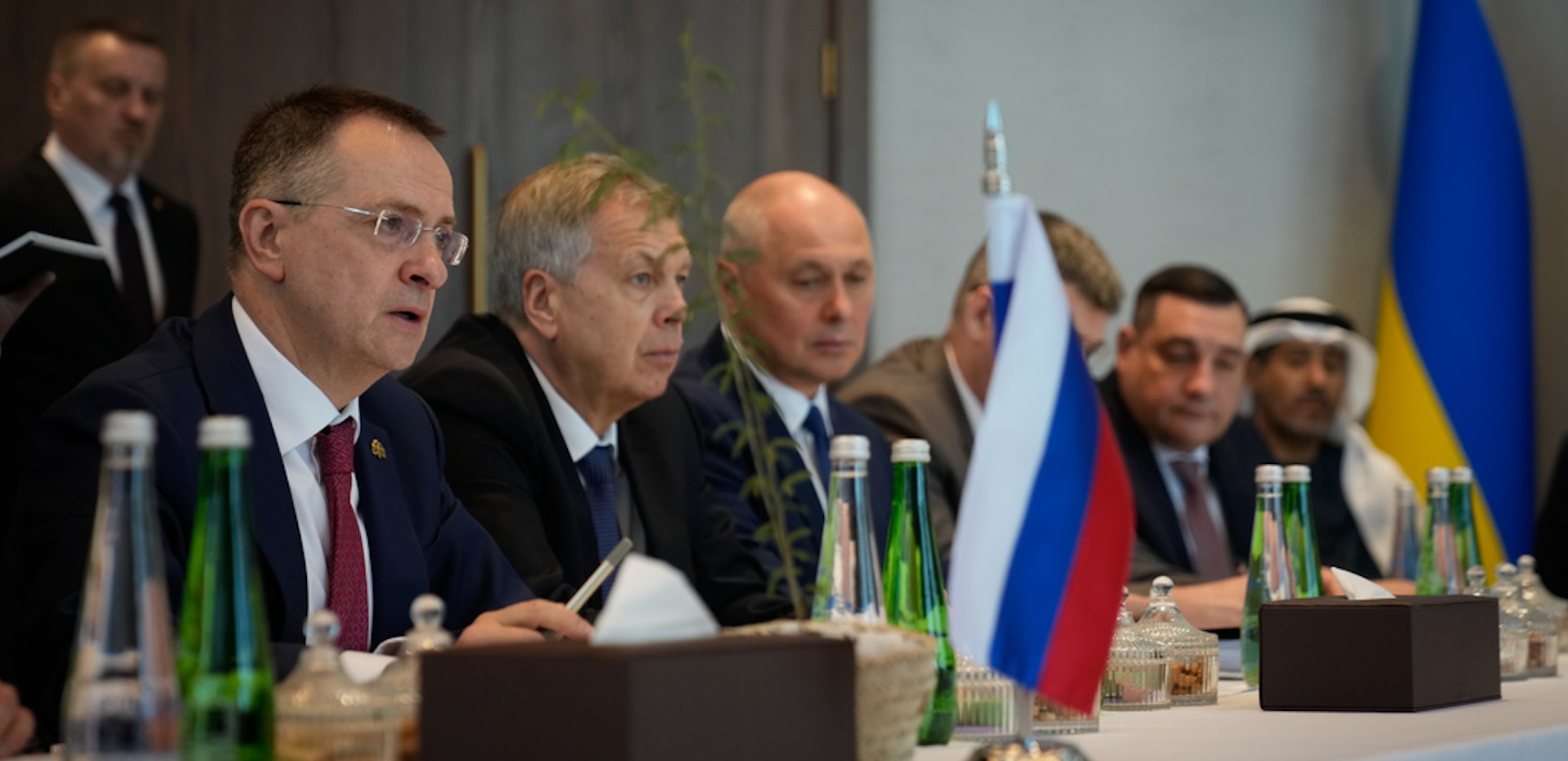
Last week’s talks between the US, Russia, and Ukraine in Abu Dhabi have brought about significant developments. The focus has moved from territorial issues to Europe’s security architecture, which some experts believe is a far greater priority for Vladimir Putin than capturing the Donbas. Even assuming that substantive negotiations of this kind are theoretically possible, they could take years. However, the Kremlin is in no hurry and is prepared to continue the war, calculating that European countries will be forced to accept its terms because time is working against Ukraine and its allies.
At a meeting with the US delegation following the Abu Dhabi talks, Putin effectively resurrected the ultimatum which he issued in 2021 as a ‘core element’ of Europe’s future security architecture. Russian presidential aide Yuri Ushakov reiterated that Moscow continues to demand an end to NATO’s eastward expansion, a ban on the deployment of offensive weapons near Russia’s borders, and a return to the alliance’s 1997 force configuration in Europe. According to Ushakov, Russia plans to supplement these demands with new ‘considerations’ formulated ‘in light of the current situation’. At the same time, media reports suggested that Russia is demanding Finland’s withdrawal from NATO, and the removal of the alliance’s military bases in the Baltic states and other countries that joined NATO after 1997.
Alongside the talks in the UAE, Moscow hosted the International Forum on Collective Security, where representatives of the Russian Foreign Ministry outlined possible forms of engagement with Western countries that would be of interest to the Kremlin. In particular, they proposed bilateral non-aggression agreements with individual NATO member states, modelled on the 1970 treaty between the Soviet Union and West Germany. Both Vladimir Putin and Russian Foreign Minister Sergei Lavrov have previously expressed their readiness to extend legally binding guarantees of non-aggression to European states.
The Kremlin’s desire to conclude such agreements can be explained by the fact that the worldview of the Russian president and his inner circle took shape in the 1980s, towards the end of the Cold War, when the two superpowers were engaged in systemic confrontation but relied on an extensive framework of treaties to reduce the risk of direct military conflict. Over the past three decades, most of these agreements have lapsed, which, together with the expansion of NATO, has created what the Russian leadership sees as a less favourable security environment.
‘Putin feels cornered. For him, confrontation with the West has become the only option, but he is not prepared to engage in a large-scale military conflict. Putin sees a way out, both for himself and for ensuring Russia’s security as he understands it, by setting clear limits on NATO and EU expansion, and concluding new agreements, the broad outlines of which he wants to agree with Washington.’
Sergey Aleksashenko
Head of Economics
Over the past five years, the strategic balance has shifted further against Moscow: Ukraine has strengthened its military capabilities, NATO has expanded with the accession of Finland and Sweden, and European countries have launched large-scale rearmament programmes. At the same time, the Kremlin is losing its levers of influence across the post-Soviet space, particularly in Armenia and Moldova, which are seeking closer integration with Europe.
At the same time, the current US administration has a favourable stance towards Moscow, sharing its contempt for today’s European elites and showing a willingness to reach compromises with Russia. With two years remaining in Donald Trump’s term, the Kremlin is seeking to use this period to legitimise, via US influence, a discussion on the restructuring of European security, and to establish a negotiating framework favourable to its interests, while continuing its military operations in Ukraine.
‘The Kremlin is using the US to put pressure on Ukraine’s European allies to accept its position that agreement on new European security arrangements is a precondition for it to stop fighting. Putin wants to go down in history as the Russian leader who made good the damage caused by Gorbachev’s decision to abandon central Europe and accept Germany’s unification without a binding commitment that NATO would not enlarge beyond Germany’s borders.’
John Lough
Head of Foreign Policy
An alternative view is that the Kremlin is simply playing for time, seeking to avoid a confrontation with the Trump administration: revising Europe’s collective security architecture is a large and complex task that could take years to complete. The Kremlin is now effectively changing the subject of the negotiations: instead of discussing the terms of a ceasefire in Ukraine, Moscow is imposing protracted negotiations on the West over the future of Europe as a whole. The calculation is that, during these discussions, the political landscape in Europe will shift in Moscow’s favour, while support for Ukraine will weaken, along with Ukraine’s ability to resist militarily.