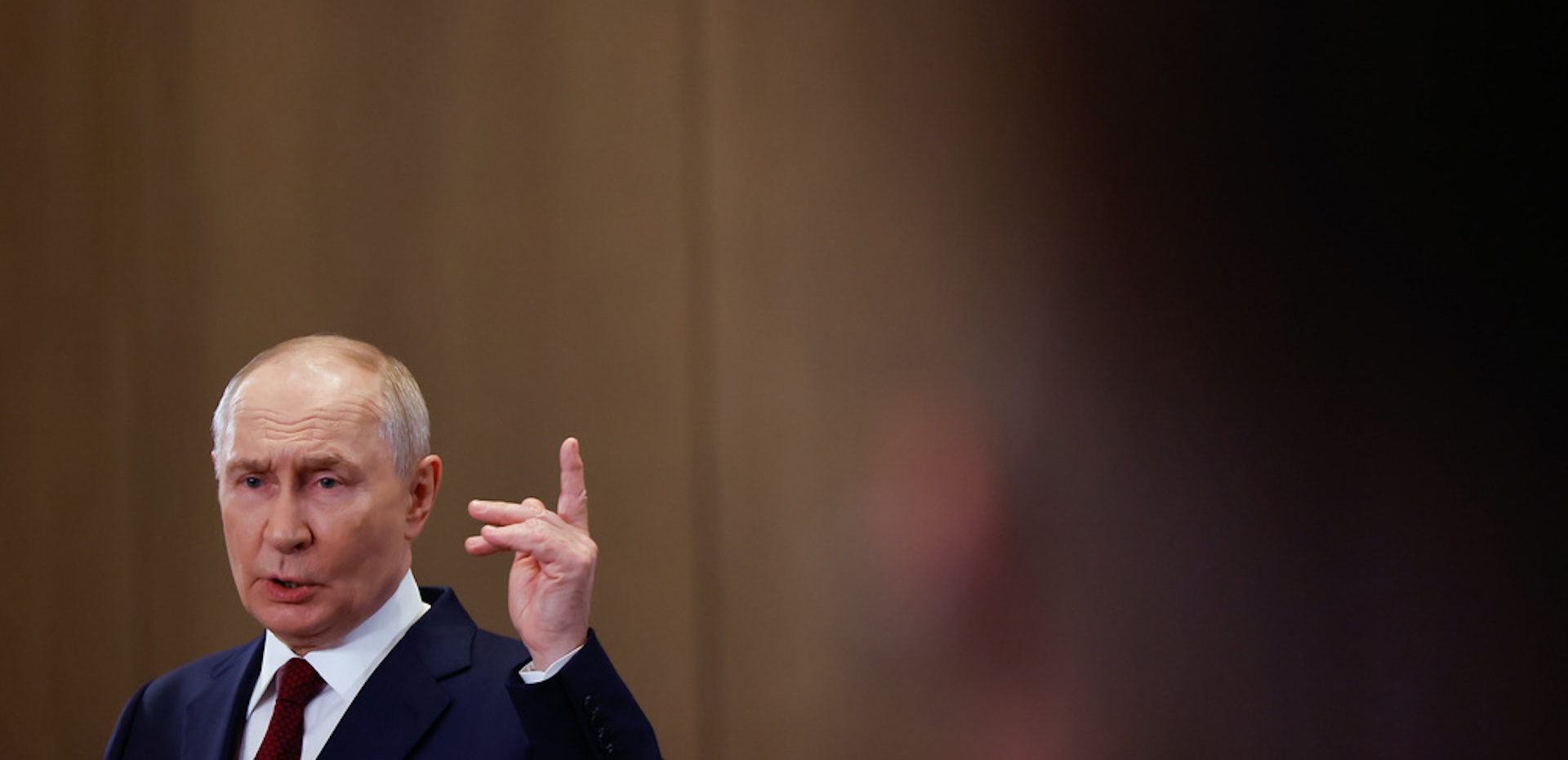
Talks at the APEC summit in Shenzhen and consultations among the ‘Coalition of the Willing’ in Berlin have once again exposed divisions between the US and its European allies over the prospects for ending the war in Ukraine. While officials in the Trump administration say Moscow is prepared to compromise, Vladimir Putin continues to reject a ceasefire, and insists that Ukraine must make territorial concessions.
The Kremlin is sending conflicting signals. It calculates that dragging out the negotiations will allow Russia not only to make further gains on the battlefield but also to deepen divisions within the Western coalition. The longer the uncertainty over the potential for a peace settlement lasts, the harder it becomes for Washington and European capitals to align their positions, and for European governments to agree on continued support for Ukraine.
Despite earlier claims that it had been taken off the agenda, the war in Ukraine was discussed at the APEC summit in the Chinese city of Shenzhen. Vladimir Putin and Donald Trump held talks ahead of a trilateral meeting with Xi Jinping, after which the US president said Moscow wanted to end the war. But following the three-way meeting, Putin ruled out agreeing to a ceasefire in the wake of Ukrainian strikes on the Crimean Bridge. He also insisted that Russia would make no territorial concessions in Donbas.
Meanwhile, Volodymyr Zelenskyy joined a meeting of the ‘Coalition of the Willing’ in Berlin alongside White House envoys Steve Witkoff and Jared Kushner. Kushner said Washington had made Moscow ‘comfortable’ with security guarantees for Ukraine based on NATO’s Article 5 backed by the United States. But Russia continues to insist that any arrangement which effectively makes Ukraine a member of NATO would be categorically unacceptable.
While there were hopes that the latest round of talks in Abu Dhabi (10–11 November) would lead to substantive negotiations, a series of conflicting statements this week suggests that the Kremlin is deliberately avoiding concrete steps towards ending the war.
‘By insisting that any negotiations must address the “root causes” of the crisis, the Kremlin has put European security at the centre of the diplomatic process – an issue that cannot be discussed without Europe, but can be discussed without Ukraine. Debates over the new agenda and who should take part in the talks have inevitably pushed the question of ending the war to the sidelines.’
Sergey Aleksashenko
Head of Economics
The resumption of talks in Abu Dhabi has allowed the Kremlin to buy time to pursue two objectives in parallel. The first is to weaken the Ukrainian economy by continuing its strikes on Ukraine’s energy infrastructure, while maintaining good relations with Donald Trump. The second is to deepen divisions both between the US and Europe and within the European Union itself.
New signs of tensions between Washington and its European partners emerged in public last week. US defence under-secretary Elbridge Colby criticised Ukrainian strikes deep inside Russian territory, arguing that they did little to help end the war. Germany’s defence minister Boris Pistorius responded by calling Colby’s assessment ‘rather stupid’.
Earlier, German chancellor Friedrich Merz raised the possibility of blocking the EU’s next seven-year budget unless all member states approved additional funding for Ukraine. His warning came as Hungary, Slovakia, Bulgaria and the Czech Republic signalled their unwillingness to contribute to further EU financial support for Kyiv.
The Kremlin is seeking to exploit the reduced US role in supporting Ukraine, and the growing burden on European countries, to deepen divisions between Washington and Brussels. This could undermine NATO unity, a risk reinforced by the Trump administration’s goal of making Europe more self-reliant in defence.
‘Ukraine has shown far greater resilience and determination to fight than Putin expected. He attributes this to western support for Kyiv. He is calculating that his strategic bombardment campaign against Ukraine will raise the price for Europe of supporting Ukraine to the point where its unified position fractures, causing dissension within both the EU and NATO.’

John Lough
Head of Foreign Policy
Trump’s reference to Putin as ‘his friend’ is interpreted by the Kremlin as meaning that it can extract further concessions from the US since the statement confirms that the White House is not going to put pressure on Russia to end the war.
By prolonging the negotiations and maintaining military pressure on Ukraine, the Kremlin hopes to extract concessions from Kyiv while deepening the divisions among its western allies. But this calculation depends not only on Moscow’s actions, but also on European governments’ ability to remain united as the cost of supporting Ukraine grows. Upcoming elections in EU member states will test that unity. In the meantime, Putin appears to see little reason to abandon either the negotiations or the war.