Introduction
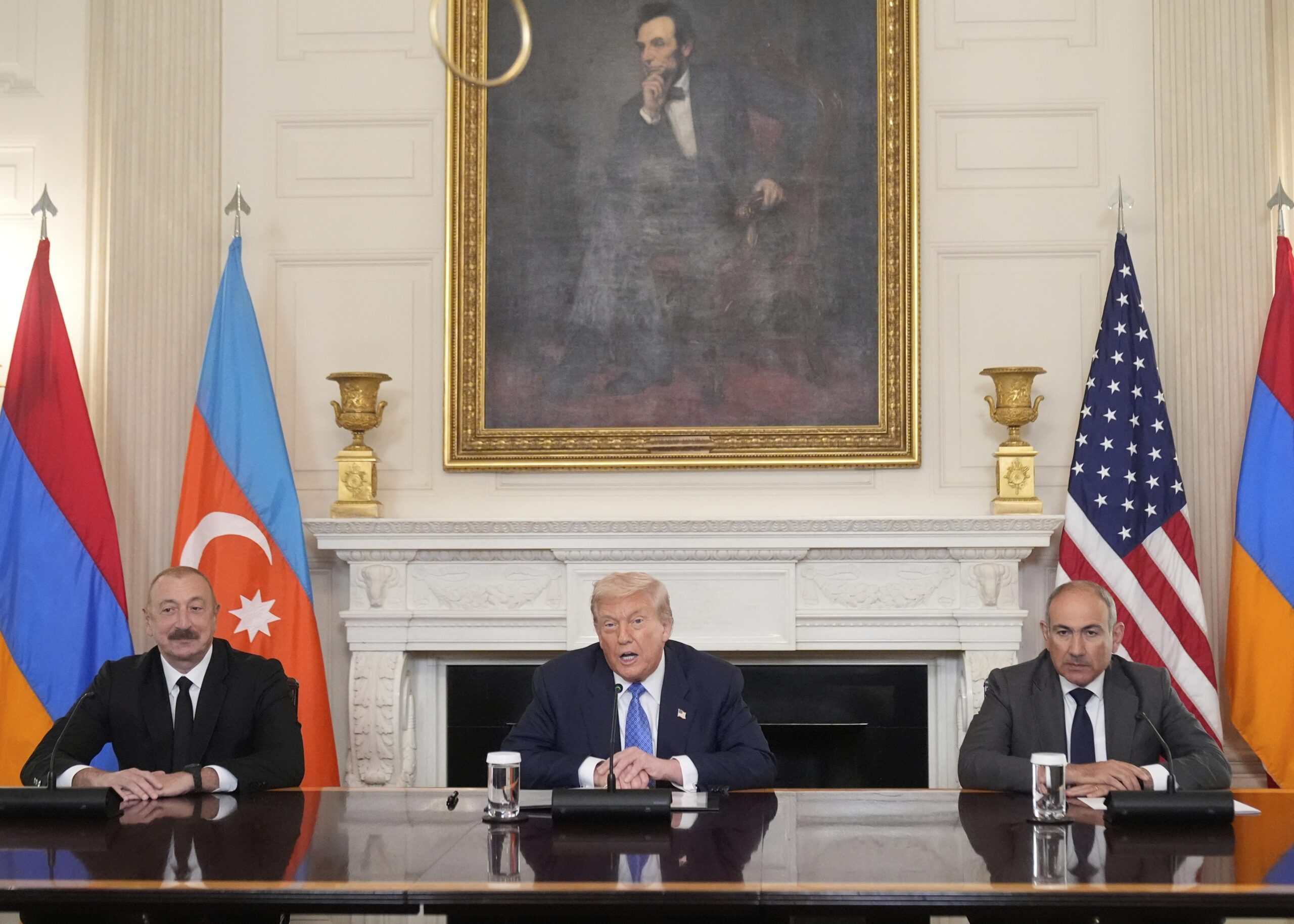
The meeting between Armenian Prime Minister Nikol Pashinyan and Azerbaijani President Ilham Aliyev at the White House in early August last year was widely portrayed as a historic event that would fundamentally alter the region. This sentiment was shared by nearly all parties involved – Baku and Yerevan themselves, as well as Western media outlets, many of which, echoing Donald Trump, announced that a peace agreement had been signed in Washington. In reality, this was not the case: the peace agreement has not been signed, only initialled.
More significant, however, was the Trump administration’s announcement of the Trump Route for Peace and Prosperity (TRIPP) project. It was presented as a firm and definitive answer to a long-standing question: how to resolve the issue of the Zangezur corridor. This proposed route would connect mainland Azerbaijan with the Nakhichevan exclave through Armenian territory, running parallel to Armenia’s border with Iran. During the Soviet period, both a road and a railway traversed this area, but since the outbreak of the conflict, Azerbaijanis have been able to reach Nakhichevan only by air or by detouring through Iran.
Background: The current situation in the Zangezur corridor area
The southern section of the Armenian-Azerbaijani border has remained unchanged since 2020. It is still militarised and has not been demarcated, meaning that disputes could arise in the future over the precise location of the border, with the rival sides’ claims separated by as little as a few hundred metres. The task of defining the border precisely is yet to be carried out. The failure to do so may affect relatıons between the two countries, and therefore the construction of the transit route.
The Armenian-Iranian border follows the course of the River Araks and is jointly patrolled by Armenian and Russian border guards. According to Yerevan, there are no plans to request the withdrawal of Russian personnel from this area. The proposed TRIPP route would run immediately north of this frontier. At present, only a dirt road exists there, and the railway tracks have long since been dismantled. Since July 2025, Armenia has been building a new highway to link its border towns and villages, but this road is unrelated to TRIPP – it is intended for domestic use.
On the Azerbaijani side, the infrastructure is far more advanced. Construction of a railway line from Horadiz to the Armenian border is scheduled for completion in 2026, and a highway along the same route is already nearing completion. In the Nakhchivan exclave, much less work is required. The Soviet-era highway and railway across the whole exclave (from Ordubad to Sadarak) still exist and they could easily be connected with roads on Armenian territory – if such roads existed.
Trump’s peace ambitions and the horizons of TRIPP
It appears that Donald Trump is now emphasising peacemaking as a central element of his international image. This is evident from official State Department communications, which sometimes border on the self-congratulatory when listing how many conflicts the ‘president-peacemaker’ has resolved during his twelve months in office. The same pattern is visible in his recent and similarly ambitious initiative concerning the Gaza Strip and the Board of Peace.
Speculation that Trump might shift his focus to the Armenian-Azerbaijani conflict if developments in Ukraine faltered first emerged in the spring of 2025, though it was initially treated as a joke. It has since become clear that the idea was serious, and that Trump genuinely wishes to add the Armenian-Azerbaijani issue to his record of foreign policy accomplishments.
Achieving progress in the South Caucasus proved relatively straightforward. By the time the summit was held, Armenia and Azerbaijan had already made substantial progress, leaving the Americans to perform a largely symbolic role: inviting the two leaders to the White House – an offer neither could easily decline – and encouraging them to sign a joint document that the media would inevitably present as a ‘peace declaration’, even though, as noted above, this was not strictly accurate.
The notion that Trump might approach the Zangezur issue in his own style – offering large-scale investment and the involvement of US businesses – was first voiced almost casually by the US ambassador to Turkey, Tom Barrack, on 11 July. When his remarks are considered in the context of his wider speech, it remains unclear whether he was announcing an official initiative or simply citing an example of the approach to politics which is supposedly typical for this region: ‘They [Armenia and Azerbaijan] are arguing over 32 kilometers of road, but this is no joke. It’s been going on for a decade – 32 kilometers of road. So what happens is America comes in and says, “Okay, we’ll take it over. Give us the 32 kilometers of road on a hundred-year lease, and you can all share it.” But these tribal points of view do not fade’, he observed while reflecting on Middle Eastern politics more broadly.
Soon afterwards, the idea of a century-long (in fact, 99-year) lease reappeared in Trump’s own remarks at the meeting with Aliyev and Pashinyan. ‘Armenia is also creating an exclusive partnership with the United States to develop this charter which could extend for up to 99 years and then they promise in 99 years they’ll extend it, right? You promise?’ he said, addressing Pashinyan. ‘We anticipate significant infrastructure development by American companies. They are very anxious to go into these two countries and they’re going to spend a lot of money, a lot of money, which will economically benefit all three of our nations.’
Between symbolism and legality
Neither earlier statement provides a reliable foundation for policy. Nevertheless, both the media and many experts have repeated the claim of a ‘99-year lease’ as though a corresponding document existed. In reality, the TRIPP project initially consisted of a single clause in the declaration signed in Washington:
‘The Republic of Armenia will work with the United States of America and mutually determined third parties, to set forth a framework for the “Trump Route for International Peace and Prosperity” (TRIPP) connectivity project in the territory of the Republic of Armenia. We confirm our determination to pursue efforts in good faith to achieve this goal in the most expeditious manner.’ Even the memorandum on infrastructure signed by Pashinyan and Trump contains no mention of TRIPP.
In January 2026 a few details appeared. After Armenian Foreign Minister Ararat Mirzoyan and US Secretary of State Marco Rubio met in Washington, it was announced that the entity that would run the project is to be called the TRIPP Development Company. ‘Armenia intends to offer the United States a 74% share and to hold itself a 26% share in the TRIPP Development Company. This arrangement is expected to be extended for an additional term of 50 years with a grant of additional equity to the government of Armenia bringing its share to 49%’, reported the Armenian Foreign Ministry.
In any case, discussion of a road through Syunik is still quite speculative. Azerbaijan has focused, predictably, on ensuring ‘unimpeded’ movement along the route, while Armenia has insisted that the new project must not infringe upon its sovereignty. The recent Mirzoyan-Rubio joint statement promises that this contradiction is to be solved by a ‘Front Office-Back Office’ operating model. Private operators contracted by the TRIPP Development Company are expected to provide customer-facing services like checking papers and collecting payments, while the ‘back office’ (the Armenian authorities) supervises their work, takes final customs decisions, and provides security screening and enforcement. This model guarantees the physical presence of Armenian officials, which is crucial for upholding the principle of sovereignty. But even this approach leaves many additional questions unresolved.
Baku has occasionally hinted that, as the TRIPP project is to be built on Armenian territory, it is primarily a bilateral issue between Yerevan and Washington. This is clearly incorrect: any final outcome will depend on approval from Baku.
It is worth noting that establishing any special legal regime in Syunik would require a legislative amendment, which has not happened and is unlikely to be attempted before the parliamentary elections scheduled for June 2026.
If TRIPP is implemented in the form currently envisaged, a transport corridor between Armenia and Azerbaijan would represent a project with virtually no historical precedent. The closest comparison might be the transit routes between the Federal Republic of Germany (FRG) and West Berlin, which passed through the German Democratic Republic (GDR) between 1972 and 1990.
The parallels are abundant. The residents of divided territories (West Berlin and the FRG) were compelled to cross the territory of a state perceived as a de facto adversary. Both agreements required external mediation: in the case of the GDR, by Moscow (which effectively controlled East Germany from 1945 onwards); in the case of the South Caucasus, by Washington. Notably, both transit regimes employed the term ‘unimpeded’ in the documentation (ohne Behinderungen in German).
In February, the TRIPP project received a boost. US Vice President JD Vance visited both Armenia and Azerbaijan, in order, said Donald Trump, to ‘advance the Trump Route for International Peace and Prosperity’. Arriving in Baku from Yerevan, Vance even joked that he was one of the first people ever to fly along this route. However, this was not true: Azerbaijani and foreign commercial flights follow the same route daily.
Moreover, since this visit the US has established a strategic partnership with Azerbaijan. One was already agreed with Armenia in early 2025.
Strategic uncertainty and early follow-up
Further uncertainty stems from the fact that the American companies slated to participate in the project have not been identified. Yet the introduction of US businesses into a conflict-prone area, so that their economic presence might deter confrontation, is central to the initiative. In essence, it mirrors the model Trump once proposed to Ukraine concerning rare earth metals. ‘It’s a backstop, you could say’, he said. ‘I don’t think anybody’s going to play around if we’re there with a lot of workers and having to deal with rare earths and other things which we need for our country.’
The settlement of contentious issues still lies ahead. On 8 September, a delegation from the US Certified Trade Mission for the Middle Corridor visited Baku. This visit was clearly connected to the new road project, since the Zangezur corridor is intended to form part of the broader Middle Corridor network.
Speaking to national TV channels on 5 January, Aliyev reiterated that he is eager to open the road in any case. ‘I do not believe that Armenia will be able to evade it, this would be tantamount to suicide, especially considering that US President Trump has given his name to this road, and this is already his road’, he said. These comments may be considered as intimidating. But there are now reasons to believe Aliyev when he says that ‘this is also beneficial for Armenia’.
Since the end of 2025, Baku has permitted the use of its railroads for the transit to Armenia of Russian or Kazakh grain and even Azerbaijani petroleum being transported via Georgia. This truly historic step has already led to lower prices in Armenia. And it is possible that the opening of direct routes will make this transportation more convenient. A year or two earlier, this scenario would have seemed unbelievable – almost no one expected that Azerbaijan would actually allow Armenians to benefit from the use of its infrastructure.
Regional reactions: Russia and Turkey
To avoid admitting that Russia faces being sidelined in the Southern Caucasus, Russian officials have said that TRIPP is as yet no more than an idea. Speaking to students at MGIMO at the start of the academic year, Foreign Minister Sergei Lavrov noted that ‘the enthusiastic reactions heard in the first few days after the Washington meeting were later replaced by more sceptical assessments once the document was published’, and that ‘not everything has in fact been agreed’. This is true, though it does not imply that the original Russian plan included in the joint statement signed by Putin, Aliyev and Pashinyan on 9 November 2020 – in which the road would simply be controlled by Russian border guards – would be any more effective.
Moscow’s current approach to its post-Soviet partners represents a new tactic: it rarely criticises their actions directly, avoids responding to public accusations, and reappears only when difficulties arise, saying, in effect, ‘We warned you that nothing would work without us.’
Moscow’s prospects for participating in the construction and operation of the Zangezur corridor, should US efforts fail, remain uncertain. In theory, Yerevan might support such an option if it comes to perceive the corridor’s operation under Azerbaijani terms as a threat to its security – a scenario that will likely unfold if Washington’s involvement ends – and seeks to enlist the backing of at least one external actor. For Russia, the legal basis for participation already exists: it could simply invoke paragraph 9 of the trilateral statement mentioned above (‘Control over transport communications shall be exercised by the Border Guard Service of the Federal Security Service of Russia’). For Russia this agreement was crucial. It announced Russia’s permanent and legalised involvement in the peace process between Armenia and Azerbaijan. Now this paper means almost nothing – and Russia is sidelined.
Yet this step would contradict Armenia’s current policy of rapprochement with the European Union and its gradual, soft distancing from Russia. Yerevan would therefore consider involving Russia only in an extreme scenario – for example, if direct negotiations with Azerbaijan over the issue risked escalating into armed confrontation.
Since no peace treaty has yet been signed and the ‘Trump Road’ remains a mere proposal, Armenia is seeking at least indirect diplomatic gains. Yerevan has repeatedly declared its readiness to open the border with Turkey immediately: the infrastructure is already in place, and the crossing point has been refurbished. So far, however, only Turkey’s special envoy for normalisation with Armenia, Serdar Kılıç, and his delegation have crossed the border there. Prospects for a full reopening of the Armenian-Turkish border remain limited. Ankara continues to align its policy with Baku’s preferences, and Azerbaijan will seek to delay any concessions to Yerevan. Yet expectations within Armenia remain high: access to Turkey’s large market could substantially stimulate the national economy and reduce dependence on Russia.
The 8 August meeting in Washington, therefore, has not transformed the regional situation as dramatically as it purported to do. The South Caucasus has not, contrary to some fears or hopes, become a sphere of US influence. Having abandoned Russian mediation, Armenia and Azerbaijan are now negotiating sensitive issues directly, and are doing so quite literally along their shared border, symbolically visiting each other’s territory. The peace treaty still depends less on external mediation than on Yerevan’s willingness to amend its constitution under pressure from Baku – something the Armenian authorities predictably continue to resist.
Conclusion
For now, the ‘Trump Road’ remains an idea fraught with contradictions. Moscow and Tehran, which both oppose Western influence in the region, will continue to monitor its progress but are unlikely to criticise it openly. According to regional analyst Olesya Vartanyan, this restraint may stem from a direct request by Trump’s associate Stephen Witkoff, who is said to have used his contacts within the Russian and Iranian elites. Yet another explanation is equally plausible: opponents of the project may simply hope that it collapses of its own accord, without external intervention. Such an outcome is entirely conceivable. There is not even a design for the road, meaning that extensive coordination, financing, and political management will still be required.
The greatest challenge may come from resistance within the Armenian elite, which could slow the project for domestic political reasons. No one wishes to unsettle the electorate before the elections scheduled for June 2026; afterwards, the political situation may prove unpredictable, potentially resulting in a coalition government – or a crisis. Since February, it has been clear that Pashinyan’s main opponent in this election will be Samvel Karapetyan, one of the richest ethnic Armenians in the world, with an estimated wealth of $4.4 billion. He is a Russian citizen, and has close ties with Russian elites, while most of his business interests are in Russia.
Karapetyan is under criminal prosecution in Armenia for ‘calls for the seizure of power’, indicating that Pashinyan sees him as a formidable opponent. What Karapetyan will do if he wins the election is unclear. But JD Vance, while visiting Yerevan, frankly said that he hoped that Pashinyan would win. This makes sense: under his government, the TRIPP project would have a much stronger chance of success.