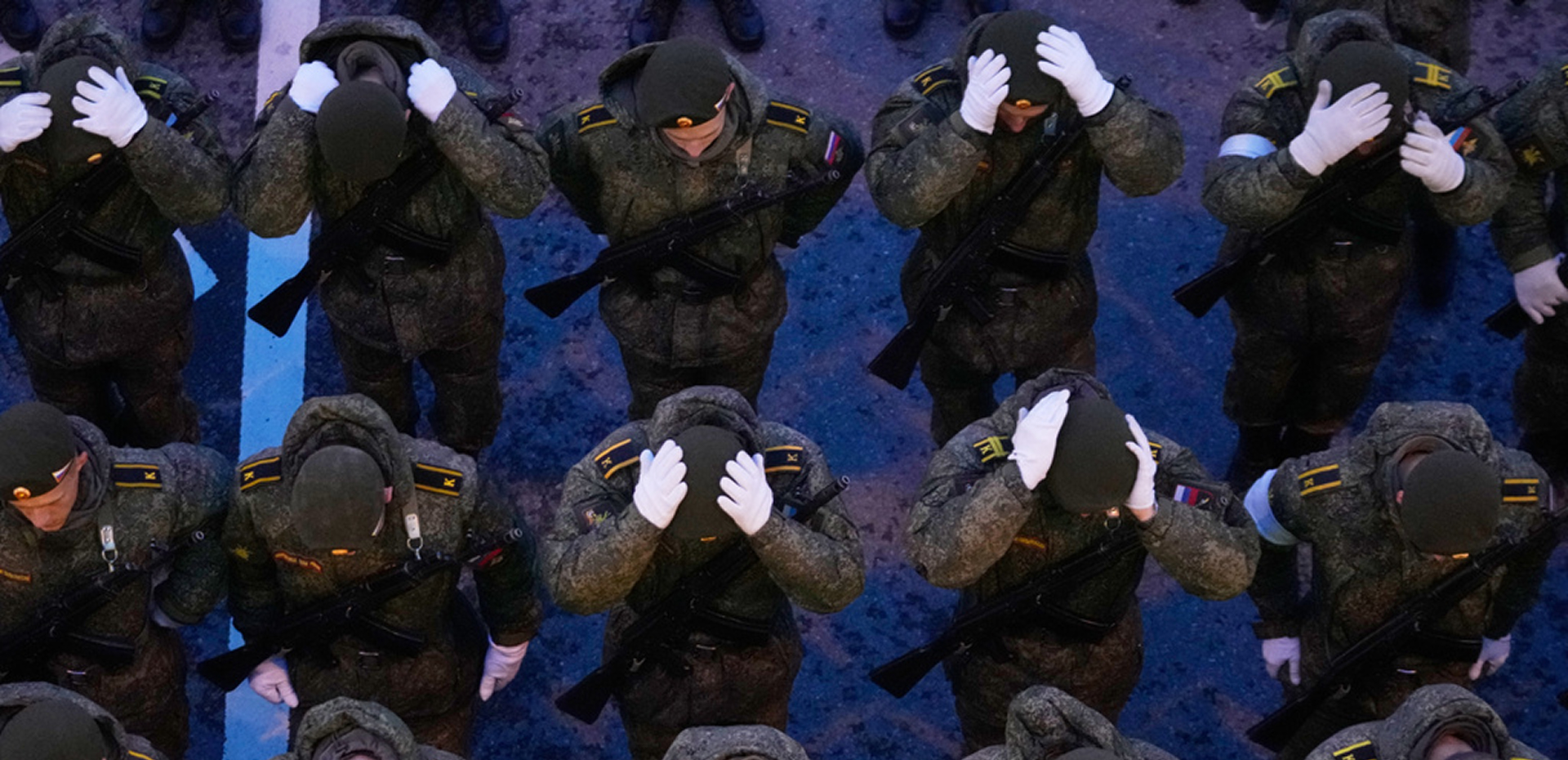
This year’s 9 May celebrations – the annual commemoration of the Allies’ victory over Nazi Germany that is exceptionally important for the Putin regime – find the Russian leadership in a state of heightened vulnerability. For the first time in almost 20 years, the annual parade on Red Square in central Moscow will take place without military hardware. The authorities have also announced large-scale restrictions on mobile communications and the internet in the capital due to the threat of Ukrainian strikes. Against this backdrop, Vladimir Putin has proposed a ceasefire for the duration of the celebrations, with US President Donald Trump acting as an intermediary between him and Volodymyr Zelenskyy.
Victory Day is one of the central elements of contemporary Russian official ideology. Over recent decades, its meaning has changed significantly: originally a day for remembrance of the war dead, it has become an opportunity to demonstrate military strength, and an element of a cult centred on the commemoration of the Soviet Union as the superpower that defeated fascism. The Russian authorities have used the narrative of the fight against fascism, which supposedly re-emerged 80 years later in Ukraine, to justify both the military aggression of 2014–2015 and the full-scale invasion that followed in 2022.
The current military dynamics in Ukraine hardly support Russia’s claims of military strength and superpower status. The war has now lasted more than 1,530 days – longer than the USSR’s war with Germany (1,418 days). Since 2023, the pace of the Russian advance has been minimal, and the front remains largely static. Meanwhile, Ukrainian strikes on Russian infrastructure have intensified in recent months, reaching targets ever deeper inside Russian territory. In these conditions, the annual celebration of victory increasingly contrasts with the reality of the war and undermines one of the regime’s key ideological pillars.
The military stalemate is heightening tensions within Russia. According to one poll, Putin’s approval rating has fallen to 71 per cent – its lowest level since the start of the war in Ukraine. For comparison, as recently as December 2025, his approval rating exceeded 80 per cent. At the same time, dissatisfaction is growing among pro-war audiences, who do not see tangible results on the battlefield. In parallel, economic problems are intensifying, and everyday discontent among the population expressed on social media is growing.
During last year’s Victory Day celebrations in Moscow, marking the 80th anniversary of the end of the Second World War, the Government introduced emergency measures due to the threat of drone attacks for the first time, including the shutdown of mobile internet services. Putin also proposed a temporary ceasefire from 8 to 10 May, but no agreement was reached. For the Kremlin, Victory Day passed calmly: there were no major incidents in Moscow, the situation on the battlefield developed favourably for Russia, and several prominent foreign leaders attended the parade.
This year, Putin will mark Victory Day amid a military stalemate: the battlefield situation runs counter to the triumphalist tone associated with 9 May. Pro-war commentators regularly acknowledge on their Telegram channels that Russian advances are strictly tactical, and a new wave of posts criticising the lack of progress has recently started to appear. In this context, the unprecedented security measures – including the possible shutdown not only of mobile communications but even of ethernet connections – are not only intended to ensure security, but will also, for a time, almost certainly help to make the voices of Putin’s right-wing critics less audible.
The Russian authorities’ level of concern is also evident in Moscow’s decision to call onTrump to help achieve a Victory Day ceasefire. The US President has effectively acted in Putin’s interests by publicly presenting himself as the initiator of a ceasefire that, for now, is more advantageous to Moscow than to Kyiv. By proposing this in last week’s phone call with Trump, Putin has shifted the pressure onto Ukraine: it is more difficult for Zelenskyy to say no to such an idea when it is put forward by Trump himself.