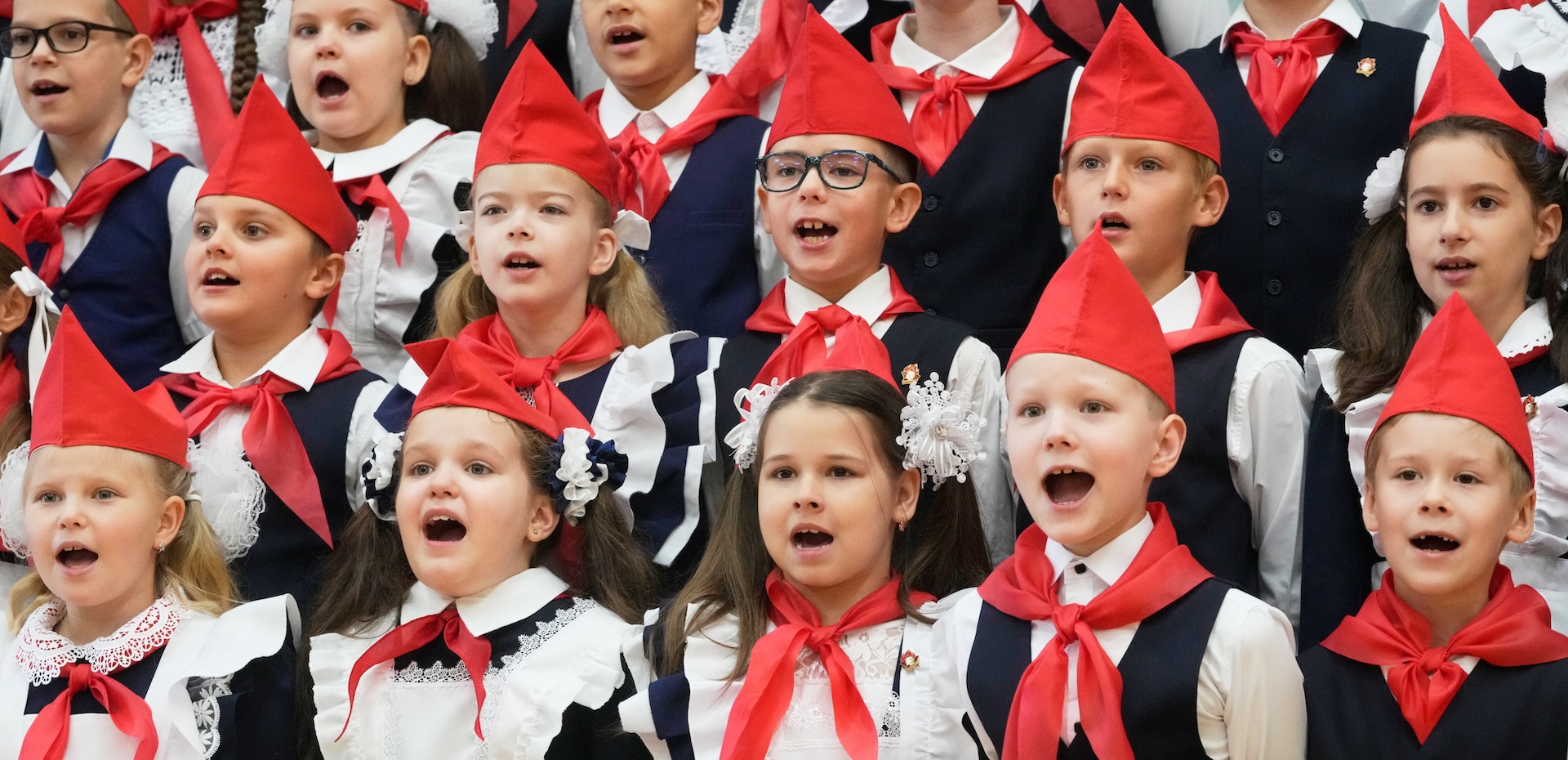
Since the start of the full-scale invasion of Ukraine, war has become embedded in Russia’s education system. Military propaganda has entered the curriculum, extracurricular activities, and everyday school life: pupils undergo military training, write letters to soldiers, and weave camouflage nets. The militarisation of schools does not necessarily turn children into committed supporters of the war. Still, it accustoms them to seeing war as normal, and to viewing silent participation in state-imposed rituals as part of everyday life.
Summary
- The pro-war agenda is embedded in everyday school life long before most children begin to take an independent interest in politics. The main target of military propaganda is children aged 9 to 14, when they are most vulnerable to such influence.
- The intensity of propaganda varies with locality size. Schools and kindergartens in large cities are significantly less likely to hold events in support of the military. Educational institutions in localities with populations below 10,000 are the most heavily involved in propaganda activities.
- The state sets a mandatory framework and ensures that the war remains a constant presence in schools. Although methodological guidelines regulate the overall approach to propaganda, teachers retain considerable discretion over the specific content of lessons and activities.
- Propaganda in schools often lacks clear political or even moral content. Children are shown military equipment, told about support for military personnel, and encouraged to write letters and take part in fundraising, but they are often given no explanation of why the war began or what its aims are. The ‘special military operation’ is presented not as a political event requiring explanation, but simply as a given.
- Pupils are expected above all to be present and participate, rather than to adopt a particular set of beliefs. Authorities generally do not assess knowledge and learning outcomes from such activities; the expected response is silent participation.
- Constant compulsory participation turns the pro-war agenda into routine. The result is not necessarily a conviction that the Kremlin’s policies are right, but a habit of passively accepting political rituals imposed by the state. This pattern of behaviour is particularly advantageous to an authoritarian political system.
Routine, culture, cage: How propaganda returned to Russian schools
Foreword by Pavel Talankin
After the start of the full-scale invasion of Ukraine, many well-educated Russians in their thirties, with financial reserves and the ability to work remotely, packed their belongings and left the country. Hundreds of thousands of young professionals voted against the war with their feet.
One of the main things that distinguishes these thirty-somethings who left is that they never attended Soviet schools, were not exposed to anti-Western propaganda, and did not live behind the Iron Curtain. They grew up and went to school amid the ruins of the Soviet Union, in the relatively free 1990s. It appears that the Kremlin drew its own conclusion from this: it does not want to make the same mistake and lose another generation.
Today, propaganda permeates every level of Russian education. I personally watched the war begin to creep into the small school where I worked. From their first year at school, children were taught to understand what was happening in the world ‘correctly’, to follow ‘traditional values’, and to support ‘our own’ in the war against Ukraine.
How children respond to this propaganda depends largely on the age at which it enters their minds. Older pupils who were already approaching the end of their schooling when the full-scale war began understood perfectly well what was happening – no one needed to explain to them that the state was brainwashing them. For six- and seven-year-olds, however, the war, and talk of enemies and duty to the motherland, became part of ordinary school life from the outset. We will see the real results of this propaganda only when the children who started school during the war reach adulthood.
One teacher who watched my film left a comment that captures exactly what is happening in Russian schools: ‘First it becomes routine, then it becomes culture, and then it becomes a cage you can no longer escape from.’ In a sense, Russian schools have been in this cage before. For many of today’s teachers, who themselves grew up in the Soviet education system, all of this is familiar and readily understood. The difference is that a new cage – Putin’s – has now sprung up almost overnight on top of the old Soviet one.

Pavel Talankin
Pavel Talankin is a teacher and documentary filmmaker. While working at a school in Karabash, in the Urals, he filmed compulsory ‘patriotic’ lessons and events, documenting how the war was becoming part of everyday school life. This footage formed the basis of the film Mr Nobody Against Putin (2025), for which Talankin received the Academy Award for Best Documentary Feature in 2026.
Introduction
Russia began developing a system of ‘patriotic education’ at all levels – from kindergarten to university – even before the full-scale invasion of Ukraine. In 2020, amendments to the Federal Law ‘On Education in the Russian Federation’ made ‘patriotic education’ a compulsory element of educational programmes. In 2022, schools introduced the position of adviser to the headteacher on educational work,1 a weekly ceremony of raising the flag and singing the national anthem, and Razgovory o Vazhnom (‘Conversations about Important Things’) – weekly lessons devoted to patriotic education and the discussion of social, historical, and political issues.
A separate law established the ‘Movement of the First’ – a patriotic youth organisation, analogous to the Soviet-era Young Pioneers, that provides educational and leisure activities and involves schoolchildren in community projects. Since it was founded, the movement has established 55,000 local branches. This is more than the total number of schools in the country.
Participation in the movement’s activities earns preferential treatment in university admissions. During the 2026/2027 admissions campaign, 111 universities award up to 10 extra points for such participation – the maximum bonus that can be added to Unified State Exam scores for ‘individual achievements’.
Military training returned to the curriculum in 2024 with the introduction of a compulsory subject, ‘Fundamentals of Security and Defence of the Motherland’. It includes a module entitled ‘Military Training: Fundamentals of Military Knowledge’, developed with input from the Ministry of Defence. The subject covers drill, firearms, tactical and military medical training, and drone operation. It is compulsory for pupils in Years 8–11 (aged 14–17) and may be taught in Years 5–7 (aged 11–13) at the school’s discretion.
Pupils in Years 10–11 now use a standardised history textbook with a separate chapter on the ‘special military operation’. It sets out the official interpretation of events approved by the Kremlin, leaving no room for alternative interpretations.
‘We have to cover this. It is included in the Unified State Exam questions, so we are required to study it and cover it. But, you know, it is a sensitive subject… You have to discuss everything very carefully in class – that is the reality now. You can discuss it, but then you might end up being sent somewhere far away for a very long time because of those discussions.’
Form teacher, Ivanovo
Today, military propaganda extends across the curriculum, extracurricular activities, and even the physical environment of educational institutions. In addition to compulsory Razgovory o Vazhnom lessons and basic military training, pupils must take part in activities that symbolically demonstrate support for the military. For younger pupils, this may involve making crafts and gifts; for older pupils, writing letters to soldiers at the front and meeting veterans of the ‘special military operation’. Schools organise humanitarian aid collections for the front and involve children in making equipment such as camouflage nets and trench candles.
Posters about the ‘special military operation’ and ‘Hero’s Desks’ have become part of the physical environment of educational institutions,2 turning the war into a constant backdrop and normalising what is happening. Outside regular lesson time, pupils visit military museums and watch ‘patriotic films’.
However, the scale of this system alone tells us little about its effectiveness. To assess how military propaganda operates in Russian schools and how its intended audience receives it, we examined a range of military-patriotic activities in Russian educational institutions between 2022 and 2026 and interviewed participants, including teachers, pupils, and parents. This research provides insight into how propaganda operates in Russian schools, how it affects pupils and staff, and what the authorities have achieved in this area over four and a half years of war.
Methodology
The study draws on two complementary datasets: posts published on educational institutions’ VKontakte pages and in-depth interviews.
Since 1 December 2022, the Russian government has required all state institutions to maintain official social media pages and publish activity reports. This requirement has effectively turned VKontakte, the country’s largest social network, into a nationwide archive of school activities.
For the quantitative component of the study, we collected 102,831,244 posts published between 1 January 2022 and 23 June 2026 by 67,712 official accounts belonging to educational institutions, including kindergartens, schools, colleges, and universities. Using dictionary-based filtering, deduplication, and language-model classification, we identified 994,179 reports of specific activities related to the ‘special military operation’ that involved children. The classifier achieved 91.8 per cent accuracy, a 93.8 per cent F1 score, and Cohen’s κ of 0.82.
The number of posts does not match the number of activities, but we consider the two sufficiently comparable for this analysis. Posts in official groups serve as a form of reporting on activities undertaken. Some of the recorded activities may have been largely ritual in nature – for example, children may have been assembled solely for a photograph. We include such cases in our count because the organised gathering of children is itself evidence that the system is operating, regardless of how actively participants are engaged.
The qualitative component comprised 30 in-depth interviews with 33 participants: 15 teachers aged 23–61, 11 pupils aged 16–19, and seven parents. Participants came from 15 localities, ranging from Moscow and St Petersburg to the village of Tyukhtet and Severomorsk,3 a closed city in northern Russia. Interviews lasted an average of 1.5 hours. All participants gave explicit, informed verbal consent and are identified by pseudonyms throughout the study.
The scale of war propaganda
Over four years of war, posts on school social media pages reporting activities related to the ‘special military operation’ increased fourfold, from 74,450 in 2022 to 299,244 in 2025. The sharpest increase occurred in 2023, coinciding with the expansion of military-patriotic education initiatives, after which the number of posts remained relatively stable.
Over the same period, the total number of posts published by school accounts increased by only 2.6 times. This indicates that military-related content displaced other content, rather than simply expanding alongside it. By our estimates, at least 65 per cent of Russian schools – around 26,000 out of 40,000 – are involved in war propaganda.
Year after year, the number of pro-war activities rises sharply in February, May, and December. This pattern coincides with periods when Russian schools traditionally hold more activities around public holidays and the end of the school year: New Year, International Women’s Day on 8 March, Defender of the Fatherland Day on 23 February, Victory Day on 9 May, and school-leaving ceremonies, which usually take place in late May. Schools generally avoid scheduling tests or starting new topics during these periods, making it easier to accommodate additional activities.
The annual February peak is particularly pronounced. Since 2022, the number of activities held in February has been several times higher than the monthly average, with reports of such activities accounting for almost 3 per cent of all posts published by educational institutions. Defender of the Fatherland Day on 23 February immediately precedes the anniversary of the full-scale invasion of Ukraine on 24 February.
Notably, the anniversary of the start of the ‘special military operation’ has not developed its own commemorative rituals. Instead, it has been incorporated into the existing programme of activities surrounding Defender of the Fatherland Day. This overlap allows the new war to be placed within a familiar symbolic framework and linked to established forms of patriotic mobilisation.
Who the propaganda targets
Military-patriotic activities are documented at every level of the Russian education system, but around 80 per cent take place in schools.
The intensity of exposure to military-patriotic activities varies considerably by age. Activities related to the ‘special military operation’ are held even in kindergartens, which account for 13 per cent of all recorded activities, but their main audience is pupils in Years 3–8.
This distribution reflects both the structure of the state’s propaganda programme and educators’ views about the ages at which the ‘military theme’ is most effective. According to established theories of developmental psychology, around age 11–14, children develop the capacity to think in abstract categories such as ‘motherland’, ‘enemy’, and ‘duty’.4 At the same age, the family gradually loses its monopoly over a child’s political worldview, creating more space for external narratives to exert influence.5 This shift, however, occurs before children have fully developed the ability to assess information critically.
It is precisely this combination of factors – the cognitive capacity for abstract thought, limited capacity for critical reflection, and openness to external authority – that makes pupils of this age particularly receptive to political propaganda.
The geography of militarisation
The intensity of propaganda is linked to locality size. The larger the city, the fewer pro-war activities schools tend to hold. Moscow, for example, ranks fourth among the country’s least militarised cities. The highest levels of militarisation are found in small localities: none of the ten most militarised settlements has a population above 10,000. Among cities with more than one million residents, Rostov-on-Don, located close to the front line, has the highest level of pro-war activity.
One possible explanation lies in schools’ institutional position. Large cities, and Moscow in particular, provide educational institutions with significantly greater resources. Some schools in these cities, such as lyceums or specialised schools, have more scope to select pupils, recruit qualified teachers, and reduce administrative burdens.6 As a result, they tend to achieve better educational outcomes, including higher Unified State Exam scores, a key measure of institutional performance in the Russian education system. Schools that consistently perform well attract less scrutiny from the educational authorities and have greater freedom to interpret top-down initiatives, including those related to military-patriotic education.
In schools with weaker academic results, however, teachers report that higher levels of military-patriotic activity can help to offset poor performance in the eyes of the educational authorities. Because smaller cities and towns have fewer privileged educational institutions, participation in such activities may be more widespread, often at the expense of regular teaching.
‘Our main problem with extracurricular activities is that we lose lessons and the curriculum suffers as a result. Last year, I lost eight teaching hours with one class.’
Form teacher, Ivanovo
This creates a vicious circle: schools with poor educational outcomes are expected to become more involved in extracurricular initiatives, which in turn take time away from the curriculum and do not improve pupils’ academic performance. As these practices become more entrenched, they contribute to growing educational inequality across the country.
‘It feels as though there are more and more activities every year. I would simply reduce the number of them, because we already have too many and a lot of people are tired of them. I don’t think there is a direct link, but if there were fewer of these activities, there would be more focus on studying. I think grades would improve in some cases.’
Year 10 pupil, village of Tyukhtet, Krasnoyarsk Krai
The evolution of formats
In the first months of the invasion of Ukraine in early 2022, when educational institutions first faced widespread demands to demonstrate patriotic activity, no formal guidelines governed how this should be done. Schools responded with ad hoc activities intended to demonstrate symbolic support for soldiers, such as ‘Letter to a Soldier’ and ‘Postcard from the Home Front’, as well as making crafts and gifts. In 2022, such activities accounted for 52 per cent of all documented school activities related to the ‘special military operation’.
Later, as methodological guidelines for ‘patriotic’ activities were developed, ‘Letter to a Soldier’ campaigns began to give way to other formats, including form periods, meetings with veterans, and visits to museums. Since the start of the war, educational institutions have also collected humanitarian aid for military personnel. From 2023 onwards, they began using children’s labour to demonstrate support for the war: pupils weave camouflage nets and make trench candles and dry shower kits. Over four and a half years of war, the share of such activities increased from 1 per cent to 6.5 per cent of ‘patriotic’ activities as a whole.
The types of activities also vary by participants’ age. Younger pupils are more likely to take part in symbolic displays of support, while older pupils are more likely to attend meetings with veterans of the ‘special military operation’. Meetings between pupils and war veterans have become increasingly common each year: their share of all recorded activities rose from 3 per cent to 13.5 per cent.
Pupils usually write letters to military personnel during Russian language or literature lessons. Taking part in such activities helps pupils to secure high marks. What matters for the mark is that a pupil has written the letter; its content matters little. In these activities, the emphasis is not on conviction but on emotional engagement and ritual repetition.7 Even when a child has no interest in the subject, they are required to take actions which express a particular position. Such repetition accelerates the internalisation of the pro-war narrative, particularly among children and adolescents.8
Other formats – meetings with veterans of the ‘special military operation’, lectures, and film screenings – follow the same logic, but here the main requirement is not ritualised repetition but physical presence. Teachers hold the activity, children attend, and the event is documented on social media. Although both sides recognise the gap between attendance and engagement, neither school administrators nor teachers expect pupils to participate actively.
Children describe these activities as the most boring. They understand that extracurricular activities do not affect their academic performance and that they are only required to attend.
Pupils at one of the schools in our study jokingly referred to such activities as ‘nap time’. The phrase accurately captures how pupils perceive these activities: formally compulsory, substantively optional, and emotionally neutral.
Indifference to the content of military-patriotic activities may appear to indicate a failure of the propaganda programme – but only if its purpose is assumed to be persuasion. Research on the effects of educational formats suggests that content and form produce distinct effects that are independent of one another.
Changes in educational content can indeed cultivate certain values while weakening others9 – this is a basic premise of any programme of patriotic education, including Russia’s.10 Yet the form that teaching takes can itself have an equally significant effect, regardless of what is being taught. Participatory, group-based learning that requires coordination is positively associated with the development of democratic values and the capacity for self-organisation.11 Passive, top-down forms of teaching, by contrast, are associated with greater deference to authority and a lower capacity for self-organisation, irrespective of the content being taught.12
This perspective helps to explain the deployment of propaganda in Russian schools. The system is structured so that it does not assess what pupils learn from extracurricular activities.
A child who sleeps through a lecture about the ‘heroism of a special military operation soldier’ may absorb nothing of its content. At the same time, however, the child is practising a passive relationship with authority: the lecture is a monologue that they are required to attend, with no opportunity to ask questions or receive feedback.
The programme may systematically fail to achieve its stated aim of fostering pro-war beliefs while simultaneously achieving a latent one: reproducing individuals disposed towards uncritical participation despite possible disagreement. From this perspective, the lack of substantive content in these activities is not a dysfunction of the system, but a mechanism for reproducing depoliticised young adults.
War as a backdrop
By 2026, the war had become a constant presence in the physical environment of Russian schools: in ‘patriotic corners’ – designated areas displaying state symbols and materials on Russian history – as well as on boards reporting activities related to the ‘special military operation’, ‘Hero’s Desk’, and displays of crafts and letters to soldiers at the front. Teachers regard this as one of the safest ways of accommodating the war within the school environment, because these objects do not need to be discussed explicitly and can be relegated to a distant corner.
‘At our school, they decided to install a Hero’s Desk dedicated to [name of a veteran of the “special military operation”]. It was made; it sits somewhere in a corner. It is not very noticeable, but it is there. Then we were told to put up posters. We chose them so that their colours would blend in with the walls. I don’t know who notices these posters. Perhaps visitors to the school, other people who happen to be on that floor. But they blend in. My pupils simply walk past them. They don’t spit at them or do anything else. They just walk past and look away.’
Form teacher, St Petersburg
Yet even when posters are deliberately chosen to ‘blend in with the walls’, they keep the war constantly within pupils’ field of vision. It becomes a backdrop that is never discussed but never disappears, accustoming pupils to concealing their genuine reactions and remaining silent. Repeatedly ‘walking past’ references to the war does not neutralise the anxiety it creates; on the contrary, it reinforces it.13
Although the war is a constant presence in school life, its political and historical substance – the parties involved, its causes, and its aims – generally remains unarticulated. Instead, impersonal language is used: ‘our own’, ‘for the fight’, ‘support for the soldiers’. Meetings with veterans of the ‘special military operation’ are organised around displays of military equipment and gear, and presentations of the ‘results of support’, rather than discussion of the aims and meaning of what is taking place. The war becomes a ritualised event: something to be carried out and documented, but not interpreted.
The silence surrounding the war’s political content is not a side effect, but a structural feature of this practice. This mechanism helps to shift the war from the realm of claims open to debate into the realm of dogma – that which is taken for granted and no longer considered open to discussion.14
Pupils and teachers are expected neither to interpret nor support; they are expected to participate in reproducing a symbolic form in which the war becomes an everyday reality that requires no reflection.
The emotional pressure created by this constant backdrop is reinforced by the systematic exclusion of the war from informal discussion within schools. Public silence about the war and one’s own position becomes not a matter of personal choice, but an institutional norm that teachers pass on to pupils.
‘Everyone has the right to hold whatever position they choose, but it is best not to voice it. Especially at school.’
Form teacher, Yekaterinburg
Uncertainty about the boundaries of what is permissible proves to be a particularly effective mechanism, precisely because teachers do not know which statements might result in sanctions.
‘I still don’t really understand what I can and cannot say during form periods.’
Form teacher, Yekaterinburg
The result is not merely caution, but pre-emptive silence as self-protection. The teacher’s silence provides pupils with a model to follow: disagreement may exist, but it is not voiced. Through repetition, this pattern becomes established as a norm not only of behaviour at school, but of civic behaviour more broadly.
Adaptive strategies among teachers
As part of their professional training, Russian teachers acquire not only pedagogical skills but also norms of professional ethics in which humanistic values play an important role.15 At the same time, current requirements for lessons on the ‘special military operation’ entail active endorsement of military action. Although many teachers have benefited from these changes, others feel compelled to alter their professional principles, creating internal conflict.
Even with detailed methodological guidelines in place, teachers retain control over what happens during patriotic lessons: which topics are raised and which views are expressed. To manage the tension between their own beliefs and the system’s demands, teachers develop everyday strategies that let them express disagreement without open confrontation.16
Substitution. Teachers describe this strategy in relation to additional lessons such as Razgovory o Vazhnom. The activity formally takes place, but its prescribed content is replaced entirely with a topic the teacher considers relevant – a conversation about ‘what is important to us’. In its most extreme form, substitution becomes semi-formalised within the school. For example, the period allocated to Razgovory o Vazhnom may instead be used for a regular mathematics tutorial.
‘I have that period [Razgovory o Vazhnom] on my timetable. I think the children have a mathematics tutorial that day. So they simply go to another teacher.’
Form teacher, Perm
Simulation. The activity is held solely so that it can be documented.
‘It’s mostly for show – take a photo, put up a post. Whether they actually did it or not doesn’t matter. The children see through it very clearly.’
Form teacher, Kirov
Filtering. Teachers decide for themselves which elements of the programme imposed from above are acceptable and omit the rest without explanation.
‘When we had topics in Razgovory o Vazhnom related to heroes of the special military operation, I deliberately left that material out and instead chose heroes who had rescued someone from a fire or from under the ice.’
Form teacher, village of Tyukhtet, Krasnoyarsk Krai
Reduction. Teachers minimise the depth and intensity with which they cover the prescribed material, without omitting it altogether.
Indirect expression. Teachers convey their own views indirectly, in ways that allow for more than one interpretation:
‘Sometimes I try to express my own point of view. I tell them that if they wanted to know what I really thought, I would probably be in prison by now. And they understand.’
Teacher, Severomorsk
Evasion. Teachers avoid expressing their own views and deflect questions on ‘sensitive’ subjects.
Formal compliance, combined with distancing. Teachers comply with formal requirements while making clear that these requirements are not their own, but have been imposed by the school or by higher-level officials:
‘Some people find it very uncomfortable, for example, to write about yet another collection of humanitarian aid. In general, everyone decides how, and whether, they are prepared to communicate it. For example, I write that the school administration is announcing another collection – to make clear that it is not me announcing it, or us, but the school.’
Form teacher, Ivanovo
All of these strategies share one feature: they require no organisation, involve no open expression of dissent, and leave no trace that could provide grounds for punishment. Yet this is also where their limitations become apparent. These strategies protect teachers and, to some extent, shield pupils from the most overt ideological content. But they do not eliminate repeated ritual participation itself, nor do they disrupt the norm of silence that such participation reinforces. Reduction, however, is not the same as absence: even when military symbols are rare, they still serve as a backdrop that normalises war in everyday school life.
Conclusion
Over four and a half years, the Russian state has embedded the pro-war agenda in everyday school life. Activities related to the ‘special military operation’ and patriotic propaganda have become established routines. The war is present in school timetables, the physical environment of schools, meetings with veterans, letters to soldiers, aid collections, and the production of equipment for the front. For millions of children, it is becoming not an exceptional event, but part of the familiar order of school life.
Although the state sets the ideological framework and procedures for military-patriotic activities, it does not always control their specific content. Teachers can reduce their classes’ participation in activities imposed from above, find alternatives to them, or feign compliance. As a result, the war remains a constant presence in schools, while its causes, aims, and political meaning often remain unspoken.
The principal product of propaganda in Russian schools is less a conviction that the Russian military is acting rightly or that traditional values are sacred, than compulsory participation itself. Even where the content of propaganda is not internalised, the ritual of interaction with the state – and submission to its will – remains.
The militarisation of schools does not necessarily turn children into committed supporters of the war. A more likely effect, and one already observable, is the normalisation of war itself and a passive attitude towards politics. Children become accustomed to the state imposing compulsory rituals whose meaning need not be discussed, while learning that their personal views are best kept to themselves. In this sense, pupils’ indifference does not necessarily mean that propaganda has failed: the system may not teach them to love war, but it can teach them to regard war – and their own silent participation in it – as normal.
Endnotes
- This position entails organising school events, working with the student council, liaising between the school and organisations for children and youth, and establishing and supporting local chapters of the Pioneer-style organisation ‘Movement of the First’. ↩︎
- The ‘Hero’s Desk’ is a nationwide project involving the installation of desks featuring information about local people or alumni who have fought for Russia, including during Russia’s invasion of Ukraine. ↩︎
- Severomorsk houses the main base of the Russian Navy’s Northern Fleet; a pass is required to enter the city. ↩︎
- J. Adelson and R. P. O’Neil, ‘Growth of political ideas in adolescence: The sense of community’, Journal of Personality and Social Psychology, 4(3), 1966, pp. 295–306, https://doi.org/10.1037/h0023699 ↩︎
- R. E. Dawson, K. Prewitt and K. S. Dawson, Political Socialization, 2nd ed., Little, Brown, 1977. ↩︎
- E. A. Tkacheva, A. A. Andreeva, D. I. Miroshnikova et al., ‘Bottom-up innovations in urban and rural schools: Barriers, resources, strategies’, Voprosy obrazovaniya / Educational Studies Moscow, no. 4, 2025, pp. 270–292. ↩︎
- M. Zembylas, ‘Rethinking political socialization in schools: The role of “affective indoctrination”’, Educational Philosophy and Theory, 54(14), 2022, pp. 2480–2491; S. Ahmed, ‘Affective economies’, Social Text, 22(2), 2004, pp. 117–139. ↩︎
- R. E. Dawson, K. Prewitt and K. S. Dawson, Political Socialization, 2nd ed., Little, Brown, 1977; J. Adelson and R. P. O’Neil, ‘Growth of political ideas in adolescence: The sense of community’, Journal of Personality and Social Psychology, 4(3), 1966, pp. 295–306, https://doi.org/10.1037/h0023699. ↩︎
- D. Cantoni, Y. Chen, D. Y. Yang, N. Yuchtman and Y. J. Zhang, ‘Curriculum and ideology’, Journal of Political Economy, 125(2), 2017, pp. 338–392, https://doi.org/10.1086/690951. ↩︎
- H. Huang, ‘Propaganda as signaling’, Comparative Politics, 47(4), 2015, pp. 419–437, https://doi.org/10.5129/001041515816103220. ↩︎
- E. L. Glaeser, G. A. M. Ponzetto and A. Shleifer, ‘Why does democracy need education?’, Journal of Economic Growth, 12(2), 2007, pp. 77–99, https://doi.org/10.1007/s10887-007‑9015‑1. ↩︎
- Y. Algan, P. Cahuc and A. Shleifer, ‘Teaching practices and social capital’, American Economic Journal: Applied Economics, 5(3), 2013, pp. 189–210, https://doi.org/10.1257/app.5.3.189. ↩︎
- S. Ahmed, ‘Affective economies’, Social Text, 22(2), 2004, pp. 117–139. ↩︎
- P. Bourdieu, Outline of a Theory of Practice, Cambridge University Press, 1977. ↩︎
- A. A. Petrusevich and E. V. Chukhina, Pedagogical ethics: A textbook, Omsk State Pedagogical University Press, 2018, p. 296. ↩︎
- J. C. Scott, Domination and the Arts of Resistance: Hidden Transcripts, Yale University Press, 1990. ↩︎