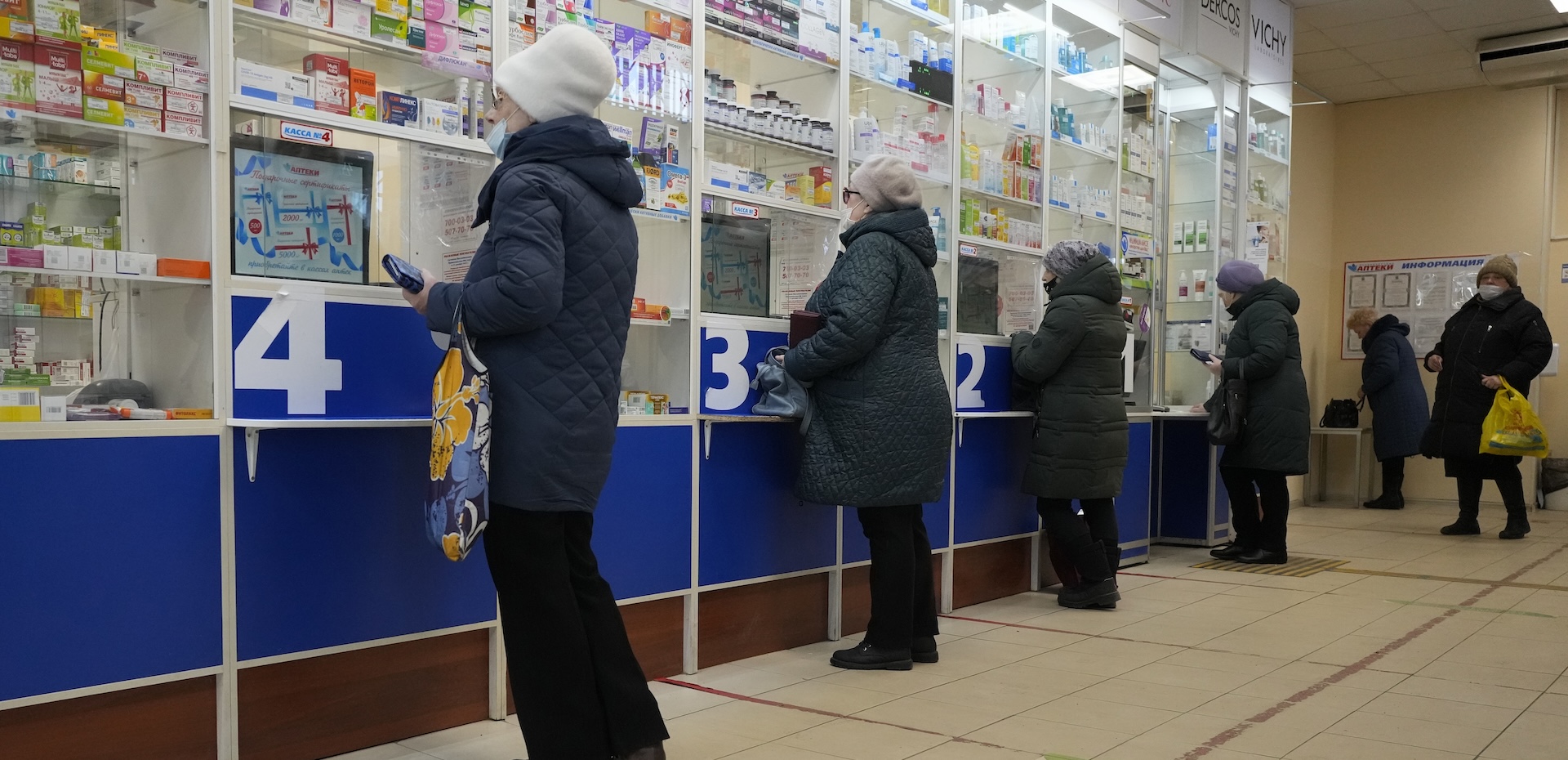
Since the late 2000s, the Russian authorities have pursued a policy of pharmaceutical sovereignty, aimed at developing the domestic pharmaceutical industry rather than relying on imports of medicines, materials, and technologies. To support import substitution, the authorities have introduced price controls and restricted foreign suppliers’ access to the Russian market. These measures enabled the Russian pharmaceutical industry to begin producing domestic replacements for foreign medicines, but they did not resolve the problem of import dependence. Instead, Russia now relies on imports not of finished medicines but of the raw materials needed to produce them. At the same time, the industry has been unable to develop original medicines: production volumes (even of cancer medicines, which the state considers particularly important and in which it invests substantial resources) remain extremely low.
Russia’s shift towards pharmaceutical sovereignty
In June 2008, Vladimir Putin, then Prime Minister, visited the Pharmstandard plant in Kursk and asked its employees who they worked with to develop new medicines, where the equipment used at the plant came from, and where the company sourced its chemical raw materials. It emerged that the raw materials and equipment were imported, as were most of the medicines sold in Russian pharmacies. Following this visit, the Russian authorities began consistently advocating a policy of import substitution in the pharmaceutical sector.
In October 2009, the Ministry of Industry and Trade approved the Pharma 2020 strategy for the development of the pharmaceutical industry. The programme envisaged that, by 2020, Russian-made medicines would account for 50 per cent of the domestic market by volume, annual exports of medicines produced in Russia would reach RUB 75 billion (approximately $2.5 billion), and 57 new original molecules – that is, domestically developed active pharmaceutical ingredients that had not previously existed – would be created in Russia.
To achieve these goals, the government introduced measures to support Russian manufacturers. In 2010, the authorities tightened price controls on medicines included in the List of Vital and Essential Medicines, which covers several hundred products, ranging from antibiotics to cancer medicines. Formally, this measure was intended to make medicines more affordable. However, a side effect was the creation of favourable conditions for import substitution: the costs of imported medicines include logistics, customs duties, and exchange rate differences, making it more difficult for them than for domestically produced medicines to meet fixed price limits. Price controls created economic incentives for localising production and manufacturing generic medicines.
In 2015, Prime Minister Dmitry Medvedev signed a decree introducing the ‘third is excluded’ rule: if two or more manufacturers from the Eurasian Economic Union (Armenia, Belarus, Kazakhstan, Kyrgyzstan, and Russia) submitted bids, suppliers from other countries were excluded from public procurement tenders. In 2025, public procurement accounted for 36 per cent of the pharmaceutical market by value.
Russian companies easily achieved the first goal of Pharma 2020: by the end of 2020, the market share of imported medicines had fallen to 31.4 per cent by volume, meaning that domestically produced medicines accounted for almost 69 per cent of the market. However, the second target was clearly missed: exports totalled just RUB 40.2 billion in the first three quarters of 2020, significantly below the planned level. The third target was missed entirely: instead of the 57 original molecules envisaged, no more than four to six were developed, according to various estimates.
The localisation trap
The Pharma 2020 strategy undoubtedly encouraged the localisation of production (the transfer of the manufacturing of existing medicines to Russia, either under licence or as generics). Around 100 international companies entered the Russian market, building more than 50 new production facilities and manufacturing approximately 400 of their medicines there. However, the programme did not include any measures to encourage the development of new medicines.
This choice was entirely rational: following the 2008–2009 financial crisis and the sanctions imposed over Crimea in 2014–2015, the government placed greater emphasis on rapidly replacing imports and ensuring the physical availability of medicines than on supporting costly projects with uncertain outcomes.
The public procurement system for medicines encouraged the production of generics, as officials focused primarily on minimising treatment costs when making purchasing decisions. Companies that chose to invest in developing original medicines were at a disadvantage, as their products cost the state substantially more. Producing a high-quality generic was far more profitable: the formula was already known, and the process of bringing the medicine to market was shorter and considerably less expensive.
That generics account for a large share of the medicines produced in Russia does not in itself represent a failure of government policy: pharmaceutical markets in most other countries operate in a similar way. The failure lies in the fact that Russia produces very few original medicines of its own. The Western sanctions imposed after the invasion of Ukraine do not restrict imports of medicines, and so have not created demand for domestic production of them. As of December 2025, international pharmaceutical companies accounted for more than 60 per cent of the Russian pharmaceutical market by value, a share that had remained virtually unchanged since 2021.
Having reported a reduction in import dependence, the government failed to mention that this dependence persists at the level of raw materials. This is true even of medicines whose production has been localised in Russia. According to a report by Cursor, a company that analyses the public procurement of medicines and medical devices, 63 per cent of the 881 medicines1 on the List of Vital and Essential Medicines undergo a full production cycle in Russia. Another 17 per cent are partially localised, meaning that only some stages of production take place in the country, while 20 per cent are finished medicines imported directly and only packaged or repackaged in Russia.
Dependence on imports of raw materials is even greater in the case of strategically significant medicines, which are officially required to undergo a full production cycle in Russia. In summer 2020, the government expanded the list of these medicines to 215 entries.2 However, at that time, Russia produced only 5.5–6 per cent of the raw materials needed to manufacture them.
False independence
In 2023, the government launched a new programme, Pharma 2030. The Ministry of Industry and Trade began developing it as early as 2018, but its launch was initially delayed by the pandemic, which caused the rouble to depreciate sharply and disrupted supplies of pharmaceutical substances, and then by sanctions, which forced the authorities to rewrite the strategy from scratch. Pharma 2030 focuses on full-cycle production, including that of pharmaceutical substances, and the development of domestically produced innovative medicines. In effect, the strategy amounts to an acknowledgement that the localisation of pharmaceutical production in Russia does not mean pharmaceutical independence.
The programme introduced the ‘second is excluded’ rule, which is intended to become one of the key mechanisms of the new phase of import substitution. Unlike the existing ‘third is excluded’ rule, the new rule requires not merely the localised production of a medicine but the domestic production of its active pharmaceutical ingredient. The proposal immediately faced objections from the industry: more than 80 per cent of domestically produced medicines are made using imported raw materials, while establishing domestic full-cycle production facilities takes five to seven years. Introducing the rule immediately would have excluded most Russian manufacturers from public procurement tenders and created a risk of widespread medicine shortages. In late 2024, the government announced that the ‘second is excluded’ rule would take effect on 1 July 2026. However, in March 2026, it proposed postponing the introduction of the rule until 1 December. The reason is straightforward: the Russian pharmaceutical industry is still unable to meet the stated requirements.
A marker of stagnation
The difference between localising pharmaceutical production and actually developing medicines is particularly evident in areas where lives are at stake, such as oncology. Developing new cancer medicines is costly and time-consuming, which makes their availability an indicator of whether a country has a functioning pharmaceutical industry or merely the appearance of one. At the end of 2015, 13 of the 49 new cancer medicines introduced into the global market in 2010–2014 were available in Russia, compared with just six in China. Since then, however, the situation has changed: while 37 new cancer medicines were launched in China in 2015–2019, the figure rose to 84 in 2020–2024, almost matching the United States, where 85 new cancer medicines were launched over the same period. This means that, over these five years, each country saw an average of around 17 new cancer medicines enter the market annually.
International databases contain no data on developments in the Russian pharmaceutical market since the invasion of Ukraine. The State Register of Medicines (GRLS) records the first registration of medicines in Russia rather than their introduction into the global market, so the figures are not directly comparable. However, the register does show the relative shares of original medicines and their copies on the Russian market.
In 2024, only seven of the 103 cancer medicines registered for the first time in Russia were original medicines. In 2025, the figure was seven out of 81, and in the first seven months of 2026, it was six out of 48. The remainder were generics and biosimilars of existing medicines.
Even among the six or seven original cancer medicines registered in Russia each year, almost none are Russian. The five companies that registered the largest numbers of original cancer medicines in 2024–2026 were all foreign: Johnson & Johnson, Servier, AstraZeneca, Swixx, and Roche. Of the six original cancer medicines registered for the first time in Russia in 2026, only one (Sibcordia, produced by Pharmasyntez) was manufactured in the country.
Even in one of the best-funded segments of the industry, original Russian developments remain the exception: the Russian pharmaceutical industry has become far better at copying medicines developed elsewhere than at creating its own.
Endnotes
- As of December 2025, the list contained 914 entries in total. Cursor’s analysts grouped together entries that effectively referred to the same active pharmaceutical ingredient. ↩︎
- In April 2026, the list was revised and now contains 206 entries. ↩︎