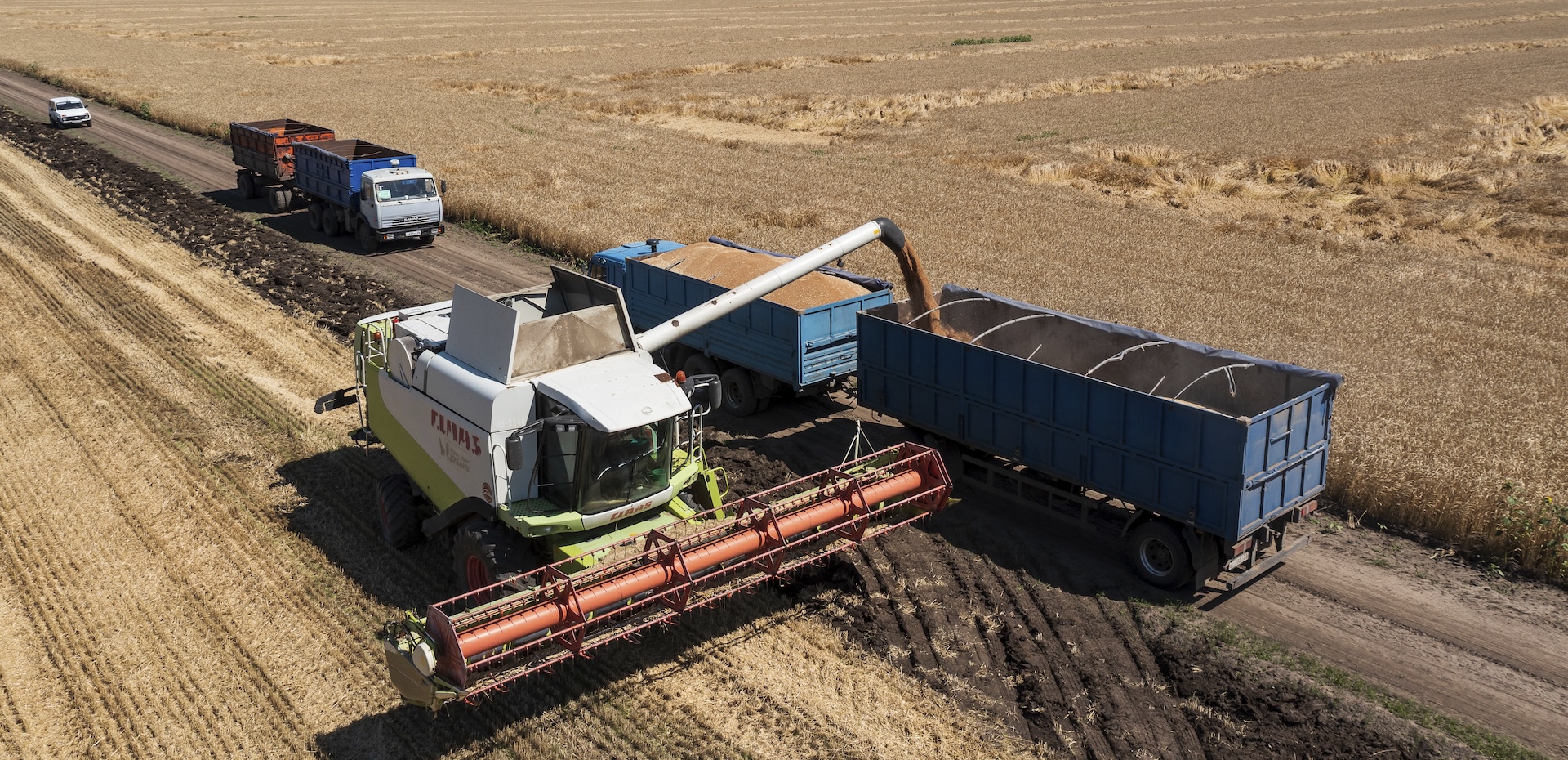
Russia remains one of the world’s leading exporters of fertilisers: in 2025, it accounted for around one-fifth of global trade in them. Just four large companies control 85 per cent of the Russian market. This degree of concentration allows the Kremlin to manage the sector from the top down, imposing quotas on domestic sales and duties on exports. Given the business community’s lack of political influence, this model resembles the Soviet planned economy. The state determines the rules of the game and even sales volumes, while market participants are left only to bargain over what share of the profit each of them will receive.
Export giant
In 2025, Russia produced 30.5 million tonnes of fertilisers – twice as much as in 1991, when production stood at just over 15 million tonnes. Today, the country ranks second in the world for fertiliser exports, accounting for around one-fifth of global trade.
After the invasion of Ukraine, the share of Russian fertilisers in the global market only increased. EU countries attempted to restrict Russian exports, but this effort was doomed to fail from the outset – the global market cannot replace Russian fertilisers. According to an analysis by the Food and Agriculture Organization of the United Nations (FAO), based on Global Trade Tracker data, Russia accounted for around 19 per cent of global trade in the main types of fertiliser in 2021, rising to 21 per cent in 2024.1 Russia’s position is even stronger in individual products: its share of global trade in potash rose from 18 per cent to 25 per cent, in urea from 12 per cent to 16 per cent, and in phosphate fertilisers from 14 per cent to 17 per cent.
In volume terms, fertiliser exports in 2025 reached 45 million tonnes, almost matching wheat exports (Russia’s main grain export in the 2024/2025 and 2025/2026 agricultural years) of 46.5 million tonnes. Some 65–70 per cent of fertilisers produced in Russia are exported, and they account for around 3 per cent of the country’s total exports.
Permanent temporary restrictions
The first signs of a special relationship between the state and fertiliser producers emerged in 2018. When fertiliser prices began to rise as the rouble weakened, threatening to reduce demand and increase costs for agricultural producers, Agriculture Minister Dmitry Patrushev reached an agreement with the sector’s largest companies to freeze domestic prices until the end of the sowing season. In 2024, Andrey Guryev, president of the Russian Association of Fertiliser Producers, reported that Russian agricultural producers’ purchases of fertilisers had increased by 80 per cent over five years. In 2018, the price freeze was a one-off agreement between the state and several of the largest fertiliser companies, but subsequent developments prompted the Kremlin to institutionalise the direct regulation of the sector.
In autumn 2021, gas prices on the European market began to rise sharply after Russia’s Gazprom reduced gas supplies. This increased production costs and forced many European fertiliser manufacturers to halt production. The Russian authorities began to worry that domestic companies would prefer exporting to supplying the domestic market. The issue became one of the main topics at Vladimir Putin’s meeting with ministers on 20 October. The president instructed the government to ‘propose a set of measures aimed at mitigating the negative consequences that may arise on global markets and affect the Russian economy’.
Less than two weeks later, the government introduced temporary restrictions, initially due to remain in force until 1 May 2022. Fertiliser manufacturers were assigned mandatory quotas for supplying their products to Russian agricultural producers, in the quantities that the latter declared necessary. Companies could export fertilisers only after meeting these domestic supply obligations, and only in volumes agreed with the government. Domestic fertiliser prices were frozen, as the sharp increase in prices had already forced some farms to cut purchases by 15–20 per cent, which in turn threatened to reduce crop yields. As a result, Russian agricultural producers were able to purchase the volumes of fertilisers which they needed without fearing that domestic prices would replicate the surge seen on global markets. By the end of 2021, Russia’s agricultural sector had purchased almost 20 per cent more fertilisers than a year earlier.
Implementing this system was not difficult: fertiliser production in Russia is a highly concentrated industry. Four groups – PhosAgro, Uralchem, EuroChem, and Acron – account for 85 per cent of production. The government does not need to control hundreds of enterprises: the main terms can be agreed with a handful of the largest producers. Nor was there any need to fear that companies would go bankrupt, given the industry’s exceptionally high profitability: in 2022, Acron’s EBITDA margin reached 53 per cent, while PhosAgro’s stood at 45 per cent. After global prices fell in 2023–2024, these figures declined to 39 per cent and 31 per cent respectively in 2025, but they remain extremely high compared with other civilian industries.
But high concentration also has a downside. It is much easier for a small number of major producers to formulate common demands on the state and press for them to be met. From the outset, therefore, the system that emerged involved not only administrative pressure by the state on the industry, but also constant bargaining with it.
At the end of May 2022, the government extended the measures for the rest of the year, explaining that this was necessary to avoid fertiliser shortages and rising food prices amid the newly imposed sanctions and the collapse of food imports from Europe. From then on, the temporary measures became permanent. The quotas were extended again and again. After two indexations in 2022, manufacturers no longer raised the maximum selling prices for Russian agricultural producers which had been agreed with the Federal Antimonopoly Service (FAS). However, this did not mean that the prices paid for fertilisers by agricultural producers were frozen: they continued to rise because of delivery and storage costs, as well as intermediaries’ mark-ups.
Export checks and balances
At the same time, the authorities wished to ensure that, once the quotas had been fulfilled, Russian companies exported as much of their output as possible. To this end, transport corridors were expanded and new logistics routes were developed. In 2024, the quantity of fertilisers transported by Russian Railways reached a record 67.7 million tonnes, rising to 74.5 million tonnes in 2025. Export shipments in 2025 increased by 14.4 per cent compared with 2024, to 46.3 million tonnes.
The government sought to redistribute some of the fertiliser manufacturers’ export revenue in favour of Russian agricultural producers without channelling this money through the budget. Fertiliser manufacturers sold some of their output on the domestic market at prices below those on the global market. However, in 2023, the state decided to capture additional revenue directly through the budget and introduced an export duty on fertilisers. By the end of 2024, its maximum rate had reached 10 per cent, while annual revenues from the duty amounted to around RUB 89 billion.
Andrey Guryev, president of the Russian Association of Fertiliser Producers, called the duties ‘an absolutely unnecessary mechanism that restricts exports’ and warned that any further increase in the tax burden would lead to lower investment. As a result, producers secured the abolition of the export duty. At the end of 2024, the maximum rate was reduced from 10 per cent to 7 per cent, and from 1 January 2025 the duty was abolished altogether. Export quotas remained in place, but unlike in the oil sector, the state did not compensate fertiliser producers for the difference between domestic and export prices.2
The scheme created for fertiliser producers did not require the adoption of new legislation and did not involve channelling agricultural subsidies through the budget. In addition, the system had a built-in stabiliser: when global prices rise, the gap between export and domestic prices widens, and fertiliser manufacturers transfer a larger share of their potential income to agricultural producers. When the global market declines, as it did in 2023–2024, the gap narrows, reducing the financial burden on companies. Under this system, the industry continues to expand: new production capacity is being brought on stream, while output and exports are reaching record levels.
However, the first warning signs are already beginning to emerge. In 2025, PhosAgro’s revenue rose by 13 per cent, while adjusted EBITDA increased by 16.9 per cent to RUB 199.4 billion. At the same time, the company cut investment by 10.5 per cent, and free cash flow fell by more than a quarter. In May 2026, the company’s board of directors recommended, for the first time in many years, that no dividend be paid for the previous year, although its debt burden remained virtually unchanged. It appears that the financial position of Russian fertiliser producers has begun to deteriorate as they are increasingly affected by the broader weakening of the Russian economy.
Planned capitalism
Can it be said that government restrictions are stifling the industry? Not yet: production and exports continue to grow. But the system itself is unusual. While requiring fertiliser exporters to support agriculture through low domestic prices, in 2024 the government took RUB 141 billion in export income from agricultural producers through export duties on grain and processed oilseed products – almost three times more than they received in hidden subsidies when purchasing fertilisers.3 Support for agricultural producers can therefore hardly be regarded as an independent objective of the system. Rather, the aim appears to be to preserve the gap between domestic and export prices in order to reduce volatility in retail food prices. The redistribution of revenue between export industries is merely a tactical instrument – the government can decide at any moment how much to take from one sector and how much to leave to another.
In 2026, another weakness of the system became apparent. Despite production exceeding domestic consumption, agricultural producers faced shortages of certain types of fertiliser in the spring, above all ammonium nitrate. The quotas ensured that the domestic market received the necessary overall volume, but did not guarantee that the required fertilisers would be available in the right place and at the right time. Making these quotas more detailed would require the creation of a mechanism similar to the Soviet command system, with strict allocation of resources, production planning, and price regulation. When the risk of an ammonium nitrate shortage emerged, the authorities once again resorted to bureaucratic intervention and temporarily suspended exports of it.
The high level of concentration among Russian businesses is to a large extent inherited from the Soviet economy. In the 1990s, when the state was weak, it gave a narrow circle of businessmen enormous economic and political power. But after 2000, the state became stronger, while large businesses lost political influence but remained highly concentrated. This gave the Kremlin the ability to return to the principles of a command economy.
The fertiliser industry provides a clear example of how this mechanism works. Four groups control 85 per cent of production, so agreements with these companies allow the government to determine the operating conditions for the entire industry. Concentration works both ways: it enables producers to bargain successfully with the state and secure concessions, as happened with the abolition of the export duty. But the bargaining concerns only what share of the revenue each participant will receive, not the state’s right to determine the rules for dividing it. Russian capitalism has acquired distinctly feudal features: property remains private, but above the owner there is always a suzerain claiming a share of the profit.
Endnotes
- ‘Changes in fertilizer trade post-2022’, Food Outlook, June 2025, FAO, p. 58. https://doi.org/10.4060/cd5655en ↩︎
- Since 2019, Russia has operated a system to stabilise retail prices for motor fuel, which are intended to rise in line with consumer price inflation. To achieve this, the Ministry of Finance compensates oil companies for profits lost as a result of reduced exports. In 2024–2025, these payments amounted to RUB 5.9 trillion ($89 billion), reducing budget revenues by more than 6 per cent. ↩︎
- According to expert estimates, in 2024 the gap between domestic and export prices cost fertiliser producers around RUB 50 billion in lost revenue – effectively a hidden subsidy to Russian agricultural producers. ↩︎