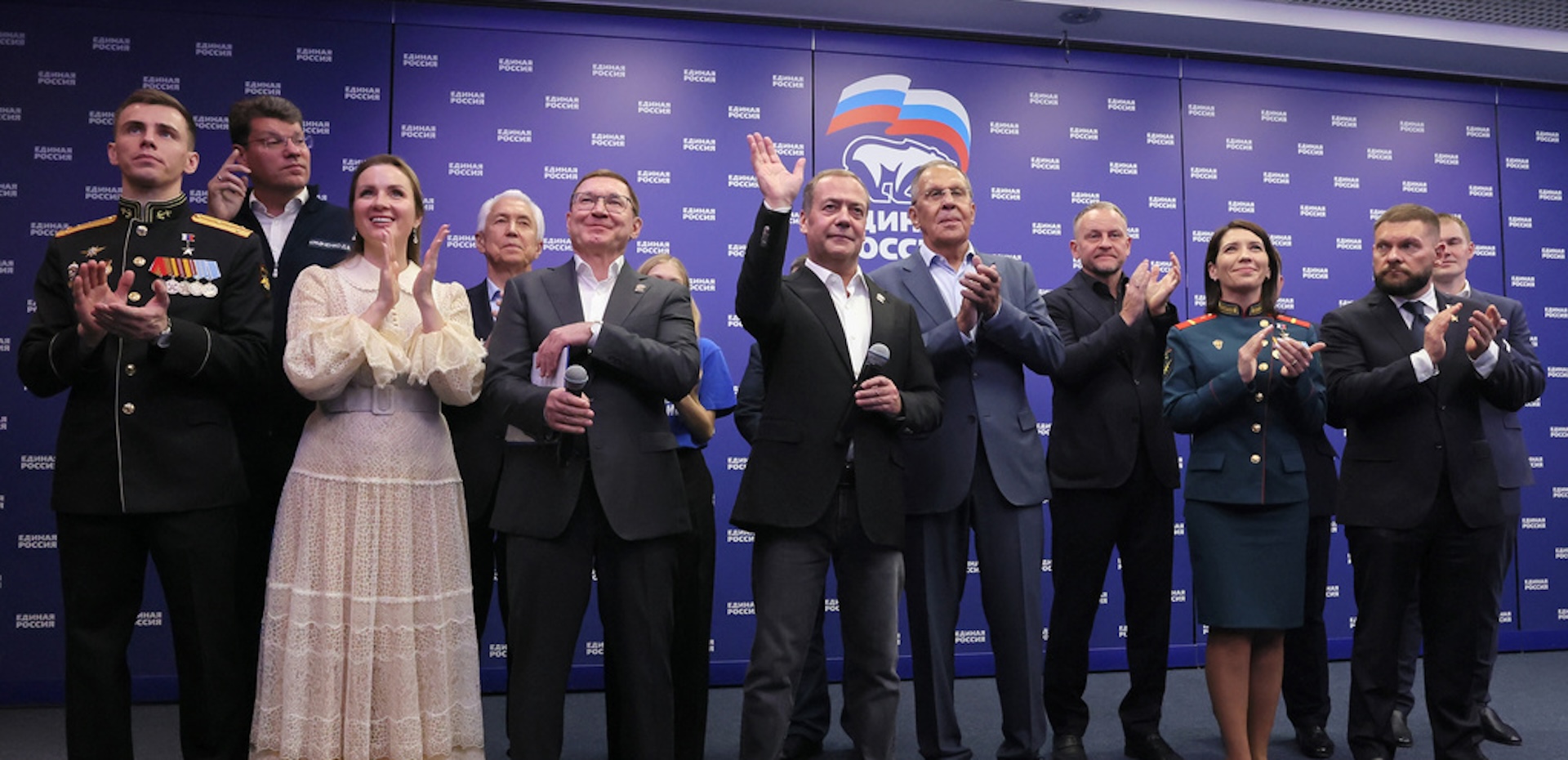
Russia has held its first State Duma elections since the start of the full-scale war against Ukraine. The outcome was predetermined: United Russia won an absolute majority of the vote on the federal party list, with 57.86 per cent – a record result in its history. The Kremlin could point to public approval of its military course, with turnout reaching 59.32 per cent, the highest level since 2011. However, excluding the only opposition force from the elections and strictly mobilising public-sector employees does not support its claims of ‘unconditional support for the war’.
Voting took place over three days, from 18 to 20 September. Preliminary results show the vote was distributed as follows: United Russia – 57.86 per cent, the Communist Party of the Russian Federation (CPRF) – 13.84 per cent, the Liberal Democratic Party of Russia (LDPR) – 8.90 per cent, and New People – 7.94 per cent. The ruling party improved its result compared with the 2021 elections, when it received 49.82 per cent.
Taking into account the results in single-member constituencies, the party’s parliamentary representation will be even greater: United Russia candidates are leading in 208 of the 225 constituencies. Overall, the party could secure 355 of the State Duma’s 450 seats – a record constitutional majority.
During the voting, several practices characteristic of the Putin era were recorded: public-sector employees were forced to vote, observers were removed en masse on various pretexts, safes and sealed packages containing ballot papers were illegally opened, and voters complained that others had already voted on their behalf. In Moscow, on 20 September, officials stopped issuing paper ballots to voters, citing a computer failure, and instead offered them the option of voting through the remote electronic voting system, which is not open to independent audit. The overall scale of the falsification of the voting results is likely to become clear in the coming days.
The official results do not allow assessment of the actual level of anti-war sentiment or the public’s growing fatigue with the prolonged conflict. The removal of the Yabloko party from the elections – both from the federal party list and in many single-member constituencies – blocked legal channels of protest for citizens. The party managed to win seats only in the Novgorod Regional Duma – the only one of eight regions where a list nominated by Yabloko was allowed to contest the regional parliamentary elections.
‘The Kremlin treats elections as an unavoidable obligation because it cannot simply get rid of them: Russian society is unlikely to understand a transition to monarchy. The Kremlin knew the election result in advance. It was more interested in whether the state machinery would unquestioningly carry out the orders it received. Apparently, there were no problems.’
Sergey Aleksashenko
Head of Economics
In the new State Duma, small but significant changes may favour the ruling party, which dominates parliament. When the relevant committees are formed, the unwritten parity rule – a 50–50 split between United Russia and the systemic opposition – is expected to be abandoned. United Russia members are now likely to hold all leadership positions.
‘In the State Duma Defence Committee, military commander Andrei Kartapolov will be replaced by General Alexander Lapin. The State Duma Security Committee will be strengthened by transferring Senator Andrei Klimov, the former head of the Federation Council commission on preventing foreign interference. But there will be no fundamental changes because a system of coordination between the government, the Presidential Administration, and the relevant committees is already in place.’
Alexander Morozov
Head of Russia Domestic Policy Research
One important distinguishing feature of the new State Duma will be the significant presence of deputies with experience of the war in Ukraine. According to preliminary data, several dozen participants in the ‘special military operation’ are expected to enter the State Duma – perhaps as many as 60 people.
‘The composition of this parliament will be different because the authorities are determined to ensure representation of veterans from the war against Ukraine. This is part of the broader militarisation of Russia aimed at preparing the country for prolonged confrontation with Europe.’

John Lough
Head of Foreign Policy
In addition, for the first time, State Duma elections were held in the Russian-occupied territories of Donetsk, Luhansk, Zaporizhzhia, and Kherson regions, completing their formal integration into Russia’s political system. According to official data, turnout stood at 75–80 per cent, and candidates from the ruling party won in all seven constituencies. According to media reports, voting took place under the direct supervision of armed Russian military personnel.